The Fuel Penalty Factor
Source: Airbus Safety First URL: https://safetyfirst.airbus.com/the-fuel-penalty-factor/ Published: 2012-01-14 Magazine Issue: 2012-01 Category: Archive PDF: Original PDF
Safety
Thomas LEPAGNOT
Section titled “Thomas LEPAGNOT”Senior Engineer, A320/A330/A340 Standards Flight Operations Support and Safety Enhancement
The Fuel Penalty Factor Failures Affecting the Fuel consumption A320 Family and A330/A340
Section titled “The Fuel Penalty Factor Failures Affecting the Fuel consumption A320 Family and A330/A340”1. Introduction
Section titled “1. Introduction”Monitoring the fuel consumption all along a mission is one of the most important tasks of the flight crew. This general statement was already highlighted in the Safety First article “Low Fuel Situation Awareness” published in issue n°6 (July 2008). This article stressed the following points:
q The importance of the different fuel checks in cruise, to detect an abnormal fuel situation
q The functionality limitations of the Flight Management System (FMS) in terms of fuel predictions, under non-nominal aircraft conditions.
In this new article, we will focus on the second theme: The FMS Estimated Fuel On Board (EFOB) predictions do not currently take into account the in-flight failures
that have an impact on the fuel consumption. The only exception is the one engine out failure, once confirmed in the FMS. For all other cases, the FMS predictions should be corrected to take into account the consequences of these failures in terms of excessive fuel consumption.
The purpose of this article is to present new developments in terms of:
q Documentation and procedure that have been introduced in November of 2011
q Coming standards of Flight Warning Computers that will soon become available.
These enhancements were designed to improve the crews’ awareness of the fuel consumption increase generated by certain failures.
2. Failures Affecting the Fuel consumption
Section titled “2. Failures Affecting the Fuel consumption”All failures that affect the nominal aerodynamic characteristics of the aircraft will also increase its fuel consumption. The additional drag penalty drag has to be compensated by an increase in thrust (to maintain the same flight conditions) or by a descent to a lower flight level (if there is no thrust margin).
The two main sources of additional drag are:
q A failure affecting the flight control surfaces, which may lead to three specific configurations, generating each a different amount of drag:
• The surface is blocked in its full deflection position (runaway), or
• The surface is free and floats in the wind (zero hinge moment position), or
• The surface (only applicable to spoilers) slowly extends over time, after the loss of its hydraulic actuation (spoiler drift, see explanations in box below).
q A failure affecting the l anding gears or landing gear doors retraction function, which will lead to the gears, or doors, remaining extended.
SPOILER DRIFT
Section titled “SPOILER DRIFT”In case of hydraulic system failure, some spoilers will no longer operate. An antiextension device will avoid the deflection of the spoiler. However, depending on the condition of the spoiler servo control, this anti-extension device could be sensitive to temperature variations or prone to actuator leak. In that case, the spoiler may not be maintained retracted and may extend over time up to its zero hinge moment position.
Let us consider the cockpit effects of such a failure mode on an A320:
q First, the Hydraulic failure (HYD G SYS LO PR for instance), with all affected spoilers indicated fault retracted in amber on the ECAM Flight Control page (fig. 1A).
q If one of the affected spoilers (n°5 left, for instance) drifts, no indication will appear on the ECAM as long as the extension value remains below 2.5°.
q Once it crosses that threshold, a F/CTL SPLR FAULT amber caution is triggered and the affected spoiler is indicated fault deflected in amber on the ECAM F/CTL page (fig. 1B).
q From then on, it is considered that the affected spoiler generates a non negligible increase of the fuel consumption, which will evolve over time, as the spoiler extends further.
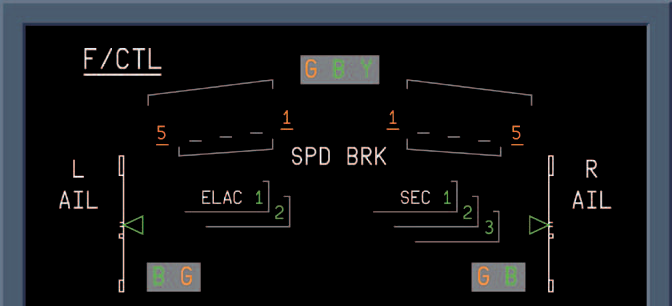
Figure 1A A320 ECAM F/CTL page: affected spoilers indicated fault retracted
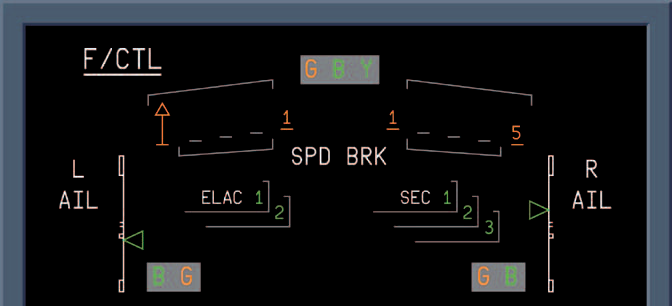
Figure 1B A320 ECAM F/CTL page: spoiler n°5 indicated fault deflected
We can segregate these failures into four systems : ELEC, F/CTL, HYD, L/G.
Indeed, as the flight control surfaces are all electrically controlled, and hydraulically activated, some ELEC and/or HYD failures will lead to the loss of flight control surfaces (ailerons and/or spoilers).
Safety
MULTIPLE FAILURES
Section titled “MULTIPLE FAILURES”Some faults that independently do not generate any fuel consumption increase can, if combined, lead to an overconsumption. This can be due to in-flight failures, or more likely, to the combination of a dispatch under MEL followed by an in-flight failure. This kind of combination has to be taken into account in the failure cases generating a fuel consumption increase.
To illustrate the concept of multiple failures, let us consider an example on the A330. The general architecture of the aircraft’s flight control system is is illustrated in fig. 2A.
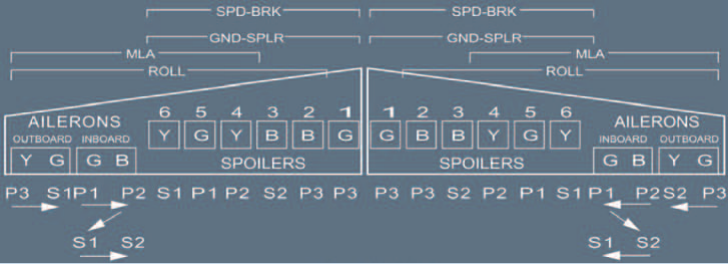
Figure 2A A330 Flight Control Architecture
The aircraft may be dispatched with PRIM3 inoperative under MEL. This implies that two pairs of spoilers (spoilers n°1 and n°2) and the redundancy on both outboard ailerons are lost (fig. 2B).
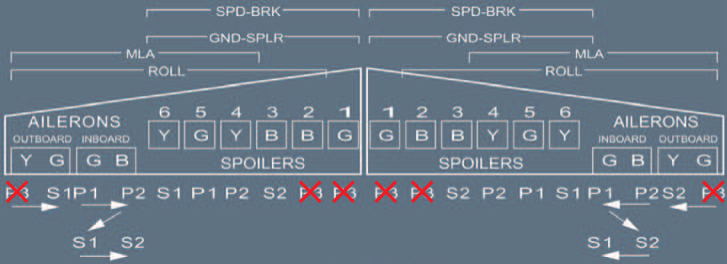
Figure 2B Loss of PRIM3
If SEC1 fails in flight, the aircraft loses an additional pair of spoilers (n°6) as well as the left outboard aileron, which goes to its zero hinge moment position (fig. 2C).
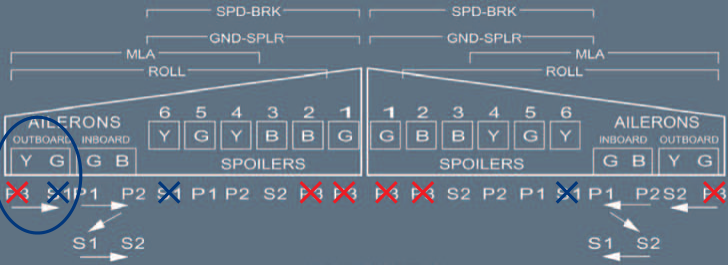
Figure 2C Loss of PRIM3 and SEC1
The simple failure of SEC1 taken independently, would have no effect on the fuel consumption. However, combined with the loss of PRIM3 , it leads to drag being generated by the left aileron in the zero hinge moment position.
The flight control and landing gear/ landing gear doors malfunctions may be caused by either simple or multiple failures (see explanations in box above).
3. Information Provided to the Flight crew up to Nov 2011
Section titled “3. Information Provided to the Flight crew up to Nov 2011”3.1 Failures Managed by Ecam
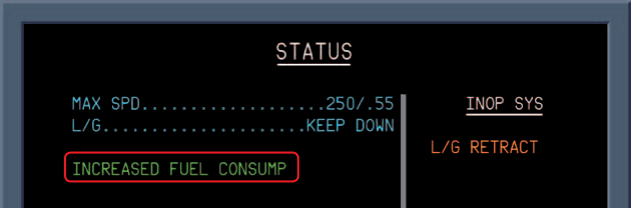
Section titled “3.1 Failures Managed by Ecam”For failures affecting the fuel consumption, a dedicated “INCREASED FUEL CONSUMP” message is provided through the associated ECAM STATUS page. However, in the current FWC standards, this line is not displayed for all failures generating a fuel consumption increase (in particular for multiple in-flight failures or for cases of dispatch under MEL) (fig. 3).
To obtain information on the consumption increase, the flight crew had to refer, if time permitted, to the description of the associated ECAM alert in the FCOM. Retrieving this information was therefore left to the pilot’s initiative (fig. 4).
3.2 Failures Managed by Qrh
Section titled “3.2 Failures Managed by Qrh”For failures that were managed through the QRH, the additional fuel consumption information was directly provided in the QRH procedure (like for instance by a caution for the LANDING WITH SLATS OR FLAPS JAMMED procedure) (fig. 5).
4. Information Provided to the Flight crew from Nov 2011
Section titled “4. Information Provided to the Flight crew from Nov 2011”With the QRH revision of November 2011, the procedure has been improved to give better guidance and more comprehensive information. This procedure will be further supported by future Flight Warning Computer (FWC) standards.
All the information on the fuel consumption increase linked to system failures is now gathered in the In-Flight Performance chapter of the QRH (FPE-FPF):
The Fuel Penalty Factors, assessing the fuel consumption increase, are provided through two different tables:
q One table with an entry by ECAM Alerts, and
q One table with an entry by INOP SYS.
Only the failures leading to a fuel consumption increase greater than 3% have been taken into account in these tables.
Safety
4.1.1 EcAM Alert Table
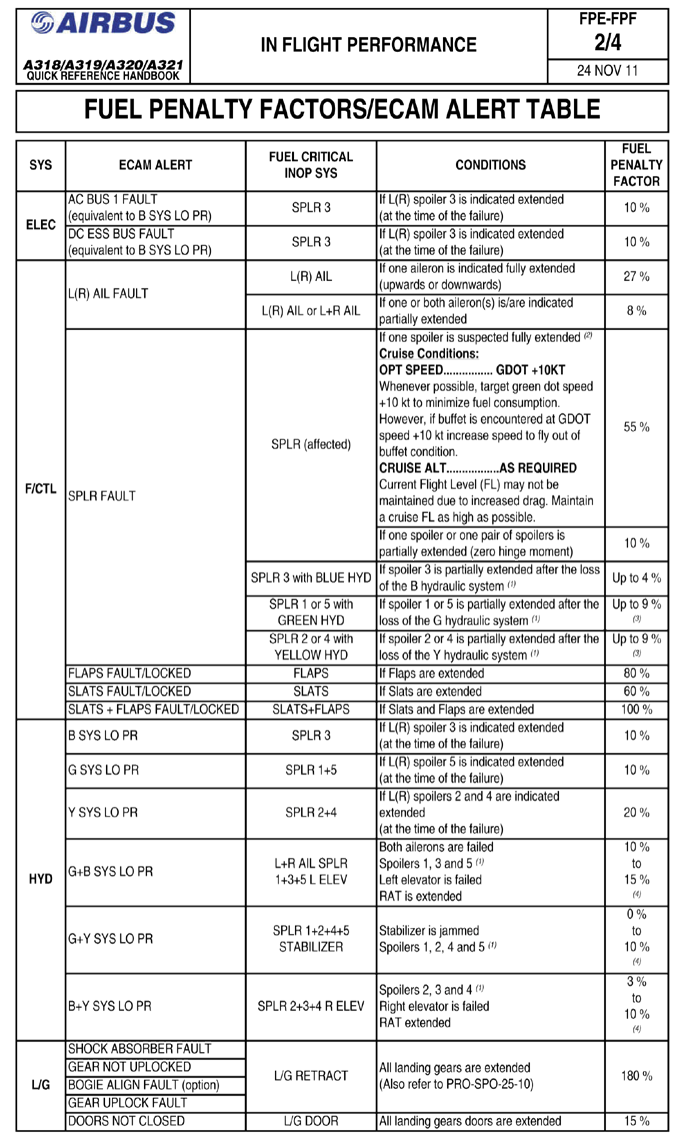
Section titled “4.1.1 EcAM Alert Table”For each ECAM alert impacting the fuel consumption, the first table (fig. 6A) provides:
q The critical inoperative system(s) in terms of fuel consumption
q The conditions taken into account to compute the Fuel Penalty Factor, and
q The value of the corresponding Fuel Penalty Factor.
4.1.2 INOP SYS Table
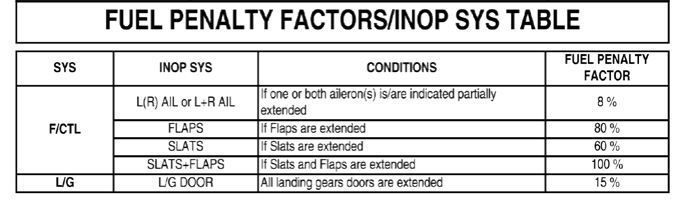
Section titled “4.1.2 INOP SYS Table”For each INOP SYS impacting the fuel consumption, the second table (fig. 6B) provides:
q The conditions taken into account to compute the Fuel Penalty Factor, and
q The value of the Fuel Penalty Factor associated with the INOP SYS.
Figure 6A A320 Fuel Penalty Factor table / ECAM alert entry
-
(1) During the flight, the spoiler(s) may gradually extend and increase the fuel consumption.
-
(2) A spoiler can be suspected fully extended (runaway) if high roll rate has been experienced immediately after the failure, associated with a possible AP disconnection. A visual inspection, if time permits, can also confirm the full extension of the spoiler.
-
(3) The maximum value of the Fuel Penalty Factor provided in the table considers that the two pairs of corresponding spoilers gradually extend during the flight.
-
(4) The minimum value of the Fuel Penalty Factor provided in the table considers that all spoilers remain retracted. The maximum value has been calculated considering that all impacted spoilers gradually extend during the flight.
Figure 6B A320 Fuel Penalty Factor table / INOP SYS entry
4.1.3 utilization of the New Qrh Tables
Section titled “4.1.3 utilization of the New Qrh Tables”The Fuel Penalty Factors provided in the QRH tables are given as a guideline. The flight crew should confirm this Fuel Penalty Factor by monitoring the actual fuel consumption.
When should these two QRH tables be used?
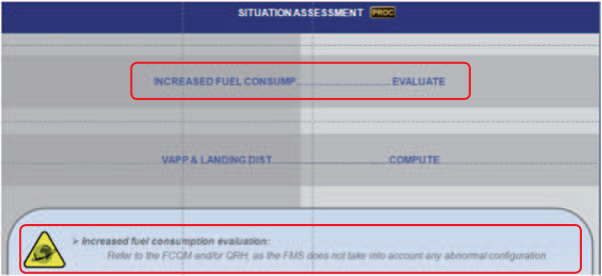
Section titled “When should these two QRH tables be used?”According to the ECAM management philosophy, after the ECAM actions are completed, the flight crew should perform a situation assessment (fig. 7).
The situation assessment by the flight crew has been amended to include an evaluation of the fuel consumption whenever the ECAM STATUS page displays:
q INCREASED FUEL CONSUMP
Section titled “q INCREASED FUEL CONSUMP”q A flight control surface in the INOPS SYS
q L/G RETRACT or L/G DOOR in the INOP SYS
To do so, the flight crew should now refer to the Fuel Penalty Factor in the QRH (fig. 8).
How should these two QRH tables be used?
Section titled “How should these two QRH tables be used?”The Fuel Penalty Factors in the QRH tables have been calculated taking into account the aircraft configuration, speed or altitude (when mentioned) described in the CONDITIONS column. Ensure that these conditions are well met (or applied) before taking into account the corresponding Fuel Penalty Factor.
To determine whether a Fuel Penalty factor is applicable, the crew needs to proceed in two steps:
q First enter the ECAM alert table, then
q Enter the INOP SYS table.
The second table, INOP SYS, is provided to cover the cases of multiple in-flight failures or dispatch under MEL.
In such cases, two different situations may be encountered:
responding ECAM alert) has an impact on the fuel consumption. In that circumstance, the flight crew will find another applicable Fuel Penalty Factor in the INOP SYS table.
q The ECAM alert associated with the failure generating the increase of fuel consumption is not mentioned in the ECAM alert table. This is typically the case for failures, which do not impact the fuel consumption when taken independently, but which do lead to an increase in fuel burn when combined with previous failures.
Once the pertinent Fuel Penalty Factors have been identified, the procedure is as follows:
q If only one Fuel Penalty Factor (FPF) is applicable:
In this circumstance, the flight crew will find the applicable Fuel Penalty Factor in the INOP SYS table.
ADDITIONAL FUEL = (FOB - EFOB at DEST) x FPF
Section titled “ADDITIONAL FUEL = (FOB - EFOB at DEST) x FPF”q If two or more Fuel Penalty Factors (FPF) are applicable:
q The ECAM alert associated with the failure generating the increase of fuel consumption is mentioned in the ECAM alert table. However, due to previous failures, an additional INOP SYS on the STATUS page (different from the one(s) mentioned in the FUEL CRITICAL INOP SYS column for the cor-
ADDITIONAL FUEL = (FOB - EFOB at DEST) x (FPF1 + FPF2 +…)
Section titled “ADDITIONAL FUEL = (FOB - EFOB at DEST) x (FPF1 + FPF2 +…)”This ADDITIONAL FUEL must be added to the fuel predictions provided by the FMS.
Safety
Example of Utilization of QRH tables
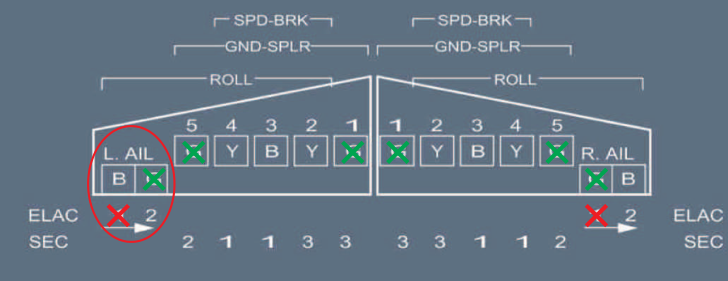
Section titled “Example of Utilization of QRH tables”To illustrate the method, let us consider an A320 under the following conditions: q A dispatch with the ELAC 1 inoperative under MEL, and
q An HYD G SYS LO PR ECAM caution in flight
These two failures lead to the loss of the left aileron:
Therefore, the INOP SYS will display “L AIL” that should lead the flight crew to enter the QRH Tables. In the ECAM alert table: FPF (HYD G SYS LO PR) = 10 % (if spoiler(s) are indicated extended) In the INOP SYS table: FPF (INOP SYS: L AIL) = 8 %
4.2 ECAM Development
Section titled “4.2 ECAM Development”With future Flight Warning Computer (FWC) standards, all failure cases leading to an increase in fuel consumption of more than 3%, including multiple in-flight failures and dispatch under MEL, will trigger a “FUEL CONSUMPT INCRSD” message on the ECAM STATUS page. This message will be complemented with a “FMS PRED UNRELIABLE” line to highlight the unreliability of the FMS (fig. 9). The same wording will also be used in the associated ECAM procedure.
All these improvements will be introduced in the following FWC standards:
q A320 Family: H2F7 standard (certification planned for December 2012)
q A330 and A340-500/600: T5 standard (certification planned for January 2013)
q A340-200/300: L13 standard (certification planned for August 2013).
Two possible cases may be encountered:
Section titled “Two possible cases may be encountered:”q If the Fuel Penalty Factor of the HYD G SYS LO PR ECAM alert is not applicable (spoiler remains retracted), apply the Fuel Penalty Factor related to the INOP SYS “L(R) AIL” partially extended.
ADDITIONAL FUEL = (FOB - EFOB at DEST) x 8 %
q If the Fuel Penalty Factor of the HYD G SYS LO PR ECAM alert is applicable (spoiler extended), add the corresponding factor to the Fuel Penalty Factor related to the INOP SYS “L(R) AIL” partially extended.
ADDITIONAL FUEL = (FOB - EFOB at DEST) x (10 % + 8 %)
Figure 9 Future A330 STATUS page of the F/CTL L(R) INR (OUTR) AIL FAULT
5. CONCLUSION
Section titled “5. CONCLUSION”After an in-flight failure, it is essential for the flight crew to have a clear view of all the operational consequences generated by this failure. In particular, when the fuel consumption is affected, the pilot should have means to estimate this impact.
into account more operational cases (multiple failure, dispatch under MEL), and the associated procedure is more formalized.
This policy ensures a standardized and common treatment of all the failures impacting the fuel consumption, by giving the same level of information to all flight crew.
This is the purpose of this new policy supported by new QRH tables and future developments implemented in the next FWC standards. The information is now concentrated in one part of the Operational Documentation (simplified access), takes
It improves crew awareness on consequences of such failures, and as a result, represents a new step in the safety of airline operations.
Safety
Safety
Thomas LEPAGNOT
Section titled “Thomas LEPAGNOT”高级工程师,A320/A330/A340 标准飞行操作支援与安全增强
燃油惩罚因子 影响燃油消耗的故障 A320 系列及 A330/A340
Section titled “燃油惩罚因子 影响燃油消耗的故障 A320 系列及 A330/A340”在整个飞行任务过程中监控燃油消耗是飞行机组最重要的任务之一。这一普遍原则已在《Safety First》第 6 期(2008 年 7 月)刊登的《低油量情景意识》文章中重点强调。该文着重指出以下几点:
q 巡航期间进行各项燃油检查的重要性,以发现异常的燃油状况
q 飞行管理系统(FMS)在非正常飞行条件下的燃油预测功能存在局限性。
在本文中,我们将聚焦第二个主题:FMS 估计燃油量(EFOB)预测目前未考虑对燃油消耗产生影响的各种飞行中故障。唯一的例外是当双发一台失效后经 FMS 确认的情况。对于所有其他情况,应对 FMS 预测进行修正,以计入这些故障在过度燃油消耗方面的后果。
本文的目的是介绍以下方面的新进展:
q 2011 年 11 月引入的文件和程序
q 即将推出的飞行警告计算机新标准。
这些改进旨在提高机组对某些故障导致燃油消耗增加的认识。
2. 影响燃油消耗的故障
Section titled “2. 影响燃油消耗的故障”所有影响飞机正常气动特性的故障也会增加其燃油消耗。附加的阻力惩罚必须通过增加推力(以维持相同的飞行条件)或下降至较低飞行高度(如果没有推力余度)来补偿。
附加阻力的两个主要来源是:
q 影响飞行控制面的故障,可能导致三种特定构型,每种产生不同的阻力:
• 飞行面卡阻在最大偏转位置(偏转卡阻),或
• 飞行面自由活动并随风飘动(零铰链力矩位置),或
• 飞行面(仅适用于扰流板)在液压作动失效后随时间缓慢伸出(扰流板漂移,见下文说明框)。
q 影响起落架或起落架舱门收上功能的故障,将导致起落架或舱门保持伸出状态。
在液压系统失效的情况下,部分扰流板将不再运作。防伸装置将防止扰流板偏转。然而,根据扰流板伺服控制器的状态,该防伸装置可能对温度变化敏感或容易发生作动筒泄漏。在这种情况下,扰流板可能无法保持收上状态,并会随时间逐渐伸出至其零铰链力矩位置。
让我们来看一下这种故障模式在 A320 上的驾驶舱效应:
q 首先是液压失效(例如 HYD G SYS LO PR),所有受影响的扰流板在 ECAM 飞行控制页面显示为琥珀色故障收上指示(图 1A)。
q 如果其中一个受影响的扰流板(例如 5 号左扰流板)发生漂移,只要偏度保持在 2.5° 以下,ECAM 上不会显示任何指示。
q 一旦超过该阈值,将触发 F/CTL SPLR FAULT 琥珀色警告,受影响的扰流板将在 ECAM F/CTL 页面上显示为琥珀色故障偏转指示(图 1B)。
q 从此时起,受影响的扰流板被认为产生了不可忽略的燃油消耗增加,该增量将随扰流板进一步伸出而持续变化。
图 1A A320 ECAM F/CTL 页面:受影响的扰流板显示为故障收上状态
图 1B A320 ECAM F/CTL 页面:5 号扰流板显示为故障偏转状态
我们可以将这些故障分为四个系统:ELEC、F/CTL、HYD、L/G。
事实上,由于所有飞行操纵面均为电控、液压驱动,因此部分电气(ELEC)和/或液压(HYD)故障将导致飞行操纵面(副翼和/或扰流板)失效。
安全
某些单独发生时不会产生任何燃油消耗增加的故障,在组合条件下可能导致过度消耗。这可能是由飞行中故障引起的,更可能是由于依据最低设备清单(MEL)放行后叠加飞行中故障所致。此类组合情况必须在产生燃油消耗增加的故障案例中予以考虑。
为说明多重故障的概念,我们以A330为例。飞机飞行控制系统的总体架构如图2A所示。
图 2A A330飞行控制架构
飞机可依据MEL在PRIM3不工作状态下放行。这意味着两对扰流板(1号和2号扰流板)以及两侧外侧副翼的冗余将丧失 (图 2B)。
图 2B PRIM3失效
若SEC1在飞行中发生故障,飞机将额外丧失一对扰流板(6号)以及左侧外侧副翼,该副翼将处于零铰链力矩位置 (图 2C)。
图 2C PRIM3和SEC1同时失效
SEC1单独失效不会对燃油消耗产生影响。然而,与PRIM3失效组合后,将导致左侧副翼在零铰链力矩位置产生阻力。
飞行控制和起落架/起落架舱门故障可能由单一故障或多重故障引起(详见上文方框中的说明)。
3. 2011年11月前向飞行机组提供的信息
Section titled “3. 2011年11月前向飞行机组提供的信息”3.1 由ECAM管理的故障
Section titled “3.1 由ECAM管理的故障”对于影响燃油消耗的故障,通过相关的ECAM状态(STATUS)页面提供专用的**“燃油消耗增加(INCREASED FUEL CONSUMP)”**信息。然而,按照当前的飞行警告计算机(FWC)标准,该项目并非对所有产生燃油消耗增加的故障都予以显示(尤其是多重飞行中故障或依据MEL放行的情况) (图 3)。
若时间允许,为获取消耗增加信息,飞行机组需参阅《飞行手册》(FCOM)中相关ECAM警告的说明。因此,信息的获取取决于飞行员的主动性 (图 4)。
3.2 由QRH管理的故障
Section titled “3.2 由QRH管理的故障”对于通过快速参考手册(QRH)管理的故障,附加燃油消耗信息直接在QRH程序中提供(例如“缝翼或襟翼卡阻时的着陆”程序中的警告信息) (图 5)。
4. 2011年11月起向飞行机组提供的信息
Section titled “4. 2011年11月起向飞行机组提供的信息”随着2011年11月QRH的修订,程序得到了改进,提供了更好的指导原则和更全面的信息。该程序将在未来的飞行警告计算机(FWC)标准中得到进一步支持。
所有与系统故障相关的燃油消耗增加信息现均汇总于QRH的飞行中性能章节(FPE-FPF):
燃油惩罚因子通过两个不同的表格评估燃油消耗增加:
- 一个表格按ECAM警告条目排列,以及
- 一个表格按不工作系统(INOP SYS)条目排列。
仅燃油消耗增加超过3%的故障被纳入这些表格。
安全
4.1.1 ECAM警告表格
Section titled “4.1.1 ECAM警告表格”对于每个影响燃油消耗的ECAM警告,第一个表格 (图 6A) 提供:
- 在燃油消耗方面至关重要的不工作系统
- 用于计算燃油惩罚因子的条件,以及
- 相应燃油惩罚因子的数值。
4.1.2 INOP SYS表格
Section titled “4.1.2 INOP SYS表格”对于每个影响燃油消耗的INOP SYS,第二个表格 (图 6B) 提供:
- 用于计算燃油惩罚因子的条件,以及
- 与INOP SYS相关的燃油惩罚因子数值。
图 6A A320燃油惩罚因子表格/ECAM警告条目
-
(1) 在飞行过程中,扰流板可能逐渐伸出并增加燃油消耗。
-
(2) 若在故障后立即经历高滚转率,并可能伴随自动驾驶(AP)脱开,则可怀疑扰流板完全伸出(失控)。如时间允许,也可通过目视检查确认扰流板是否完全伸出。
-
(3) 表格中提供的燃油惩罚因子最大值考虑了相应的两对扰流板在飞行过程中逐渐伸出的情况。
-
(4) 表格中提供的燃油惩罚因子最小值考虑了所有扰流板保持收上的情况。最大值则考虑了所有受影响扰流板在飞行过程中逐渐伸出的情况。
图 6B A320燃油惩罚因子表格/INOP SYS条目
4.1.3 新 QRH 表格的使用
Section titled “4.1.3 新 QRH 表格的使用”QRH 表格中提供的燃油惩罚因子仅供参考。飞行机组应通过监控实际燃油消耗来确认该燃油惩罚因子。
这两个 QRH 表格何时使用?
Section titled “这两个 QRH 表格何时使用?”根据 ECAM 管理原则,完成 ECAM 动作后,飞行机组应进行情况评估 (图 7)。
飞行机组的情况评估已修订为:当 ECAM STATUS 页面显示以下内容时,评估燃油消耗:
q 燃油消耗增加
q 飞行操纵面处于 INOP SYS
q INOP SYS 中显示 L/G RETRACT 或 L/G DOOR
为此,飞行机组应参考 QRH 中的燃油惩罚因子 (图 8)。
如何使用这两个 QRH 表格?
Section titled “如何使用这两个 QRH 表格?”QRH 表格中的燃油惩罚因子已综合考虑 CONDITIONS 列中描述的飞机构型、速度或高度(如有提及)。在采用相应的燃油惩罚因子之前,应确保这些条件已满足(或已应用)。
要确定燃油惩罚因子是否适用,机组需按以下两个步骤进行:
q 首先进入 ECAM 告警表,然后
q 进入 INOP SYS 表格。
第二个表格 INOP SYS 用于涵盖多次飞行中失效或依据 MEL 放行的情形。
在这种情况下,可能遇到两种不同的情况:
q 与导致燃油消耗增加的失效相关的 ECAM 告警已在 ECAM 告警表中提及。然而,由于先前存在的失效,STATUS 页面上显示的额外 INOP SYS(与对应 ECAM 告警的 FUEL CRITICAL INOP SYS 列中提及的项目不同)会对燃油消耗产生影响。在这种情况下,飞行机组将在 INOP SYS 表格中找到另一个适用的燃油惩罚因子。
q 与导致燃油消耗增加的失效相关的 ECAM 告警未在 ECAM 告警表中提及。这通常是以下情况:单独出现时不影响燃油消耗的失效,但与先前失效组合后会导致燃油消耗增加。
一旦确定了适用的燃油惩罚因子,按以下程序执行:
q 如果仅有一个燃油惩罚因子(FPF)适用:
在这种情况下,飞行机组将在 INOP SYS 表格中找到适用的燃油惩罚因子。
ADDITIONAL FUEL = (FOB - EFOB at DEST) x FPF
Section titled “ADDITIONAL FUEL = (FOB - EFOB at DEST) x FPF”q 如果有两个或更多燃油惩罚因子(FPF)适用:
ADDITIONAL FUEL = (FOB - EFOB at DEST) x (FPF1 + FPF2 +…)
Section titled “ADDITIONAL FUEL = (FOB - EFOB at DEST) x (FPF1 + FPF2 +…)”此 ADDITIONAL FUEL 必须添加到 FMS 提供的燃油预测中。
安全
QRH 表格使用示例
Section titled “QRH 表格使用示例”为说明此方法,我们以 A320 在以下条件为例:
q 依据 MEL 放行时 ELAC 1 不工作,以及
q 飞行中出现 HYD G SYS LO PR ECAM 警戒
这两个失效导致左副翼失效:
因此,INOP SYS 将显示”L AIL”,机组应查阅 QRH 表格。在 ECAM 告警表中:FPF (HYD G SYS LO PR) = 10%(如果指示缝翼伸出)在 INOP SYS 表格中:FPF (INOP SYS: L AIL) = 8%
4.2 ECAM 开发
Section titled “4.2 ECAM 开发”随着未来飞行警告计算机(FWC)标准的更新,所有导致燃油消耗增加超过 3% 的失效案例(包括多次飞行中失效和依据 MEL 放行)都将在 ECAM STATUS 页面上触发 “FUEL CONSUMPT INCRSD” 消息。该消息将附带 “FMS PRED UNRELIABLE” 行,以强调 FMS 的不可靠性 (图 9)。相同的措辞也将用于相关的 ECAM 程序中。
所有这些改进将在以下 FWC 标准中引入:
q A320 系列:H2F7 标准(认证计划于 2012 年 12 月)
q A330 和 A340-500/600:T5 标准(认证计划于 2013 年 1 月)
q A340-200/300:L13 标准(认证计划于 2013 年 8 月)
可能遇到两种情况:
Section titled “可能遇到两种情况:”q 如果 HYD G SYS LO PR ECAM 告警的燃油惩罚因子不适用(缝翼保持收上),应用与 INOP SYS “L(R) AIL” 部分伸出相关的燃油惩罚因子。
ADDITIONAL FUEL = (FOB - EFOB at DEST) x 8%
q 如果 HYD G SYS LO PR ECAM 告警的燃油惩罚因子适用(缝翼伸出),将与 INOP SYS “L(R) AIL” 部分伸出相关的燃油惩罚因子相加。
ADDITIONAL FUEL = (FOB - EFOB at DEST) x (10% + 8%)
图 9 未来 A330 F/CTL L(R) INR (OUTR) AIL FAULT 的 STATUS 页面
飞行中失效后,飞行机组必须清楚了解该失效造成的所有运行后果,这一点至关重要。特别是当燃油消耗受到影响时,飞行员应能够评估其影响。
新 QRH 表格中考虑了在更多运行案例(多次失效、依据 MEL 放行),相关程序也更加规范化。
该政策确保了对所有影响燃油消耗的失效进行标准化和统一处理,为所有飞行机组提供相同级别的信息。
这就是新政策的目的,通过新的 QRH 表格和在未来 FWC 标准中实施的开发来实现。信息现在集中于运营文档的一个部分(简化查阅),纳入了更多运行案例(多次失效、依据 MEL 放行),相关程序更加规范化。
它提高了机组人员对此类失效后果的认识,并因此成为航空公司运营安全的新一步。
安全