The importance of the pre-flight flight controls check
Source: Airbus Safety First URL: https://safetyfirst.airbus.com/the-importance-of-the-pre-flight-flight-controls-check/ Published: 2005-01-27 Category: Archive PDF: Original PDF

The importance of the pre-flight, flight controls check
Section titled “The importance of the pre-flight, flight controls check”By: Albert Urdiroz Flight Safety Manager
1 Introduction
Section titled “1 Introduction”As far as aeronautics systems are concerned, the pre-flight flight controls (F/CTL) check has existed since before the first powered flight. It aims at ensuring that flight controls respond to the pilot inputs, i.e. with no jamming, or movement limitation, or stiffness, or delayed or inadequate response. It is thus a key factor in the safe operation of the aircraft. The pre-flight F/CTL check has been made on a flight basis by pilots since they flew an airplane for the very first time. Being so familiar with it, one may fall in the trap of routine and neglect the importance of it. One may also believe that the aircraft’s self-monitoring capabilities are sufficient to provide the adequate information, but they are not. Improper maintenance or components failure are to be considered also. Here we review the scope of the pre-flight F/CTL check, and demonstrate based on in-service examples, how topical it still is.
2 Scope of the F/CTL check
Section titled “2 Scope of the F/CTL check”-
An efficient F/CTL check ensures that the systems respond adequately: 1- In direction – for instance elevator moves down when the control column or the sidestick is pushed;
-
2- In amount of travel, up to full deflection; 3- In return to neutral; 4- In feeling.
On any Airbus aircraft, the F/CTL check involves the elevators, ailerons, spoilers and rudder control systems. Not only the components activated with the control wheel, control column and pedals, but the whole system. Let us refer to figure 1 and take the rudder axis of an A310 as an example in order to illustrate this comment.
Consider now each of the 4 items we have mentioned and review which systems are involved.
-
1- In direction;
-
2- In amount of travel;
-
3- In return to neutral;
-
4- In feeling.
The majority of the components represented in figure 1 are involved:
-
Obviously rudder pedals, mechanical linkage and servocontrols;
-
Any inopportune rudder trim that would shift the rudder from neutral would be detected with criteria 3;
-
Artificial Feel Mechanism with criteria 4;
-
Detection of any offset from Yaw Damper system with criteria 3;
-
Rudder Travel Limiting Systems with criteria 2.
We may come to similar conclusions on other axis, and/or other aircraft types. Note on fly-by-wire systems, it would be electrical wiring instead of mechanical linkage.
The F/CTL check is thus not limited to the relationship in between the servocontrols, observed with the surface position indicators, and the controls at cockpit. The whole system is checked.
Safety first #01 January 2005 - 1
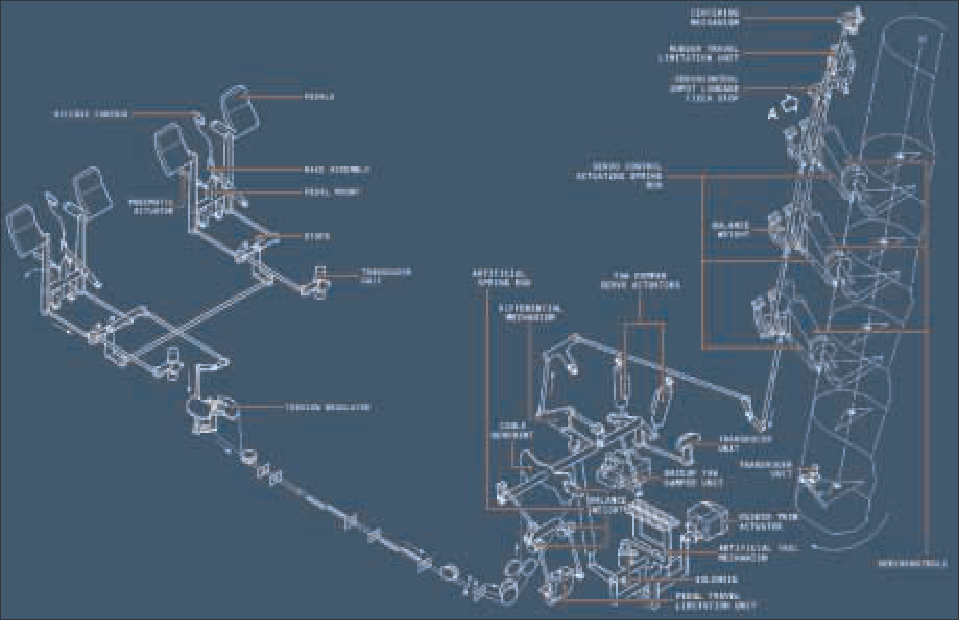
Figure 1 : A330 moder system schematic
3 Take-off after
Section titled “3 Take-off after”F/CTL check failed
Section titled “F/CTL check failed”We will here go through some examples gathered from in-service experience, when crew did not strictly adhere to the golden rules of F/CTL check.
3.1 Surfaces not at neutral with controls not at neutral
Section titled “3.1 Surfaces not at neutral with controls not at neutral”Let’s come back on an event that was evoked in issue 7 dated October 2001 of Hangar flying under title “A310/A300-600 – Rudder trim incorrect indication – ATA 27”, and also commented in OIT/FOT Ref. AI/SE 999.0030/00/CL dated 14 February 2000.
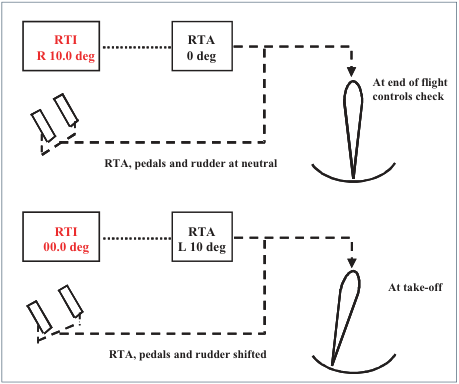
At the end of the F/CTL check, rudder trim indicator (RTI) was showing some rudder trim input. However rudder and rudder pedals were at neutral. Pedals and rudder trim are linked.
Rudder trim actuator (RTA) had to be at neutral also. Indication was erroneous.
Rudder trim indication was manually brought back to neutral with no further check. This shifted the rudder, the rudder trim actuator and the pedals out of neutral.
Safety first #01 January 2005 - 2
Take-off was performed with the shift first compensated by inputs on the pedals and then by the autopilot yaw actuator once autopilot was engaged. But the rudder moved sharply to the rudder trim position once the autopilot declutched and the aircraft experienced an unexpected and sudden bank.
Such an event is covered with criteria 3, rudder at neutral with controls (what includes rudder trim) at neutral. There was no warning triggered to the crew, but it could have been detected by carefully performing the existing Standard Operating Procedures (SOP) F/CTL Check.
3.2 Response in opposite direction
Section titled “3.2 Response in opposite direction”We will here discuss an in-flight turn back due to Inverted Roll Command experienced with an A320.
The F/CTL check was performed with no anomalies noticed by the crew. At take-off, the Captain applied a lateral sidestick input to the right, but the aircraft banked to the left. The F/O took over, and successfully landed the aircraft.
Upon troubleshooting, a maintenance error was found. A wiring inversion had been made between the transducer unit of Captain roll sidestick and ELAC 1, on both the COMMAND & MONITOR channel. With this double inversion, ELAC 1 was receiving consistent signals, and thus could not detect the anomaly and could not trigger a warning to the crew (Figure 3).
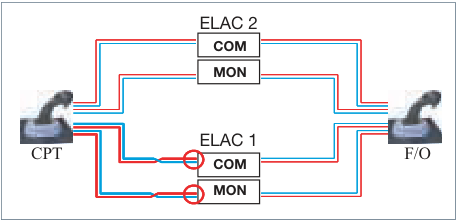
The functional check required after performing AMM tasks had partially been performed on the F/O side only, and thus the anomaly was no detected by mechanics. Crew missed the last opportunity to detect it by not carefully performing the existing SOP F/CTL Check.
This event was presented during the 8th flight safety conference held in October 2001 (Item 15 entitled “A320 crossed roll controls”). It was also covered with an OIT/FOT entitled “ATA 27 – Inflight turn back due to inverted aileron deflection after take-off”, Ref. AI/SE 999.0069/01/CL REV 01 dated 15 June 2001.
3.3 Lack of response
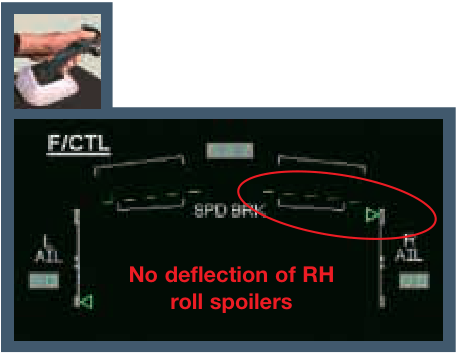
Section titled “3.3 Lack of response”Another example is an in-flight turn back due to reduced ability to turn left experienced just after taking off with an A320. Almost full left sidestick inputs were required in order to laterally control the aircraft. At 1500ft, ECAM warning “F/CTL SPLR FAULT” came up with all right hand roll spoilers shown inoperative.
During a previous maintenance task, R/H spoilers 2 to 5 were left in the maintenance position. After lift-off, they deployed to the zero hinge moment positions and would not respond to inputs.
Preventive instructions have been added in AMM, and monitoring has been improved to trigger an ECAM warning in such condition. But it could also have been detected by carefully performing the existing SOP F/CTL Check (Figure 4).
Safety first #01 January 2005 - 3
4 Efficiency of the F/CTL check
Section titled “4 Efficiency of the F/CTL check”Some events, including recent ones, have highlighted the importance of the F/CTL check. Indeed anomalies were detected which required correction before flight, when aircraft systems did not trigger any failure warning to the crew. Here after are some of them.
4.1 Lack of response
Section titled “4.1 Lack of response”A few events of this kind have been experienced with aircraft of the A340 family. The crew detected during the pre-flight F/CTL check that one elevator was stuck down (Figure 5). The loss of the elevator control was not indicated to the crew by any warning.
17 December 2003 entitled “ATA 27– elevator dropped down – Cracked mode selector valve transducer at servocontol in damping position”; - OIT Ref. SE 999.0066/04/BB Rev. 01 dated 11 June 2004 and FOT Ref. STL 999.0061/04 dated 10 June 04 entitled “ATA 27 – Right elevator stuck down in full pitch down position caused by double failure.
4.2 Limited deflection
Section titled “4.2 Limited deflection”One last example is an event of undue rudder travel limitation on ground.
The Rudder Travel Limitation Unit (RTLU) had failed closed in the high-speed configuration. The ECAM warning “F/CTL TRAVEL LIM FAULT” dedicated to the monitoring of the RTLU position was not displayed.
Indeed, at that time, FCSC which is the computer that controls the RTLU and PTLU did not monitor their behaviour during phases when they are not electrically supplied and thus not supposed to move. However the RTL system failed and RTLU closed during such a phase of no monitoring on ground. Monitoring has since been reviewed.
Figure 5
These events resulted from failure of the servocontrol in damping mode failed. Investigating these events has allowed definition of modifications to both the servocontrols and the F/CTL computers in order to prevent similar events. Appropriate ECAM warnings are triggered for crew annunciation. For these events, detection was ensured by carefully performing the existing SOP F/CTL Check only. Additional information about these event is available with
- OIT/ FOT Ref. SE 999.0149/03 dated
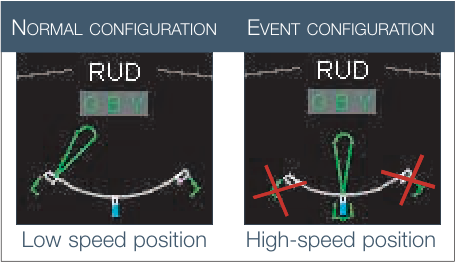
The failure was thus detected only by performing the existing SOP F/CTL Check, and the right decision to return to the gate could be taken.
起飞前飞控检查的重要性
Section titled “起飞前飞控检查的重要性”作者:Albert Urdiroz 飞行安全经理
就航空系统而言,起飞前飞控(F/CTL)检查早在首次动力飞行之前就已存在。其目的是确保飞控系统对飞行员输入做出正确响应,即无卡阻、无活动限制、无僵硬感、无延迟或不恰当的响应。因此它是飞机安全运营的关键因素。自飞行员首次驾驶飞机起,起飞前F/CTL检查就已成为每次飞行前的基础程序。由于对该检查非常熟悉,人们可能会陷入按部就班的陷阱,忽视其重要性。人们还可能认为飞机的自监控能力足以提供充分的信息,但事实并非如此。不当的维修或部件故障也是需要考虑的因素。本文将回顾起飞前F/CTL检查的范围,并通过实际运营中的案例说明其现实意义。
2 F/CTL检查的范围
Section titled “2 F/CTL检查的范围”-
有效的F/CTL检查确保系统响应适当:1- 方向——例如推杆或侧杆时升降舵向下运动;
-
2- 行程量,直至全偏转;
-
3- 回中立;
-
4- 感觉。
在空客任何机型上,F/CTL检查涉及升降舵、副翼、扰流板和方向舵控制系统。不仅包括由驾驶盘、操纵杆和脚蹬驱动的部件,而是整个系统。让我们参考图1,以A310的方向舵轴线为例来说明这一点。
现在让我们逐一回顾上述四个项目,并检查涉及哪些系统。
-
1- 方向;
-
2- 行程量;
-
3- 回中立;
-
4- 感觉。
图1中的大多数部件都会涉及:
-
显然,脚蹬、机械连杆和伺服舵面;
-
任何不恰当的方向舵配平导致方向舵偏离中立位置的情况,都可通过第3项标准检测出来;
-
人工感觉机构可通过第4项标准检查;
-
偏航阻尼器系统的任何偏置可通过第3项标准检测;
-
方向舵行程限制系统可通过第2项标准检测。
我们对其他轴线和/或其他机型可得出类似结论。注意,对于电传操纵系统,用电气线路替代了机械连杆。
因此,F/CTL检查不仅限于驾驶舱内观察到的伺服舵面与驾驶舱操纵装置之间的关系(通过舵面位置指示器),而是检查整个系统。
Safety first #01 January 2005 - 1
图1:A330/A340系统示意图
3 F/CTL检查失败后的起飞
Section titled “3 F/CTL检查失败后的起飞”以下我们将通过从实际运营中收集的案例,介绍飞行员未严格遵守F/CTL检查黄金规则的情况。
3.1 舵面不在中立位置且驾驶舱操纵装置不在中立位置
Section titled “3.1 舵面不在中立位置且驾驶舱操纵装置不在中立位置”让我们回顾2001年10月第7期《Hangar Flying》中一篇标题为”A310/A300-600 – 方向舵配平指示不正确 – ATA 27”的事件,该事件也在2000年2月14日发布的OIT/FOT Ref. AI/SE 999.0030/00/CL中有所提及。
在F/CTL检查结束时,方向舵配平指示器(RTI)显示存在一定的方向舵配平输入。然而方向舵和脚蹬均在中立位置。脚蹬与方向舵配平是相互联动的。
方向舵配平作动筒(RTA)也应处于中立位置。指示是错误的。
方向舵配平指示被手动恢复到中立位置,但未进行进一步检查。这导致方向舵、方向舵配平作动筒和脚蹬偏离了中立位置。
Safety first #01 January 2005 - 2
起飞时,方向舵的偏移首先通过蹬舵输入来补偿,随后当自动驾驶仪接通后由自动驾驶仪偏航作动筒补偿。但当自动驾驶仪脱开时,方向舵突然移动到方向舵配平位置,飞机经历了意外的突然倾斜。
此类事件可通过第3项标准(方向舵中立而包括方向舵配平在内的操纵装置不在中立)进行检测。系统没有向机组发出警告,但只要仔细执行现有的标准操作程序(SOP)F/CTL检查,是可以发现这一问题的。
3.2 方向相反的响应
Section titled “3.2 方向相反的响应”这里我们将讨论一起 A320 机型因横滚指令反向而在飞行中返航的事件。
F/CTL 检查由机组执行,未发现任何异常。起飞时,机长施加了向右的侧杆横侧输入,但飞机却向左倾斜。副驾驶接管飞机并成功着陆。
经故障排查,发现是维护错误。机长横滚侧杆的传感器组件与 ELAC 1 之间的导线接反了,且在 COMMAND 和 MONITOR 两个通道上都出现了接反的情况。由于这种双重接反,ELAC 1 接收到的信号是一致的,因此无法检测到该异常,也无法向机组触发警告(图 3)。
执行 AMM 任务后需要进行的功性能检查只在副驾驶侧进行了部分检查,因此维护人员未能检测到该异常。机组也错过了最后一次检测机会,因为他们未能仔细执行现有的 SOP F/CTL 检查。
该事件曾在 2001 年 10 月举行的第 8 届飞行安全会议上进行了汇报(议程项目 15,标题为”A320 横滚控制反向”)。同时还发布了 OIT/FOT,标题为”ATA 27 – 起飞后反推导致的飞行中返航”,编号为 AI/SE 999.0069/01/CL REV 01,日期为 2001 年 6 月 15 日。
3.3 响应缺失
Section titled “3.3 响应缺失”另一个案例是一起 A320 起飞后不久因向左转向能力减弱而在飞行中返航的事件。当时几乎需要满幅的左侧杆输入才能对飞机进行横侧控制。在 1500ft 高度,ECAM 警告”F/CTL SPLR FAULT”出现,同时所有右侧滚转扰流板显示不工作。
在一次之前的维护工作中,右侧扰流板 2 至 5 被留在维护位置。离地后,它们展开到零铰链力矩位置,且无法响应输入。
AMM 中已增加预防性说明,监控也已改进以在此类情况下触发 ECAM 警告。但通过仔细执行现有的 SOP F/CTL 检查也能检测到该故障(图 4)。
Safety first #01 January 2005 - 3
4 F/CTL 检查的效能
Section titled “4 F/CTL 检查的效能”包括近期事件在内的一些案例,凸显了 F/CTL 检查的重要性。当飞机系统未向机组触发任何失效警告时,正是通过检查发现了需要修正的异常。以下列举其中部分。
4.1 响应缺失
Section titled “4.1 响应缺失”A340 系列飞机曾经历过几起此类事件。机组在飞行前 F/CTL 检查中发现一个升降舵卡在下偏位置(图 5)。升降舵控制功能的丧失并未通过任何警告向机组指示。
OIT/FOT 参考文件 AI/SE 999.0069/01/CL REV 01,日期为 2001 年 6 月 15 日,标题为”ATA 27 – 起飞后反推导致的飞行中返航”;OIT 参考文件 SE 999.0066/04/BB Rev. 01,日期为 2004 年 6 月 11 日,以及 FOT 参考文件 STL 999.0061/04,日期为 2004 年 6 月 10 日,标题为”ATA 27 – 右侧升降舵卡在全俯仰向下位置,系由伺服控制阻尼位置处的模式选择阀传感器双故障所致。
4.2 偏转受限
Section titled “4.2 偏转受限”最后一个案例是地面上不当的方向舵行程限制。
方向舵行程限制组件(RTLU)在高速构型下卡阻在关闭位置。用于监控 RTLU 位置的 ECAM 警告”F/CTL TRAVEL LIM FAULT”未显示。
实际上,FCSC 作为控制 RTLU 和 PTLU 的计算机,在它们未通电因此不应动作的阶段并不监控其行为。然而 RTL 系统在地面此类无监控阶段失效,RTLU 关闭。此后监控已重新审查。
Figure 5
这些事件源于伺服控制在阻尼模式下的失效。通过对这些事件的调查,已确定了对伺服控制和 F/CTL 计算机的改进方案,以防止类似事件的发生,并为机组触发了适当的 ECAM 警告。对于这些事件,检测仅通过仔细执行现有的 SOP F/CTL 检查实现。关于这些事件的更多信息,可参见
- OIT/FOT 参考文件 SE 999.0149/03,日期为
因此,该故障仅通过执行现有的 SOP F/CTL 检查才被检测到,从而能够做出返回机坪的正确决定。