Safe Aircraft Refuelling
Source: Airbus Safety First URL: https://safetyfirst.airbus.com/safe-aircraft-refuelling/ Published: 2020-03-31 Category: Cabin Ops, Flight Ops, Ground Ops, Maintenance, bonding, defuel, earthing, fire, fuel, grounding, jet pump, refuel, spillage PDF: Original PDF
Safe Aircraft Refuelling Safe refuelling operations require strict adherence to procedures and careful application of the safety precautions, not only by the refuelling operators but also fl ight crew, the cabin crew and the other ground operators.
This article highlights the safety precautions that must be considered when refuelling an aircraft. It also describes supplementary tasks that are necessary if refuelling when passengers are on-board.
Safety first #30 - 1/6
FIRE PREVENTION
Section titled “FIRE PREVENTION”The main threat during refuelling operation is the fire threat.
The general safety precautions for refuelling/defuelling are available in:
-
the A220 AMP SERVICING – REPLENISHING AND DEPLETING - FUEL REPLENISHING AND DEPLETING
-
the A300/A310 AMM SERVICING - REPLENISHING OF FUEL TANKS
-
the A320/A330/A340 AMM SERVICING - FUEL - FUEL SYSTEM - SERVICING
-
General Refuel/Defuel Safety Procedures
-
the A380 AMM FUEL - REFUEL/DEFUEL SYSTEM - SERVICING - General Refuel/Defuel Safety Procedures
-
the A350 MP FUEL - DISTRIBUTION - REFUEL/DEFUEL SYSTEM - MAINTENANCE PROCEDURES - General Refuel/Defuel Safety Procedures
In addition to the availability of the firefighting equipment and use of personal protection by the fuelling operator, bonding the aircraft and respecting fuelling safety zones is essential.
Bonding and grounding during refuelling/defuelling
Section titled “Bonding and grounding during refuelling/defuelling”Bonding
Section titled “Bonding”Bonding ensures electrical continuity between the aircraft and the refuelling vehicle, preventing any spark to appear when the ground operator connects the refuelling hose to the aircraft coupling.
It is mandatory to bond the aircraft to the refuelling vehicle/device before connecting the refuelling hose (fig.1).
It is mandatory to bond the aircraft to the refuelling vehicle/device before connecting the refuelling hose.
(fig.1)
Section titled “(fig.1)”Mandatory bonding during refuelling/defuelling operations
-
On the Nose Landing Gear (NLG)
-
On the Main Landing Gears (MLG)
-
On the wings
-
On the engine air inlet
-
At the High Pressure (HP) connector.
Safety first #30 - 2/6
(fi g.2)
Section titled “(fi g.2)”Examples of placard used for grounding point identifi cation
Airbus
doesn’t request the grounding (earthing) of the aircraft or of the refuelling vehicle during refuelling operations but some local authority regulations may request it.
A cable section of 20 mm² or more is recommended to ensure suffi cient bonding. The total electrical resistance of the cable between the A/C and the fuel tanker must not be more than 10 ohms.
Grounding (earthing)
Section titled “Grounding (earthing)”Grounding ensures electrical continuity between the aircraft and the earth. Static electricity resulting from the fl ight or the environmental conditions on ground (wind with dust, sand, etc…) is discharged to the earth through the tires.
Airbus doesn’t request the grounding (earthing) of the aircraft or of the refuelling vehicle during refuelling operations but some local authority regulations may request it.
Refuelling safety zones
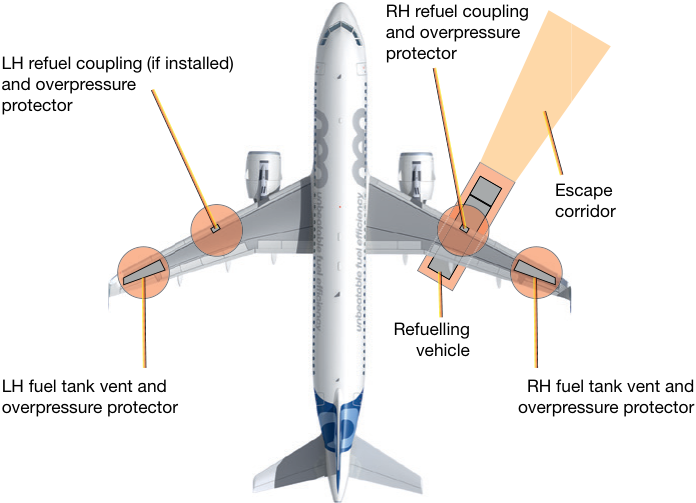
Section titled “Refuelling safety zones”As an industry standard, a 3-meter safety zone must be respected around the area located under the NACA vents, overpressure protectors and refuel coupling(s) (fi g.3). These areas must be clear of any object or personnel. Their location can be found in the Refuel/Defuel Safety procedures of the AMM/ AMP/MP. In addition, an escape corridor must be clear of obstacles so that the refuelling vehicle can leave the area in case of emergency.
(fi g.3)
Section titled “(fi g.3)”Example of the fuelling safety zones on an A320 aircraft
REFUELLING WITH PASSENGERS ON-BOARD
Section titled “REFUELLING WITH PASSENGERS ON-BOARD”Today’s short transit time used by some operators often requires refuelling operations while passengers are still -or already- on-board the aircraft.
It is essential for all actors to respect additional safety precautions and be prepared to initiate an emergency evacuation should it be required.
Keep ground areas clear for slide deployment
Section titled “Keep ground areas clear for slide deployment”Depending on the ground servicing and catering operations, the area beneath the available exits must be clear to enable proper slide deployment in the case of an evacuation.
Cabin and passengers handling
Section titled “Cabin and passengers handling”It is essential for all actors to respect additional safety precautions and be prepared to initiate an emergency evacuation should it be required.
The flight crew must switch OFF the SEAT BELT signs and switch ON the NO SMOKING signs (if installed) and inform the cabin crew when the refuelling/ defuelling operation starts and ends.
The CCOM SOP “Refuelling/defuelling - Refuelling/defuelling with passengers onboard” provides the procedure and precaution to apply.
The cabin aisle(s) and exits must be free of obstacles that could impair the evacuation path. Cabin curtains must be secured in the open position and the cabin lighting should be ON.
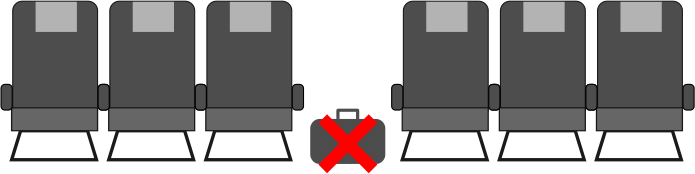
The cabin crew must inform passengers that a refuelling operation is on-going and that they must not fasten their seatbelt to ease evacuation in the case of an emergency.
Each cabin crew should be prepared for an evacuation and at least one cabin crew member should be positioned at each door pair.
Safe Aircraft Refuelling
飞机安全加油需要严格遵守操作程序并仔细落实安全防护措施,这不仅是对加油操作人员的要求,也包括飞行机组、客舱乘务员及其他地面作业人员。
本文强调了飞机加油时必须考虑的安全防护措施,并介绍了旅客在机上时进行加油所需的补充任务。
Safety first #30 - 1/6
加油操作过程中的主要威胁是火灾风险。
加油/抽油的一般安全防护措施可在以下手册中查阅:
-
A220 AMP SERVICING – REPLENISHING AND DEPLETING - FUEL REPLENISHING AND DEPLETING
-
A300/A310 AMM SERVICING - REPLENISHING OF FUEL TANKS
-
A320/A330/A340 AMM SERVICING - FUEL - FUEL SYSTEM - SERVICING
-
General Refuel/Defuel Safety Procedures
-
A380 AMM FUEL - REFUEL/DEFUEL SYSTEM - SERVICING - General Refuel/Defuel Safety Procedures
-
A350 MP FUEL - DISTRIBUTION - REFUEL/DEFUEL SYSTEM - MAINTENANCE PROCEDURES - General Refuel/Defuel Safety Procedures
除了提供消防设备并由加油操作人员使用个人防护装备外,对飞机进行跨接以及遵守加油安全区域同样至关重要。
加油/抽油期间的跨接与接地
Section titled “加油/抽油期间的跨接与接地”跨接可确保飞机与加油车辆之间的电气连续性,防止地面操作人员将加油软管连接至飞机接头时产生任何火花。
在连接加油软管之前,必须将飞机与加油车辆/设备进行跨接 (图1)。
在连接加油软管之前,必须将飞机与加油车辆/设备进行跨接。
加油/抽油作业期间的强制跨接
-
前起落架 (NLG)
-
主起落架 (MLG)
-
机翼
-
发动机进气口
-
高压 (HP) 接头。
Safety first #30 - 2/6
用于识别接地点的标牌示例
空中客车公司在加油作业期间不要求对飞机或加油车辆进行接地,但某些当地法规可能要求接地。
建议使用截面积为 20 mm² 或更大的电缆以确保足够的跨接。电缆在飞机与燃油车之间的总电阻不得超过 10 欧姆。
接地可确保飞机与大地之间的电气连续性。飞行中或地面环境条件(风沙等)产生的静电通过轮胎释放至大地。
空中客车公司在加油作业期间不要求对飞机或加油车辆进行接地,但某些当地法规可能要求接地。
加油安全区域
Section titled “加油安全区域”作为行业标准,必须在 NACA 通气口、释压保护装置和加油接头所在的区域周围保持 3 米的安全区域 (图3)。这些区域必须清除任何物体和人员。其位置可从 AMM/AMP/MP 的加油/抽油安全程序中找到。此外,必须保持一条畅通的逃生通道,以便加油车辆在紧急情况下能够驶离该区域。
A320 飞机加油安全区域示例
旅客在机上的加油作业
Section titled “旅客在机上的加油作业”如今,某些运营商使用的过站时间较短,往往需要在旅客仍在机上或已登机的情况下进行加油作业。
所有相关人员必须遵守额外的安全防护措施,并做好在需要时启动紧急撤离的准备。
保持地面区域畅通以便于滑梯展开
Section titled “保持地面区域畅通以便于滑梯展开”根据地面服务和配餐作业情况,可用出口下方区域必须保持畅通,以便在发生撤离时能够正常展开滑梯。
客舱和旅客管理
Section titled “客舱和旅客管理”所有相关人员必须遵守额外的安全防护措施,并做好在需要时启动紧急撤离的准备。
飞行机组必须在加油/抽油作业开始时关闭安全带指示灯并打开禁止吸烟指示灯(如已安装),同时通知客舱乘务员。加油/抽油作业结束时,须再次通知客舱乘务员。
CCOM _SOP “加油/抽油 - 旅客在机上的加油/抽油”提供了应执行的程序和防护措施。
客舱过道和出口必须畅通,不得有障碍物影响撤离通道。客舱窗帘必须固定在打开位置,客舱照明应保持打开。
客舱乘务员必须告知旅客加油作业正在进行中,并提醒他们不要系紧安全带,以便在紧急情况下顺利撤离。
每位客舱乘务员都应做好撤离准备,至少应有一名客舱乘务员位于每对舱门处。