Safe operations with composite aircraft
Source: Airbus Safety First URL: https://safetyfirst.airbus.com/safe-operations-with-composite-aircraft/ Published: 2014-07-29 Magazine Issue: 2014-07 Category: Ground Ops, Maintenance, carbon, cfrp, composite, corrosion, delamination,, fatigue, fiber, honeycomb, lightning, ndt, strike PDF: Original PDF
AIRCRAFT
Section titled “AIRCRAFT”
Composite materials are increasingly used in aircraft design. The A350 XWB is the most recent illustration of this trend. Yet if the benefi ts of composite materials are not in doubt for airlines, some questions still remain as to their potential effects on safety.

CHANTAL FUALDES Executive Expert Composite

XAVIER JOLIVET Director Flight Safety

CÉDRIC CHAMFROY
Product Leader NDT Customer Services
Why composites in the first place?
Section titled “Why composites in the first place?”The large increase of the fuel cost in the early 70s challenged aircraft manufacturers to improve considerably the fuel efficiency of commercial airplanes. This quest led designers to progressively replace aluminium by compos-
ites, as they typically weigh 20 per cent less than aluminium for an equivalent function. This aircraft weight reduction, in turn, led to a lower fuel consumption.
What are composites?
Section titled “What are composites?”Composites are a particular kind of plastic. The majority of plastics in the world today are pure, and may be used to make things like toys or mineral bottles.
When additional strength is needed, plastics are reinforced with fibres and become comp, broadly known as reinforced plastics. The reinforcing fibres, or fabric, provide strength and stiffness to the composite, while the plastic resin, or matrix, gives cohesive properties, stability and environmental resistance.
In today’s aerospace industry, most applications use carbon as reinforcing fibres. They are referred to as Carbon Fibre Reinforced Plastics (CFRP). (fig.1)
Fibres reinforced plastics are usually made into laminates, i.e. layered sheets. A layer or ply is made to the specified size and orientation and then more layers are added, playing on the orientation until the piece has the properties it needs to support the loads it will carry.
Reinforced plastics may be in monolithic or sandwich form. Monolithic if they are solid and sandwich if the laminate sheets are separated by a core of different material type, usually honeycomb or foam. (fig.2)
Heavily loaded structural components are usually monolithic, while lightly loaded fairings, interior components are usually of the sandwich type.
(fig.1)
Carbon/Epoxy Impregnation (Prepreg)
The two main concepts of composite: sandwich and monolithic
Are there safety implications to the use of composites?
Section titled “Are there safety implications to the use of composites?”We are going to consider this question by looking at safety from three different perspectives:
The certification process
The behaviour of composites in the face of operational threats The assessment of impact damage
AIRCRAFT
Section titled “AIRCRAFT”The certification process
Section titled “The certification process”Composite aircraft are certified according to the same rules as their conventional counterparts.
Composite aircraft are certified ac - cording to the same rules as their conventional counterparts.
Since composites show, in some respects, a different behaviour when compared to metallic materials, the Airworthiness Authorities have developed new Acceptable Means of Compliance (AMC), allowing manufacturers to demonstrate that these
new materials meet the existing safety requirements.
In line with a conservative Airbus policy on the introduction of new technology, the manufacturer has carried out numerous tests, taking into consideration even the most exceptional scenarios, thereby exceeding the requirements defined in the above AMCs by a large margin.
The behaviour of composites in the face of operational threats
Section titled “The behaviour of composites in the face of operational threats”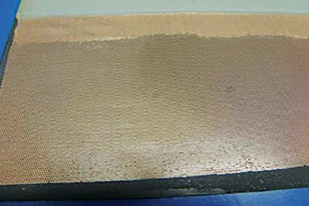
(fig.3) Metallic mesh, general view
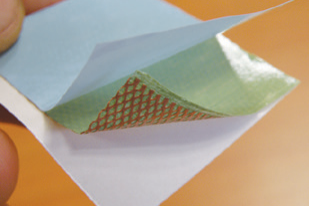
(fig.4) Metallic mesh, close-up view
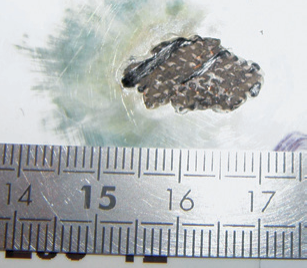
(fig.5) Impact of typical lightning strike (scale in centimetres)
In the course of its lifetime, an aircraft structure is exposed to a certain number of threats. Let us consider the main ones and the means put in place on the A350 XWB to mitigate these threats:
• Lightning strikes
Section titled “• Lightning strikes”Full scale tests have demonstrated that the A350 XWB fuselage is protected against lightning strikes. This is achieved by a proper dimensioning of the structure and by compensating the lower conductivity of carbon fibre composites by integrating a metallic mesh. (fig.3 and 4)
The typical lightning strikes led to no more than clearly visible burn marks and paint scrapes, as illustrated in figures 5 and 6. For very severe lightning strikes, despite more extensive damage, no detrimental effect was witnessed on the fuselage integrity.
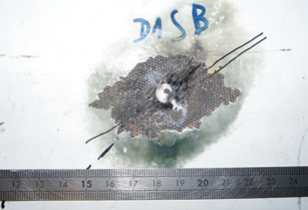
(fig.6) Impact of very severe lightning strike (scale in centimetres)
• Bird strikes
Section titled “• Bird strikes”Safe flight continuation was proven through residual strength analysis carried out after dedicated tests. The objective was to verify the resistance of specific parts of the structure to damage caused by bird strikes. The most exposed composite areas are the radome and the leading edges of the wing and horizontal/vertical tail planes.
During these tests, damage from bird strikes was acceptable on secondary structure like aerodynamic fairings or leading edges but without detrimental effect on any load carrying primary structure.
One of these tests consisted of projecting an 8 pounds bird against the leading edge of the horizontal tail plane at a speed of 330 kt. The test demonstrated that the damage was limited to the leading edge, while the spar was unaffected by the collision. (fig.7)
(fig.7) Damage to horizontal tail plane after bird strike test
• In-flight hail
Section titled “• In-flight hail”The risk of in-fl ight hail was mitigated through design precautions, mainly by increasing the thickness of the structure on the most exposed areas, like the nose cone of the aircraft.
• Uncontained engine failure
Section titled “• Uncontained engine failure”A range of high velocity impact tests were performed on fuselage barrels to simulate the effects of an uncontained engine failure. The tests demonstrated no detrimental damage and no dynamic effect on the fuselage.
• Fire
Section titled “• Fire”Fire, Smoke and Toxicity requirements (FST) are applied for all aircraft interior elements. Composite materials are common to both structure and cabin, they therefore also have to fulfil the same smoke and toxicity requirements. Concerning the resistance to fire, it is interesting to note that CFRP is auto-extinguishable and that the thinner composite fuselage skin is more “burn through” resistant than a metallic equivalent.
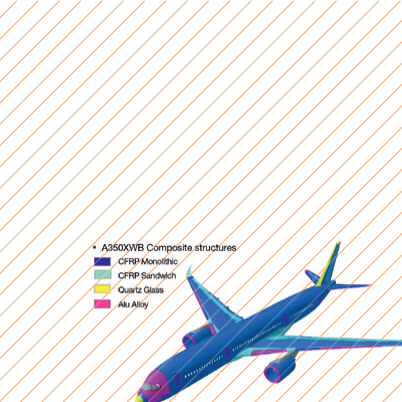
A350 XWB Composite Structure
• Corrosion
Section titled “• Corrosion”On their own, composite parts do not corrode and do not require specifi c protection against corrosion, while aluminium structures require continuous inspection and re-protection. The risk of galvanic corrosion, which exists when composites are in contact with metal, has been mitigated on all Airbus programs by paying attention to the choice of metallic elements and by taking associated design precautions. Aluminium rivets for example, were replaced by titanium on the fuselage.
• Fatigue
Section titled “• Fatigue”Whereas aluminium structures require very specifi c attention, the composite structures do not require inspection for fatigue.
Composite structures are designed using static ultimate conditions, where the Materials and Design principle demonstrate no sensitivity to fatigue cycling.
Carbon-Fibre Components: Lighter, Stronger, Tougher
Section titled “Carbon-Fibre Components: Lighter, Stronger, Tougher”The use of carbon-fi bre components in the aviation industry is becoming more and more common. But for Airbus, Carbon Fibre Reinforced Plastic (CFRP) components are nothing new.
Airbus has used carbon-fi bre materials for years. starting with the A310-200 in 1983 when the spoilers, airbrakes and rudder were made of sandwich CFRP. Three years later, the A310-300 pioneered the introduction of composite on a primary structure with the vertical tail plane designed in monolithic CFRP. On the A320, carbon-fi bre materials were used on fl aps, ailerons, spoilers and on the vertical and horizontal tail planes. On the A340-600 the rear pressure bulkhead and keel beams were made of CFRP. On the A380, Airbus introduced them in the fuselage rear section and centre wing box connecting the two wings together, while the wing ribs moved to carbon-fi bre. This evolution continued on the A350 XWB where the entire fuselage and wing skins – more than half of the structure - is made from carbon-fi bre composites.
AIRCRAFT
Section titled “AIRCRAFT”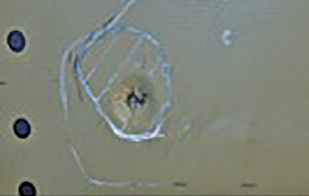
(fi g.8) External view of the damage
Section titled “(fi g.8) External view of the damage”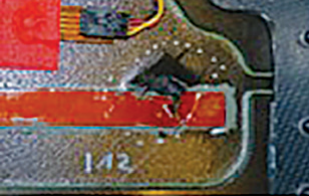
(fi g.9) Resulting internal delamination
The “line tool”
Section titled “The “line tool””The “line tool” is an easy to use device developed by Airbus, which allows basic ultrasonic inspections to be performed by non NDT qualifi ed personnel.
This tool will allow the release of an aircraft if no delamination is found. But if delamination is observed, a more detailed inspection must be performed by means of additional Non-Destructive Testing (NDT), which uses ultrasonic methods to determine the exact extent of that damage.
The assessment of impact damage
Section titled “The assessment of impact damage”In case of impact damage, a composite structure may behave in a different way when compared to a metallic structure. As a consequence, in case of an impact with a foreign object, the internal damage on a composite structure might be larger than the visible external damage. This point was illustrated in a previous Safety fi rst article (ref.A) as well as in an Airbus Operator Information Transmission (ref.B). Thorough visual inspection of the
aircraft exterior is therefore even more important on a composite aircraft than on its metallic counterpart. (fi g.8 and 9)
Whereas a mechanic inspecting a metallic structure will typically look for dents or cracks and will determine whether action is needed based on the size of the damage, the same mechanic on a composite structure will rather look for any visual clue, more particularly for dents.
If damage is smaller than barely visible….
Section titled “If damage is smaller than barely visible….”According to the Barely Visible Inspection Damage (BVID) concept, any dent whose depth is less than a certain threshold, defi ned in the Structural Repair Manual, is acceptable and does not require any action. The dimensioning of the aircraft panels takes into account the BVID cri-
teria. In other words the panels have been sized with a margin corresponding to the loss of strength that the panel would incur when the damage is barely visible.
If damage is larger than barely visible…
Section titled “If damage is larger than barely visible…”Repair Manual (SRM) and carried out in accordance with the Non-destructive Testing Manual (NTM).
If a damage is visible and lies beyond the BVID threshold, a more detailed inspection, typically ultrasonic testing, may be required by the Structural
The special case of high energy blunt impacts
Section titled “The special case of high energy blunt impacts”Two types of events may be classifi ed as high energy blunt impacts:
but potentially important damage to its internal core.
On the A350 XWB, additional inspection tasks have been added to sections 05-51 of the AMM to deal with these types of impacts.
-
Tire bursts
-
Impacts from ground servicing vehicles
Above a certain energy threshold, a metallic structure sustains a permanent deformation and displays a dented area, whereas a composite panel deforms and then returns to its original shape with minor or no damage on its surface,
Whereas tire bursts are self-evident occurrences, impacts from ground vehicles require a high level of awareness among all ramp actors on the necessity to report these types of events.
For abnormal events, such as lightning strikes or bird/hail impacts, reference should be made to the applicable Aircraft Maintenance Manual (AMM) 05-51 section.
These sections include relevant instructions for composite components inspections and checks.

INFORMATION
Section titled “INFORMATION”Focus on training
Section titled “Focus on training”Information on structure courses proposed by Airbus Training is available on: AirbusWorld and airbus.com
Extract from FAA Advisory Circular 65-33:
Section titled “Extract from FAA Advisory Circular 65-33:”As more composite aircraft enter into operation, detailed and documented composite training should be developed to ensure that personnel performing composite maintenance on aircraft structures and components properly repair damage to meet the highest level of safety.

Extract from FAA Advisory Circular 20-107B and EASA Alternative Means of Compliance 20-29:
Section titled “Extract from FAA Advisory Circular 20-107B and EASA Alternative Means of Compliance 20-29:”d. Damage Detection, Inspection and Repair Competency. (2) Pilots, ramp maintenance, and other operations personnel that service aircraft should be trained to immediately report anomalous ramp incidents and fl ight events that may potentially cause serious damage to composite aircraft structures. In particular, immediate reporting is needed for those service events that are outside the scope of the damage tolerance substantiation and standard maintenance practices for a given structure…
The use of composites provides signifi cant benefi ts to aircraft operators in the form of fuel savings, weight reduction, fatigue and corrosion resistance and extended in-service life. Composite aircraft are certified according to the same rules as their conventional counterparts. Due to the specifi cities of composites, Airworthiness Authorities have developed new Acceptable Means of Compliance (AMC) to adapt to this new technology and ensure an equivalent level of safety. In accordance with its policy on the introduction of new technology, Airbus has gone a long way beyond these AMCs. Composite aircraft are designed to respond as well and in some cases, like fatigue and corrosion, better than traditional metallic airplanes to operational threats. Composites provide also some additional benefi ts in terms of behaviour to fi re: Carbon Fibre Reinforced Plastic (CFRP) is auto extinguishable and more burn through resistant than aluminium. Composites, however, have a specifi city that needs to be taken into account when assessing damage: the non-visible side deterioration might be larger than the visible external damage. After visual inspections, the maintenance programs call for:
-
No further action if the damage is barely visible
-
A specific inspection if the dent lies beyond the Barely Visual Inspection Damage (BVID) threshold
This rule has two exceptions: tire bursts and impacts by ground servicing vehicles. Both types of events must always be reported and require appropriate inspection prior to returning the aircraft into service.
References
Section titled “References”A. Safety first “Trimmable Horizontal Stabilizer Damage” issue n°3 December 2006
B. Operator Information Transmission (OIT) 999.0115/04 “Assessment of external damage on composite structure”
复合材料在飞机设计中的应用日益广泛。A350 XWB 是这一趋势的最新例证。尽管复合材料对航空公司的好处毋庸置疑,但其在安全方面的潜在影响仍存在一些疑问。
CHANTAL FUALDES 复合材料执行专家
XAVIER JOLIVET 飞行安全总监
CÉDRIC CHAMFROY
无损检测(NDT)客户服务产品负责人
为什么要使用复合材料?
Section titled “为什么要使用复合材料?”20 世纪 70 年代初燃油成本的大幅上涨,促使飞机厂商大幅提升商用飞机的燃油效率。这一需求推动设计师逐步以复合材料替代铝材——在同等功能下,复合材料通常比铝材轻 20%。飞机重量的降低,进而带来了燃油消耗的减少。
什么是复合材料?
Section titled “什么是复合材料?”复合材料是一种特殊的塑料。世界上大多数塑料是纯的,可用于制造玩具或矿泉水瓶等产品。
当需要额外强度时,塑料用纤维增强后成为复合材料,统称为增强塑料。增强纤维或织物为复合材料提供强度和刚度,而塑料树脂或基体则赋予其粘结性能、稳定性和环境耐受性。
在当今航空航天行业中,大多数应用采用碳作为增强纤维,被称为碳纤维增强塑料 (CFRP)。(图 1)
纤维增强塑料通常被制成层压板,即分层薄片。每层按指定的尺寸和方向铺设,然后添加更多层,通过调整铺层方向使部件具备承受载荷所需的性能。
增强塑料可以是单层实心式或夹层式。单层实心式为实体结构,夹层式则是层压板之间被不同类型的芯材隔开,通常是蜂窝或泡沫。(图 2)
承受高载荷的结构部件通常采用单层实心式,而载荷较小的整流罩、内饰件通常采用夹层式。
(图 1)
碳/环氧预浸料
两种主要的复合材料概念:夹层式和单层实心式
使用复合材料是否涉及安全问题?
Section titled “使用复合材料是否涉及安全问题?”我们将从三个不同角度来探讨这一问题:
认证过程
复合材料面对运营威胁时的表现
冲击损伤的评估
复合材料飞机按照与同级别传统飞机相同的规则进行认证。
复合材料飞机按照与同级别传统飞机相同的规则进行认证。
由于复合材料在某些方面表现出与金属材料不同的特性,适航当局制定了新的可接受符合性方法 (AMC),使制造商能够证明这些新材料满足现有的安全要求。
根据空客在引进新技术方面一贯保守的政策,制造商进行了大量测试,甚至考虑了最极端的场景,大幅超越了上述 AMC 中规定的要求。
复合材料面对运营威胁时的表现
Section titled “复合材料面对运营威胁时的表现”
(图 3) 金属网全景图
(图 4) 金属网细节图
(图 5) 典型雷击的影响(刻度单位:厘米)
在飞机使用寿命期间,飞机结构会暴露在一定数量的威胁之下。让我们来看看主要威胁,以及 A350 XWB 为减轻这些威胁而采取的措施:
全尺寸试验已证明 A350 XWB 机身可抵御雷击。通过对结构进行适当尺寸设计,以及通过集成金属网来补偿碳纤维复合材料较低的导电性来实现防护。(图3和图4)
典型的雷击仅造成明显的烧灼痕迹和漆面刮擦,如图图5和图6所示。对于极为严重的雷击,尽管会造成更广泛的损伤,但未发现对机身完整性产生不利影响。
(图6) 极严重雷击的影响(刻度单位:厘米)
通过专项试验后的剩余强度分析证明了安全继续飞行的可行性。目的是验证结构特定部件对鸟击所致损伤的抵抗能力。最易受鸟击影响的复合材料区域为雷达罩以及机翼和水平/垂直尾翼的前缘。
在这些试验中,鸟击对次要结构(如整流罩或前缘)造成的损伤是可接受的,但不会对任何承受载荷的主要结构产生不利影响。
其中一项试验以 330 节的速度将一只 8 磅重的鸟投射向水平尾翼前缘。试验表明损伤仅限于前缘,翼梁未受到碰撞影响。(图7)
(图7) 鸟击试验后水平尾翼的损伤情况
• 飞行中冰雹
Section titled “• 飞行中冰雹”通过设计预防措施降低了飞行中冰雹的风险,主要通过增加最易暴露区域(如飞机鼻锥)的结构厚度来实现。
• 发动机非包容性失效
Section titled “• 发动机非包容性失效”在机身段上进行了多项高速冲击试验,以模拟发动机非包容性失效的影响。试验表明未对机身造成不利损伤,也未产生动力学影响。
防火、烟雾和毒性要求(FST)适用于所有飞机内饰元件。复合材料同时应用于结构和客舱,因此也必须满足相同的烟雾和毒性要求。关于防火性能,有趣的是注意到 CFRP 具有自熄特性,且较薄的复合材料机身蒙皮比同等金属材料更耐烧穿。
A350 XWB 复合材料结构
复合材料部件本身不会腐蚀,也不需要专门的防腐保护,而铝合金结构则需要持续检查和重新防护。复合材料与金属接触时存在的电偶腐蚀风险,已通过在所有空客项目中注意金属元件的选择并采取相关设计预防措施来缓解。例如,机身用钛合金铆钉替代了铝合金铆钉。
铝合金结构需要特别注意,而复合材料结构不需要进行疲劳检查。
复合材料结构采用静极限条件进行设计,材料与设计原则已证明对疲劳循环不敏感。
碳纤维部件:更轻、更强、更韧
Section titled “碳纤维部件:更轻、更强、更韧”碳纤维部件在航空工业中的应用越来越普遍。但对空客而言,碳纤维增强塑料(CFRP)部件并非新事物。
空客使用碳纤维材料已有多年历史。始于 1983 年的 A310-200,当时扰流板、减速板和方向舵采用夹层 CFRP 制造。三年后,A310-300 开创了复合材料应用于主要结构的先河,垂直尾翼采用单体 CFRP 设计。在 A320 上,碳纤维材料应用于襟副翼、扰流板以及垂直和水平尾翼。在 A340-600 上,后压力隔框和龙骨梁采用 CFRP 制造。在 A380 上,空客将碳纤维引入机身尾部段和连接两侧机翼的中央翼盒,而机翼肋也改为碳纤维制造。这一演进在 A350 XWB 上得以延续,整个机身和机翼蒙皮——超过一半的结构——均由碳纤维复合材料制成。
(图 8) 损伤外观
Section titled “(图 8) 损伤外观”
(图 9) 导致的内部分层
“划线工具”
Section titled ““划线工具””“划线工具”是一款由空客开发的易于使用的设备,允许非NDT资质人员执行基础超声波检测。
使用该工具,如果未发现分层,即可放行飞机。但如果观察到分层,则必须通过额外的无损检测(NDT)进行更详细的检查,以确定该损伤的确切程度。
冲击损伤评估
Section titled “冲击损伤评估”在发生冲击损伤时,复合材料结构与金属结构的表现可能不同。因此,当与外来物发生撞击时,复合材料结构的内部损伤可能大于可见的外部损伤。这一要点在此前的Safety First文章**(参考A)以及空客运营信息通报(参考B)中均有所说明。因此,对复合材料飞机外表的彻底目视检查比其金属对应机型更为重要。(图 8 和 9)**
金属结构检验员通常会查找凹痕或裂纹,并根据损伤大小来决定是否需要采取行动,而复合材料结构的检验员则会更多地关注任何可视线索,尤其是凹痕。
损伤小于勉强可见损伤时……
Section titled “损伤小于勉强可见损伤时……”根据目视勉强可见损伤(BVID)概念,深度小于结构修理手册中规定的某一阈值的任何凹痕均是可接受的,无需采取任何行动。飞机蒙皮的尺寸设计已考虑BVID标准。换言之,蒙皮的设计已预留了与勉强可见损伤时面板强度损失相对应的裕度。
损伤大于勉强可见损伤时……
Section titled “损伤大于勉强可见损伤时……”修理手册(SRM)并在无损检测手册(NTM)的指导下执行。
如果损伤可见且超出BVID阈值,结构修理手册可能要求进行更详细的检查,通常为超声波检测。
高能钝性撞击的特殊情况
Section titled “高能钝性撞击的特殊情况”以下两类事件可归类为高能钝性撞击:
可能导致其内部芯材受到潜在重大损伤。
在A350 XWB上,维护手册(AMM)的05-51章节增加了额外的检查任务以应对此类撞击。
-
轮胎爆胎
-
地面勤务车辆撞击
超过某一能量阈值时,金属结构会发生永久变形并呈现凹陷区域,而复合材料面板则会发生变形后恢复原状,表面仅有轻微或无损伤,
轮胎爆胎是显而易见的事件,而地面车辆撞击则需要所有机坪作业人员对此类事件报告的必要性保持高度警觉。
对于异常事件(如雷击或鸟击/冰雹撞击),应参考适用的 Aircraft Maintenance Manual (AMM) 05-51 部分。
这些部分包含复合材料部件检查的相关说明。
空客培训提供的结构课程信息详见:AirbusWorld 和 airbus.com
摘自 FAA Advisory Circular 65-33:
Section titled “摘自 FAA Advisory Circular 65-33:”随着越来越多的复合材料飞机投入运营,应开发详细且有记录的复合材料培训,以确保对飞机结构和部件进行复合材料维护的人员能够正确修复损伤,满足最高安全水平。
摘自 FAA Advisory Circular 20-107B 和 EASA Alternative Means of Compliance 20-29:
Section titled “摘自 FAA Advisory Circular 20-107B 和 EASA Alternative Means of Compliance 20-29:”d. 损伤探测、检查与修理能力。(2) 飞行员、机坪维护及其他为飞机提供服务作业的人员应接受培训,以便立即报告可能对复合材料飞机结构造成严重损坏的异常机坪事件和飞行事件。特别是对于超出特定结构损伤容限验证和标准维护作业范围的服务事件,需要立即报告……
复合材料的使用为飞机运营商带来了显著的益处,包括燃油节省、重量减轻、抗疲劳和抗腐蚀性能提升以及更长的在役寿命。复合材料飞机按照与同级别传统飞机相同的规则进行认证。由于复合材料的特殊性,适航当局制定了新的可接受符合性方法 (AMC) 以适应这一新技术,并确保等效的安全水平。根据其新技术引入政策,空客已远超前于这些 AMC。复合材料飞机的设计使其能够良好地应对运营威胁,在某些方面(如疲劳和腐蚀)甚至优于传统金属飞机。复合材料在防火性能方面也具有额外优势:碳纤维增强塑料 (CFRP) 具有自熄性,且比铝合金更具抗烧穿性能。然而,复合材料有一种特殊性需要在评估损伤时加以考虑:非可见侧的劣化程度可能大于可见的外部损伤。在进行目视检查后,维护大纲要求:
-
如果损伤仅勉强可见,则无需进一步操作
-
如果凹痕超过勉强目视检查损伤阈值 (BVID),则需进行专项检查
此规则有两个例外:轮胎爆裂和地面勤务车辆撞击。这两类事件必须始终报告,并在飞机恢复服役前进行相应的检查。
A. Safety first “Trimmable Horizontal Stabilizer Damage” issue n°3 December 2006
B. Operator Information Transmission (OIT) 999.0115/04 “Assessment of external damage on composite structure”