Preventing Inadvertent Slide Deployments
Source: Airbus Safety First URL: https://safetyfirst.airbus.com/preventing-inadvertent-slide-deployments/ Published: 2018-09-21 Category: Cabin Ops, Flight Ops, Ground Ops, Maintenance, armed, cabin, disarmed, door, doors, escape slide, Inadvertent Slide deployment, ISD, ISDPL, slide, watchdog PDF: Original PDF
AIRCRAFT Preventing Inadvertent Slide Deployments
007

INADVERTENT SLIDE DEPLOYMENTS
Section titled “INADVERTENT SLIDE DEPLOYMENTS”ISDs and their impact
Section titled “ISDs and their impact”Aircraft escape slides are an essential piece of Safety equipment. Designed to be fully deployed and inflated within a maximum of ten seconds, they are a powerful and efficient means of ensuring safe exit from an aircraft in case of an emergency.
Yet the same speed and efficiency of activation can also mean that there is no time to stop the deployment, when anybody operating a door inadvertently activates a slide.
As per IATA definitions, an Inadvertent Slide Deployment (ISD) is the ‘unintentional deployment (full or partial) of an aircraft emergency evacuation slide or slide raft’.
An Inadvertent Slide Deployment is the full or partial unintentional deployment of an aircraft emergency evacuation slide or slide raft.
ISDs occur when the operator attempts to open the door under normal operational circumstances such as at aircraft turnaround, when the slide is in the armed condition.
If an ISD occurs, it may cause serious injury of operatives inside the cabin or outside the aircraft. ISDs also have economic impacts and cause operational disruptions.
The minimum cost of an event involving a 90 minute ground delay is estimated at around 11,000 USD. If the ISD leads to a flight cancellation and a requirement to accommodate passengers in hotels, the cost can rise as high as 200,000 USD.
Causes of ISDs
Section titled “Causes of ISDs”Airbus monitors reports of ISDs coming in from in-service operations, and investigates each report to understand the causes. The number of cases reported to Airbus is quite consistent on an annual basis, at 35-45 per year.
Investigation of the location of ISDs occurring on Airbus fleets in 2017 shows that the majority occur at the forward left door and the rear doors, due to the more frequent usage for boarding and loading operations.
AIRCRAFT
Section titled “AIRCRAFT”(fi g.1)
Section titled “(fi g.1)”Results of a study into factors contributing to ISDs. Source: IATA Cabin Operations Safety Conference 2014.
An IATA survey of 47 airlines conducted between 2014 & 2015, found that the occupational group most frequently identifi ed in reported ISDs was cabin crew. Ground staff, maintenance, fl ight crew and passengers were all less frequently identifi ed in ISD reports.
Factors contributing to ISDs
Section titled “Factors contributing to ISDs”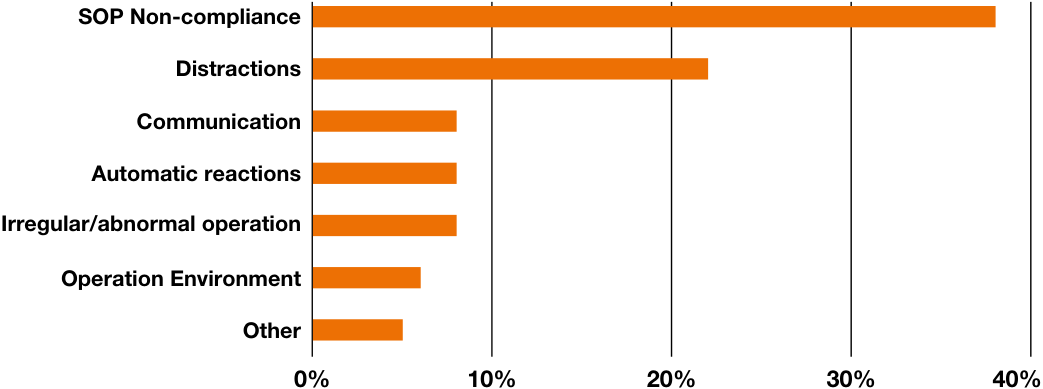
In a previous study presented at the 2017 IATA Cabin Operations Safety Conference, a number of contributing factors to ISDs were identifi ed which are highlighted in (fi g.1). SOP Non-compliance and distractions are identifi ed as the leading factors.
In reports provided to Airbus these factors are also evident, together with information putting into context the human factors elements associated with the report.
Issues of crew fatigue, distraction by passengers moving in the cabin, and the time pressures of turn-around operations can be identifi ed.
Other factors include poor communication/coordination between crew members, and the complexity present when cabin crew fl y on various aircraft types with different door designs.
Examples of ISD report contents:
Section titled “Examples of ISD report contents:”“ The captain accidentally deployed Door 1R slide at the gate, when he opened the door to look outside, the door was still armed.”
“ During a short transit time, catering staff opened Door 1R in armed position and the escape slide deployed.”
at the forward doors inadvertently pulled the door operating handle instead of the door disarming lever.”
Safety first #27 | September 2018 009
DOOR OPENING PRACTICES
Section titled “DOOR OPENING PRACTICES”Cabin Crew Standard Operating Procedures (SOP)
Section titled “Cabin Crew Standard Operating Procedures (SOP)”Definition of SOP by each airline is a process which needs to take into account factors specific to the airline, including standardisation of procedures in mixed fleet operations between aircraft of different manufacturers, the regulations of local airworthiness authorities, practices of ground handling companies at different airports, etc.
It is therefore an airline responsibility to identify within their own SOP which staff take which actions, and when. Nevertheless, in all cases, the procedures to arm and disarm the slide include three stages; the command, the action (arm or disarm), and the confirmation (cross-check).
When performing these three stages on Airbus aircraft, SOP can take into account the design of Airbus slides, which include a Safety Pin. When used in accordance with SOP, the Safety Pins prevent the arming lever from being inadvertently moved to the armed position.
The Airbus PIN-LEVER-PIN model
Section titled “The Airbus PIN-LEVER-PIN model”Once the command to arm or disarm the slides has been issued, cabin crew can use the mental model of ‘PIN-LEVER-PIN’ in order to ensure the steps associated with arming or disarming in the SOP are correctly followed.
(fig.2)
Section titled “(fig.2)”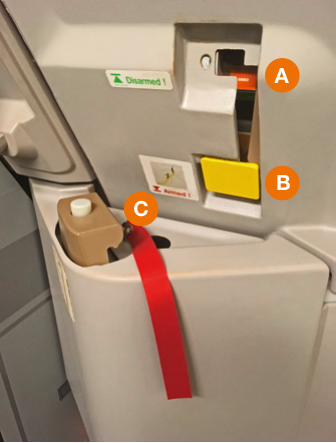
-
A[ Visual indicator shows ]
ARMEDcondition -
B[ Arming lever in the ]
ARMEDposition
C Safety pin in its stowage
D Safety pin installed
-
E[ Visual indicator shows ]
DISARMEDcondition -
F[ Arming lever in the ]
DISARMEDposition
To disarm a door slide, the first action is to remove the safety pin from its stowage in the door (PIN). The arming lever is then placed in the disarmed position (LEVER). Finally, the Safety Pin is inserted into the dedicated hole near the Arming Lever (PIN). The lever then cannot be accidentally being moved from the disarmed to the armed position.
AIRCRAFT
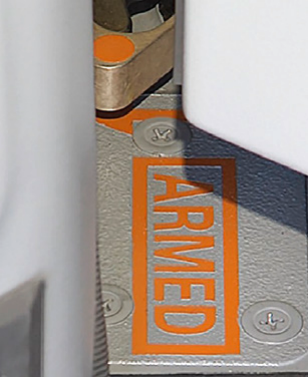
Section titled “AIRCRAFT”(fi g.3) Girt Bar Floor Indicator on A320 Family aircraft
To arm a slide, the procedure is applied in reverse; the Safety Pin is removed from its hole near the Arming Lever (PIN). The Arming Lever can then be pushed down into the armed position (LEVER). With the door armed, the pin is placed back in its stowage (PIN).
Once the arm or disarm action is complete, the principle means of confi rmation of the door condition of the door is by use of the Visual Indicator (fi g.2).
For A320 Family aircraft, Girt Bar Floor indicators at doors 1 and 4 provide an additional visual indicator to aid crew awareness of the slide’s arming condition (fi g.3). When the door is armed the indicator (orange spot) aligns with an arrow
A PRODUCT IMPROVEMENT TO PREVENT ISD
Section titled “A PRODUCT IMPROVEMENT TO PREVENT ISD”Doors on Airbus aircraft are equipped with a “SLIDE ARMED” warning light and an optional buzzer. This light and buzzer are activated when the slide is armed and someone lifts the door handle.
In order to prevent ISDs Airbus has introduced an upgraded “SLIDE ARMED” light and buzzer system, which provides a warning to operatives before they touch the handle.
This system is called the Inadvertent Slide Deployment Prevention Light (ISDPL), and is currently available for the forward and aft doors of A320 Family aircraft.
Inadvertent Slide Deployment Prevention Light (ISDPL)
Section titled “Inadvertent Slide Deployment Prevention Light (ISDPL)”ISDPL is a maintenance free plug & play replacement to the standard Slide Armed Warning Lights, which are installed under the passenger door window (fi g.4).
Compared to the standard warning light, ISDPL also includes an ultrasonic sensor to measure the proximity of personnel to the door handle, and a small loudspeaker to provide audible warnings.
(fi g.4) Example of pre and post-modifi cation ISDPL
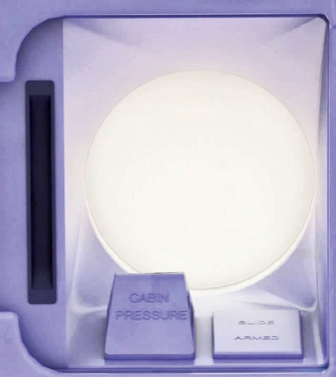
Standard Slide Armed Warning Light
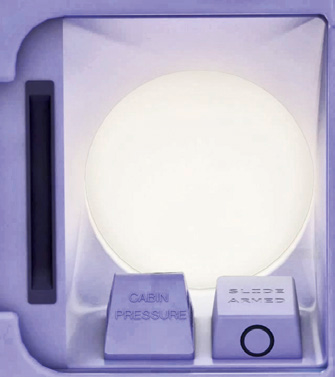
ISDPL
Safety fi rst #27 | September 2018 011
When operative, ISDPL provides both visual and audible means for reminding personnel who are operating the door that the door is armed. Both visual and acoustic alerts are triggered when three conditions are met:
-
The aircraft is powered, and on ground
-
The slide lever is in the armed position
-
A person approaches or tries to lift the door handle
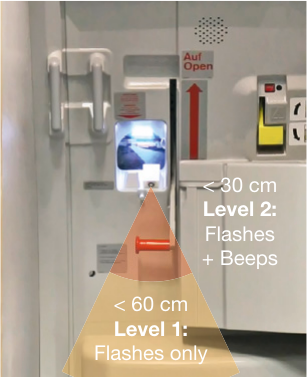
As operatives approach the door, warnings are triggered. Two different warning levels occur, depending on the person’s proximity to the ultrasonic detection device, located near the door handle (fi g.5).
When someone approaches within 60 cm of the ultrasonic detection device, the slide armed warning light fl ashes.
When someone approaches within 30 cm of the ultrasonic detection device, a second level of warning is generated by adding three short audio warnings in addition to the fl ashing light.
As with the basic “SLIDE ARMED” warning light, when someone has placed their hand in immediate proximity to the ultrasonic detection device, or moves the handle, ISDPL makes a continuous noise and the light remains on.
(fi g.5)
Section titled “(fi g.5)”The levels of warning generated by ISDPL depend on proximity to the detection sensor
The development of ISDPL has been driven primarily by Human Factors (HF) considerations. Specifi cally, the design objective has been to provide a warning that reminds operatives that the slide is armed, with the warning being provided early enough to prevent crew action.
Testing of different designs allowed Airbus to identify that this warning must be provided before operatives have touched the handle.
Full scale Human Factors tests using the visual plus audible warning concept embodied in ISDPL were conducted with 240 industry professionals from three airlines including 185 cabin crew and 23 fl ight crew. These tests successfully validated that the concept prevents operatives from opening the door when the slide is still armed.
Watch a description video of the ISDPL by scanning this QR code, or connect to safetyfi rst.airbus.com
During certifi cation of the design with the airworthiness authorities, additional Human Factors tests were performed to prove that passengers would still open the door during a real evacuation.
These tests proved that, when under evacuation conditions, the visual and audible warnings do not delay or prevent actions to open the door and deploy the escape slides.
Availability
Section titled “Availability”ISDPL is available for both line-fit and retrofit on a chargeable basis, for A320 Family aircraft. Offerability of ISDPL on other Airbus programmes is currently under review.
AIRCRAFT
Section titled “AIRCRAFT”ISD ON A321 DOORS 2 & 3
Section titled “ISD ON A321 DOORS 2 & 3”Whilst over 70% of ISDs reported to Airbus occur at Doors 1 or 4 due to action by cabin crew or pilots, a further 25% of reported cases occur on Doors 2 and 3 of A321 aircraft.
Emergency Exit Doors are installed on all A321 aircraft, except on A321neo models with Airbus Cabin Flex (ACF). On A321neo ACF aircraft, Door 3 remains an Emergency Exit door which may however be optionally deactivated.
A321 Emergency Exit doors are similar in appearance to normal passenger doors, except that the escape slides are installed in the fuselage and not a door bustle.
AMM Procedures for opening A321ceo emergency exit doors
Section titled “AMM Procedures for opening A321ceo emergency exit doors”Opening of the Emergency Exit Doors from the Inside TASK 52-22-00-010-001-A
Opening of the Emergency Exit Doors from the Outside TASK 52-22-00-010-002-A
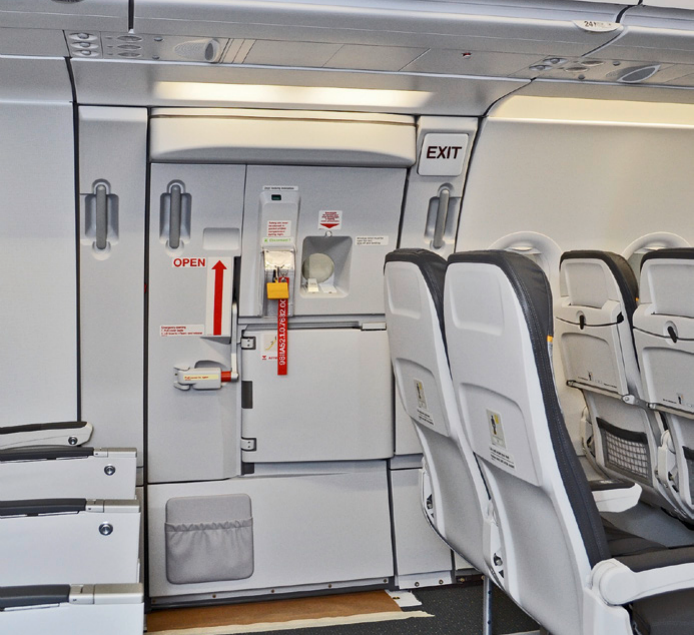
(fig.6)
Section titled “(fig.6)”Example of an A321ceo Emergency Exit Door, installed at Doors 2 and 3. Reports to Airbus indicate that 25% of ISDs on Airbus fleets occur on these doors. Reports indicate that the slides of these doors are sometimes left in the armed condition during turnaround.
Since they are emergency exits the majority of airlines do not configure them for passenger boarding/disembarkation. ISD reports to Airbus indicate that the slides of these doors are often left in the armed condition during turnaround. ISDs subsequently occur when the doors are opened by maintenance, or other operatives onboard the aircraft.
For cabin crew, Airbus SOPs for arming/disarming of the slides on these doors are the same as for Doors 1 and 4, and available in the CCOM Departure/Arrival procedures.
For maintenance staff, the procedures for slide arming or disarming of A321ceo Door 2 and 3 can be found in the AMM in chapter 52-22. Operators can communicate these procedures to any subcontracting organization which will need to open the doors, including catering or cleaning suppliers.
来源:Airbus Safety First URL:https://safetyfirst.airbus.com/preventing-inadvertent-slide-deployments/ 发布日期:2018-09-21 分类:客舱运营、飞行运营、地面运营、维修、预位、客舱、解除预位、舱门、舱门、逃生滑梯、意外滑梯展开、ISD、ISDPL、滑梯、监控定时器 PDF:原始 PDF
飞机 防止意外滑梯展开
007
意外滑梯展开
Section titled “意外滑梯展开”ISD 及其影响
Section titled “ISD 及其影响”飞机逃生滑梯是一项重要的安全设备。其设计要求在最长十秒内完全展开并充气,是确保在紧急情况下人员安全撤离飞机的高效手段。
然而,同样的激活速度和效率也意味着,当任何操作舱门的人员意外触发滑梯时,根本没有时间阻止其展开。
根据 IATA 定义,意外滑梯展开(ISD)是指“飞机应急撤离滑梯或滑梯筏的非故意展开(全展或半展)”。
意外滑梯展开是指飞机应急撤离滑梯或滑梯筏的非故意展开(全展或半展)。
ISD 发生在操作人员在正常运营情况下(如航后过站时)尝试打开舱门,而此时滑梯处于预位状态的情况下。
一旦发生 ISD,可能会对客舱内或飞机外的工作人员造成严重伤害。ISD 还会造成经济损失和运营中断。
据估算,涉及延误地面停留 90 分钟的事件最低成本约为 11,000 美元。若 ISD 导致航班取消且需要为旅客安排酒店住宿,成本可能高达 200,000 美元。
ISD 原因
Section titled “ISD 原因”空客持续监测来自在役运营的 ISD 报告,并对每一起报告进行调查以了解原因。每年报告给空客的案例数量相当稳定,为 35-45 起。
对 2017 年空客机队 ISD 发生位置的调查表明,大多数发生在前左舱门和后舱门,因为这些舱门在登机和装卸作业中使用更为频繁。
对 ISD 影响因素的研究结果。来源:IATA 客舱运营安全会议 2014。
IATA 在 2014 年至 2015 年期间对 47 家航空公司进行的调查显示,在报告的 ISD 中最常被提及的职业群体是客舱乘务员。地面人员、维修人员、飞行机组和旅客在 ISD 报告中被提及的频率均较低。
导致 ISD 的因素
Section titled “导致 ISD 的因素”
在 2017 年 IATA 客舱运营安全会议上发表的一项先前研究中,确定了导致 ISD 的多项影响因素,如**(图 1)**所示。标准操作程序未遵守和分心被确定为主要因素。
在提供给空客的报告中,这些因素同样显而易见,同时还有相关信息说明与报告相关的人为因素要素。
可以识别出的问题包括:机组疲劳、旅客在客舱内移动造成的分心、以及航后过站作业的时间压力。
其他因素包括:机组人员之间沟通/协调不畅,以及当客舱乘务员在配备不同舱门设计的各种机型上执飞时所面临的复杂性。
ISD 报告内容示例:
Section titled “ISD 报告内容示例:”“机长在廊桥处意外展开了 1R 舱门的滑梯,当时他打开舱门向外看时,舱门仍处于预位状态。”
“在短暂过站期间,配餐人员以预位状态打开了 1R 舱门,逃生滑梯展开。”
“在前舱门处,不小心拉动了舱门操作手柄而非舱门解除预位手柄。”
Safety First #27 | 2018 年 9 月 009
舱门开启操作规范
Section titled “舱门开启操作规范”客舱乘务员标准操作程序(SOP)
Section titled “客舱乘务员标准操作程序(SOP)”各航空公司对 SOP 的定义是一个需要考虑航空公司特定因素的过程,包括在不同制造商飞机混合机队运营中的程序标准化、当地适航当局的规章、各机场地面代理公司的作业规范等。
因此,确定其自身 SOP 中哪些人员执行哪些操作以及何时执行,是航空公司的责任。然而,在所有情况下,预位和解除预位滑梯的程序都包含三个阶段:指令、动作(预位或解除预位)和确认(交叉检查)。
在空客飞机上执行这三个阶段时,标准操作程序可以考虑到空客滑梯的设计特点,其中包括安全销。按照 SOP 使用时,安全销可防止预位手柄被意外移动至预位状态。
空客 PIN-LEVER-PIN 模型
Section titled “空客 PIN-LEVER-PIN 模型”一旦发出了预位或解除预位滑梯的指令,客舱乘务员可以使用“PIN-LEVER-PIN”这一心理模型,以确保正确执行 SOP 中与预位或解除预位相关的步骤。
-
A[ 目视指示器显示 ]
预位状态 -
B[ 预位手柄处于 ]
预位位置
C 安全销存放于存放位
D 安全销已安装
-
E[ 目视指示器显示 ]
解除预位状态 -
F[ 预位手柄处于 ]
解除预位位置
解除舱门滑梯预位的第一步是从舱门上的存放位取下安全销(PIN)。然后将预位手柄置于解除预位位置(LEVER)。最后,将安全销插入预位手柄附近专用孔中(PIN)。此后,手柄将无法被意外地从解除预位位置移动至预位位置。
(图 3) A320 系列飞机上的挂接杆地板指示器
预位滑梯时,按相反顺序执行操作:从预位手柄附近的孔中拔出安全销(PIN)。然后可将预位手柄推至预位位置(LEVER)。舱门预位后,将安全销放回存放位(PIN)。
预位或解除预位操作完成后,确认舱门状态的主要手段是使用目视指示器 (图 2)。
对于 A320 系列飞机,1 号和 4 号舱门处的挂接杆地板指示器提供了额外的目视提示,以帮助乘务员了解滑梯的预位状态 (图 3)。 当舱门处于预位状态时,指示器(橙色圆点)与箭头对齐
防止 ISD 的产品改进
Section titled “防止 ISD 的产品改进”空客飞机舱门配备了“滑梯预位”警告灯和可选蜂鸣器。当滑梯处于预位状态且有人抬起舱门手柄时,该灯和蜂鸣器会被激活。
为了防止 ISD,空客推出了升级版的“滑梯预位”灯光和蜂鸣器系统,可在操作人员触碰手柄之前提供警告。
该系统称为意外滑梯展开预防灯(ISDPL),目前可用于 A320 系列飞机的前舱门和后舱门。
意外滑梯展开预防灯(ISDPL)
Section titled “意外滑梯展开预防灯(ISDPL)”ISDPL 是一种免维护的即插即用替代产品,替代安装在旅客舱门舷窗下方的标准滑梯预位警告灯 (图 4)。
与标准警告灯相比,ISDPL 还包含一个超声波传感器,用于测量人员与舱门手柄的接近程度,以及一个小扬声器,用于提供声音警告。
(图 4) ISDPL 改装前后示例
标准滑梯预位警告灯
ISDPL
Safety first #27 | 2018 年 9 月 011
ISDPL 运行时,可通过视觉和声音两种方式提醒正在操作舱门的人员该舱门已预位。当以下三个条件同时满足时,视觉和声音警报均会被触发:
-
飞机已通电,且停在地面
-
滑梯手柄处于预位位置
-
有人接近或试图抬起舱门手柄
当操作人员接近舱门时,警告即被触发。根据人员与位于舱门手柄附近的超声波探测装置的距离,会产生两个不同级别的警告 (图 5)。
当有人进入超声波探测装置 60 厘米范围内时,滑梯预位警告灯开始闪烁。
当有人进入超声波探测装置 30 厘米范围内时,在闪烁灯光的基础上增加三级短促声音警告,形成第二级警告。
与基本型“滑梯预位”警告灯一样,当有人将手放置在超声波探测装置的紧邻位置,或移动手柄时,ISDPL 会发出持续声响,警告灯保持常亮。
ISDPL 产生的警告级别取决于与探测传感器的距离
ISDPL 的开发主要由人为因素(HF)考量驱动。具体而言,设计目标是提供一种警告,在滑梯预位状态下提醒操作人员,并且在操作人员触碰手柄之前足够早地发出警告,以便预防操作人员的开舱门动作。
通过对不同设计的测试,空客确认该警告必须在操作人员触碰手柄之前发出。
使用 ISDPL 所体现的视觉加声音警告概念,进行了全尺度人为因素测试,测试对象为来自三家航空公司的 240 名行业专业人员,其中包括 185 名客舱乘务员和 23 名飞行机组人员。这些测试成功验证了该概念能够防止操作人员在滑梯仍处于预位状态时打开舱门。
扫描此二维码观看 ISDPL 介绍视频,或访问 safetyfirst.airbus.com
在向适航当局申请设计认证期间,进行了额外的人为因素测试,以证明乘客在真实疏散情况下仍能打开舱门。
这些测试证明,在疏散条件下,视觉和声音警告不会延迟或阻止打开舱门和展开逃生滑梯的动作。
ISDPL 可通过有偿方式作为生产线安装或改装件供货,适用于 A320 系列飞机。ISDPL 在其他空客项目上的供货状态目前正在评估中。
A321 2号和3号舱门的 ISD
Section titled “A321 2号和3号舱门的 ISD”尽管空中客车收到的 ISD 报告中,超过 70% 发生在 1 号或 4 号舱门(由客舱乘务员或飞行员操作导致),但另有 25% 的报告案例发生在 A321 飞机的 2 号和 3 号舱门。
所有 A321 飞机均安装紧急出口舱门,A321neo 配备空客客舱灵活布局(ACF)的型号除外。在 A321neo ACF 飞机上,3 号舱门仍为紧急出口舱门,但可选择性地停用。
A321 紧急出口舱门外观与普通乘客舱门相似,区别在于逃生滑梯安装在机身内,而非舱门裙部。
A321ceo 紧急出口舱门打开的 AMM 程序
Section titled “A321ceo 紧急出口舱门打开的 AMM 程序”从内部打开紧急出口舱门 任务 52-22-00-010-001-A
从外部打开紧急出口舱门 任务 52-22-00-010-002-A
安装在 2 号和 3 号舱门位置的 A321ceo 紧急出口舱门示例。报告给空中客车的数据显示,空中客车机队中 25% 的 ISD 发生在这些舱门。报告显示,这些舱门的滑梯有时在过站期间保持待用状态。
由于这些是紧急出口,大多数航空公司不将其配置用于乘客登机/下机。报告给空中客车的 ISD 数据显示,这些舱门的滑梯在过站期间经常保持待用状态。当维修人员或机上其他工作人员打开舱门时,会随后发生 ISD。
对于客舱乘务员,空客关于这些舱门滑梯待用/解除待用的 SOP 与 1 号和 4 号舱门相同,可在 CCOM 离港/进港程序中查阅。
对于维修人员,A321ceo 2 号和 3 号舱门滑梯待用或解除待用的程序可在 AMM 第 52-22 章中找到。运营商可将这些程序传达给任何需要打开舱门的分包组织,包括配餐或清洁供应商。