Proper Landing Gear Servicing for Safe Operations
Source: Airbus Safety First URL: https://safetyfirst.airbus.com/proper-landing-gear-servicing-for-safe-operations/ Published: 2022-12-16 Category: Maintenance, gear, jacks, L/G, shock absorber PDF: Original PDF

Proper servicing of landing gear is obviously important to ensure proper landing gear operations during takeoff and landing. It is equally important to ensure proper retraction and extension to prevent potential interference with other aircraft systems in the case of abnormal landing gear conditions.
If the landing gear servicing tasks are not properly performed, issues can occur such as struts seized in a retracted position and strong vibrations that can affect the function of avionics equipment.
This article provides a description of best practices that maintenance crew can apply when performing the landing gear servicing tasks, with a focus on the shock absorber and the importance of regular lubrication.
This article is also available on safetyfrst.airbus.com and on the Safety first app for iOS and Android devices.
CASE STUDY
Section titled “CASE STUDY”Event Description
Section titled “Event Description”Ten minutes after takeoff, passing FL340, the flight crew of an A319 lost the autopilot (AP) and the autothrust (ATHR). The AUTO FLT AP OFF, AUTO FLT A/THR OFF and ENG THRUST LOCKED ECAM alerts were triggered. The Flight Directors (FDs) were no longer displayed on the PFD. The NAV FM/GPS POS DISAGREE ECAM alert was briefly triggered twice, but this was not seen by the flight crew. The flight crew managed to re-engage the AP and the ATHR 5 minutes later. The flight crew noticed abnormal IRS positions on the MCDU position monitor page. They decided to continue the flight with the support of ATC to assist them with determining their position.
During the ILS approach, the AP and ATHR disconnected again at 4000 ft. The flight crew discontinued the approach. They decided to perform a manual approach using only radio navigation aids and they safely landed the aircraft.
Event Analysis
Section titled “Event Analysis”Severe IRS drift
Section titled “Severe IRS drift”Recorder data analysis showed that the AP and ATHR disconnected due to severe drift of the 3 IRS. The first IRS was rejected by the Auto Flight System (AFS) during the climb and the AFS: ADIRU 1/2/3 DISAGREE PFR maintenance message was triggered with no operational impact. A discrepancy between the 2 remaining IRS in the following few minutes led to the rejection of both IRS and to the loss of the AP and ATHR. This triggered the AUTO FLT AP OFF and AUTO FLT A/THR OFF ECAM alerts. The IRS drift then decreased and remained stable during the flight, but it increased again during approach, causing the second loss of AP and ATHR.
Effects of the high vibrations
Section titled “Effects of the high vibrations”The IRS drift started during the takeoff roll. The analysis showed that the root cause was abnormal shocks and high vibrations transmitted to the 3 Air Data Inertial Reference Units (ADIRUs) by the Nose Landing Gear (NLG) during the takeoff roll. This forced the IRS to operate outside of its qualification envelope and it caused the IRS drift condition.
Effects of incorrect shock absorber servicing
Section titled “Effects of incorrect shock absorber servicing”The NLG shock absorber was overinflated during its last service. This made the shock absorber stiffer and reduced its ability to absorb impacts and vibrations. The vibrations experienced during this event were transmitted through the shock absorber to the aircraft structure. The A320 family aircraft ADIRUs are installed in the avionics bay aft of the NLG bay, and they were affected by the excessive vibrations and shocks during the takeoff roll on this flight.
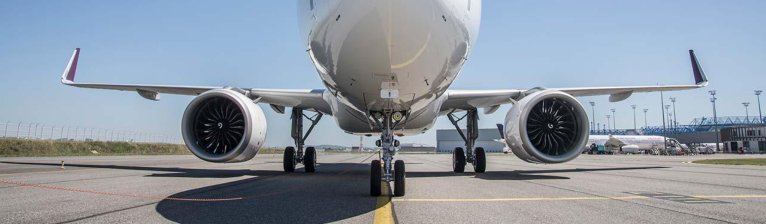
The “In flight severe IR drift with ADIRU inducing possible loss of AP/FD and ATHR” Technical Follow-Up (TFU 34.12.00.003) is available on AirbusWorld , which describes the root cause and the mitigation actions. It recommends performing the “Vibrations felt on the NLG during Takeoff and Lift-off phases” TroubleShooting Manual (TSM) task that focuses more on the NLG shock absorber servicing maintenance task than on the more usual wheels and tires inspections that are also part of this TSM task.
SHOCK ABSORBER SERVICING
Section titled “SHOCK ABSORBER SERVICING”Landing Gear shock absorbers on all Airbus aircraft are oleo-pneumatic shock absorbers, which means they use both oil (hydraulic fluid) and gas (nitrogen) to absorb and dissipate the shocks during taxi, takeoff, and landing. The Maintenance Planning Document (MPD) requires regular checks of nitrogen pressure and the quantity of hydraulic fluid in each shock absorber. The shock absorber servicing tasks must be performed if this is out of tolerance and the hydraulic fluid quantity or nitrogen pressure adjusted in accordance with the Airbus AMP/AMM/MP maintenance procedures.
The In-Service Information (ISI) article 32.21.00002 is available on AirbusWorld and describes best practices and the challenges of the NLG shock absorber servicing for the A320 Family aircraft.
Incorrect shock absorber servicing can have serious consequences
Section titled “Incorrect shock absorber servicing can have serious consequences”The aim of the shock absorber servicing task is to ensure that the shock absorber has the correct gas pressure and quantity of hydraulic fluid to provide optimal shock absorption. Incorrect servicing of the shock absorber can have the following consequences:
-
If the shock absorber is too stiff, the vibrations can propagate to the aircraft structure.
-
If the shock absorber is too soft, the shocks can damage parts of the landing gear and the structure where the gear is attached to the airframe.
-
● The NLG wheels may rotate during the retraction or turn in the NLG bay, which will prevent deployment of the NLG.
-
Faults and ECAM alerts, for example, L/G SHOCK ABSORBER FAULT, can be triggered during flight leading to operational situations, such as the loss of certain avionics functions or conditions requiring an in-flight turn back.
A video of A330/A340 NLG shock absorber servicing is available to illustrate the different steps of the servicing procedure. This video is for information only. The Airbus AMM procedures always prevail.
Checking and Adjusting the Nitrogen Gas Pressure
Section titled “Checking and Adjusting the Nitrogen Gas Pressure”Checking and adjusting the gas pressure in the shock absorber can be done with aircraft either on jacks or on wheels.
Waiting time before checking the pressure
Section titled “Waiting time before checking the pressure”It is important to wait for a minimum time period after the last operation of the aircraft to ensure that an accurate measure of the gas pressure in the shock absorber is taken. As an example, the recommendation for the A320 fleet is to wait for at least 2 hours after the last aircraft operation. There are two main reasons for this:
● Effect of the temperature
Section titled “● Effect of the temperature”The pressure of the nitrogen will vary with the temperature of the shock absorber. During cruise, the landing gear bay is at a very low temperature. However, the fast compression of the shock absorber during landing followed by the multiple and quick landing gear movements on ground may quickly increase the temperature of the shock absorber and it will take time with the aircraft on the ground for the temperature to stabilize.
● Emulsion effect
Section titled “● Emulsion effect”The shock absorbers fitted on the Airbus fleet contain both gas and liquid in direct contact. During landing, an emulsion or mix of gas and fluid is created where the gas and fluid are in contact. This emulsion will affect the pressure level and the temperature of the shock absorber. It will take time with the aircraft stationary on the ground for the gas and oil to separate, and the temperature to stabilize before any check for correct hydraulic fluid levels and nitrogen gas pressure can be made.
Measuring the shock absorber extension and temperature
Section titled “Measuring the shock absorber extension and temperature”To assess the shock absorber charge pressure, it is necessary to measure the shock absorber extension (dimension ‘H’ refer (fig.1) ) and the shock absorber temperature. The AMP/AMM/MP procedures provide tables and graphs that provide the correct value of the dimension ‘H’ relative to the temperature and the pressure. A placard with these graphs is also fitted on the landing gears as a quick reference during the task.
(fig.1) shock absorber extension (dimension ‘H’)
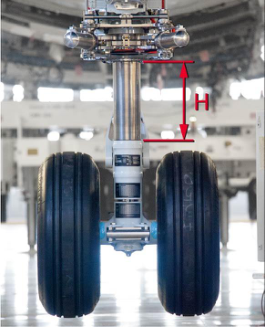
Use the shock absorber temperature, and not the ambient air temperature to know the correct charge pressure of the shock absorber. Using the wrong temperature value can significantly affect the servicing.
Adjusting the nitrogen quantity
Section titled “Adjusting the nitrogen quantity”Depending on the pressure value, the quantity of nitrogen may need to be adjusted. On A220, A320, and A350 Family aircraft, the procedure intentionally overestimates the quantity of nitrogen. This is to take into account the dissolution of the nitrogen in the hydraulic fluid. That will lead to a decrease of the H dimension in the days following the nitrogen servicing until it stabilizes.
Gas Dissolution
Section titled “Gas Dissolution”When a gas is compressed, its molecules will more easily find their way through the fluid that it is in contact with. Gas molecules will pass from the gas chamber inside the fluid (fig.2) :
-
When the shock absorber is fully extended, this will cause a decrease in the pressure of the gas
-
● When the aircraft is on the ground, this will decrease the H dimension.
The gas dissolution effect is more perceivable on A220, A320, and A350 aircraft.
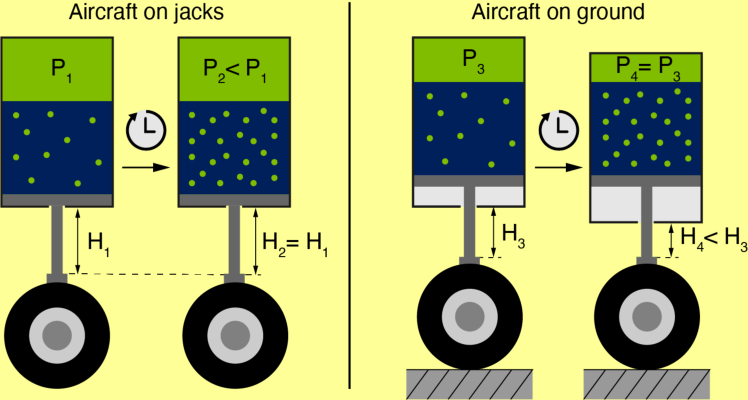
(fig.2) Effects of gas dissolution
The challenge of the “stiction”
Section titled “The challenge of the “stiction””“Stiction” is when the sliding cylinder in the shock absorber can “stick” due to the “friction” with the shock absorber housing when performing the servicing task with the weight-on-wheels. This can cause the “H” dimension to suddenly increase when the cylinder overcomes the “stiction” effect. This means that the H dimension may not slowly and continuously move during the nitrogen pressure adjustment task, which can cause the value of the H dimension to vary for a given pressure and can lead to incorrect servicing. To avoid this, it is preferable to perform this task with the aircraft on jacks when possible.
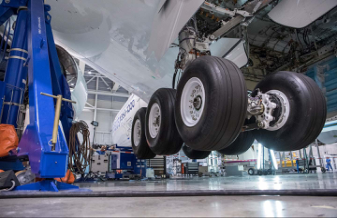
Due to the challenge of “stiction”, it is recommended to perform this servicing task with aircraft on jacks to alleviate the loads acting on the landing gear. This will ensure accurate and efficient servicing of the shock absorber pressure.
Before the introduction of the A350 aircraft, one pressure value at a given temperature was associated with a single ‘H’ value. Since the introduction of the A350 aircraft, a pressure value at a given temperature is now associated with a range (or min. and max. value) for the measurement of dimension ‘H’. The objective is to avoid any risk of bottoming (mechanical contact due to underinflation) and the performance of unnecessary pressure adjustments. This is being implemented for all other Airbus aircraft.
Shock Absorber Hydraulic Fluid Replenishment
Section titled “Shock Absorber Hydraulic Fluid Replenishment”This procedure can either be done with aircraft on jacks or the aircraft weight on wheels with the exception of the NLG of A330/A340 aircraft and NLG/MLG of A350 aircraft, for which the procedure is only possible with aircraft on jacks. The check and adjustment of the hydraulic fluid level has a direct impact on the gas pressure, and therefore an adjustment of the nitrogen quantity is also necessary.
Waiting time before checking the fluid level
Section titled “Waiting time before checking the fluid level”It is important to wait for a minimum time period after the last operation of the aircraft to ensure an accurate measure is taken of the fluid level in the shock absorber. As an example, the recommendation for the A320 fleet is to wait for at least 2 hours after the last aircraft operation. The reason for this is due to the “emulsion effect”, as described above.
The shock absorber needs to be deflated to check the fluid level. If the task is performed too soon after the last aircraft operation, there will still be nitrogen gas emulsified in the hydraulic fluid of the shock absorber. Rapid depressurization will cause emulsion bubbles to be ejected, which may be an injury risk for the maintenance crew performing the task. This will also cause a loss of hydraulic fluid and hydraulic fluid replenishment will be necessary.
Deflate and compress
Section titled “Deflate and compress”The shock absorber needs to be fully deflated to check the hydraulic fluid quantity. Opening the charging valve as slowly as possible will prevent too much fluid loss. After deflation is complete, the shock absorber will then be compressed to observe if hydraulic fluid is released from the charging valve. If no fluid is released, then the level is low and the hydraulic fluid level must be adjusted in accordance with the Airbus AMP/AMM/MP maintenance procedures.
Refill, compress and repeat
Section titled “Refill, compress and repeat”After refilling the shock absorber with hydraulic fluid, it is compressed to check the quantity. There is likely to be foam in the hydraulic fluid released from the shock absorber (fig.3). More hydraulic fluid needs to be added and the shock absorber compressed again, repeating these steps until there is no more foam released (fig.4). It is harder to inject hydraulic fluid into the shock absorber with the aircraft weight on wheels, and it is more likely to produce foam in the fluid, making the procedure more difficult to perform.
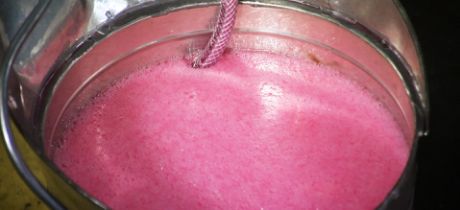
(fig.3) Foam noticed while compressing the shock absorber. Hydraulic fluid needs to be added again.
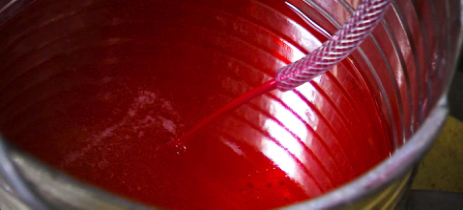
(fig.4) No foam noticed while compressing the shock absorber.
The best way to perform accurate full servicing (hydraulic fluid level and nitrogen gas pressure check) of the shock absorber is with the aircraft on jacks to ensure the optimum hydraulic fluid quantity and pressure.
Extract the nitrogen from the hydraulic fluid
Section titled “Extract the nitrogen from the hydraulic fluid”After refilling the shock absorber, the nitrogen needs to be extracted from the mix of new hydraulic fluid with older fluid, which will contain dissolved nitrogen molecules due to the gas dissolution effect. This is done on A220, A320 Family, and A350 aircraft to ensure that the shock absorber is serviced with the correct nitrogen gas pressure. This can only be done with the aircraft on jacks. The pressure valve is slowly opened and the shock absorber is fully compressed. The pressure valve is then closed and the shock absorber can extend under its own weight. This creates a vacuum effect that will draw the nitrogen gas molecules out of the hydraulic fluid. This step can take several minutes depending on the size of the shock absorber (e.g. 30 minutes for A320 Family aircraft, 60 minutes for A220 aircraft, and 90 minutes for A350 aircraft).
Adjust the nitrogen quantity
Section titled “Adjust the nitrogen quantity”The shock absorber is inflated with the necessary quantity of nitrogen mentioned in the procedure. For A220, A320 Family, and A350 aircraft, this quantity takes into account the nitrogen dissolution that will occur in the days after the servicing and the consequent decrease of the H dimension before it stabilizes.
Performing the procedure weight on wheels is possible with constraints
Section titled “Performing the procedure weight on wheels is possible with constraints”For the NLG/MLG of the A220 aircraft and for the NLG of the A320 Family aircraft, it is possible to perform the hydraulic replenishment procedure with weight on wheels. However, this will mean that extraction of the nitrogen from the hydraulic fluid step cannot be performed, and it will make it more difficult to define a precise pressure. Therefore, full servicing (hydraulic fluid and nitrogen gas) is required with aircraft on jacks in the following days on A220 aircraft. For A320 Family aircraft, the nitrogen quantity needs to be checked again, either with aircraft on jacks or with aircraft weight on wheels in both light and heavy load configurations.
Automatic Shock Absorber Servicing Solution:
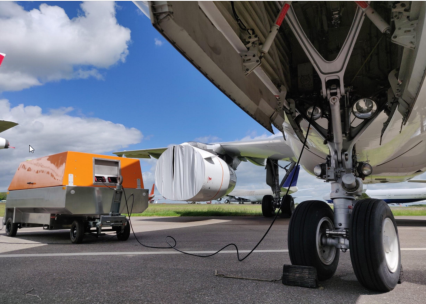
Section titled “Automatic Shock Absorber Servicing Solution:”The Liquid And Nitrogen Charging Equipment (LANCE) tool is being developed to provide Airbus Operators with a precise way to perform shock absorber servicing (for both NLG and MLG) with aircraft weight on wheels. The tool has a cart that automatically ensures that the hydraulic fluid level in the shock absorber is correct and replenished with the exact mass of nitrogen that is required based on the servicing temperature . This solution is currently for use on A320 family and A350 aircraft and is being assessed to check its feasibility on other aircraft types.
LANDING GEAR LUBRICATION
Section titled “LANDING GEAR LUBRICATION”Lubrication of landing gear at regular intervals protects the joints and moving parts from excessive wear and corrosion. The lubricating grease will attract and contain contaminants and particles. Regular replacement with new grease will remove the contaminated grease before the particles and contaminants trapped can cause abrasion or corrosion. This will prevent wear at the joints and moving parts that could lead to excessive vibrations or even failure to correctly extend or retract in operations.
Even during long periods of parking and storage, lubrication must be continuously performed according to the MPD to prevent any jamming of the landing gear during extension and retraction.
Depending on the environmental conditions in which the aircraft is operated such as a sandy environment, it may be necessary to lubricate the landing gear at more frequent intervals than specified in the MPD for contaminated grease to be regularly renewed. Refer to the recommendation to lubricate at a higher frequency in TFU 32.11.13.024.
Injecting the Right Quantity of Grease
Section titled “Injecting the Right Quantity of Grease”The grease is injected through the “grease nipples”, using an electrical or manual grease pump. Fresh grease must be seen coming out of the dedicated “witnesses” hole or from the part that is being lubricated (fig.5).
For certain lubrication points, the fresh grease will not be visible coming out of the part. In that case, the maintenance procedure specifies the number of injections to be performed using only a manual grease pump. For greasers without witnesses, even if no fresh grease is visible after the specified number of grease
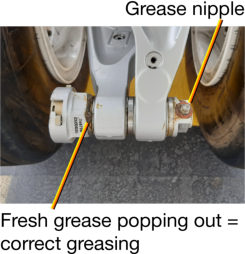
(fig.5) Example of correct greasing
injections, no additional injection needs to be performed as this may lead to deterioration of the part.
Excess grease can cause malfunctions
Section titled “Excess grease can cause malfunctions”On A320 aircraft, for example, the main landing gear uplock hook needs to be lubricated, but it has no “witness” for the maintenance crew to indicate that the correct quantity of grease was injected. Therefore, cases of excessive quantities of grease occurred, which led to the malfunction of the uplock hook and the triggering of the L/G NOT UPLOCKED ECAM alert for the flight crew with associated operational consequences.
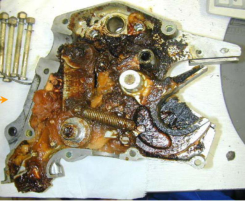
(fig.6) MLG uplock hook malfunction due to excess of grease
Contributors :
Section titled “Contributors :”Frédéric BOUCHER Engineering Specialist A220 Design Office
Cédric DESCHEEMAEKER Director Product Safety Enhancement Product Safety
Benoît DUQUESNE Expert Operations ADIRS Customer Support
Jean-Marc LACANETTE Landing Gear Systems Senior Engineer Customer Support
Jordane SOULA-OUDOT Incident/Accident Investigator Product Safety
François-Xavier TARDI Expert Operations Landing Gear Customer Support
Laurent TIZAC Landing Gear Mechanical Design Expert Design Office
Landing gear servicing tasks include servicing of shock absorbers and lubrication of landing gears. To ensure optimal performance of the landing gear in operation, scheduled maintenance should be performed as defined in the MPD, and Airbus maintenance procedures and best practices should be applied.
Shock absorber servicing should ensure that it contains the correct nitrogen gas pressure and quantity of hydraulic fluid for the optimal absorption of the shocks during taxi, takeoff, and landing. Incorrect servicing can lead to a number of outcomes that may require more regular and costly maintenance, affect operational efficiency, and even have consequences on safety.
The shock absorber servicing procedure must be applied as described in the Airbus aircraft maintenance manuals. The best way to perform precise shock absorber servicing is with aircraft on jacks. Even if there is still the option to perform servicing with weight on wheels on some aircraft, it can be more difficult to charge the shock absorber with the correct nitrogen gas pressure when using this method. For example, it will be necessary to perform an additional check a few days after servicing the A320 NLG shock absorber with weight on wheels by putting the aircraft on jacks or performing a check with the aircraft in both light and heavy load configurations.
The landing gears must also be regularly lubricated to ensure they are functioning correctly. Too little or too much grease can lead to malfunction of the landing gear, which could have serious consequences.
With thanks to Paula ARTEAGA URIBE from Ground Support Equipment
Safety first, 2022. Safety first is published by Airbus S.A.S. 1, rond point Maurice Bellonte - 31707 Blagnac Cedex/France.
Editor: Yannick Malinge, Chief Product Safety Officer.
Editorial team: Guillaume Estragnat, Vanessa Sadi, Gwyneth Duggan, Tim Roach.
- Reference: X00D16031905.
Photos & illustrations by Airbus.
来源:Airbus Safety First 网址:https://safetyfirst.airbus.com/proper-landing-gear-servicing-for-safe-operations/ 发布日期:2022-12-16 类别:维护、起落架、千斤顶、L/G、减震器 PDF:原始 PDF
正确维护起落架对于确保起飞和着陆过程中的正常起落架操作显然至关重要。同样重要的是确保正常收放,以防在起落架出现异常情况时对其他飞机系统造成潜在干扰。
如果起落架维护任务未正确执行,可能会出现问题,如活塞杆卡阻在收上位置,以及可能影响航电设备功能的强烈振动。
本文描述了维修人员执行起落架维护任务时可采用的最佳实践,重点介绍减震器和定期润滑的重要性。
本文也可在 safetyfirst.airbus.com 和 iOS 和 Android 设备上的 Safety First 应用中获取。
一架 A319 起飞十分钟后穿越 FL340 时,飞行机组失去了自动驾驶仪(AP)和自动推力(ATHR)。触发了 AUTO FLT AP OFF、AUTO FLT A/THR OFF 和 ENG THRUST LOCKED ECAM 警告。飞行指引仪(FDs)在 PFD 上不再显示。NAV FM/GPS POS DISAGREE ECAM 警告短暂触发了两次,但机组未注意到。5 分钟后,机组成功重新接通了 AP 和 ATHR。机组注意到 MCDU 位置监控页面上的 IRS 位置异常。他们决定在 ATC 的协助下继续飞行以确定位置。
在 ILS 进近过程中,AP 和 ATHR 在 4000 ft 高度再次断开。机组中断了进近。他们决定仅使用无线电导航设备执行手动进近,并安全着陆。
严重的 IRS 漂移
Section titled “严重的 IRS 漂移”记录器数据分析表明,AP 和 ATHR 断开是由于 3 个 IRS 严重漂移造成的。第一个 IRS 在爬升过程中被自动飞行系统(AFS)拒绝,并触发了 AFS: ADIRU 1/2/3 DISAGREE PFR 维护信息,无运行影响。在随后几分钟内,剩余 2 个 IRS 之间存在差异,导致两个 IRS 均被拒绝,并造成了 AP 和 ATHR 的失效。这触发了 AUTO FLT AP OFF 和 AUTO FLT A/THR OFF ECAM 警告。IRS 漂移随后减小并在飞行过程中保持稳定,但在进近过程中再次增大,导致第二次 AP 和 ATHR 失效。
高振动的影响
Section titled “高振动的影响”IRS 漂移在起飞滑跑期间开始。分析表明,根本原因是前起落架(NLG)在起飞滑跑过程中向 3 个大气数据惯性基准组件(ADIRUs)传输了异常冲击和高振动。这迫使 IRS 在其鉴定包线外工作,并导致了 IRS 漂移状况。
减震器维护不当的影响
Section titled “减震器维护不当的影响”前起落架减震器在上一次维护时充气过量。这使得减震器变硬,减少了其吸收冲击和振动的能力。本次事件中经历的振动通过减震器传递到飞机结构。A320 系列飞机的 ADIRUs 安装在前起落架舱后部的电子舱中,在本次飞行起飞滑跑期间受到过度振动和冲击的影响。
“在起飞和离地阶段前起落架感受到振动的严重 IR 漂移导致可能的 AP/FD 和 ATHR 失效”技术跟踪(TFU 34.12.00.003)可在 AirbusWorld 上获取,其中描述了根本原因和缓解措施。该文件建议执行“起飞和离地阶段前起落架感受到振动”故障排除手册(TSM)任务,该任务更侧重于前起落架减震器维护任务,而不是该 TSM 任务中通常涉及的轮子和轮胎检查。
减震支柱维护
Section titled “减震支柱维护”空客所有飞机的起落架减震支柱均为油气式减震支柱,即在滑行、起飞和着陆过程中使用液压油(液压油)和氮气(气体)共同吸收和消散冲击载荷。维护计划文件(MPD)要求定期检查每个减震支柱的氮气压力和液压油量。如果超出公差范围,必须执行减震支柱维护工作,并按照空客AMP/AMM/MP维护程序调整液压油量或氮气压力。
在_AirbusWorld_上提供了《在役信息》(ISI)文章32.21.00002,介绍了A320系列飞机前起落架减震支柱维护的最佳实践和挑战。
减震支柱维护不当可能造成严重后果
Section titled “减震支柱维护不当可能造成严重后果”减震支柱维护的目的是确保减震支柱具有正确的气体压力和液压油量,以提供最佳的减震效果。减震支柱维护不当可能导致以下后果:
- 如果减震支柱过硬,振动会传播到飞机结构。
- 如果减震支柱过软,冲击可能损坏起落架部件和起落架与机身连接处的结构。
- 前起落架(NLG)轮子可能在收起过程中转动或在NLG舱内移动,这将阻止NLG放下。
- 在飞行中可能触发故障和ECAM警告,例如L/G SHOCK ABSORBER FAULT(起落架减震支柱故障),导致运行情况,例如某些航电功能失效或需要返航的条件。
提供了A330/A340前起落架减震支柱维护视频,用于说明维护程序的不同步骤。此视频仅供参考。空客AMM程序始终优先。
检查和调节氮气压力
Section titled “检查和调节氮气压力”可在飞机处于千斤顶或机轮状态下检查和调节减震支柱的气体压力。
检查压力前的等待时间
Section titled “检查压力前的等待时间”在飞机最后一次操作后必须等待最短时间,以确保获得减震支柱内氮气压力的准确测量值。例如,A320机队的建议是在最后一次飞机操作后至少等待2小时。有两个主要原因:
氮气压力会随减震支柱温度变化。在巡航期间,起落架舱处于非常低的温度。然而,着陆时减震支柱的快速压缩,随后在地面上的多次快速起落架移动,可能迅速升高减震支柱的温度,飞机在地面需要时间来使温度稳定。
空客机队安装的减震支柱内气体和液体直接接触。在着陆过程中,气体和液体接触处会产生乳化或混合状态。这种乳化状态会影响减震支柱的压力和温度。飞机在地面静止时,需要时间让气体和油液分离,以及温度稳定,才能进行正确的液压油量和氮气压力检查。
测量减震支柱伸长量和温度
Section titled “测量减震支柱伸长量和温度”为了评估减震支柱充气压力,必须测量减震支柱伸长量(尺寸“H”,参见图1)和减震支柱温度。AMP/AMM/MP程序提供了表格和图表,根据温度和压力给出尺寸“H”的正确值。起落架上也装有这些图表的标牌,作为执行该工作时快速参考。
(图1) 减震支柱伸长量(尺寸“H”)
应使用减震支柱温度,而不是环境气温来确定减震支柱的正确充气压力。使用错误的温度值会严重影响维护结果。
根据压力值,可能需要调节氮气量。在A220、A320和A350系列飞机上,程序有意高估了氮气量。这是考虑到氮气在液压油中的溶解。这将导致在氮气维护后的几天内尺寸H减小,直到稳定。
当气体被压缩时,其分子更容易透过与其接触的液体。气体分子会从气体腔进入液体内部**(图2)**:
- 当减震支柱完全伸长时,这会导致气体压力下降
- 当飞机在地面时,这会导致H值减小。
气体溶解效应在A220、A320和A350飞机上更为明显。
(图2) 气体溶解效应
“静摩擦”的挑战
Section titled ““静摩擦”的挑战”“静摩擦”是指在飞机有重量的情况下执行维护任务时,减震支柱内的滑动筒可能因与减震支柱外壳的“摩擦”而“粘滞”。当滑动筒克服“静摩擦”效应时,这可能导致“H”值突然增大。这意味着在氮气压力调节过程中,H值可能不会缓慢且连续地变化,从而导致在给定压力下H值出现偏差,并可能造成不正确的维护。为避免此问题,条件允许时,优先选择在千斤顶支撑飞机状态下执行此项任务。
由于“静摩擦”带来的挑战,建议在千斤顶支撑飞机状态下执行此维护任务,以减轻作用在起落架上的载荷。这将确保减震支柱压力调节的准确性和高效性。
在A350飞机引入之前,在给定温度下,一个压力值对应一个单一的“H”值。自A350飞机引入以来,在给定温度下,一个压力值现在对应一个H值范围(或最小值和最大值)。其目的是避免任何底部撞击(因充气不足导致的机械接触)的风险,并减少不必要的压力调节。此做法正在推广至所有其他空客飞机。
减震支柱液压油补充
Section titled “减震支柱液压油补充”此程序可在飞机处于千斤顶支撑状态或飞机重量由起落架承载的状态下进行,但A330/A340飞机的前起落架(NLG)以及A350飞机的前/主起落架(NLG/MLG)除外,这些机型只能在飞机处于千斤顶支撑状态下进行此程序。液压油液位的检查和调节直接影响气体压力,因此也需要对氮气量进行调节。
检查液面前的等待时间
Section titled “检查液面前的等待时间”为确保准确测量减震支柱内的液压油液位,飞机完成最后一次运行后必须等待最短时间。例如,A320机队的建议是等待飞机完成最后一次运行后至少2小时。这是因为如上所述的“乳化效应”。
减震支柱需要放气才能检查液压油液位。如果在飞机完成最后一次运行后过早执行此任务,减震支柱液压油中仍会有氮气乳化。快速泄压会导致乳化气泡被排出,这可能对执行任务的维护人员造成伤害风险。同时也会导致液压油损失,需要进行液压油补充。
需要将减震支柱完全放气以检查液压油量。尽可能缓慢地打开充气阀,以防止过多的液压油流失。放气完成后,压缩减震支柱以观察是否有液压油从充气阀流出。如果没有液压油流出,则液位偏低,必须按照空客AMP/AMM/MP维护程序调节液压油液位。
补充、压缩并重复
Section titled “补充、压缩并重复”重新加注液压油后,压缩减震支柱以检查油量。从减震支柱排出的液压油中可能含有泡沫**(图3)。需要继续添加液压油并再次压缩减震支柱,重复这些步骤直至没有泡沫排出(图4)**。在飞机有重量的情况下向减震支柱注入液压油更加困难,且更可能在液压油中产生泡沫,使操作程序更加难以执行。
(图3) 压缩减震支柱时发现泡沫。需要再次添加液压油。
(图4) 压缩减震支柱时未发现泡沫。
执行减震支柱完整维护(液压油液位和氮气压力检查)的最佳方式是在千斤顶支撑飞机状态下进行,以确保最佳的液压油量和压力。
从液压油中提取氮气
Section titled “从液压油中提取氮气”重新加注减震支柱后,需要从新液压油与旧液压油的混合物中提取氮气。由于气体溶解效应,旧液压油中含有溶解的氮分子。此操作在 A220、A320 系列和 A350 飞机上进行,以确保减震支柱以正确的氮气压力进行维护。此操作只能在飞机顶升状态下进行。缓慢打开压力阀,完全压缩减震支柱。然后关闭压力阀,减震支柱在其自身重力作用下伸展。这会产生真空效应,将氮气分子从液压油中吸出。此步骤可能需要数分钟,具体取决于减震支柱的尺寸(例如:A320 系列飞机 30 分钟,A220 飞机 60 分钟,A350 飞机 90 分钟)。
用程序中规定的必要氮气量对减震支柱进行充气。对于 A220、A320 系列和 A350 飞机,该充气量已考虑到维护后数天内将发生的氮气溶解,以及由此导致的 H 尺寸减小直至稳定的过程。
在有负重条件下执行程序是可能的
Section titled “在有负重条件下执行程序是可能的”对于 A220 飞机的前起落架(NLG)/主起落架(MLG)和 A320 系列飞机的前起落架(NLG),可以在有负重条件下执行液压补充程序。然而,这意味着无法执行从液压油中提取氮气的步骤,并且将更难确定精确的压力。因此,在 A220 飞机上,几天后需要使用顶升状态的飞机进行完整维护(液压油和氮气)。对于 A320 系列飞机,需要重新检查氮气量,可使用顶升状态的飞机或有负重状态的飞机,在轻载和重载两种构型下进行。
自动减震支柱维护解决方案
Section titled “自动减震支柱维护解决方案”液体与氮气充装设备(LANCE)工具正在开发中,旨在为空客运营商提供一种精确的方法,在有负重条件下执行减震支柱维护(前起落架 NLG 和主起落架 MLG)。该工具配有台车,可自动确保减震支柱中的液压油液位正确,并根据维护温度补充精确质量的所需氮气。该解决方案目前用于 A320 系列和 A350 飞机,并正在评估其在其他机型上的可行性。
定期对起落架进行润滑,可保护关节和运动部件免受过早磨损和腐蚀。润滑脂会吸附并滞留污染物和颗粒。定期更换新润滑脂,可在被困颗粒物和污染物造成磨损或腐蚀之前清除受污染的润滑脂。这将防止关节和运动部件磨损,避免可能导致过度振动,甚至在运行中无法正确伸出或收上。
即使在长时间停放和存储期间,也必须按照维护计划文件(MPD)持续进行润滑,以防止起落架在伸出和收上过程中发生任何卡滞。
根据飞机运行的环境条件(如沙尘环境),可能需要比 MPD 中规定的更频繁地对起落架进行润滑,以定期更换受污染的润滑脂。请参阅技术飞行指令 TFU 32.11.13.024 中关于以更高频率进行润滑的建议。
注入正确量的润滑脂
Section titled “注入正确量的润滑脂”润滑脂通过”润滑脂嘴”注入,使用电动或手动油脂泵。必须看到新鲜润滑脂从专用”观察”孔或被润滑的部件处流出 (图 5)。
对于某些润滑点,新鲜润滑脂可能不会从部件表面可见。在这种情况下,维护程序指定了使用手动油脂泵进行的注入次数。对于没有观察孔的润滑脂嘴,即使在指定的润滑脂注入次数后看不到新鲜润滑脂,也不需要进行额外注入,因为这可能导致部件损坏。
(图 5) 正确润滑示例
过量润滑脂可能导致故障
Section titled “过量润滑脂可能导致故障”例如,在 A320 飞机上,主起落架上位锁钩需要润滑,但没有任何“指示标记”告知维修人员已注入正确数量的润滑脂。因此曾出现过润滑脂过量的情况,导致上位锁钩故障,并触发 L/G NOT UPLOCKED ECAM 警戒,给飞行机组带来相应的运营后果。
(图 6) 主起落架上位锁钩因润滑脂过量而故障
Frédéric BOUCHER A220 设计办公室工程专家
Cédric DESCHEEMAEKER 产品安全增强总监
Benoît DUQUESNE ADIRS 客户支持运营专家
Jean-Marc LACANETTE 起落架系统高级工程师客户支持
Jordane SOULA-OUDOT 产品安全事件/事故调查员
François-Xavier TARDI 起落架客户支持运营专家
Laurent TIZAC 设计办公室起落架机械设计专家
起落架维护工作包括减震支柱勤务和起落架润滑。为确保起落架在运营中发挥最佳性能,应按照 MPD 规定执行计划性维护,并采用空客维护程序和最佳实践。
减震支柱勤务应确保其氮气压力和液压油量正确,以便在滑行、起飞和着陆过程中最佳吸收震动。不正确的勤务可能导致需要更频繁、成本更高的维护,影响运营效率,甚至产生安全后果。
减震支柱勤务程序必须按照空客飞机维护手册所述执行。进行精确减震支柱勤务的最佳方式是将飞机顶升。即使部分飞机仍可选择轮载状态下进行勤务,但使用此方法可能更难正确充入氮气压力。例如,使用轮载状态对 A320 前起落架减震支柱勤务后,有必要在数日后通过顶升飞机或在不同轻重装载构型下进行检查来执行额外检查。
起落架也必须定期润滑以确保其正常运作。润滑脂过少或过多都可能导致起落架故障,从而可能造成严重后果。
感谢 Ground Support Equipment 的 Paula ARTEAGA URIBE
Safety first, 2022. Safety first 由空中客车公司出版。1, rond point Maurice Bellonte - 31707 Blagnac Cedex/France。
主编:Yannick Malinge,产品安全首席官。
编辑团队:Guillaume Estragnat, Vanessa Sadi, Gwyneth Duggan, Tim Roach。
20192534。编号:X00D16031905。
照片和插图由空客提供。