Fuel monitoring on A320 Family aircraft
Source: Airbus Safety First URL: https://safetyfirst.airbus.com/fuel-monitoring-on-a320-family-aircraft/ Published: 2015-06-29 Magazine Issue: 2015-07 Category: Flight Ops, Maintenance, FOB,, FQI, fuel, pump PDF: Original PDF
Since the fi rst A320 entry into service, very few events have involved undetected fuel quantity issues. Yet, coming across a situation where engines shut down by lack of fuel is a situation no one wants to experience.

GÉRALDINE VALLÉE Product Safety Enhancement manager
REGIS PERNET Flight Operations engineer
ALBERT URDIROZ Director Flight Safety

If fuel systems have proven their reliability, in case of failure, the ultimate safety barrier to avoid finding oneself in a fuel critical situation is fuel monitoring by the crew. Let’s go back to some fundamental questions around fuel monitoring on A320 Family aircraft. How to determine the fuel quantity available in the tanks? What are the various sources of information and how redundant are they? Why is it key to perform regular fuel checks?
RARE BUT STRIKING EVENTS
Section titled “RARE BUT STRIKING EVENTS”In more than 25 years of Airbus A320 Family aircraft operation, there have been not more than a handful of events involving undetected fuel quantity issues.
The reasons for these fuel quantity issues vary from one event to another. Early detection and management of the issue remains key to successfully deal with such events.
Event 1
Section titled “Event 1”During cruise of an A320 Family aircraft, the crew observed 3 occurrences of the ECAM warning L TK PUMP 1 + 2 LO PR. In line with this warning, they noticed a more rapid fuel level decrease in the left fuel tank compared to the right one. Following the applicable FCOM procedure, they opened the fuel cross feed valve, only to close it soon after as fuel quantity was abnormally decreasing. Minutes later, engine 1 shut down by itself and the ECAM warning ENG 1 FAIL triggered.
The crew managed to land the aircraft uneventfully with engine 2 still running,
and passengers disembarked safely. The remaining fuel quantity upon landing turned out to be 840 kg in the right fuel tank, and no fuel in the left tank. Investigation into this event highlighted that maintenance was done on the fuel tanks prior to the event flight, and both engines 1 and 2 fuel pump filters had been replaced. After the event flight, engine 1 HP fuel pump filter cover was found not properly fitted, with 4 threaded inserts out of 6 being reported unserviceable, thus allowing the cover to partially open. It was estimated that approximately 4 to 5 tons of fuel had leaked.
Event 2
Section titled “Event 2”In another event, the Fuel Quantity Indication (FQI) system had been showing discrepancies for a period of time. Given the intermittent nature of the fault, entries in the aircraft logbook were investigated but without findings by maintenance despite carrying out precautionary maintenance. On two occasions, different crews failed to identify or properly record the FOB discrepancy during pre-departure or post-flight fuel checks.
For the event flight, the aircraft departed with an indicated FOB of approximately 5000kg (fuel at arrival from previous leg was approx. 3800kg and fuel uplift was 1200kg). The flight crew performed the initial fuel checks with reference to the fuel logs of the preceding flight. The calculated values remained consistent.
In flight, transient fuel quantity fluctuations were experienced and eventually the ECAM alert FUEL L (R) WING TK LO LVL triggered. It was pro-
cessed as per SOP by the crew who checked the SD page as being nominal. The alert was thus considered spurious. The flight continued with repeated fuel checks at short intervals; however during the approach, engine 1 flamed out. Landing was performed on engine 2 safely. After the flight, the left wing tank was
confirmed empty with the FQI over reading by 1 ton.
The analysis of the event indicated that preceding fuel log entries did not allow the crew to identify a significant discrepancy of about 800 kg prior to departure.
Event 3
Section titled “Event 3”On the third flight of the day on an A320 Family aircraft, while the aircraft was approaching its destination, a LO LVL alert triggered on one side. The crew considered it spurious, as likely resulting from fuel movement in the tank. Shortly after this first alert, a new LO LVL alert triggered on the other side. The crew continued the flight and eventually landed uneventfully. The remaining fuel quantity upon landing turned out to be approximately 900 kg.
During the first flight of the day, the flight crew calculated a ~500 kg discrepancy at arrival. Nothing was mentioned in relation to fuel in the log book.
During the second flight of the day, the discrepancy calculated by the crew at arrival was almost 3000 kg. The First Officer noticed that it was not what he had expected but considered that they had benefited from a number of favorable factors such as a direct ATC routing, and they eventually had arrived 20 to 25 minutes earlier than scheduled. In addition, they sometimes ferry fuel according to the company policy. As a consequence, nothing unusual was mentioned in the log book. Before the third flight - which was the event flight - the refueler only added little fuel since there was still a fuel over read. Yet, the flight crew

read was due to an intermittent FQI Computer (FQIC) failure. The maintenance record of this FQIC highlighted numerous returns to the shop in the months preceding the event.
HOW MUCH FUEL IS AVAILABLE ONBOARD?
Section titled “HOW MUCH FUEL IS AVAILABLE ONBOARD?”Considering the consequences of running out of fuel in flight, knowing how much fuel is available on board during the flight is clearly essential to safety. What information can be used to determine the amount of fuel on board? How is this information established? Do the various pieces of
information relate to one another? Are they independent? Let’s explore the various types of onboard fuel information that are available to the flight crew. Where does this information originate and how are fuel levels established on Airbus A320 Family aircraft?
FQI or Fuel Quantity Indication: a source based on measures performed inside fuel tanks
Section titled “FQI or Fuel Quantity Indication: a source based on measures performed inside fuel tanks”The FQI system calculates the fuel quantity based on values taken from probes in the tanks. The probes measure the level of the fuel in the tank, as a consequence of changing capacitance due to the amount the probe is immersed. This allows the determination of the fuel volume in the tank.
Yet the information that is needed by pilots is the quantity of fuel on board expressed as a weight. The translation of fuel volume into fuel weight is performed by the FQIC using the fuel density measured by specific devices in each wing tank (fig.1).
INFORMATION
Section titled “INFORMATION”The low level sensing does not appear on the System Description page. Therefore, for fuel indication, do not rely on SD page only.
Fuel Flow Meters: a source based on engines consumption
Section titled “Fuel Flow Meters: a source based on engines consumption”(fig.1)
Section titled “(fig.1)”FUEL System page on Lower ECAM Display Unit
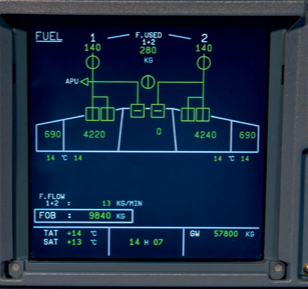
Each engine is equipped with Fuel Flow mation is integrated by the FADEC and Meters that measure the quantity of fuel provides pilots with information on the consumed by the engine. This inforfuel used.
Low level sensors: an additional independent source based on dedicated sensors in the wing tank
Section titled “Low level sensors: an additional independent source based on dedicated sensors in the wing tank”In addition to the sensors and three independent dedicated low probes feeding the FQI system, level sensors. These sensors are each wing tank is equipped with located in such a way that they
(fig.2)
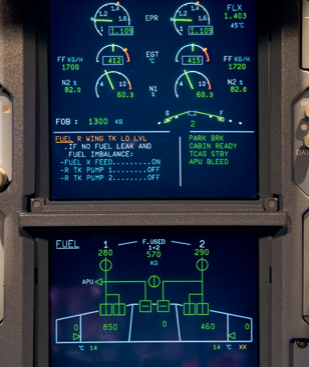
Section titled “(fig.2)”Low level alert display on ECAM
become dry when the remaining fuel in the tank is approximately 750 kg. If two sensors in the same tank remain dry for more than 30 seconds, a low level alert triggers in the cockpit (fig.2).
-
Do not provide pilots with a continuous indication of the fuel quantity in the wing tanks, but only the signal that the fuel level has reached below 750 kg (threshold crossed).
-
The information provided to pilots in the form of the low level alert results from a physical measure (sensors dry or wet) rather than from a calculation.
The low level sensors are fully independent from the Fuel Quantity Indication, and are different in that they:
DID YOU KNOW
Section titled “DID YOU KNOW”The A320 Family aircraft low level indication is based on remaining fuel quantity in the tank being sufficient to meet the requirement of 30 minutes at 1500 ft (corresponding to approximately 1 200 kg). Should the low level alert trigger on both fuel tanks, the total remaining fuel is: 750kg + 750kg = 1 500 kg.
INFORMATION
Section titled “INFORMATION”The low level sensors are fully independent from the Fuel Quantity Indication.
The presence of water in the fuel tanks can lead to erroneous (over reading) fuel indications. The parameters used by the fuel system (density and capacitance) are highly affected by the presence of water. Flight deck effects of a buildup of water in the fuel tanks include fuel gauging fluctuations and over reads.
Consequently, among the maintenance tasks that are to be performed if pilots detect an abnormal fuel indication during a fuel check is fuel tank draining (fig.3). This can also help to prevent microbiological contamination, which is often another cause of fuel gauging fluctuations.
(fig.3)
Section titled “(fig.3)”Maintenance Planning Document – ATA 28 Fuel – Task 281100-01-2 – Drain water content in tanks
FUEL CHECKS
Section titled “FUEL CHECKS”An unnecessary burden or essential safety net?
Section titled “An unnecessary burden or essential safety net?”Ensuring an accurate awareness of the quantity of fuel on board requires use of several sources of data. Certainly the FQI is the primary source of fuel indication, but the other key sources such as the Fuel Used, the fuel uplifted at the latest refuel, the crosscheck between what is expected to be uplifted and what is uplifted, information from the refue-
ler and fuel consumption figures during flight, are all important. But to ensure the information remains accurate, the safety barrier common to all cases is fuel monitoring by the crew.
Although fuel checks with the manual calculations they involve can sometimes be perceived as a tedious task,
they form in reality an integral part of the measures taken to ensure safe operations. They were designed and meant for detecting as early as possible any fuel quantity issue, ensuring timely and accurate maintenance intervention, and allowing appropri-
ate measures to secure the safety of the fl ight. They are applicable to all Airbus Families aircraft from the fi rst A300B to the latest A350, and remain an essential part of airmanship when piloting the A320 Family aircraft.
What is to be checked and when?
Section titled “What is to be checked and when?”The maximum effi ciency of fuel larly and at different times to either checks relies on the fl ight crew perconfi rm anticipations, or detect any forming a number of checks regudiscrepancy.
The fuel available onboard can be determined based on two independent sources of information… even three in case of low level.
Before start
Section titled “Before start”The fi rst fuel check to be performed is available for the f ight. This check conbefore start to consolidate the inforsists in making sure that: mation about the total amount of fuel
Initial Fuel On Board (FOB) + Fuel Uplifted = Fuel On Board (FOB) ± ∆
Section titled “Initial Fuel On Board (FOB) + Fuel Uplifted = Fuel On Board (FOB) ± ∆”FOB is the fuel quantity derived from the FQI system Fuel Uplifted is the amount of fuel indicated by the refueler as having been added during refueling. This may require converting volume into weight,
based on the uplifted fuel density. Δ is an acceptable tolerance (see Why do we need to consider a certain tolerance on fuel onboard values? insert).
During the fl ight
Section titled “During the fl ight”During the fl ight, fuel checks mainly aim at detecting any abnormal consumption, be it due to a leak or unanticipated drag (e.g. spoiler or landing gear, slats or fl aps not fully retracted) or any other reason. Indeed, such situation would make
the FMS fuel predictions too optimistic and potentially lead to fuel exhaustion in fl ight.
To ensure that there is no undetected fuel leak, the following calculation should be performed at each way point or every 30 minutes:
Fuel On Board (FOB) + Fuel Used = Initial Fuel On Board (FOB) ± ∆
Section titled “Fuel On Board (FOB) + Fuel Used = Initial Fuel On Board (FOB) ± ∆”Fuel Used is derived from the fuel fl ow meters In addition, the remaining FOB and Fuel Used values must also be consistent with the values given by the computed fl ight plan at each waypoint.
Post fl ight
Section titled “Post fl ight”All fuel checks are equally important in the detection and safe management of any fuel quantity issue.
At the end of the fl ight, when the aircraft has reached its parking stand, a fi nal fuel check is to be performed to check the consistency between the information provided by the var-
ious sources and thus detect any abnormal discrepancy that would call for maintenance actions. The post fl ight fuel check consists of making sure that:
Fuel On Board (FOB) + Fuel Used = Initial Fuel On Board (FOB) ± ∆
Section titled “Fuel On Board (FOB) + Fuel Used = Initial Fuel On Board (FOB) ± ∆”WHAT IF A FUEL CHECK IS MISSED?
Section titled “WHAT IF A FUEL CHECK IS MISSED?”Depending on the underlying reason for a fuel quantity issue, missing a fuel check may make it very diffi cult to detect. In the second event described, the failure of the Fuel Quantity Indication Computer did not lead to a systematic wrong indication but rather to quantity fl uctuations. The fuel quantity indicated by the FQI system before the fi rst fl ight of the day was correct. In such cases, skipping a fuel check may be a missed opportunity to detect a failure that may not be detectable later on, at the time of the following check. More generally, whatever the origin of a fuel quantity issue, detecting it as early as possible allows for managing it and making sure appropriate decisions can be made in time to best manage the rest of the fl ight as safely and effi ciently as possible.
WHY DO WE NEED TO CONSIDER A CERTAIN TOLERANCE ON FUEL ON BOARD VALUES?
Section titled “WHY DO WE NEED TO CONSIDER A CERTAIN TOLERANCE ON FUEL ON BOARD VALUES?”Due to the nature of the fuel system, it is essential that the system tolerance be taken into consideration when performing fuel quantity calculations. The overall FQI system accuracy is designed to take into consideration several factors such as: attitude effects, wing deformation, systems tolerances, manufacturing tolerances, component tolerances, environmental effects, fuel characteristics.
These individual tolerances lead to an overall tolerance on the global system resulting from the worst case (maximum tolerance) on each individual element.
The maximum tolerance is defi ned for the aircraft to guarantee an acceptable level of integrity of the measure and the associated fuel quantity information. When a fuel check is performed, any fuel discrepancy calculated by the crew and exceeding this value may then be considered abnormal.
For an A320 Family aircraft, the instrumental tolerance on the ground is calculated as follows:
± (1% of current FOB + 1% max possible FOB for this aircraft)
Section titled “± (1% of current FOB + 1% max possible FOB for this aircraft)”As an illustration, for an A320 aircraft, if there are 5 tons left in the aircraft, the maximum normal tolerance value is:
± (5000kg (current FOB) * 1% + 20000kg (max FOB)* 1% ) = ± 250kg
Section titled “± (5000kg (current FOB) * 1% + 20000kg (max FOB)* 1% ) = ± 250kg”Note: The FQI system is designed in such a way that the lower the fuel quantity in the tank, the more accurate the fuel indication.
The FQI system is calibrated on ground during manufacturing and its accuracy (as per the formula above) will remain the same throughout the operational life of the aircraft.
TO FURTHER ENHANCE SAFETY…
Section titled “TO FURTHER ENHANCE SAFETY…”Following the investigation of real events involving fuel monitoring issues, Airbus identified and implemented enhancements in several areas:
• Further refinement of the description of the Fuel Quantity Indicating and level sensing systems in the FCOM documentation. During the interactions with the airlines involved, it turned out that the independence of the two fuel measures coming from respectively the FQI system and the low level alert was not clear to all crews.
• Definition of empirical criteria on A320 Family aircraft to consider a fuel discrepancy “abnormal” or “unusual” when performing the before start fuel check. These thresholds will be expressed in
kg or lbs and will vary depending on the fuel on board and fuel uplifted. They will lead to a generic maintenance task in the TSM (Trouble Shooting Manual).
• Service Bulletin A320-28-1214 for A318/A319/A320 and Service Bulletin A320-28-1202 for A321 aircraft introduce a new fuel leak detection function, which eases and improves the detection of a fuel leak. This new function is meant to prevent situations where a loss of fuel would remain undetected by the crew.
• A new FCOM evolution will be available soon, that will describe the triggering conditions of the low level alert in the procedure, and to show that the alert is independent of the displayed fuel.
DID YOU KNOW
Section titled “DID YOU KNOW”A “GOLDEN RULE” IN THE TROUBLE SHOOTING MANUAL (TSM)
Section titled “A “GOLDEN RULE” IN THE TROUBLE SHOOTING MANUAL (TSM)”Until recently, there was no generic entry into the TSM in case of abnormal fuel quantity. It is therefore worth reminding everyone of a key sentence in the introduction of the TSM that encourages airlines to manage cases where there may be a doubt as to the aircraft airworthiness:
“If you cannot find a fault symptom and/or a fault isolation procedure necessary to ensure the continued airworthiness of the aircraft, or if you think that the information given is not complete, contact Airbus”.
An engine failing in flight, because of fuel starvation, is a situation all pilots would like to avoid. In order to do so, and to ensure the continuing accuracy of the FQI, performing thorough fuel checks before start, throughout the flight and after arrival at the parking stand is essential.
Should any discrepancy appear, effectively tackling the underlying issue, be it intermittent or permanent, is the only way to prevent further fuel quantity indication and possible resulting safety issues. This relies on good cooperation between flight crews, maintenance and the manufacturer.
Should the LO LVL alert trigger , it is to be trusted! It is the independent voice from the tanks themselves warning you …
来源:Airbus Safety First 网址:https://safetyfirst.airbus.com/fuel-monitoring-on-a320-family-aircraft/ 发布日期:2015-06-29 杂志期号:2015-07 类别:飞行运营、维护、FOB、FQI、燃油、泵 PDF:原始 PDF
自 A320 首次投入运营以来,涉及燃油量问题却未被发现的飞行事件极少。然而,若真的遇到因燃油耗尽而导致发动机停车的状况,这是任何人都不愿经历的。
GÉRALDINE VALLÉE 产品安全改进经理
REGIS PERNET 飞行操作工程师
ALBERT URDIROZ 飞行安全总监
虽然燃油系统已证明其可靠性,但在发生故障的情况下,避免陷入燃油临界状况的最终安全屏障是飞行机组的燃油监控。让我们回顾一下 A320 系列飞机燃油监控的一些基本问题:如何确定油箱中的可用燃油量?有哪些信息来源以及它们的冗余度如何?为什么定期进行燃油检查至关重要?
罕见但触目惊心的事件
Section titled “罕见但触目惊心的事件”在空客 A320 系列飞机运营的 25 年多时间里,涉及未被发现燃油量问题的事件不超过寥寥数起。
这些燃油量问题的原因各有不同。及早发现和处理问题始终是成功应对此类事件的关键。
在一架 A320 系列飞机巡航期间,机组观察到 ECAM 警告 L TK PUMP 1 + 2 LO PR 出现了 3 次。根据该警告,他们注意到左侧油箱的燃油量下降速度比右侧更快。按照适用的 FCOM 程序,他们打开了燃油交输活门,但随后便关闭了它,因为燃油量异常下降。几分钟后,发动机 1 自动停车,触发 ECAM 警告 ENG 1 FAIL。
机组成功驾驶飞机安全着陆,发动机 2 仍在运转,乘客安全下机。着陆时的剩余燃油量显示右侧油箱为 840 公斤,左侧油箱则无燃油。事件调查表明,在事件航班之前对燃油箱进行了维护工作,发动机 1 和 2 的燃油泵滤芯均已更换。事件航班结束后,发现发动机 1 的高压燃油泵滤芯盖未正确安装,其中 6 个螺纹嵌件中有 4 个报告为不可用,导致滤芯盖部分打开。据估计,大约有 4 至 5 吨燃油发生泄漏。
在另一起事件中,燃油量指示(FQI)系统曾在一段时间内显示数据存在偏差。由于故障呈间歇性,维修人员对飞行日志中的相关记录进行了调查,尽管开展了预防性维护工作,但未发现任何问题。有两次,不同的机组在离港前或离港后的燃油检查中未能识别或正确记录 FOB 偏差。
在事件航班上,飞机起飞时显示 FOB 约为 5000 公斤(前序航班到达时的燃油约为 3800 公斤,加油量为 1200 公斤)。飞行机组参考前序航班的燃油记录进行了初始燃油检查,计算值保持一致。
飞行中,燃油量出现瞬时波动,随后触发了 ECAM 警报 FUEL L (R) WING TK LO LVL。机组按照 SOP 对其进行了处理,并检查了 SD 页面显示正常。因此,该警报被认为是虚警。航班继续飞行,机组以较短间隔反复进行燃油检查;然而在进近期间,发动机 1 熄火。飞机在发动机 2 的推动下安全落地。飞行结束后,确认左侧机翼油箱已空,燃油量指示(FQI)高读了 1 吨。
事件分析表明,前序航班的燃油记录未能使机组在起飞前识别出约 800 公斤的重大偏差。
在一架 A320 系列飞机当天第三个航段中,飞机接近目的地时,一侧触发了 LO LVL 警报。机组认为这是虚警,可能是由于油箱内燃油晃动所致。首次警报后不久,另一侧也触发了 LO LVL 警报。机组继续飞行,最终顺利着陆。着陆时的剩余燃油量约为 900 公斤。
在当天第一个航段中,飞行机组计算出到达时存在约 500 公斤的偏差。日志中未提及任何与燃油相关的内容。
在当天第二个航段中,机组计算出的到达时偏差将近 3000 公斤。副驾驶注意到这与他预期的不符,但认为可能受益于一些有利因素,如直飞的空管引导,以及实际比计划提前了 20 至 25 分钟到达。此外,根据公司政策他们有时会进行燃油调运。因此,日志中未提及任何异常情况。在第三个航段——即事件航班——之前,由于仍存在燃油高读,加油员只添加了少量燃油。然而,飞行机组
高读是由于间歇性的 FQI 计算机(FQIC)故障所致。该 FQIC 的维修记录显示,在事件发生前的数月内曾多次返厂维修。
机上可用燃油量是多少?
Section titled “机上可用燃油量是多少?”考虑到飞行中燃油耗尽的严重后果,了解飞行中机上可用燃油量对安全至关重要。可使用哪些信息来确定机上燃油量?这些信息是如何确定的?各种信息之间是否相互关联?它们是否相互独立?让我们探索机组可用的各种机上燃油信息来源。这些信息从何而来?空中客车A320系列飞机上的燃油量是如何确定的?
FQI(燃油量指示):基于油箱内部测量的数据源
Section titled “FQI(燃油量指示):基于油箱内部测量的数据源”FQI系统根据油箱内探头的测量值计算燃油量。探头测量油箱中的燃油液位,通过燃油浸没探头引起的电容变化实现。由此可确定油箱中的燃油体积。
然而,飞行员需要的信息是以重量表示的机上燃油量。燃油体积到燃油重量的换算由FQIC根据每个机翼油箱内专用设备测量的燃油密度来完成 (图1)。
低油面感应不会出现在系统描述页面(SD)上。因此,关于燃油指示,不要仅依赖SD页面。
燃油流量计:基于发动机消耗的数据源
Section titled “燃油流量计:基于发动机消耗的数据源”(图1)
下ECAM显示组件上的燃油系统页面
每台发动机都装有燃油流量计,用于测量发动机消耗的燃油量。该信息由FADEC集成后向飞行员提供已用燃油信息。
低油面传感器:基于机翼油箱内专用传感器的额外独立数据源
Section titled “低油面传感器:基于机翼油箱内专用传感器的额外独立数据源”除了向FQI系统提供数据的传感器和探头外,每个机翼油箱还配有三个独立的专用低油面传感器。这些传感器布置在特定位置,当油箱内剩余燃油量约为750公斤时会变干。如果同一油箱内的两个传感器保持干燥状态超过30秒,驾驶舱内会触发低油面警告 (图2)。
-
不向飞行员提供机翼油箱燃油量的连续指示,仅在燃油液位低于750公斤(阈值已触发)时发出信号。
-
以低油面警告形式向飞行员提供的信息源自物理测量(传感器干燥或湿润),而非计算。
低油面传感器与燃油量指示完全独立,区别在于:
A320系列飞机的低油面指示基于油箱内剩余燃油量足以满足在1500英尺高度飞行30分钟的要求(对应约1200公斤)。如果两个油箱都触发低油面警告,剩余燃油总量为:750公斤+750公斤=1500公斤。
低油面传感器与燃油量指示完全独立。
燃油箱内存在水分可能导致燃油指示错误(读数偏高)。燃油系统使用的参数(密度和电容)受水分影响很大。燃油箱内积水在驾驶舱的表现包括燃油表读数波动和读数偏高。
因此,如果飞行员在燃油检查中发现燃油指示异常,需要执行的维护任务之一是排放燃油箱积水 (图3)。这也有助于防止微生物污染,微生物污染通常是导致燃油表读数波动的另一个原因。
维护计划文件 – ATA 28 燃油 – 任务281100-01-2 – 排放油箱内水分
不必要的负担还是关键的安全保障?
Section titled “不必要的负担还是关键的安全保障?”确保准确掌握机上燃油量需要使用多个数据源。毫无疑问,FQI是燃油指示的主要数据源,但其他关键数据源(如已用燃油、最近一次加油量、预期加油量与实际加油量的核对、加油员提供的信息以及飞行中的燃油消耗数据)同样重要。但为确保信息持续准确,所有情况下的共同安全屏障是机组的燃油监控。
尽管包含手动计算的燃油检查有时可能被视为繁琐任务,但它们实际上是确保安全运营措施中不可或缺的组成部分。这些检查的设计目的是尽早发现任何燃油量问题,确保及时准确的维护介入,并允许采取适当措施保障飞行安全。它们适用于从最早的A300B到最新A350的所有空客系列机型,在驾驶A320系列飞机时仍是飞行员专业素养的重要组成部分。
检查什么?何时检查?
Section titled “检查什么?何时检查?”燃油检查的最大效率取决于飞行机组定期且在不同时刻执行多项检查,以确认预期或发现任何差异。
机上可用燃油可基于两个独立信息源来确定……在低油量情况下甚至有三个。
在起飞前执行的首次燃油检查,用于汇总机上可用燃油总量信息。此项检查包括确认:
初始机上燃油(FOB)+ 添加燃油 = 机上燃油(FOB)± ∆
Section titled “初始机上燃油(FOB)+ 添加燃油 = 机上燃油(FOB)± ∆”FOB为FQI系统得出的燃油量 添加燃油是加油员指示的在加油过程中添加的燃油量。这可能需要根据添加燃油的密度将体积转换为重量。 Δ为可接受容差(见“为什么燃油量数值需要考虑一定容差?”插框)。
飞行中的燃油检查主要用于检测任何异常消耗,无论是因泄漏还是未预计的阻力(如扰流板或起落架、缝翼或襟翼未完全收回)或其他原因所致。实际上,这种情况会使FMS燃油预测过于乐观,并可能导致飞行中燃油耗尽。
为确保没有未被检测到的燃油泄漏,应在每个航路点或每30分钟执行以下计算:
机上燃油(FOB)+ 已用燃油 = 初始机上燃油(FOB)± ∆
Section titled “机上燃油(FOB)+ 已用燃油 = 初始机上燃油(FOB)± ∆”已用燃油由燃油流量计得出。此外,剩余的FOB和已用燃油值也必须与每个航路点飞行计划给出的计算值保持一致。
所有燃油检查对于燃油量问题的检测和安全处理同等重要。
飞行结束时,当飞机到达停机位后,需执行最终燃油检查,以检查各种来源信息的一致性,从而检测出任何需要采取维护措施的异常差异。飞行后燃油检查包括确认:
机上燃油(FOB)+ 已用燃油 = 初始机上燃油(FOB)± ∆
Section titled “机上燃油(FOB)+ 已用燃油 = 初始机上燃油(FOB)± ∆”如果错过燃油检查会怎样?
Section titled “如果错过燃油检查会怎样?”根据燃油量问题的根本原因,错过燃油检查可能会使其难以被发现。在第二个事件中,燃油量指示计算机故障并未导致系统性错误指示,而是导致数量波动。一天首次飞行前FQI系统指示的燃油量是准确的。在这种情况下,跳过燃油检查可能是一个错失的机会,无法检测到可能在后续检查时无法发现的故障。更一般地,无论燃油量问题的来源如何,尽可能早地检测到问题能够对其进行管理,并确保能够及时做出适当决策,尽可能安全高效地管理剩余飞行阶段。
为什么燃油量数值需要考虑一定容差?
Section titled “为什么燃油量数值需要考虑一定容差?”由于燃油系统的特性,在执行燃油量计算时必须考虑系统容差。FQI系统整体精度设计需考虑多个因素,例如:姿态影响、翼面变形、系统容差、制造容差、部件容差、环境影响、燃油特性。
这些单独容差导致整个系统产生总体容差,这是每个单独元素最坏情况(最大容差)的结果。
最大容差是为飞机定义的,以确保测量的完整性水平和相关燃油量信息保持在可接受的水平。当执行燃油检查时,机组计算出的任何燃油差异若超过此值,则可视为异常。
对于A320系列飞机,地面仪表容差计算如下:
±(当前FOB的1% + 该机型最大可能FOB的1%)
Section titled “±(当前FOB的1% + 该机型最大可能FOB的1%)”举例说明,对于A320飞机,若机上剩余5吨燃油,最大正常容差值为:
± (5000kg (current FOB) * 1% + 20000kg (max FOB)* 1% ) = ± 250kg
Section titled “± (5000kg (current FOB) * 1% + 20000kg (max FOB)* 1% ) = ± 250kg”**注:**燃油量指示(FQI)系统的设计使得油箱内燃油量越低,燃油显示精度越高。
FQI系统在制造阶段于地面进行校准,其精度(按上述公式计算)在飞机整个运营寿命周期内保持不变。
进一步提升安全性……
Section titled “进一步提升安全性……”在调查了涉及燃油监控问题的实际事件后,空客在多个领域识别并实施了改进措施:
• 进一步细化FCOM文档中燃油量指示和液位传感系统的描述。在与相关航空公司的沟通中发现,来自FQI系统和低油量警告的两个燃油测量方法的独立性并非所有机组都清楚。
• 定义了A320系列飞机起动前燃油检查时判断燃油差异是否属于“异常”或“不寻常”的经验标准。这些阈值将以kg或lbs表示,并根据机上燃油量(FOB)和加油量变化。这些标准将引出TSM(《故障排除手册》)中的通用维修任务。
• 服务通告A320-28-1214(适用于A318/A319/A320)和服务通告A320-28-1202(适用于A321)引入了新的燃油泄漏探测功能,简化并改进了燃油泄漏的检测。这一新功能旨在防止燃油损失被机组漏检的情况发生。
• 新的FCOM版本即将发布,将说明低油量警告的触发条件,并表明该警告与显示的燃油量无关。
《故障排除手册》(TSM)中的“黄金法则”
Section titled “《故障排除手册》(TSM)中的“黄金法则””此前,对于燃油量异常的情况,TSM中没有通用入口。因此,有必要提醒大家TSM引言中的一个关键语句——它鼓励航空公司管理可能存在飞机持续适航性疑问的情况:
“如果找不到确保飞机持续适航所需的故障症状和/或故障隔离程序,或者你认为所给信息不完整,请联系空客”。
飞行中发动机因燃油耗尽而失效,是所有飞行员都想避免的情况。为避免这种情况,并确保FQI持续准确,在起动前、飞行全程以及停机位到达后进行彻底的燃油检查至关重要。
一旦出现任何差异,有效处理潜在问题——无论是间歇性还是永久性——是防止燃油量指示进一步恶化及可能由此引发安全问题的唯一途径。这取决于飞行员、维修人员和制造商之间的良好合作。
当低油量警告触发时,它值得被信任!这是来自油箱本身的独立声音在向你发出警告……