Attention Crew at Stations
Source: Airbus Safety First URL: https://safetyfirst.airbus.com/attention-crew-at-stations/ Published: 2020-12-03 Category: Cabin Ops, Flight Ops, evacuation, slide PDF: Original PDF

Attention! Crew at Stations!
Section titled “Attention! Crew at Stations!”An evacuation is a stressful situation for emergency always passengers, cabin crews, and flight crews. Decisions have to be made rapidly and if the communication between the cabin and cockpit is not clear, or the evacuation is delayed passengers trying to take their personal belongings, these can have critical consequences on the outcome.
From the preflight briefing until the safe evacuation of aircraft occupants, this article provides recommendations for both flight crew and cabin crew to ensure a safe and efficient emergency evacuation is performed.
This article is also available on safetyfirst.airbus.com and on the Safety first app for iOS and Android devices.
CASE STUDY 1
Section titled “CASE STUDY 1”Event Description
Section titled “Event Description”An A319 was taxiing along the taxiway when the passengers and the cabin crew detected smoke in the cabin. The purser used the interphone to notify the flight crew and asked the captain’s permission to evacuate. The captain set the parking brake to stop the aircraft on the taxiway, and called ATC to report that they detected smoke in the cabin and that they would initiate an emergency evacuation.
As the smoke became thicker in the cabin, the purser called again to the cockpit, insisting that an evacuation was necessary and requested that the captain urgently initiate the evacuation. The captain turned on the evacuation alarm by pressing the COMMAND pushbutton-switch on the EVAC panel to initiate the evacuation, but did not make an announcement to the cabin using the Passenger Address (PA) system.
The cabin crew immediately began the evacuation but both engines were still running.
The cabin crew at the rear doors of the aircraft had to hold up the passengers ready to evacuate the aircraft for more than 30 seconds until the engines were shut down. The flight crew saw the ECAM alert indicating that the doors were open with engines running, and shut down the engines using the engine fire pushbuttons instead of the master switches.
Event Analysis
Section titled “Event Analysis”Without the presence of any ECAM alerts and with pressure from the cabin crew, the captain initiated the emergency evacuation. The QRH EMER EVAC procedure, that specifically requests the flight crew to ensure that the engines are shut down before initiating the evacuation, was not followed. Because no announcement was made in the cabin for the evacuation, some passengers mistook the evacuation alarm as a smoke alarm and they did not immediately react, causing some delay to begin the evacuation. Other passengers gathered their personal belongings, this resulted in some minor injuries caused by people pushing past them or climbing over one another in the aisle to reach the exits.
CASE STUDY 2
Section titled “CASE STUDY 2”Event Description
Section titled “Event Description”The left engine of an A320 suffered a contained failure during the takeoff roll at a ground speed of 31 knots. The captain immediately rejected the takeoff and brought the aircraft to a stop on the runway. He announced “ATTENTION CREW ON STATION” twice. The flight crew completed the ECAM actions, shut down the left engine, and contacted the Rescue and Fire Fighting Services to make sure that no fire was visible outside the aircraft. The flight crew decided to taxi the aircraft off the runway and were about to tell the cabin crew to resume normal operations, but the purser had already initiated an emergency evacuation.
Event Analysis
Section titled “Event Analysis”The purser initiated the emergency evacuation and did not inform the flight crew despite the “ATTENTION CREW ON STATION” announcement, which clearly indicated that the flight crew was in control of the situation.
Lack of knowledge of the communication system hindered communication between the crew members. Even though there was no sign of immediate danger, the purser initiated the emergency evacuation without a decision from the captain and with the right engine still running.
Fortunately, only some passengers suffered minor injuries, some of which were caused by them being blown over by the jet exhaust coming from the right engine that was still running. Many of the passengers gathered their personal belongings and took these with them when they evacuated the aircraft.
BE PREPARED FOR EVACUATION
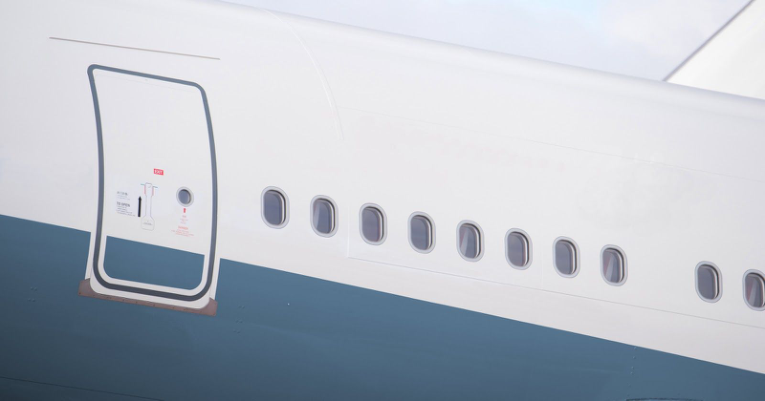
Section titled “BE PREPARED FOR EVACUATION”Being prepared makes it easier to perform an emergency evacuation and will help the crew in their capacity to make decisions and apply the Standard Operating Procedures in a stressful environment.
Aircraft Knowledge
Section titled “Aircraft Knowledge”To ensure efficient evacuation, the cabin crew must have extensive knowledge of the aircraft systems. This includes the cabin communication system and the aircraft configuration, especially the cabin layout that could impact visibility of the cabin and other cabin crew members or generate congested areas. Operating a diverse fleet can imply various cabin configurations that have different numbers of exits or positions of galleys and toilets. Cabin crew must be familiar with the cabin layout to ensure an efficient emergency evacuation.
Crew Briefing
Section titled “Crew Briefing”Maintaining effective communication and ensuring compliance with the Standard Operating Procedures starts with the preflight briefing. This is when the flight
“Maintaining effective communication and ensuring compliance with the Standard Operating Procedures starts with the preflight briefing.”
crew and cabin crew should define together any parameters that could affect their decision-making if an emergency were to occur. It is also the opportunity to review the emergency evacuation procedure with the associated standard callouts, and discuss them in the context of the upcoming flight. The crew should take into account any specific conditions such as airport equipment, external conditions, and the application of MEL items.
Passenger Identification & Briefing
Section titled “Passenger Identification & Briefing”“The cabin crew At the beginning of the flight, the cabin crew must select the Able Bodied Passengers (ABP) who are able to assist them in the case of evacuation. They should remind must also identify any passengers who may require additional support during passengers to evacuation for example unaccompanied children. leave all The preflight briefing will help passengers to be better prepared for an evacuation if passengers are encouraged to pay attention. The cabin crew will indicate the personal location of the nearest emergency exits, and should remind passengers to leave belongings all personal belongings inside the aircraft in the event of an evacuation. inside the aircraft in the event of an evacuation.”
The Silent Review
Section titled “The Silent Review”The silent review (or 30-second review) is recommended for cabin crew mentally recall the key aspects of the emergency evacuation procedure while they are seated at their station before each takeoff and landing, and decreases the risk of distraction. This silent review will help the cabin crew to focus and be prepared in case an emergency evacuation is required. This technique will also help to minimize the startle effect.
STOP - INFORM - ECAM - ASSESS
Section titled “STOP - INFORM - ECAM - ASSESS”In the case of an emergency situation during takeoff or landing, task sharing should be established and respected so that the crew are well prepared for potential emergency evacuation.
Stop the aircraft
Section titled “Stop the aircraft”The flight crew must bring the aircraft to a stop and set the parking brake. In the case of fire, they should consider positioning the aircraft so that the wind direction will blow the flames away from the fuselage.
Inform ATC
Section titled “Inform ATC”Once the aircraft is stopped, the flight crew should notify the ATC.
Captain: Inform Cabin Crew
Section titled “Captain: Inform Cabin Crew”After the aircraft stops, the captain tells the cabin crew to prepare for a possible evacuation. The “ATTENTION CREW AT STATION” callout is made through the
Passenger Address system, which lets the cabin crew know the flight crew is not incapacited and that they are performing actions to determine if evacuation required. This callout avoids unnecessary evacuations initiated by the cabin crew.
First Officer: Clear ECAM Actions
Section titled “First Officer: Clear ECAM Actions”The first officer should independently perform any ECAM action in a “read and do” manner. On A220 aircraft, the first officer should independently perform the Electronic Checklist (ECL) procedure from any EICAS message in a “read and do” manner.
When the ECAM actions (or ECL procedures) are completed, the first officer can then assist the captain with the situation assessment.
Captain: Assess the Situation
Section titled “Captain: Assess the Situation”The captain should use any possible means to get a clear and comprehensive overview of the situation. They can use direct communication with any relevant person, for example, cabin crew, ATC, ground personnel, Rescue and Fire Fighting Services. The decision to evacuate should rely on the captain’s judgement based on their assessment of the overall situation.
Cabin crew: Assess the Situation and Identify Usable Exits
Section titled “Cabin crew: Assess the Situation and Identify Usable Exits”As soon as the flight crew informs the cabin crew of the possible evacuation, the cabin crew must assess the situation at each cabin station. They should identify the available exits and begin to assess the outside conditions as well as the conditions inside the cabin. The cabin crew must communicate any pertinent information to the flight crew.
“The decision to evacuate should rely on the captain’s judgement based on their assessment of the overall situation.
DECIDE - SECURE - INITIATE
Section titled “DECIDE - SECURE - INITIATE”Decide if evacuation is required
Section titled “Decide if evacuation is required”The situations that lead to an emergency evacuation are very stressful with high workload in a short period of time for both flight crew and cabin crew. The
decision to evacuate is irreversible and can have severe consequences. The main factors that result in the crew initiating an emergency evacuation are uncontrollable fire, thick smoke, and severe structural damage.
In most cases, the flight crew initiates the evacuation. However, in catastrophic situations with immediate risks of life-threatening injuries or when the flight crew is incapacitated, the cabin crew can decide to initiate the evacuation.
No evacuation required
Section titled “No evacuation required”If the situation does not require an evacuation, the captain should notify the cabin crew and ATC, and should resume normal operations.
Need for evacuation
Section titled “Need for evacuation”If the situation requires an evacuation, the captain calls for the EMER EVAC procedure to be performed.
Secure the aircraft as per EMER EVAC Procedure
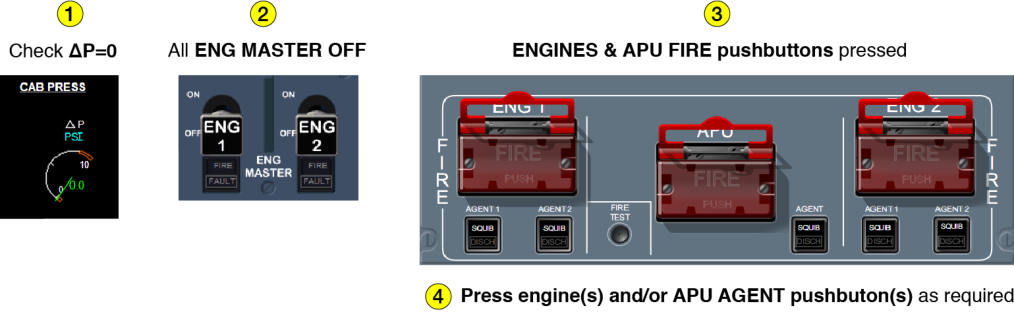
Section titled “Secure the aircraft as per EMER EVAC Procedure”To ensure safe evacuation, the flight crew must secure the aircraft before the evacuation is initiated by performing the following actions:
-
Check the cabin ΔP=0 on the CAB PRESS SD page to prevent
-
explosive door opening due to residual pressure if manual pressure mode was used in flight.
-
Set all engine master switches to OFF
-
Press all engines and APU FIRE pushbuttons to secure them
-
- Press relevant ENG and/or APU AGENT pushbuttons as required in case of engine and/or APU fire.
On A220 aircraft, step is performed after step . The flight crew ensures cabin ΔP=0 by setting the EMER DEPRESS guarded switch to ON.
“To ensure safe evacuation, the flight crew must secure the aircraft before the evacuation is initiated”
(fig.1) Example of the A320 aircraft securing steps before evacuation initiation
Order from flight crew
Section titled “Order from flight crew”The captain initiates the evacuation with a short and clear announcement to the cabin crew over the PA.
For aircraft equipped with the EVAC panel (optional for A300-600/A310/A320/A330/A340/A350 aircraft, standard for A380 aircraft), the
captain presses the EVAC COMMAND guarded pushbutton-switch. For A220 aircraft, the captain presses the EVAC CMD guarded switch. This ensures clear communication with the cabin crew and helps the flight crew to focus on other actions in this high-workload situation.
Immediately after the emergency evacuation is initiated, the captain advises the ATC.
(fig.2) Example of EVAC panel on A350 aircraft
On A220, A330/A340 aircraft equipped with aircraft modification 49314 (CIDS emergency power update), A340-500/600, A350, and A380 aircraft, the flight crew must switch off the batteries. This is to make sure that after the aircraft comes to a stop, power is still supplied to the CIDS for 10 minutes. This required by regulations in the case of emergency evacuation due to an electrical emergency.
Order from cabin crew
Section titled “Order from cabin crew”The cabin crew can initiate an emergency evacuation only in the case of catastrophic event or if the flight crew is incapacitated and normal disembarkation is no longer possible. The cabin crew can use the EVAC command available on the Flight Attendant Panel or as an option on any Additional Attendant Panel. They can also use this command to request that the flight crew initiate an evacuation if they are not authorized to do so directly.
Even if the cabin crew can initiate an emergency evacuation they must try contact the flight crew first to avoid any unnecessary evacuation.
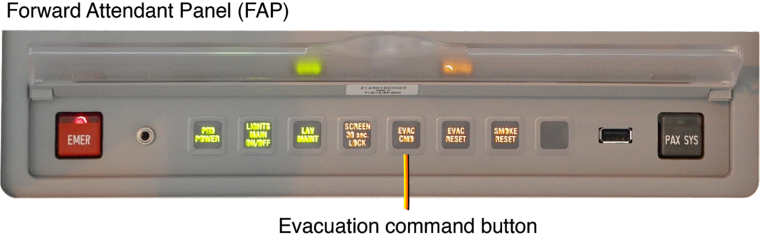
(fig.3) Example of Forward Attendant Panel (FAP) lower section A320 aircraft
EVACUATE, EVACUATE, OPEN SEAT BELTS!
Section titled “EVACUATE, EVACUATE, OPEN SEAT BELTS!”An efficient evacuation is a quick and safe evacuation
Section titled “An efficient evacuation is a quick and safe evacuation”The objective of an emergency evacuation is to evacuate all aircraft occupants as quickly and as safely as possible to ensure they have the best chance survival in the case of a life-threatening situation.
Therefore, after the cabin crew identify the usable exits and check that the slides are deployed and inflated, the objective for them is to maintain an evenly-distributed flow of passengers towards all available exits.
Crew Coordination and Adaptation
Section titled “Crew Coordination and Adaptation”“the objective for cabin crew is to maintain an evenly-distributed flow of passengers towards all available exits.
Throughout the evacuation process, a constant real time assessment of the situation is necessary in terms of aircraft and external conditions, exit usability, and passenger flow. The situation can change rapidly and efficient communication between all the crew is essential to share any elements that can impact the evacuation: Presence of immediate danger such as fire or smoke, an exit becoming unusable due to a damaged slide or external conditions, congested exit, or an exit with a reduced flow of passengers.
As a result, the crew must rapidly make decisions and adapt to changing scenarios in a dynamic and stressful environment. This will ensure a constant flow of passengers to each usable exit, and therefore, a quick evacuation.
Passenger Management
Section titled “Passenger Management”Multiple and unpredictable behaviors
Section titled “Multiple and unpredictable behaviors”Under stressful conditions, people can have varied reactions. Unlike cabin crew who are trained, passengers are not. They can have unpredictable reactions that can jeopardize their own safety and that of the other aircraft occupants. Panic can lead to “frozen” passengers overwhelmed by the situation or passengers trying to evacuate as soon as possible by aggressively pushing past other passengers as referred to in Case Study 1.
Risks to slow down the evacuation
Section titled “Risks to slow down the evacuation”Passengers that do not comply with cabin crew instructions can put the success of an evacuation at risk. Baggage retrieval, use of phones, and not jumping on
the evacuation slides are the most common factors that slow down an evacuation.
Be assertive!
Section titled “Be assertive!”Assertive management of passengers is key to dealing with the risks that could impact the success of an evacuation. The cabin crew must use clear and concise orders, and use a loud voice and assertive body language to ensure that passengers follow their instructions. The challenge for the cabin crew is to switch from a nice and smiling cabin crew to an assertive one able to use physical force, if necessary.
Evacuation of the Crew
Section titled “Evacuation of the Crew”Each cabin crew member should check for any remaining passengers, and soon as their assigned area is empty, evacuate the aircraft.
When the actions are completed in the cockpit, the first officer should assist the cabin crew with the evacuation of the passengers in the cabin, if accessible, and on the ground.
The captain should be the last crew member to evacuate the cockpit and the last one to evacuate the aircraft after a final check that all aircraft occupants have evacuated. They are in charge of the operations on ground until the rescue and emergency services arrive on site.
“Assertive
management of passengers is key to dealing with the risks that could impact the success of an evacuation.”
Keep focused even after the evacuation
Section titled “Keep focused even after the evacuation”After evacuation, the crew remains responsible for the passengers until the rescue and emergency services arrive. In 2008, after a successful evacuation, one passenger went back inside the aircraft using an evacuation slide to retrieve their personal belongings.
To prevent this situation from occurring, the cabin crew should gather the passengers away from the aircraft and from any potential danger. They should also count them and provide first aid, if necessary. For that, they have to take any necessary equipment during the evacuation to help them with crowd management on ground such as flash lights (if night conditions) or megaphones if not at an airfield.
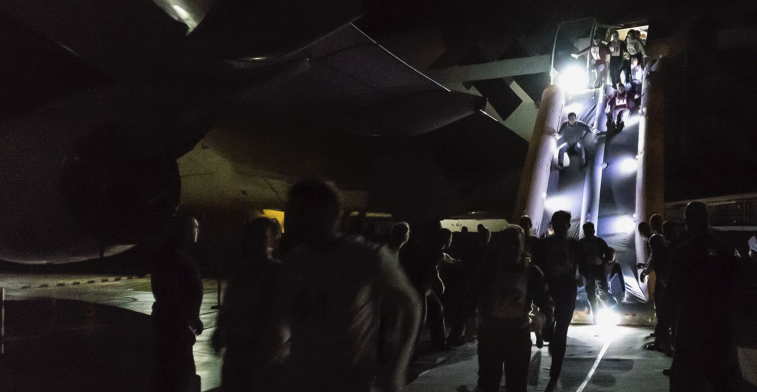
THE IMPORTANCE OF REALISTIC TRAINING
Section titled “THE IMPORTANCE OF REALISTIC TRAINING”To be able to deal with these stressful situations, appropriate training is crucial for both the flight crew and the cabin crew.
For Flight Crews
Section titled “For Flight Crews”The emergency evacuation procedure applies the same philosophy to all Airbus aircraft. This consistency across the Airbus fleet and over time is a positive contributing factor to ensuring safe application of the procedure. The emergency evacuation procedure is short and clear, the key factor is how it is trained.
It is essential that the flight crew members understand task sharing: they have to know exactly what actions must be performed, by whom, and when. It important for the flight crew to keep in mind when to work independently and when to come back together. To help understand this, the training scenarios need to be as realistic as possible and especially have to simulate the high workload that is often encountered in these situations. Instructors should be able to keep the captain busy by simulating conversations with ATC and the cabin while the first officer is performing the ECAM actions. It trains captains not following first officers actions in this specific situation and first officers continuing with ECAM actions without captain confirmation.
“The
emergency evacuation procedure is short and clear, the key factor is how it is trained.”
For Cabin Crews
Section titled “For Cabin Crews”Cabin crew training is both theoretical and practical. Scenarios have to be realistic as possible, based both on evacuations and on a return to normal operations. Cabin crew training should be conducted on a training device in order to create a realistic environment and based on case studies where possible. This enables trainees to learn from past experience and it highlights the importance of reporting incidents to learn from in the future.
“Scenarios have to be as realistic as possible”
The Cabin Safety training is designed using regulations by EASA and FAA and approved by local airworthiness authorities. It is performed annually and includes the emergency evacuation procedure.
The standard training focuses on exit and slide management, but the latest publications from aviation authorities such as the EASA and the FAA, encourage trainers to put more emphasis on passenger management, especially techniques to discourage passengers from retrieving personal belongings or baggage because it has a significant impact on the efficiency of any evacuation.
CRM Training
Section titled “CRM Training”Given the importance of communication and crew coordination, Crew Resource Management (CRM) training is of utmost importance for both flight crews and cabin crews. It should include stress management, decision-making, leadership, human factors, including surprise and startle effect management, and risk assessment.
For more information on managing emergency evacuation, you can watch the “ Evacuation Management ” video available on the Airbus Worldwide Instructor News (WIN) website.
Contributors:
Section titled “Contributors:”Claire COLEMAN
Section titled “Claire COLEMAN”Cabin Crew Instructor Flight Operations Support and Training Standards
Pierre ECHES
Section titled “Pierre ECHES”Flight Operations Support Engineer Flight Operations Support and Training Standards
Capt. Raimund GEUTER Expert Pilot - Flight Operations Flight Operations Support and Training Standards
Ian GOODWIN Director Product Safety Enhancement Product Safety
Preparation by flight crews and cabin crews is key to conducting an effective and efficient emergency evacuation. Clear communication and the knowledge of Standard Operating Procedures are vital. Knowing the aircraft systems and the cabin layout is fundamental for cabin crews. The preflight crew briefing and the passenger safety briefing help ensure everyone onboard the aircraft is better prepared to face an emergency evacuation scenario.
The silent review that cabin crew should perform before takeoff and landing is an excellent technique that helps the crew to remain focused and to be ready to act in the case of an emergency.
Knowing the essential steps and the associated task sharing of any evacuation STOP - INFORM - ECAM - ASSESS - DECIDE - SECURE INITIATE, and regularly practicing realistic training scenarios can save lives in the event of an emergency.
When emergency evacuation commences, passenger management can have a huge impact on the outcome. Passengers may feel disoriented, panicked, and helpless. Their behaviors, such as retrieving their personal belongings before moving to the nearest exit, not only endangers their own safety but also the safety of others. Well-trained and assertive cabin crew are required to urge passengers to move to the nearest available exit and to assemble outside the aircraft in a safe place away from the aircraft.
With thanks to Marc LE-LOUER from A300/A310 Flight Operations Support and Capt. Xavier LESCEU from Airbus Canada.
An emergency evacuation is always a dynamic situation where time critical, and it requires constant situational awareness combined with rapid decision-making. This can only be achieved through efficient coordination and communication between all flight crews, cabin crews, ATC, and rescue and fire fighting services on ground.
Safety first , 2020. Safety first is published by Airbus S.A.S. 1, rond point Maurice Bellonte - 31707 Blagnac Cedex/France.
Publisher and Editor: Yannick Malinge, Chief Product Safety Officer.
Editorial team: Gwyneth Duggan, Guillaume Estragnat, Timothy Roach, Vanessa Sadi.
注意!各号位乘务员注意!
Section titled “注意!各号位乘务员注意!”撤离对紧急情况下的乘客、客舱乘务组和飞行乘务组来说都是一种高压情境。必须迅速做出决定,如果客舱与驾驶舱之间的沟通不清晰,或者撤离因乘客试图拿取个人物品而延误,这些都可能对结果产生关键影响。
从飞行前简令到航空器内人员安全撤离,本文为飞行乘务组和客舱乘务组提供建议,以确保安全高效地执行紧急撤离。
本文也可在 safetyfirst.airbus.com 网站以及适用于 iOS 和 Android 设备的安全优先应用程序上获取。
案例研究 1
Section titled “案例研究 1”一架 A319 正在滑行道上滑行,乘客和客舱乘务员发现客舱内有烟雾。乘务长使用内话通知飞行乘务组,并请求机长许可进行撤离。机长设置停留刹车使航空器在滑行道上停下,并联系空中交通管制(ATC)报告他们在客舱内探测到烟雾,将启动紧急撤离。
随着客舱内烟雾越来越浓,乘务长再次呼叫驾驶舱,坚持认为必须进行撤离,并请求机长紧急启动撤离。机长按下 EVAC 面板上的 COMMAND 按钮开关启动撤离警报,但没有使用客舱广播(PA)系统对客舱进行广播。
客舱乘务组立即开始撤离,但两台发动机仍在运转。
航空器后部舱门的客舱乘务员不得不阻止准备撤离的乘客,等待了 30 多秒直到发动机停车。飞行乘务组看到 ECAM 警戒显示舱门打开且发动机仍在运转,于是使用发动机灭火按钮而不是主电门关闭了发动机。
由于没有出现任何 ECAM 警戒,且受到客舱乘务组的压力,机长启动了紧急撤离。快速参考手册(QRH)中的 EMER EVAC(紧急撤离)程序明确要求飞行乘务组在启动撤离前确保发动机关闭,但该程序未被遵循。由于没有在客舱内进行撤离广播,一些乘客误将撤离警报当作烟雾警报,他们没有立即做出反应,导致撤离开始出现延误。其他乘客则收拾个人物品,这导致了一些轻伤事件,即人们推挤或翻越彼此挤过过道前往出口。
案例研究 2
Section titled “案例研究 2”一架 A320 在起飞滑跑时以 31 节地速遭遇左发动机包容性失效。机长立即中断起飞,并将航空器停在跑道上。他两次宣布“ATTENTION CREW AT STATIONS”(各号位乘务员注意)。飞行乘务组完成 ECAM 动作,关闭左发动机,并联系救援和消防服务以确认航空器外部未见明火。飞行乘务组决定将航空器滑出跑道,正准备告知客舱乘务组恢复正常操作,但乘务长已经启动了紧急撤离。
乘务长启动了紧急撤离,尽管有“ATTENTION CREW AT STATIONS”的广播明确表明飞行乘务组正在控制局面,但乘务长并未通知飞行乘务组。
对通信系统知识的缺乏阻碍了乘务员之间的沟通。尽管没有立即危险的迹象,乘务长还是在没有机长决策且右发动机仍在运转的情况下启动了紧急撤离。
幸运的是,只有部分乘客受了轻伤,其中一些是被仍在运转的右发动机喷射气流吹倒造成的。许多乘客收拾了个人物品并在撤离时将它们带走。
为撤离做好准备
Section titled “为撤离做好准备”做好准备可以使紧急撤离更容易执行,并将帮助乘务组在高压环境下做出决策和执行标准操作程序。
为确保高效撤离,客舱乘务组必须对航空器系统有广泛的了解。这包括客舱通信系统和航空器构型,特别是客舱布局,因为这可能影响客舱和客舱乘务组其他成员的可视性,或产生拥挤区域。运营多样化的机队意味着各种客舱构型具有不同数量的出口或厨房和卫生间的位置。客舱乘务组必须熟悉客舱布局,以确保高效的紧急撤离。
“保持有效沟通并确保遵守标准操作程序,应从飞行前简令开始。”
机组和客舱乘务组应共同明确可能影响其紧急情况决策的任何参数。这也是审查紧急撤离程序及相关标准喊话的机会,并应结合即将执行的航班进行讨论。机组应考虑任何特定条件,如机场设备、外部条件以及最低设备清单项目的应用。
旅客识别与简令
Section titled “旅客识别与简令”“客舱乘务组在航班开始时,必须选择能够在撤离时协助他们的身体健康的旅客。他们还必须识别可能需要额外帮助的旅客,例如无人陪伴的儿童。飞行前简令将有助于旅客在需要时更好地为撤离做好准备,前提是鼓励旅客注意听讲。客舱乘务组将指示最近紧急出口的位置,并应提醒旅客在撤离时将所有个人物品留在飞机内。”
建议客舱乘务组在每次起飞和着陆前,在各自座位上对紧急撤离程序的关键环节进行默念回顾(也称为30秒回顾),以减少分心风险。这种默念回顾有助于客舱乘务组集中注意力,并在需要紧急撤离时做好准备。这一技巧也有助于减少惊吓效应。
停止 - 通知 - ECAM - 评估
Section titled “停止 - 通知 - ECAM - 评估”在起飞或着陆过程中遇到紧急情况时,应建立并遵守任务分工,使机组为可能的紧急撤离做好充分准备。
飞行机组必须将飞机停住并设置停留刹车。如发生火灾,应考虑将飞机定位,使风向将火焰吹离机身。
通知空中交通管制
Section titled “通知空中交通管制”飞机停住后,飞行机组应通知ATC。
机长:通知客舱乘务组
Section titled “机长:通知客舱乘务组”飞机停住后,机长告知客舱乘务组做好可能的撤离准备。通过客舱广播系统发出“ATTENTION CREW AT STATION”喊话,让客舱乘务组知道飞行机组并未失能,且正在采取行动判断是否需要撤离。此喊话可避免由客舱乘务组发起的不必要撤离。
副驾驶:完成ECAM动作
Section titled “副驾驶:完成ECAM动作”副驾驶应以“读做”方式独立执行ECAM动作。在A220飞机上,副驾驶应以“读做”方式独立执行来自任何EICAS信息的电子检查单(ECL)程序。
当ECAM动作(或ECL程序)完成后,副驾驶可协助机长进行情况评估。
机长:评估情况
Section titled “机长:评估情况”机长应使用一切可能的手段全面清晰地了解情况。可通过与相关人员直接沟通获取信息,例如客舱乘务组、ATC、地面人员以及救援消防服务。撤离决定应基于机长对整体情况的评估判断。
客舱乘务组:评估情况并识别可用出口
Section titled “客舱乘务组:评估情况并识别可用出口”飞行机组通知客舱乘务组可能需要撤离后,客舱乘务组必须对每个客舱岗位的情况进行评估。他们应识别可用的出口,并开始评估外部条件以及客舱内部条件。客舱乘务组必须将任何相关信息传达给飞行机组。
“撤离决定应基于机长对整体情况的评估判断。
决定 - 固守 - 启动
Section titled “决定 - 固守 - 启动”判断是否需要撤离
Section titled “判断是否需要撤离”导致紧急撤离的情况对飞行机组和客舱机组来说都是在短时间内压力极大、工作负荷很高的情况。撤离的决定是不可逆的,并可能产生严重后果。导致机组启动紧急撤离的主要因素包括:无法控制的火灾、浓烟以及严重的结构损坏。
在大多数情况下,由飞行机组启动撤离。然而,在灾难性情况下(存在立即危及生命的伤害风险)或飞行机组失去能力时,客舱机组可以决定启动撤离。
如果情况不需要撤离,机长应通知客舱机组和ATC,并恢复正常运行。
如果情况需要撤离,机长发布执行EMER EVAC程序(紧急撤离程序)的指令。
按照EMER EVAC程序固守飞机
Section titled “按照EMER EVAC程序固守飞机”为确保安全撤离,飞行机组必须在启动撤离前通过执行以下动作来固守飞机:
- 在CAB PRESS SD(客舱增压系统页面)上检查客舱ΔP=0,以防止在飞行中使用手动增压模式时因残余压力导致舱门爆开。
- 将所有发动机主电门设置为OFF
- 按压所有发动机和APU FIRE(灭火)按压电门以固守发动机和APU
- 如发生发动机和/或APU火警,按需按压相关的ENG和/或APU AGENT(灭火剂)按压电门。
在A220飞机上,步骤在步骤之后执行。飞行机组通过将EMER DEPRESS(紧急释压)保护开关设置为ON来确保客舱ΔP=0。
“为确保安全撤离,飞行机组必须在启动撤离前固守飞机”
(图1) A320飞机撤离启动前固守步骤示例
飞行机组的指令
Section titled “飞行机组的指令”机长通过客舱广播向客舱机组发布简短清晰的撤离通知以启动撤离。
对于配备EVAC面板的飞机(A300-600/A310/A320/A330/A340/A350飞机为选装,A380飞机为标准配置),机长按压EVAC COMMAND保护按压开关。对于A220飞机,机长按压EVAC CMD保护开关。这确保了与客舱机组的清晰沟通,并帮助飞行机组在此高工作负荷情况下专注于其他动作。
紧急撤离启动后,机长立即通知ATC。
(图2) A350飞机撤离面板示例
在A220、A330/A340飞机(配备改装49314(CIDS紧急电源更新))、A340-500/600、A350和A380飞机上,飞行机组必须关闭电瓶。这是为了确保飞机停止后,CIDS仍能获得10分钟的电源供应。这在电气紧急情况导致的紧急撤离中是法规的要求。
客舱机组的指令
Section titled “客舱机组的指令”客舱机组只能在灾难性事件或飞行机组失去能力且正常下机不再可能的情况下启动紧急撤离。客舱机组可以使用客舱乘务员面板上提供的EVAC指令,或在任何附加乘务员面板上作为选装提供此指令。如果他们没有被授权直接启动撤离,他们也可以使用此指令请求飞行机组启动撤离。
即使客舱机组可以启动紧急撤离,他们必须首先尝试联系飞行机组,以避免任何不必要的撤离。
(图3) A320飞机前客舱乘务员面板(FAP)下半部分示例
撤离,撤离,打开安全带!
Section titled “撤离,撤离,打开安全带!”高效的撤离是快速且安全的撤离
Section titled “高效的撤离是快速且安全的撤离”紧急撤离的目标是尽快且尽可能安全地撤离所有机上人员,以确保他们在危及生命的情况下有最大的生存机会。
因此,在客舱机组确认可用出口并检查滑梯已展开充气后,他们的目标是保持乘客均匀地流向所有可用出口。
机组协同与调整
Section titled “机组协同与调整”“客舱机组的目标是保持乘客均匀地流向所有可用出口。”
在整个撤离过程中,需要持续实时评估飞机和外部条件、出口可用性以及乘客流动情况。情况可能迅速变化,所有机组人员之间的有效沟通对于共享可能影响撤离的任何因素至关重要:存在火灾或烟雾等直接危险、出口因滑梯损坏或外部条件变得不可用、出口拥堵或出口乘客流动减少。
因此,机组必须在动态且压力大的环境中迅速做出决策并适应不断变化的情况。这将确保乘客持续流向每个可用出口,从而实现快速撤离。
多种且不可预测的行为
Section titled “多种且不可预测的行为”在压力条件下,人们会有不同的反应。与经过训练的客舱乘务员不同,乘客没有接受过相关培训。他们可能做出不可预测的反应,危及自身安全以及其他航空器乘员的安全。恐慌可能导致乘客”僵住”——被当时的情况所淹没,或者如案例研究 1 中所述,乘客试图尽快撤离,不惜推搡其他乘客。
减缓疏散的风险
Section titled “减缓疏散的风险”不遵从客舱乘务员指示的乘客可能会使疏散的成功面临风险。取行李、使用手机以及不跳上疏散滑梯是最常见的影响疏散效率的因素。
对乘客进行果断管理是应对可能影响疏散成功的风险的关键。客舱乘务员必须使用明确简洁的指令,并运用响亮的声音和果断的肢体语言,确保乘客遵从指示。客舱乘务员面临的挑战是要从友好微笑的客舱乘务员转变为必要时能够使用强制手段的果断执行者。
机组人员撤离
Section titled “机组人员撤离”每位客舱乘务员应检查是否有剩余乘客,一旦其负责区域清空,立即撤离航空器。
驾驶舱内的动作完成后,如果可以进入,副驾驶应协助客舱乘务员疏散客舱内的乘客,并支援地面撤离。
机长应是最后撤离驾驶舱的机组人员,并在完成最终确认所有航空器乘员已撤离后,最后一个离开航空器。他们负责地面指挥直到救援和紧急救援服务抵达现场。
“对乘客进行果断管理是应对可能影响疏散成功的风险的关键。“
疏散后仍需保持专注
Section titled “疏散后仍需保持专注”疏散完成后,机组人员仍需对乘客负责,直到救援和紧急救援服务抵达。2008 年,在一次成功疏散后,一名乘客通过疏散滑梯返回航空器内取回个人物品。
为防止此类情况发生,客舱乘务员应将乘客聚集在远离航空器的地方,并远离任何潜在危险。他们还应清点人数,并在必要时提供急救。为此,撤离时他们必须携带必要的设备以协助地面人群管理,如手电筒(夜间条件下)或扩音器(在非机场场地)。
逼真训练的重要性
Section titled “逼真训练的重要性”为了能够应对这些紧张情况,对飞行机组和客舱乘务员进行适当的培训至关重要。
对飞行机组的要求
Section titled “对飞行机组的要求”紧急疏散程序在所有空客飞机上采用相同的理念。这种跨空客机队和跨时间的一致性是确保该程序安全实施的一个积极因素。紧急疏散程序简短明了,关键因素在于如何进行训练。
飞行机组必须理解任务分工:他们必须确切知道哪些动作必须由谁在何时执行。飞行机组必须牢记何时独立工作,何时汇合。这一点对于帮助理解任务分工至关重要,训练场景需要尽可能逼真,特别是必须模拟这些情况下经常遇到的高工作负荷。教员应能够通过模拟与空管和客舱的通话来让机长保持忙碌,而此时副驾驶正在执行 ECAM 动作。这可以训练机长在这种特定情况下不跟随副驾驶的动作,以及副驾驶不需机长确认即可继续执行 ECAM 动作。
“紧急疏散程序简短明了,关键因素在于如何进行训练。“
对客舱乘务员的要求
Section titled “对客舱乘务员的要求”客舱乘务员培训包括理论学习和实际操作。场景应尽可能逼真,基于疏散和恢复正常运营两方面。客舱乘务员培训应在训练设备上进行,以创造逼真的环境,并尽可能基于案例研究进行。这使受训者能够从过去的经验中学习,并强调报告事件以供未来学习的重要性。
“场景必须尽可能逼真”
客舱安全培训依据 EASA 和 FAA 的法规设计,并经当地适航当局批准。培训每年进行一次,包括紧急疏散程序。
标准培训侧重于舱门和滑梯管理,但航空当局(如 EASA 和 FAA)的最新出版物鼓励培训师更加注重乘客管理,特别是劝阻乘客取回个人物品或行李的技巧,因为这会对任何疏散的效率产生重大影响。
CRM 培训
Section titled “CRM 培训”鉴于沟通和机组协调的重要性,机组资源管理(CRM)培训对飞行机组和客舱乘务员都至关重要。培训应包括压力管理、决策、领导力、人为因素,包括意外和惊吓效应管理,以及风险评估。
如需了解更多关于紧急疏散管理的信息,您可以观看空客全球教员新闻(WIN)网站上提供的”疏散管理”视频。
Claire COLEMAN
Section titled “Claire COLEMAN”客舱乘务教员 飞行运行支援与培训标准
Pierre ECHES
Section titled “Pierre ECHES”飞行运行支援工程师 飞行运行支援与培训标准
Capt. Raimund GEUTER 飞行运行专家 - 飞行运行 飞行运行支援与培训标准
Ian GOODWIN 产品安全增强总监 产品安全
飞行员和客舱乘务员的准备工作是开展有效、高效紧急撤离的关键。清晰的沟通和对标准操作程序的了解至关重要。了解航空器系统和客舱布局是客舱乘务员的基本功。飞行前机组简令和乘客安全简报有助于确保机上所有人更好地准备应对紧急撤离场景。
客舱乘务员在起飞和着陆前应进行的默读回顾是一项极好的技巧,有助于机组保持专注,并在紧急情况下做好行动准备。
了解任何撤离的基本步骤及相关任务分工 STOP - INFORM - ECAM - ASSESS - DECIDE - SECURE INITIATE,并定期练习真实的培训场景,可以在紧急情况下挽救生命。
当紧急撤离开始时,乘客管理对结果会产生巨大影响。乘客可能会感到迷失方向、恐慌和无助。他们的行为,例如在转移到最近出口之前先取回个人物品,不仅会危及自身安全,也会危及其他人的安全。需要训练有素且坚定的客舱乘务员督促乘客转移到最近的可用出口,并在机外安全地点集合,远离航空器。
特别感谢来自 A300/A310 飞行运行支援的 Marc LE-LOUER 以及来自 Airbus Canada 的 Capt. Xavier LESCEU。
紧急撤离始终是一个动态情况,时间至关重要,需要持续的态势感知结合快速决策。只有通过所有飞行员、客舱乘务员、ATC 和地面救援消防服务之间的高效协调与沟通才能实现。
Safety first,2020年。Safety first 由 Airbus S.A.S. 出版。地址:1, rond point Maurice Bellonte - 31707 Blagnac Cedex/法国。
出版人和编辑:Yannick Malinge,首席产品安全官。
编辑团队:Gwyneth Duggan、Guillaume Estragnat、Timothy Roach、Vanessa Sadi。