Further Preventing Runway Overrun
Source: Airbus Safety First URL: https://safetyfirst.airbus.com/further-preventing-runway-overrun/ Published: 2026-01-21 Category: Flight Ops, brake, Braking, energy, excursion, landing, landing distance, overrun, reverse, runway excursion, runway too short PDF: Original PDF
Android devices.
RUNWAY EXCURSION: ONE OF THE MAIN CAUSES OF ACCIDENTS
Section titled “RUNWAY EXCURSION: ONE OF THE MAIN CAUSES OF ACCIDENTS”The graph showing the accident distribution by flight phase from the “A - Statistical Analysis of Commercial Aircraft Accidents 1958 2024” website clearly indicates that the majority of commercial aircraft accidents in the last twenty years (59 %) occurred during the landing phase (fig.1).
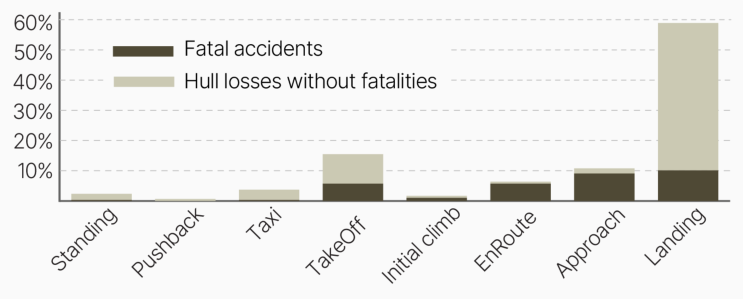
(fig.1) Commercial jet aircraft accidents distribution per flight phase 2004-2024
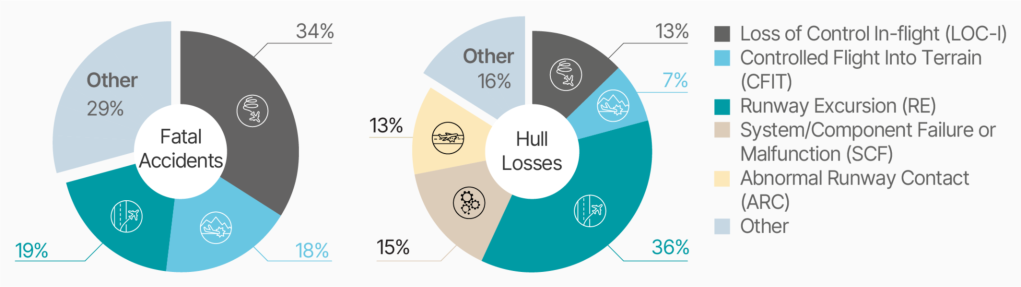
The website also highlights that runway excursion was the third main cause of commercial jet fatal accidents and the first main cause of hull losses in the last twenty years (fig.2).
(fig.2) Accident distribution per category 2004-2024
Innovating for Safety
Section titled “Innovating for Safety”In the early 2000s, Airbus initiated the development of a new technology to mitigate the risk of runway excursion: The Runway Overrun Prevention System (ROPS).
ROPS CONCEPT AND EVOLUTION
Section titled “ROPS CONCEPT AND EVOLUTION”ROPS Concept
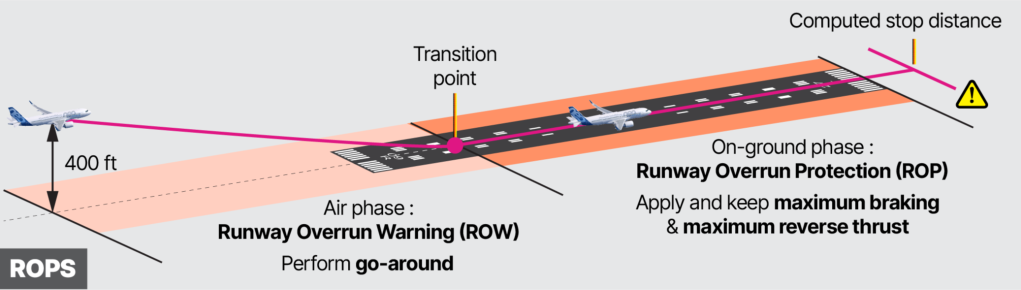
Section titled “ROPS Concept”ROPS has two subfunctions that are activated one after the other, during the final approach and landing phases.
Runway Overrun Warning (ROW)
Section titled “Runway Overrun Warning (ROW)”ROW is active during the final approach until touchdown. This is called the air phase. The system continuously computes the landing distance of the aircraft in real-time, comparing it with either the Landing Distance Available (LDA) of the runway or the remaining runway length, if the aircraft has already crossed the runway threshold.
Below 400 ft , if a runway overrun risk is detected, ROW alerts the flight crew, enabling them to decide to either continue the landing or perform a go-around.
Runway Overrun Protection (ROP)
Section titled “Runway Overrun Protection (ROP)”After touchdown, during the on-ground phase , ROP monitors the position of the aircraft relative to the remaining runway length and continuously computes the stopping distance needed by the aircraft based on current aircraft speed and deceleration.
If a runway overrun risk is identified, ROP alerts the flight crew asking them to apply and keep all available deceleration means i.e. maximum braking and maximum reverse thrust. ROP remains active until 30 kt (taxi speed) is reached.
(fig.3) ROPS concept
Continuous enhancement
Section titled “Continuous enhancement”Airbus continuously enhanced the ROPS concept taking into account in-service feedback from the operators. It evolved from Step 1 on the A380 only, to Step 2 and Step2+ also available on A320 family and A330 aircraft, to now reach Step 3, available on A350 aircraft, and progressively made available for the A320 family aircraft.
Positive trend
Section titled “Positive trend”The reduction in runway overruns encountered by Airbus aircraft in the last 20 years shows a positive trend. The combination of several industry initiatives to prevent runway overrun combined with the progressive implementation of ROPS on the Airbus fleet undoubtedly contributed to these encouraging results.
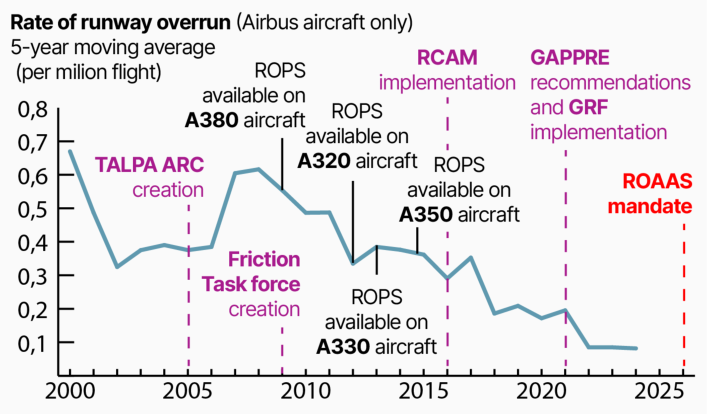
(fig.4) Implementation of ROPS combined with industry initiatives helped in reducing the rate of runway overrun of Airbus aircraft
TALPA ARC : Takeoff/Landing Performance Assessment Aviation Rulemaking Committee led by the FAA RCAM : Runway Condition Assessment Matrix from the TALPA ARC GAPPRE : Global Action Plan for the Prevention of Runway Excursions led by Eurocontrol GRF : Global Reporting Format from ICAO ROAAS : Runway Overrun Awareness and Alerting System
Runway Overrun Awareness and Alerting System (ROAAS) Mandate
Section titled “Runway Overrun Awareness and Alerting System (ROAAS) Mandate”In 2022, Amendment 47 of ICAO Annex 6 introduced a new paragraph in Chapter 6 (Airplane instruments, equipment and flight documents) stating the following:
“ 6.26.1 All turbine-engined aeroplanes of a maximum certificated take-off mass in excess of 5 700 kg, for which the individual certificate of airworthiness is first issued on or after 1 January 2026 , shall be equipped with a runway overrun awareness and alerting system (ROAAS). ”
Compliance with this requirement can be demonstrated by showing compliance with Eurocae ED-250 “Minimum Operation Performance Specification (MOPS) for Runway Overrun Awareness and Alerting System (ROAAS)”
Based on these ICAO recommendations, some national airworthiness authorities have already mandated the installation of a ROAAS on aircraft registered from 1 January 2026. EASA also mandated ROAAS on all aircraft registered from 1 July 2026.
Airbus demonstrated compliance of ROPS Step 2+ and Step 3 to the ROAAS mandate.
ROPS Step 1: The Origin
Section titled “ROPS Step 1: The Origin”The initial concept (ROPS step 1) was introduced on A380 aircraft in 2009. ROPS Step 1 was only available when an autobrake mode was selected (LO, 2, 3, HI or BTV) and was available only for dry and wet runways. ROPS Step 1 is no longer available since all A380 aircraft were upgraded to Step 2.
ROPS Step 2: DRY and WET Runway Conditions
Section titled “ROPS Step 2: DRY and WET Runway Conditions”ROPS Step 2 has the same functionalities as Step 1, but is available both in autobrake and manual braking modes. ROPS Step 2 was introduced in 2011 on A380 aircraft. It also became certified for A320 family and A330 aircraft, respectively, in 2012 and 2013.
Step 2 ROW alerts
Section titled “Step 2 ROW alerts”ROPS Step 2 continuously computes and compares the landing distance for both dry and wet runway states :
-
If the computed landing distance for a WET runway is greater than the LDA (fig.5) , the PFD displays an IF WET : RUNWAY TOO SHORT alert.
-
If the computed landing distance for a DRY runway is greater than the LDA (fig.6) :
-
Between 400 ft and 200 ft , the PFD displays a RUNWAY TOO SHORT alert.
-
Below 200 ft , the PFD still displays a RUNWAY TOO SHORT alert and adds a “ RUNWAY TOO SHORT! ” audio alert.
Step 2 ROP alerts
Section titled “Step 2 ROP alerts”Step 2 uses the WET stopping distance to trigger ROP alerts. If a risk of runway overrun is detected, the following occurs:
-
The PFD displays MAX BRAKING MAX REVERSE red messages.
-
Simultaneously, a “ BRAKE! MAX BRAKING! MAX BRAKING! ” audio alert is triggered and is repeated until full pedal braking is detected.
-
Then, if full pedal braking is detected but thrust levers are not detected in the MAX reverse position, a “ SET MAX REVERSE! ” audio alert is triggered and is repeated until MAX reverse is detected.
-
At 80 kt , if the risk of overrun is still detected, a “ KEEP MAX REVERSE ” audio message is triggered to prevent the flight crew from selecting REV IDLE at 70 kt.
On A380 aircraft, if an autobrake mode is engaged, ROPS automatically applies maximum braking if a risk of overrun is detected. In that case, the MAX BRAKING message is not displayed on the PFD and its audio alert is inhibited.
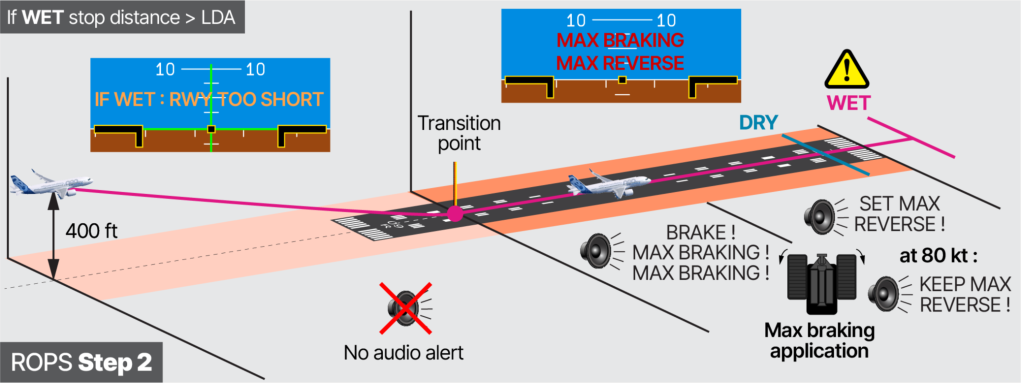
- (fig.5) ROPS Step 2 alerts when the computed landing distance for a WET runway is greater than the LDA
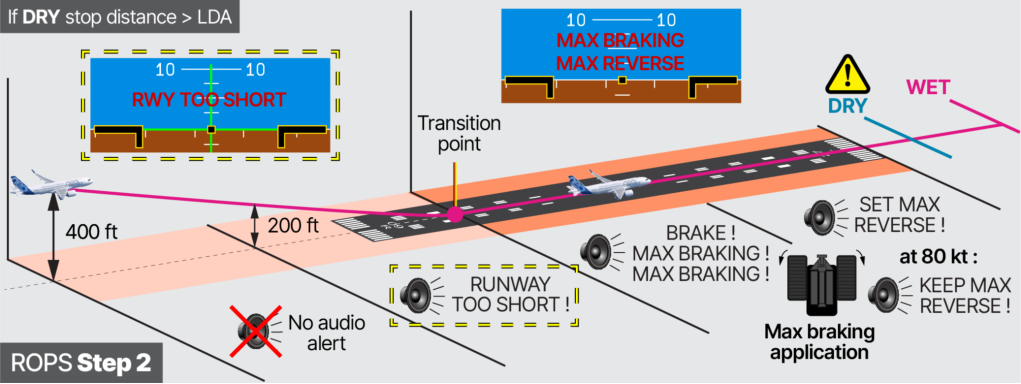
- (fig.6) ROPS Step 2 alerts when the computed landing distance for a DRY runway is greater than the LDA
ROPS Step 2+: DRY or WET Runway Condition
Section titled “ROPS Step 2+: DRY or WET Runway Condition”ROPS Step 2+ was introduced on A350 aircraft in 2014, and on A320 family and A330 aircraft in 2020.
Runway condition selector
Section titled “Runway condition selector”ROPS Step 2+ introduces a ROW/ROP runway condition selector (fig.7) that should be used during the descent preparation to select either the WET or DRY runway condition. The selected runway condition is displayed at the top of the ND.
(fig.7) Step 2+ runway condition selector and indication on ND
Step 2+ ROW alerts
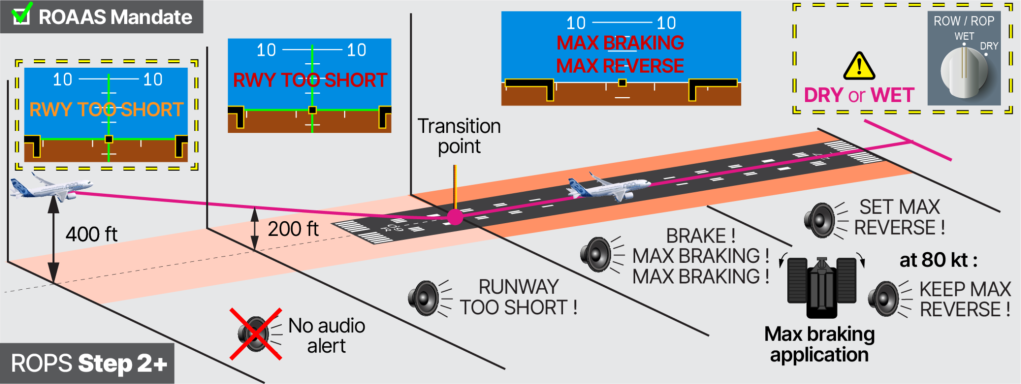
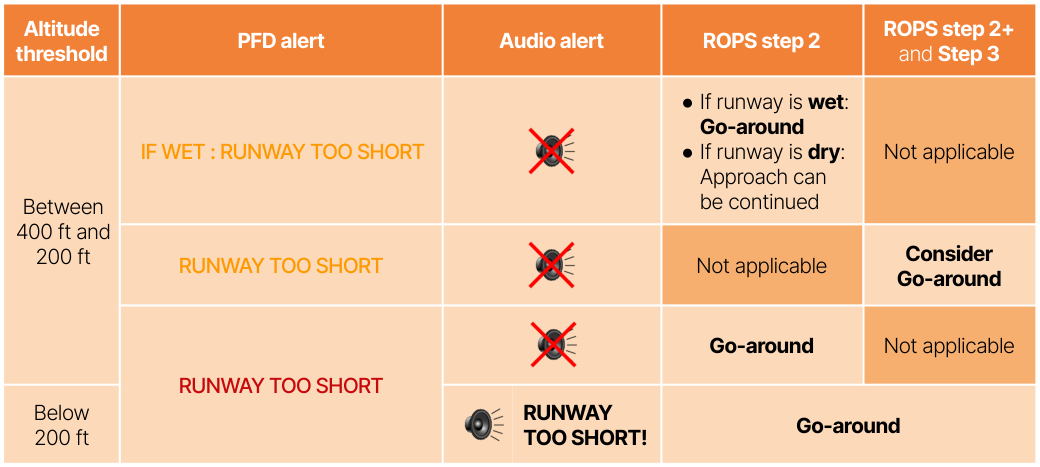
Section titled “Step 2+ ROW alerts”Unlike ROPS Step 2, the runway condition selector of ROPS Step 2+ enables the function to filter alerts, displaying only the one relevant to the selected runway condition , therefore, removing the “IF WET : RUNWAY TOO SHORT” conditional alert.
When either DRY or WET is selected:
-
Below 400 ft, if the computed landing distance of the selected runway condition is greater than the LDA, then the PFD and HUD (if installed) display an amber “RUNWAY TOO SHORT” message.
-
Below 200ft, if the computed landing distance of the selected runway condition is greater than the LDA, then the PFD and HUD (if installed) display a red “RUNWAY TOO SHORT” message combined with a ” RUNWAY TOO SHORT! ” audio alert
Step 2+ ROP alerts
Section titled “Step 2+ ROP alerts”Step 2+ ROP offers similar but enhanced alerts compared with Step 1 and Step 2 alerts. This enhancement comes from Step 2+ using the specific stopping distance for the runway state chosen on the runway condition selector, rather than the more conservative WET value used by ROPS Step 1 and Step 2 (fig.9).
ROW/ROP pushbutton-switch
Section titled “ROW/ROP pushbutton-switch”ROPS Step2+ also introduces a dedicated ROW/ROP pushbutton-switch on the overhead panel to manually inhibit the ROPS function (fig.8).
Compliance with the ROAAS mandate
Section titled “Compliance with the ROAAS mandate”Airbus demonstrated that the ROPS Step2+ is compliant with the ROAAS mandate.
(fig.8) ROW/ROP pushbutton-switch
ROPS Step 3: All Runway Conditions
Section titled “ROPS Step 3: All Runway Conditions”(fig.9) ROPS Step 2+ alerts
ROPS Step 3 was first introduced on the A350 in 2016, and is progressively being certified for the different aircraft models of the A320 family, starting with the A321XLR in 2024. It is available for all runway conditions. ROPS Step 3 represents a significant safety benefit for airlines operating on airports subjected to snow, icing, or heavy precipitation conditions or airports with shorter runways.
Selection of the runway condition
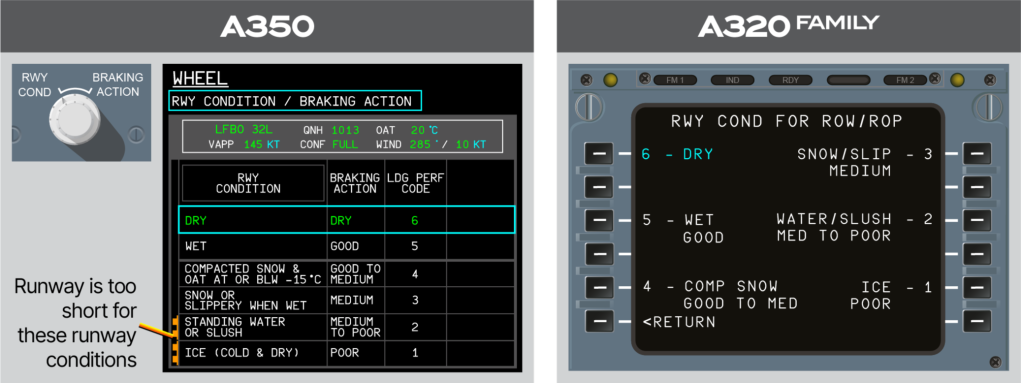
Section titled “Selection of the runway condition”ROPS Step 3 requests the flight crew to select the runway conditions or reporting braking action among the 6 levels defined in accordance with the Global Reporting Format (GRF) from ICAO.
On A350 aircraft, the flight crew can select the runway condition using the RWY COND / BRAKING ACTION selector on the brake panel (fig.10). The selected value is displayed in the RWY CONDITION / BRAKING ACTION matrix displayed on the SD. A barber pole indicates the runway conditions where a risk of overrun is detected.
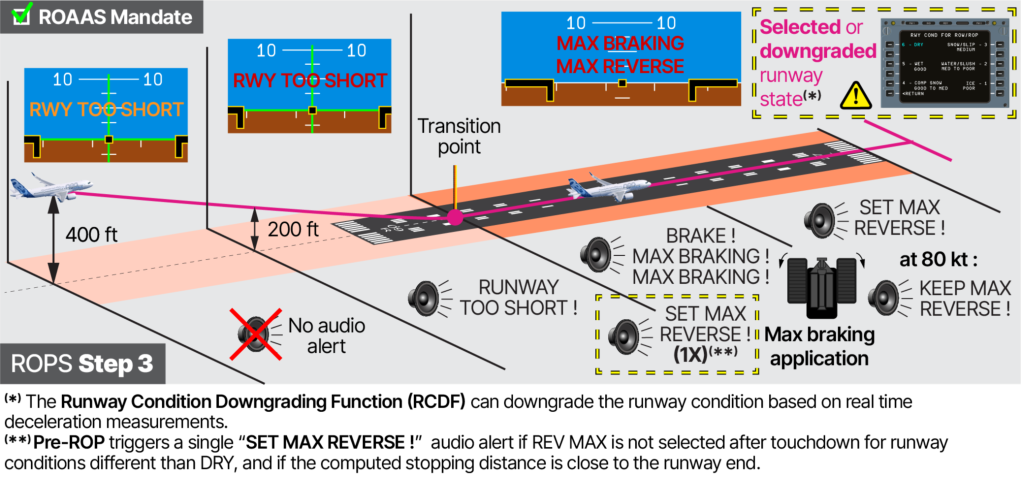
On A320 family aircraft, the flight crew can select the runway condition on the RWY COND FOR ROW/ROP page accessible from the PERF APPR page of the (fig.10) Selection of the MCDU. runway state for ROPS Step 3
Step 3 ROW and ROP alerts
Section titled “Step 3 ROW and ROP alerts”Step 3 provides similar ROW and ROP alerts to the Step 2+ alerts, but for the selected runway condition, with some enhancements.
On A350 aircraft, if an autobrake mode is engaged, ROP automatically applies maximum braking if a risk of overrun is detected. In that case, the MAX BRAKING message is not displayed on the PFD and its audio alert is inhibited.
Pre-ROP message
Section titled “Pre-ROP message”A pre-ROP function provides the crew with a single ‘SET MAX REVERSEʼ audio message , acting as a Standard Operating Procedure (SOP) reminder to select maximum reverser thrust in the following conditions:
-
The selected runway condition is different from DRY
-
MAX REV is not selected after touchdown
-
The computed stop distance is still on the runway but near the end of the runway.
Runway Condition Downgrading Function (RCDF)
Section titled “Runway Condition Downgrading Function (RCDF)”On the ground, if the braking efficiency is lower than anticipated for the selected runway condition, ROP can automatically downgrade the runway condition to the current one.
The RCDF provides awareness of the downgrading via a message on the FMA (fig.11) , as well as an update of the runway condition indication on the ND.
(fig.11) Indication of the runway condition degradation on the FMA
ROPS manual deactivation
Section titled “ROPS manual deactivation”On A320 family aircraft, ROPS Step 3 is not equipped with a ROW/ROP deactivation pushbutton-switch. It can be manually deactivated via the MCDU SURV CONTROLS page, accessible via the DATA INDEX page.
Compliance with the ROAAS mandate
Section titled “Compliance with the ROAAS mandate”Airbus demonstrated that ROPS Step 3 is compliant with the ROAAS mandate. (fig.12) ROPS Step 3 alerts
A220 Runway Overrun Awareness and Alerting System (ROAAS)
Section titled “A220 Runway Overrun Awareness and Alerting System (ROAAS)”A ROAAS function is also being developed for A220 aircraft. It is not yet certified at the time of publication of this article.
The A220 ROAAS slightly differs from the ROPS installed on the other Airbus aircraft, but the same principle applies.
Selection of the runway condition
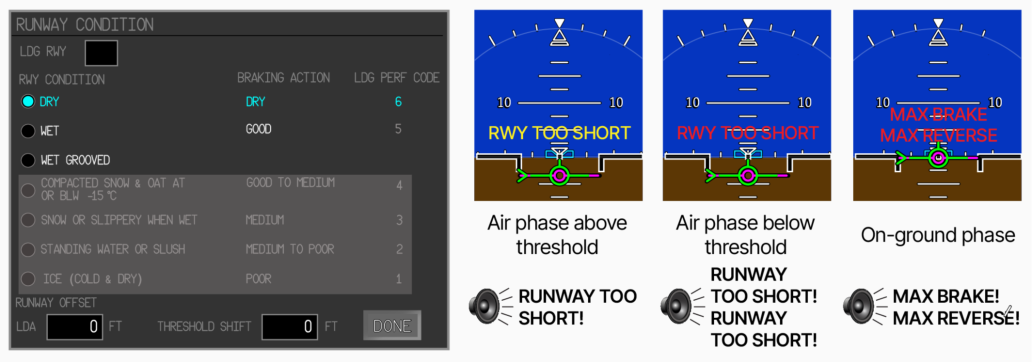
Section titled “Selection of the runway condition”The flight crew can select the runway condition from the MFD PERF page.
The DRY, WET, and WET GROOVED will be available at the introduction of the ROAAS. The other runway conditions will be available after additional certification.
A220 ROAAS alerts
Section titled “A220 ROAAS alerts”As for ROPS, the A220 ROAAS is composed of an air phase divided into two parts by an altitude threshold and an on-ground phase requesting the use of all the deceleration means in the case of a risk of overrun.
(fig.13) A220 ROAAS function
OPERATIONAL CONSIDERATIONS
Section titled “OPERATIONAL CONSIDERATIONS”Mixed Fleet Is Not an Issue
Section titled “Mixed Fleet Is Not an Issue”All A380 aircraft are equipped with ROPS Step 2 and all A350 aircraft are fitted with ROPS Step 3. On A320 family and A330 aircraft, various ROPS standards are currently in service. This can lead to operators having fleets with mixed ROPS standards. However, this is manageable as the operational differences between standards are minor and easily recognizable. Cockpit preparation - Is ROPS installed on my aircraft? During the cockpit preparation, the flight crew can check if ROPS is installed on their aircraft using the Aircraft Configuration Summary table of the QRH. Descent Preparation - Selection of the Runway Condition (if available) No action related to ROPS is required for aircraft equipped with Step 2. On aircraft equipped with ROPS Step 2+, the flight crew should use the ROW/ROP runway condition selector to select the DRY or WET condition depending on the reported conditions. On A320 aircraft with ROPS Step 3, during the FMS preparation, the flight crew will see a ROW/ROP > prompt at the bottom of the PERF APPR page. This leads to the RWY COND FOR ROW/ROP page (A320 family) where the flight crew can (table 1) ROPS actions select the appropriate runway condition. during descent preparation
| ROPS Step 2 | ROPS step 2+ | ROPS step 3 |
|---|---|---|
| SelectRunway condition | ||
| SelectDRYorWET | ||
| No action |
Final Approach
Section titled “Final Approach”Regardless of the ROPS standard, during final approach,
-
If an amber message appears on the PFD, the flight crew must quickly analyze the situation: If IF WET : RUNWAY TOO SHORT appears (step2), they must perform a go-around if the runway is not dry or contaminated, and can continue the approach if the runway is dry. If RUNWAY TOO SHORT appears (Step2+ or Step 3), the flight crew should consider a go-around depending on the situation.
-
If a red RUNWAY TOO SHORT message appears, the flight crew must immediately perform a go-around.
Landing Roll
Section titled “Landing Roll”During the landing roll, there is no difference between the ROPS standards. The handling of alerts is identical.
|---|---|---|---|---|---| |PFD Alert||Audio alert|Crew action (all ROPS standards)||| |||SET MAX REVERSE!|Set thrust lever toMAX REV||| |||KEEP MAX REVERSE!|Maintain thrust levers toMAX REV|||
(table 3) ROPS actions during landing roll
TRAINING CONSIDERATIONS
Section titled “TRAINING CONSIDERATIONS”Level B training
Section titled “Level B training”Level B (aided instruction) training is needed for the use of ROPS. Computer Based Training (CBT) is available, free of charge, and covers the following topics: ● ROW/ROP objectives (table 4) Simulator package ● Operating domain for A320 family and A330 ● ROW/ROP function overview aircraft
| Step 2 | Step 2+ | Step3 | |
|---|---|---|---|
| 2.6 | 3.1(*) | Under study |
(*) hardware modification to add the ROW/ROP runway condition selector
ROPS/ROAAS STANDARDS AVAILABILITY
Section titled “ROPS/ROAAS STANDARDS AVAILABILITY”Compliance of Newly Delivered Aircraft with the ROAAS Mandate
Section titled “Compliance of Newly Delivered Aircraft with the ROAAS Mandate”The below table provides the date of availability of each ROPS standard (table1). The year of application of the current default standard installed in the production line (linefit) for each aircraft type is highlighted in green.
Today, all newly delivered A320 family, A330, and A350 aircraft are equipped with a ROPS standard compliant with the ROAAS mandate.
The introduction of the ROAAS on A220 aircraft is expected in 2027. An exemption period of the ROAAS mandate is expected pending the availability of the function.
(table 5) Date of availability of each ROPS standard
|---|---|---|---|---|---|---|---|---| |||||2012|2020||Retrofit expected in 2029|| |||PW engines||2016|2020||Under development|| |||CFM engines|||||2024|| |||PW engines|||||2025|| |||||2013|2020||Under study|| ||||||2014||2016|| |||||2011|Retrofit expected in 2027||Under study|| |||||ROAAS||||| |||||Linefit expected in 2027|||||
Year of application of the current default standard installed in the production line (linefit)
Retrofit of ROPS standards on in-service A320 family and A330 aircraft
Section titled “Retrofit of ROPS standards on in-service A320 family and A330 aircraft”Operators with A320 family or A330 aircraft that are not equipped with ROPS can retrofit one of the ROPS standards, provided that the necessary system prerequisites are installed.
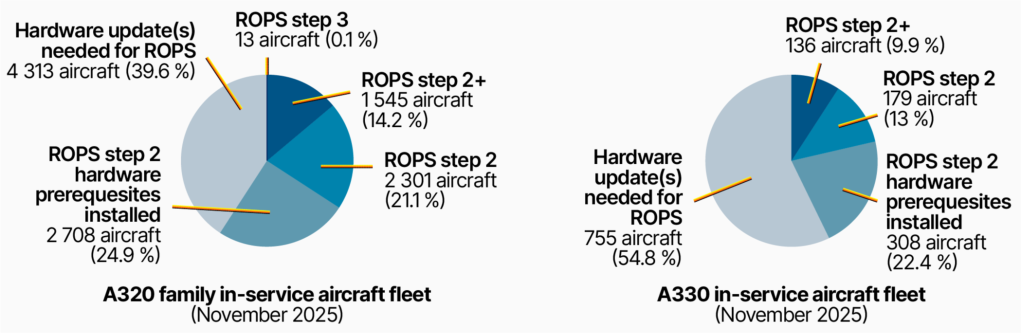
Fleet status
Section titled “Fleet status”In November 2025, the in-service fleet status concerning the ROPS function shows that 35.4 % of the A320 family in-service fleet is equipped with ROPS, representing 3 859 aircraft. It also highlights that 2 708 additional A320 family aircraft could easily activate ROPS since they have all the system hardware prerequisites already installed.
Similarly, 22.9 % of the A330 in-service aircraft fleet is equipped with ROPS and 308 A330 aircraft have all the hardware prerequisites to activate ROPS.
Operators wishing to retrofit ROPS on their aircraft can contact Navblue via https://www.navblue.aero/contact/.
(fig.14) ROPS in-service fleet status
Minimum computer standards for ROPS retrofit on A320 family aircraft
Section titled “Minimum computer standards for ROPS retrofit on A320 family aircraft”| Minimum computer standards for ROPS retrofit on A320 family aircraft | Minimum computer standards for ROPS retrofit on A320 family aircraft | Minimum computer standards for ROPS retrofit on A320 family aircraft | |||
|---|---|---|---|---|---|
| EIS1 V70 or EIS2 S10 | EIS2 S16 | EIS2 S18.1 | |||
| CAA09 or B624/625 | CAA11 | CAA14 | |||
| PC13 or C13 or PI12 or I12 | PI17 or PC20 | PI19 or PC21 | |||
| L5 | L7 | L8C |
(*) Retrofit of Step 3 on aircraft equipped with Step 2+ requires the removal of the ROW/ROP runway condition selector. The ROW/ROP deactivation pushbutton-switch may be kept as it is compatible with Step 3.
(**) Minimum Head Up Display (HUD) standard for ROPS compatibility. HUD is not a prerequisite for ROPS.
Minimum computer standards for ROPS retrofit on A330 aircraft
Section titled “Minimum computer standards for ROPS retrofit on A330 aircraft”| Minimum computer standards for ROPS retrofit on A330 aircraft | Minimum computer standards for ROPS retrofit on A330 aircraft | Minimum computer standards for ROPS retrofit on A330 aircraft | ||
|---|---|---|---|---|
| EIS1 V513 | EIS2 L13 | |||
| C10 | C12 | |||
| T5 | T9-1 | |||
| GLU-920 | GLU-920 or iMMR L2 | |||
| HJ2 | H6A | |||
| L7 | L7 |
(*) Minimum HUD standard for ROPS compatibility. HUD is not a prerequisite for ROPS
Contributors:
Section titled “Contributors:”Jérôme COLLINS
Section titled “Jérôme COLLINS”Program Manager Runway Safety Engineering Navblue
Cédric DESCHEEMAKER
Section titled “Cédric DESCHEEMAKER”Product Safety Enhancement Aviation Safety
Romain MABILLE
Section titled “Romain MABILLE”ROPS Function Leader
Design Office
Thierry RAOUL
Section titled “Thierry RAOUL”ATA 22 Systems marketing
Design Office
Jérôme TOUTAIN
Section titled “Jérôme TOUTAIN”Flight Operations Support Engineer
Customer Support
The Airbus Runway Overrun Prevention System (ROPS) is a safety innovation that addresses the risk of runway excursions, which account for a significant portion of commercial aircraft accidents.
ROPS has two subfunctions: Runway Overrun Warning (ROW) during the final approach to request a go-around, and Runway Overrun Protection (ROP) after touchdown to request the selection of all deceleration means.
ROPS has undergone continuous improvement, progressing from Step 1 to the current Step 2+ and Step 3 standards. These latest standards are compliant with the new Runway Overrun Awareness and Alerting System (ROAAS) mandate (effective from 2026 for new aircraft).
Today, all newly delivered A320 family, A330, and A350 aircraft are equipped with a ROAAS-compliant ROPS standard. A ROAAS function is also in the final development stage for A220 aircraft.
Furthermore, operational flexibility for airlines is ensured, as fleets with mixed ROPS standards are manageable, and a retrofit path is available for in-service A320 family and A330 aircraft to upgrade to one of the ROPS standards. This continuous commitment to prevention contributes to further increasing the level of safety by mitigating the risk of runway overrun across the Airbus fleet.
Safety first, 2026. Safety first is published by Airbus S.A.S. 1, rond point Maurice Bellonte - 31707 Blagnac Cedex/France.
Editor: Yannick Malinge, SVP Aviation Safety.
Editorial team: Guillaume Estragnat, Javier Martinez Marina, Vanessa Sadi, Gwyneth Duggan, Agathe Sanz, Bruno Fargeon.
Photos by Airbus.
Source: Airbus Safety First URL: https://safetyfirst.airbus.com/further-preventing-runway-overrun/ Published: 2026-01-21 Category: Flight Ops, brake, Braking, energy, excursion, landing, landing distance, overrun, reverse, runway excursion, runway too short PDF: Original PDF
Android 设备。
跑道偏出:主要事故原因之一
Section titled “跑道偏出:主要事故原因之一”从“A - 商用飞机事故统计分析 1958-2024”网站公布的各飞行阶段事故分布图可以清楚地看到,过去二十年(59 %)的大多数商用飞机事故发生在着陆阶段 (fig.1)。
(fig.1) 2004-2024 年商用喷气飞机各飞行阶段事故分布
该网站还指出,跑道偏出是过去二十年商用喷气飞机致命事故的第三大原因,也是机体损毁的第一大原因 (fig.2)。
(fig.2) 2004-2024 年各类事故分布
创新以确保安全
Section titled “创新以确保安全”二十一世纪初,空客着手开发一项新技术以降低跑道偏出的风险:跑道超出预防系统(ROPS)。
ROPS 概念与演进
Section titled “ROPS 概念与演进”ROPS 概念
Section titled “ROPS 概念”ROPS 有两个子功能,在最后进近和着陆阶段依次激活。
跑道超出警告(ROW)
Section titled “跑道超出警告(ROW)”ROW 在**最后进近直至接地期间处于激活状态,这被称为空中阶段。**系统实时持续计算飞机的着陆距离,并与跑道的可用着陆距离(LDA)或剩余跑道长度(如飞机已飞越跑道入口)进行比较。
在 400 ft 以下,如检测到跑道超出风险,ROW 向飞行机组发出警报,使他们能够决定继续着陆或执行复飞。
跑道超出保护(ROP)
Section titled “跑道超出保护(ROP)”接地后,在地面阶段,ROP 监控飞机相对于剩余跑道的位置,并根据当前飞机速度和减速能力持续计算飞机所需停止距离。
如识别出跑道超出风险,ROP 向飞行机组发出警报,要求他们应用并保持所有可用减速手段,即最大制动和最大反推。ROP 保持激活直至达到 30 kt(滑行速度)。
(fig.3) ROPS 概念
空客持续根据运营商的运营反馈改进 ROPS 概念。该系统从 A380 仅有的第 1 步,演进到第 2 步和第 2+ 步(也可用于 A320 系列和 A330 飞机),直至达到第 3 步,目前用于 A350 飞机,并逐步推广至 A320 系列飞机。
过去二十年间,空客飞机跑道超出的减少呈现积极趋势。多项行业防止跑道超出倡议与 ROPS 在空客机队上的逐步实施相结合,无疑为这些令人鼓舞的成果做出了贡献。
(fig.4) ROPS 的实施与行业倡议相结合,有助于降低空客飞机跑道超出的发生率
TALPA ARC:由 FAA 主导的起飞/着陆性能评估航空规则制定委员会 RCAM:TALPA ARC 的跑道状况评估矩阵 GAPPRE:由欧洲航空管制组织(Eurocontrol)主导的防止跑道偏出全球行动计划 GRF:国际民航组织(ICAO)的全球报告格式 ROAAS:跑道超出意识与警报系统
跑道超出意识与警报系统(ROAAS)强制要求
Section titled “跑道超出意识与警报系统(ROAAS)强制要求”2022 年,ICAO 附件 6 第 47 号修订版在第 6 章(飞机仪表、设备和飞行文件)中新增了以下条款:
“6.26.1 所有最大认证起飞质量超过 5 700 kg 的涡轮发动机飞机,对于在2026 年 1 月 1 日或之后首次颁发单独适航证的飞机,应配备跑道超出意识与警报系统(ROAAS)。”
符合此要求可通过证明符合欧洲航空电子委员会 ED-250“跑道超出意识与警报系统(ROAAS)最低运行性能规范(MOPS)”来实现。
基于这些 ICAO 建议,一些国家适航当局已强制要求在 2026 年 1 月 1 日起注册的飞机上安装 ROAAS。EASA 也强制要求在 2026 年 7 月 1 日起注册的所有飞机上安装 ROAAS。
空客已证明 ROPS 第 2+ 步和第 3 步符合 ROAAS 强制要求。
ROPS 第 1 步:起源
Section titled “ROPS 第 1 步:起源”初始概念(ROPS 第 1 步)于 2009 年在 A380 飞机上首次引入。ROPS 第 1 步仅在选择自动刹车模式(LO、2、3、HI 或 BTV)时可用,且仅适用于干燥和潮湿跑道。ROPS 第 1 步已不再可用,因为所有 A380 飞机都已升级至第 2 步。
ROPS 第2步:干跑道与湿跑道条件
Section titled “ROPS 第2步:干跑道与湿跑道条件”ROPS 第2步具有与第1步相同的功能,但在自动刹车和人工刹车模式下均可使用。ROPS 第2步于2011年在A380飞机上引入。随后分别于2012年和2013年在A320系列和A330飞机上获得认证。
第2步 ROW 警报
Section titled “第2步 ROW 警报”ROPS 第2步持续计算并比较干、湿跑道状态的着陆距离:
-
如果计算出的湿跑道着陆距离大于 LDA (图5),则 PFD 显示 IF WET : RUNWAY TOO SHORT(湿跑道:跑道过短)警报。
-
如果计算出的干跑道着陆距离大于 LDA (图6):
-
在400 ft至200 ft之间,PFD 显示 RUNWAY TOO SHORT(跑道过短)警报。
-
在200 ft以下,PFD 仍显示 RUNWAY TOO SHORT(跑道过短)警报,并叠加”RUNWAY TOO SHORT!”(跑道过短!)音频警报。
第2步 ROP 警报
Section titled “第2步 ROP 警报”第2步使用湿跑道制动距离来触发 ROP 警报。如果检测到跑道超限风险,将发生以下情况:
-
PFD 显示 MAX BRAKING MAX REVERSE(最大刹车 最大反推)红色信息。
-
同时触发”BRAKE! MAX BRAKING! MAX BRAKING!”(刹车!最大刹车!最大刹车!)音频警报,并重复播报直至检测到全脚蹬刹车。
-
然后,如果检测到全脚蹬刹车但推力手柄未处于最大反推位,则触发”SET MAX REVERSE!”(设置最大反推!)音频警报,并重复播报直至检测到最大反推。
-
在80 kt时,如果仍检测到超限风险,则触发”KEEP MAX REVERSE”(保持最大反推)音频信息,以防止机组人员在70 kt时选择慢车反推。
在A380飞机上,如果自动刹车模式接通,ROPS 将自动施加最大刹车以防止超限风险。在这种情况下,PFD 上不显示 MAX BRAKING 信息,且其音频警报被抑制。
- (图5) 当计算的湿跑道着陆距离大于 LDA 时,ROPS 第2步警报
- (图6) 当计算的干跑道着陆距离大于 LDA 时,ROPS 第2步警报
ROPS 第2步+:干或湿跑道条件
Section titled “ROPS 第2步+:干或湿跑道条件”ROPS 第2步+于2014年在A350飞机上引入,并于2020年在A320系列和A330飞机上引入。
跑道条件选择器
Section titled “跑道条件选择器”ROPS 第2步+引入了 ROW/ROP 跑道条件选择器**(图7)**,应在下降准备阶段使用,以选择干跑道或湿跑道条件。所选的跑道条件显示在 ND 顶部。
(图7) 第2步+ 跑道条件选择器及 ND 上的显示
第2步+ ROW 警报
Section titled “第2步+ ROW 警报”与 ROPS 第2步不同,ROPS 第2步+的跑道条件选择器使功能能够过滤警报,仅显示与所选跑道条件相关的警报,因此,取消了”IF WET : RUNWAY TOO SHORT”(湿跑道:跑道过短)条件警报。
当选择干跑道或湿跑道时:
-
在400 ft以下,如果所选跑道条件的计算着陆距离大于 LDA,则 PFD 和 HUD(如已安装)显示琥珀色”RUNWAY TOO SHORT”(跑道过短)信息。
-
在200 ft以下,如果所选跑道条件的计算着陆距离大于 LDA,则 PFD 和 HUD(如已安装)显示红色”RUNWAY TOO SHORT”(跑道过短)信息,并叠加”RUNWAY TOO SHORT!”(跑道过短!)音频警报
第2步+ ROP 警报
Section titled “第2步+ ROP 警报”第2步+ ROP 提供与第1步和第2步警报相似但增强的警报。此增强源于第2步+使用跑道条件选择器上所选跑道状态的特定制动距离,而非 ROPS 第1步和第2步使用的较为保守的湿跑道值**(图9)**。
ROW/ROP 按压开关
Section titled “ROW/ROP 按压开关”ROPS 第2步+还在头顶面板上引入了专用的 ROW/ROP 按压开关**(图8),用于手动抑制 ROPS 功能(图8)**。
符合 ROAAS 要求
Section titled “符合 ROAAS 要求”空中客车公司已证明ROPS 第2步+符合 ROAAS 要求。
(图8) ROW/ROP 按压开关
ROPS 第3步:所有跑道条件
Section titled “ROPS 第3步:所有跑道条件”(图9) ROPS 第2步+警报
ROPS 第3步于2016年首次在A350上引入,并正在逐步为A320系列的不同机型取得认证,从2024年的A321XLR开始。ROPS 第3步适用于所有跑道条件。对于在受冰雪或强降水条件影响的机场或使用较短跑道的机场运营的航空公司而言,ROPS 第3步代表着重大的安全效益。
跑道条件选择
Section titled “跑道条件选择”ROPS 第3步要求机组人员根据 ICAO 发布的全球报告格式(GRF)定义的6个等级中选择跑道条件或报告刹车效应。
在A350飞机上,机组人员可使用刹车面板上的**RWY COND / BRAKING ACTION(跑道条件/刹车效应)选择器****(图10)**来选择跑道条件。所选值显示在 SD 上显示的 RWY CONDITION / BRAKING ACTION(跑道条件/刹车效应)矩阵中。彩色条纹指示检测到超限风险的跑道条件。
在A320系列飞机上,机组人员可通过 MCDU 的 **PERF APPR(性能进近)**页面访问 RWY COND FOR ROW/ROP(ROW/ROP 跑道条件)页面来选择跑道条件。(图10) ROPS 第3步的跑道状态选择
第3步 ROW 和 ROP 警报
Section titled “第3步 ROW 和 ROP 警报”第3步提供与第2步+警报相似的 ROW 和 ROP 警报,但针对所选跑道条件,并有一些增强。
在A350飞机上,如果自动刹车模式接通,ROP 将自动施加最大刹车以防止超限风险。在这种情况下,PFD 上不显示 MAX BRAKING 信息,且其音频警报被抑制。
Pre-ROP message
Section titled “Pre-ROP message”预ROP功能在以下条件下向机组提供单一的”SET MAX REVERSE(设置最大反推)“音频信息,作为标准操作程序(SOP)提醒,选择最大反推推力:
- 所选跑道状况与干燥不同
- 着陆后未选择MAX REV
- 计算的停止距离仍在跑道上,但接近跑道末端
Runway Condition Downgrading Function (RCDF)
Section titled “Runway Condition Downgrading Function (RCDF)”在地面,如果所选跑道状况的制动效率低于预期,ROP可自动将跑道状况降级至当前状况。
RCDF通过FMA上的信息 (图11) 提供降级提示,同时更新ND上的跑道状况指示。
(图11) FMA上跑道状况降级的提示
ROPS manual deactivation
Section titled “ROPS manual deactivation”在A320系列飞机上,ROPS Step 3未配备ROW/ROP停用按键开关。可通过MCDU SURV CONTROLS页面手动停用,该页面可通过DATA INDEX页面访问。
Compliance with the ROAAS mandate
Section titled “Compliance with the ROAAS mandate”空客已证实ROPS Step 3符合ROAAS指令要求。(图12) ROPS Step 3警报
A220 Runway Overrun Awareness and Alerting System (ROAAS)
Section titled “A220 Runway Overrun Awareness and Alerting System (ROAAS)”A220飞机也在开发ROAAS功能。在本文发布时,该功能尚未获得认证。
A220 ROAAS与安装在其他空客飞机上的ROPS略有不同,但原理相同。
Selection of the runway condition
Section titled “Selection of the runway condition”机组可通过MFD PERF页面选择跑道状况。
ROAAS推出时将提供DRY、WET和WET GROOVED选项。其他跑道状况将在补充认证后提供。
A220 ROAAS alerts
Section titled “A220 ROAAS alerts”与ROPS一样,A220 ROAAS由空中阶段(按高度阈值分为两部分)和地面阶段组成,在存在超限风险时请求使用所有减速手段。
(图13) A220 ROAAS功能
OPERATIONAL CONSIDERATIONS
Section titled “OPERATIONAL CONSIDERATIONS”混合机队不成问题
Section titled “混合机队不成问题”所有A380飞机均配备ROPS Step 2,所有A350飞机均配备ROPS Step 3。在A320系列和A330飞机上,多种ROPS标准目前正在服役。这可能导致运营商机队中存在混合ROPS标准的情况。然而,这是可以管理的,因为不同标准之间的操作差异很小且易于识别。**驾驶舱准备——我的飞机是否安装了ROPS?**在驾驶舱准备期间,机组可使用QRH的飞机配置摘要表检查其飞机是否安装了ROPS。下降准备——跑道状况选择(若可用)配备Step 2的飞机无需执行与ROPS相关的操作。配备ROPS Step 2+的飞机,机组应使用ROW/ROP跑道状况选择器,根据报告的跑道状况选择DRY或WET。在配备ROPS Step 3的A320飞机上,FMS准备期间,机组将在PERF APPR页面底部看到ROW/ROP >提示。这将进入RWY COND FOR ROW/ROP页面(A320系列),机组可在此(表1) 选择适当的跑道状况。下降准备期间的ROPS操作
| ROPS Step 2 | ROPS Step 2+ | ROPS Step 3 |
|---|---|---|
| 选择跑道状况 | ||
| 选择DRY或WET | ||
| 无操作 |
Final Approach
Section titled “Final Approach”无论ROPS标准如何,在最后进近期间:
-
如果PFD上出现琥珀色信息,机组必须快速分析情况:如果出现IF WET : RUNWAY TOO SHORT(Step 2),且跑道不干燥或受污染,则必须执行复飞;如果跑道干燥,可继续进近。如果出现RUNWAY TOO SHORT(Step 2+或Step 3),机组应根据情况考虑复飞。
-
如果出现红色RUNWAY TOO SHORT信息,机组必须立即执行复飞。
Landing Roll
Section titled “Landing Roll”在着陆滑跑期间,不同ROPS标准之间没有差异。警报处理方式相同。
|---|---|---|---|---|---| |PFD警报||音频警报|所有ROPS标准的机组动作||| |||SET MAX REVERSE!|将推力手柄设置至MAX REV||| |||KEEP MAX REVERSE!|保持推力手柄在MAX REV|||
(表3) 滑跑期间的ROPS动作
TRAINING CONSIDERATIONS
Section titled “TRAINING CONSIDERATIONS”Level B培训
Section titled “Level B培训”使用ROPS需要Level B(辅助教学)培训。提供计算机基础培训(CBT),免费使用,涵盖以下主题:● ROW/ROP目标 (表4) 模拟机培训包● A320系列和A330飞机的运行范围● ROW/ROP功能概述
| Step 2 | Step 2+ | Step 3 | |
|---|---|---|---|
| 2.6 | 3.1(*) | 研究中 |
(*) 需要硬件改装以添加ROW/ROP跑道状况选择器
ROPS/ROAAS 标准可用性
Section titled “ROPS/ROAAS 标准可用性”新交付飞机符合 ROAAS 指令
Section titled “新交付飞机符合 ROAAS 指令”下表提供了每项 ROPS 标准的可用日期 (table1)。每种机型生产线改装(linefit)所安装的当前默认标准的应用年份以绿色高亮显示。
目前,所有新交付的 A320 系列、A330 和 A350 飞机均配备了符合 ROAAS 指令的 ROPS 标准。
A220 飞机预计将于 2027 年引入 ROAAS。在该功能可用之前,预计将有一个 ROAAS 指令的豁免期。
(table 5) 每项 ROPS 标准的可用日期
|---|---|---|---|---|---|---|---|---| |||||2012|2020||改装预计于 2029 年完成|| |||PW 发动机||2016|2020||开发中|| |||CFM 发动机|||||2024|| |||PW 发动机|||||2025|| |||||2013|2020||研究中|| ||||||2014||2016|| |||||2011|改装预计于 2027 年完成||研究中|| |||||ROAAS||||| |||||生产线改装预计于 2027 年完成|||||
生产线改装(linefit)所安装的当前默认标准的应用年份
在役 A320 系列和 A330 飞机 ROPS 标准的改装
Section titled “在役 A320 系列和 A330 飞机 ROPS 标准的改装”尚未配备 ROPS 的 A320 系列或 A330 飞机运营商可以改装其中一项 ROPS 标准,前提是已安装了必要的系统先决条件。
2025 年 11 月,在役机队 ROPS 功能状态显示,A320 系列在役机队的 35.4% 已配备 ROPS,共 3,859 架飞机。还显示另有 2,708 架 A320 系列飞机可以轻松激活 ROPS,因为它们已安装了所有系统硬件先决条件。
同样,A330 在役机队的 22.9% 已配备 ROPS,308 架 A330 飞机已具备激活 ROPS 的所有硬件先决条件。
希望为其飞机改装 ROPS 的运营商可以通过 https://www.navblue.aero/contact/ 联系 Navblue。
(fig.14) ROPS 在役机队状态
A320 系列飞机 ROPS 改装的最低计算机标准
Section titled “A320 系列飞机 ROPS 改装的最低计算机标准”| A320 系列飞机 ROPS 改装的最低计算机标准 | A320 系列飞机 ROPS 改装的最低计算机标准 | A320 系列飞机 ROPS 改装的最低计算机标准 | |||
|---|---|---|---|---|---|
| EIS1 V70 或 EIS2 S10 | EIS2 S16 | EIS2 S18.1 | |||
| CAA09 或 B624/625 | CAA11 | CAA14 | |||
| PC13 或 C13 或 PI12 或 I12 | PI17 或 PC20 | PI19 或 PC21 | |||
| L5 | L7 | L8C |
(*) 在配备 Step 2+ 的飞机上改装 Step 3 需要拆除 ROW/ROP 跑道状况选择器。ROW/ROP 关断按钮开关可以保留,因为它与 Step 3 兼容。
(**) ROPS 兼容性所需的最低平视显示器(HUD)标准。HUD 不是 ROPS 的先决条件。
A330 飞机 ROPS 改装的最低计算机标准
Section titled “A330 飞机 ROPS 改装的最低计算机标准”| A330 飞机 ROPS 改装的最低计算机标准 | A330 飞机 ROPS 改装的最低计算机标准 | A330 飞机 ROPS 改装的最低计算机标准 | ||
|---|---|---|---|---|
| EIS1 V513 | EIS2 L13 | |||
| C10 | C12 | |||
| T5 | T9-1 | |||
| GLU-920 | GLU-920 或 iMMR L2 | |||
| HJ2 | H6A | |||
| L7 | L7 |
(*) ROPS 兼容性所需的最低 HUD 标准。HUD 不是 ROPS 的先决条件
Jérôme COLLINS
Section titled “Jérôme COLLINS”跑道安全工程项目经理 Navblue
Cédric DESCHEEMAKER
Section titled “Cédric DESCHEEMAKER”产品安全增强 航空安全
Romain MABILLE
Section titled “Romain MABILLE”ROPS 功能负责人 设计办公室
Thierry RAOUL
Section titled “Thierry RAOUL”ATA 22 系统营销 设计办公室
Jérôme TOUTAIN
Section titled “Jérôme TOUTAIN”飞行运营支持工程师 客户支持
空中客车跑道冲出防护系统(ROPS)是一项安全创新,旨在应对跑道偏出跑道风险,该风险在商用飞机事故中占很大比例。
ROPS 有两个子功能:进近阶段的跑道冲出警告(ROW),用于请求复飞;以及接地后的跑道冲出防护(ROP),用于请求选择所有减速手段。
ROPS 经历了持续改进,从 Step 1 发展到当前的 Step 2+ 和 Step 3 标准。这些最新标准符合新的跑道冲出意识与警示系统(ROAAS)指令(从 2026 年起对新飞机生效)。
目前,所有新交付的 A320 系列、A330 和 A350 飞机均配备了符合 ROAAS 要求的 ROPS 标准。A220 飞机的 ROAAS 功能也处于最终开发阶段。
此外,航司的运营灵活性得到保障,因为配备不同 ROPS 标准的混合机队是可以管理的,并且为在役 A320 系列和 A330 飞机提供了改装路径,以升级至其中一项 ROPS 标准。这一对预防的持续投入有助于进一步提高安全水平,通过降低整个空客机队跑道冲出的风险来提升安全裕度。
Safety first,2026 年。Safety first 由空中客车公司出版。地址:法国布朗尼亚克 Cedex 31707,贝尔蒙大道 1 号(31707 Blagnac Cedex/France,1 rond point Maurice Bellonte)。
主编:Yannick Malinge,航空安全高级副总裁。
编辑团队:Guillaume Estragnat、Javier Martinez Marina、Vanessa Sadi、Gwyneth Duggan、Agathe Sanz、Bruno Fargeon。
照片由空中客车公司提供。