Introduction to the Soft Go-Around Function
Source: Airbus Safety First URL: https://safetyfirst.airbus.com/introduction-to-the-soft-go-around-function/ Published: 2017-01-29 Magazine Issue: 2017-01 Category: Flight Ops, AFS, disorientation, FLX, FMGC, FMGEC, go around, illusion, MCT, soft, somatogravic, spatial, SRS, TOGA PDF: Original PDF
The “all engines” go-around is a very dynamic procedure with high accelerations created by the application of TOGA thrust. Yet in-service experience has shown that as long as both engines are operating, a lower thrust can still be suffi cient to perform a safe go-around.
As a safety enhancement, Airbus has introduced the Soft Go-Around (SGA) function, which provides a reduced go-around thrust and associated operating procedures.
This article will review how the Soft Go-Around function works, how it is activated, on which aircraft it is installed, and how to deal with a “mixed” fl eet composed of aircraft with and without the function.
BRICE FERNANDEZ
Propulsion System Certifi cation & Airworthiness
CAPT. XAVIER LESCEU
Head of Operational & Training Policy
DAVID MARCONNET
Flight Operations Support & Training Standards - Safety Enhancement
GO-AROUNDS & SOMATOGRAVIC ILLUSION
Section titled “GO-AROUNDS & SOMATOGRAVIC ILLUSION”Go-arounds can be performed in various conditions (aircraft weight, speed, altitude…). However, even if these parameters are known to vary significantly from one go-around to another, up until recently only one level of thrust has been available to perform this manoeuvre: the TOGA thrust.
Flight crew are not used to the feeling of such a strong acceleration, so this may lead to them being surprised. The strong longitudinal acceleration induced by the TOGA thrust may ultimately lead to Spatial Disorientation (SD) of the flight crew caused by a Somatogravic Illusion (SI). SI is a suspected element in several fatal accidents.
Go-arounds usually take place when an aircraft’s weight is well below the Max Landing Weight, and of course, when fl ying at a low speed close to the Approach speed (VAPP). Application of the TOGA thrust under these conditions creates an unusually strong longitudinal acceleration. Such a strong acceleration is rarely experienced by fl ight crew since the only other time TOGA thrust is applied is at take-off when the aircraft is heavy.
As a means to reduce the likelihood of SI occurring, Airbus developed a function that allows crews to perform a go-around with a reduced thrust, adapted to the aircraft weight, speed and altitude: the Soft Go-Around Function (SGA).
WHAT IS THE SOMATOGRAVIC ILLUSION?
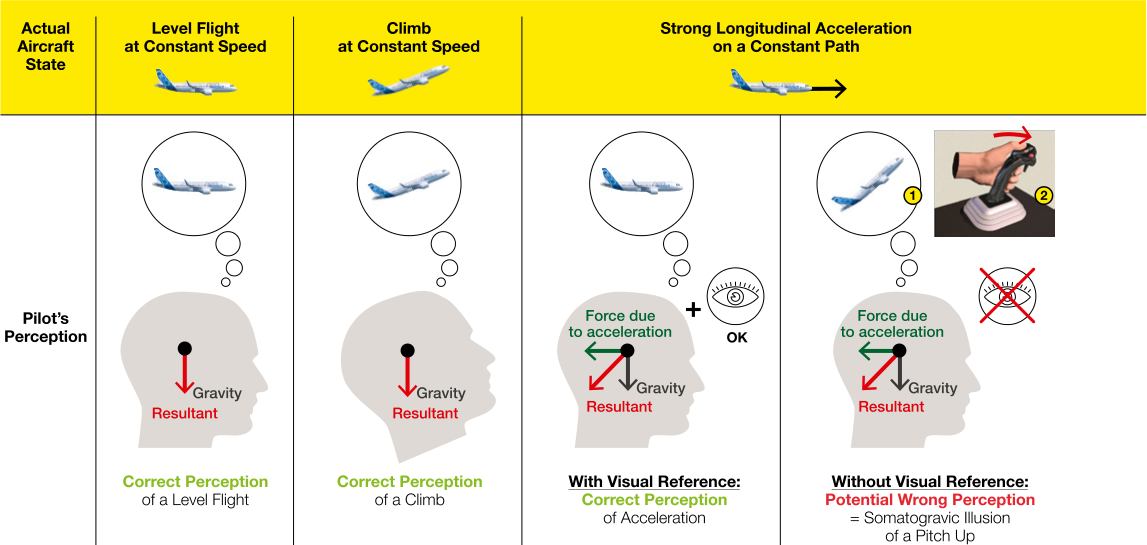
Section titled “WHAT IS THE SOMATOGRAVIC ILLUSION?”Somatogravic Illusion (SI) is a spatial disorientation phenomena which is caused by a mismatch between different signals from our senses and the brain. It is generated by a strong longitudinal acceleration or deceleration. The brain interprets acceleration as a pitch up and this may lead to inappropriate pitch down command. (fi g.1)
Pilots can be especially susceptible to SI when performing a go-around at night or in poor visual conditions. The strong longitudinal accelerations combined with a lack of visual references lead to the mistaken perception of excessive pitch up.
(fi g.1)
Section titled “(fi g.1)”Explanation of the Somatogravic Illusion
PRINCIPLE OF THE SOFT GO-AROUND FUNCTION
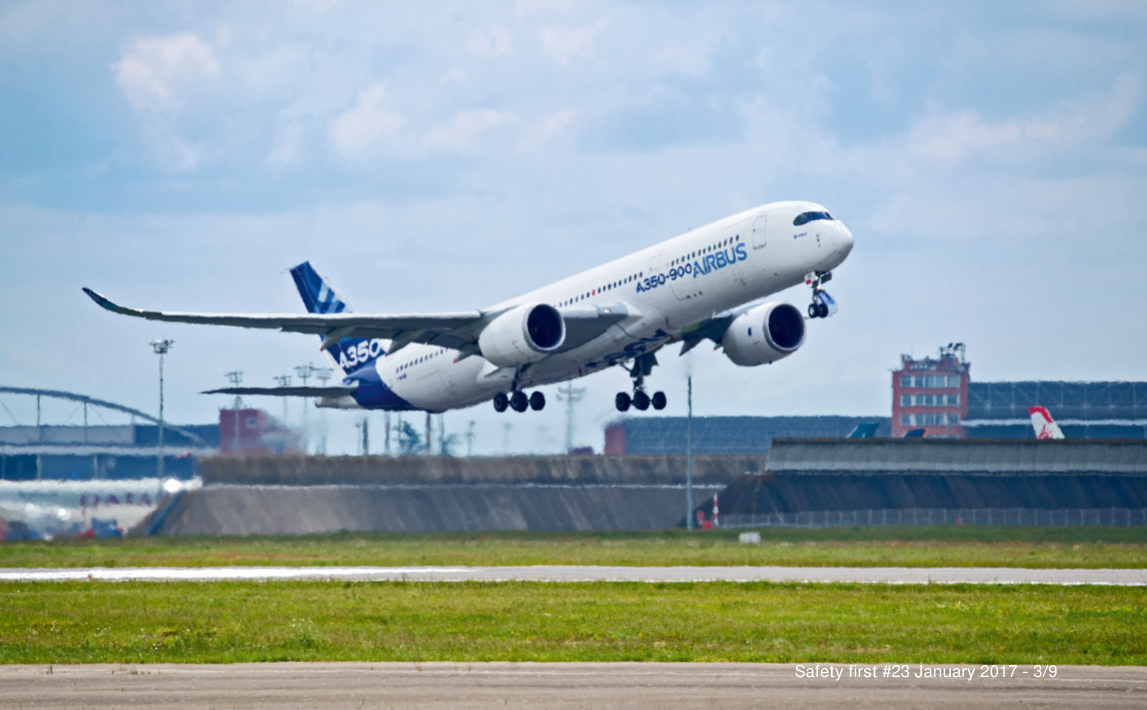
Section titled “PRINCIPLE OF THE SOFT GO-AROUND FUNCTION”The SGA function provides a lower than TOGA initial thrust level, such that it ensures a reduced acceleration and requirement to pitch up and a lower but constant final rate of climb whatever the aircraft weight, speed, altitude and Slat/Flaps configuration.
The SGA function provides a lower than TOGA initial thrust level, such that it ensures a reduced acceleration and requirement to pitch up and a lower but constant final rate of climb whatever the aircraft weight, speed, altitude and Slat/Flaps configuration.
Airbus has designed the SGA climb capability to be sufficient to be able to deal with the world’s most demanding missed approaches. The target rate of climb is either 2000 or 2300 ft/min, depending on the aircraft model.
To put 2000 ft/min into context, if a go-around is performed by an A330300 at a weight of 150 tons, at sea level, the rate of climb obtained with the TOGA thrust is 3500 ft/min.
Performance of the SGA function is demonstrated to be at least as good as if the go-around was performed with TOGA thrust with One Engine Inoperative (OEI).
The Soft Go-Around function is only available when all engines are operating:
-
If the go-around is performed with one engine inoperative, TOGA thrust must be used
-
In the case of an engine failure during a soft go-around, the flight crew must also select TOGA thrust.
At any time during a soft go-around, the TOGA thrust can be applied if needed by setting the thrust levers to the TOGA position.
Based on the environmental conditions, the aircraft weight, altitude, speed and slats/fl aps confi guration, the Auto Flight System (AFS) via the PRIMs (A350/A380) or FMGECs (A330) or FMGCs (A320) computes a thrust target that will enable the aircraft to climb at 2000 (or 2300 ft/min) (fi g.2). This thrust target is then sent to the engines FADEC that will apply the optimized thrust as soon as the function is activated via the thrust levers.
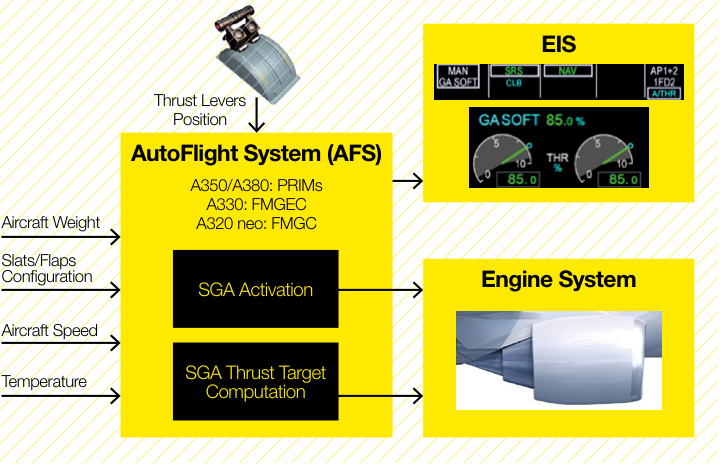
(fi g.2) SGA functional description
SOFT GO-AROUND ACTIVATION AND DEACTIVATION
Section titled “SOFT GO-AROUND ACTIVATION AND DEACTIVATION”When the go-around is initiated, the fl ight crew sets the thrust levers to TOGA position, as usual, to trigger all the logics (approach modes disengagement, FMS FPL sequencing…), and then activates the SGA by moving back without delay the thrust lever to the FLX/MCT detent. Like any mode, the fl ight crew checks the engagement of the SGA via the FMA (fi g.3) :
1. The fl ight crew fi rst sets the thrust lever to the TOGA detent to:
-
Disengage the approach modes
-
Engage the go-around guidance mode (SRS GA TRK or SRS NAV)
-
Engage the go-around phase of the FMS to insert the missed-approach procedure in the FMS fl ight plan.
2. Without delay, the fl ight crew sets the thrust levers back to the FLX/ MCT detent to engage the SGA mode (MAN GA SOFT displayed on the FMA)
3. If the fl ight crew follows FD orders or if AP is ON, a 2000 ft/mn (or 2300 ft/mn) is maintained
4. At the Go-around thrust reduction altitude, the flight crew sets the thrust levers to the CLB detent:
-
MAN GA SOFT disengages
-
The CLB guidance mode engages
-
The Autothrust activates.
(fi g.3)
Section titled “(fi g.3)”Soft Go-Around Activation/Deactivation
UPDATED FCOM GO-AROUND PROCEDURE
Section titled “UPDATED FCOM GO-AROUND PROCEDURE”On aircraft equipped with the SGA function, SGA is now fully part of the Standard Operating Procedures (SOPs). The FCOM and QRH have been updated accordingly.
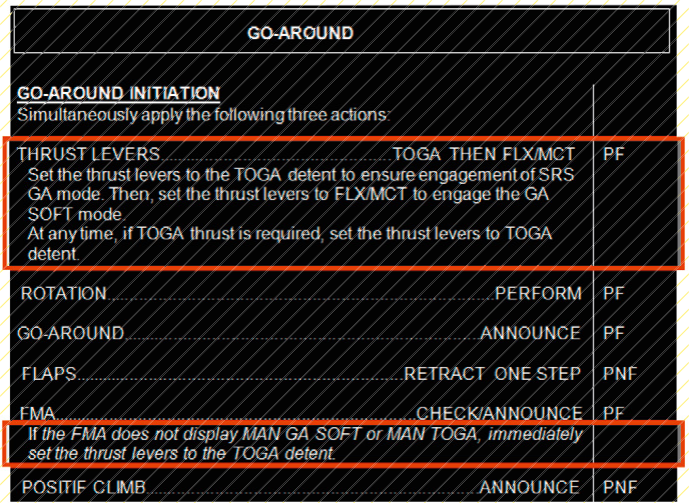
Example of FCOM GO-AROUND procedure with SGA
SOFT GO-AROUND FUNCTION AVAILABILITY
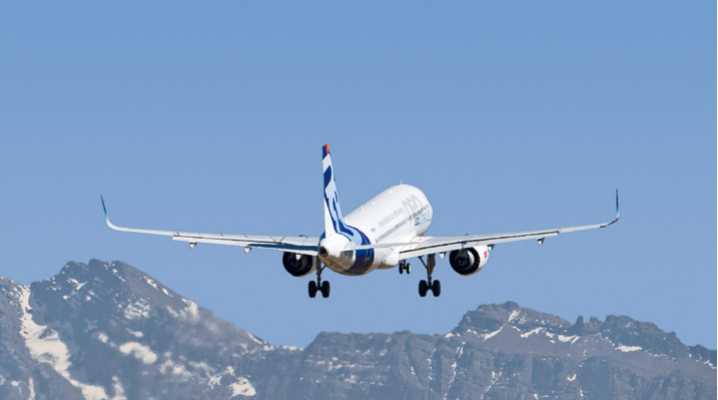
Section titled “SOFT GO-AROUND FUNCTION AVAILABILITY”The SGA function is, or will be, available for the following aircraft:
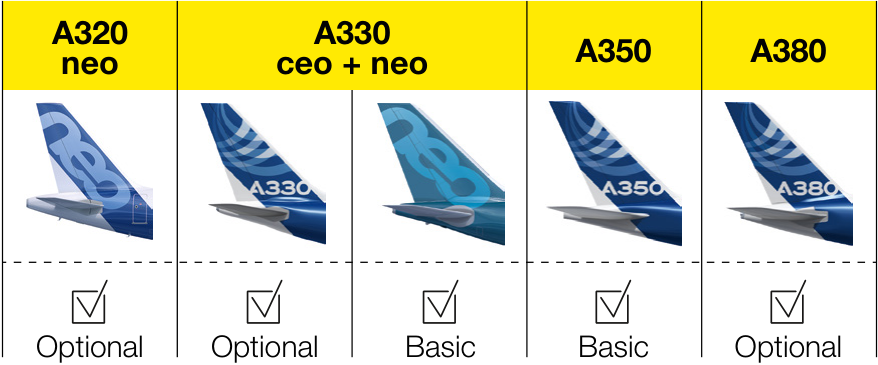
On aircraft not fitted with the Soft Go-around function, if the TOGA thrust is not required for a go-around, the flight crew can apply the procedure introduced in the FCOM/FCTM in 2013 (fig.4).
1. To initiate the go-around, the flight crew must set the thrust levers are set momentarily to the TOGA detent in order to ensure proper activation of the Speed Reference
System (SRS) guidance mode and of the FMS Go-Around phase.
2. Then, the flight crew should set the thrust lever to Climb (CL) detent to take advantage of the autothrust (A/THR).
Refer to the article: “Flying a Go-Around – Managing Energy“, published in the issue 17 of the Safety First magazine.
(fig.4)
Section titled “(fig.4)”Managing energy on aircraft without SGA feature
WHAT ABOUT MIXED FLEETS?
Section titled “WHAT ABOUT MIXED FLEETS?”Due to the recent introduction of the SGA function and its fleet-wide availability status, it is likely operators will have to deal with mixed fleet operations where some aircraft will be equipped with SGA and others will not. The key is to make sure that the flight crew is aware of the SGA / Non-SGA capability of the aircraft they are flying.
During the descent preparation, the flight crew can check the SGA capability of the aircraft using the Aircraft Configuration Summary of the QRH.
During the Approach Briefing, the PF
should brief the PM on the go-around thrust strategy based on the availability of the SGA (function installed and not inoperative).
In any case, the Go Around initiation is always done by setting the thrust levers to the TOGA detent to engage the SRS guidance mode and the GO-AROUND phase of the FMS. Then, depending on the aircraft SGA capability and on the possibility to use a reduced go-around thrust, the thrust lever may be set either to the FLX/MCT for SGA activation or to the CLB detent, if conditions permit.
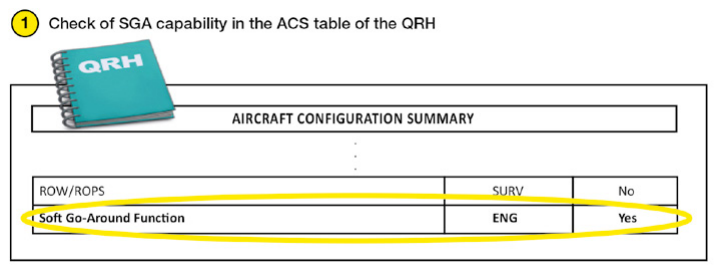
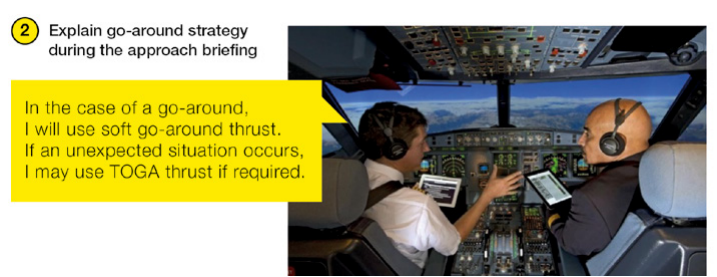
The Go Around initiation is always done by setting the thrust levers to the TOGA detent to engage the SRS guidance mode and the GO-AROUND phase of the FMS.
PREVIOUS ‘SAFETY FIRST’ ARTICLES DEVOTED TO THE GO-AROUND PROCEDURE:
Section titled “PREVIOUS ‘SAFETY FIRST’ ARTICLES DEVOTED TO THE GO-AROUND PROCEDURE:”-
“Go-around Handling” issue 10, August 2010, highlighted that on Airbus Fly By Wire aircraft the go-around fl ight guidance modes of the Auto Flight System are triggered by setting the thrust levers to TOGA.
-
“The go-around Procedure” issue 12, July 2011, insisted on the need to fl y and maintain the proper pitch and on the necessity to retard the thrust levers from TOGA to CL
detent without delay in the event of an early capture of altitude.
- “Flying a Go-Around Managing Energy” issue 17, January 2014, presented the refi ned go-around procedure to set the thrust levers to CL detent just after the TOGA detent selection when conditions permit, and introduced the discontinued approach technique.

The Soft Go-Around function represents a signifi cant safety and operational improvement. It softens the go-around manoeuvre with optimized thrust to improve go around handling by the fl ight crew.
No matter whether the aircraft is or isn’t fi tted with the SGA function, the go-around initiation is always performed by setting the thrust levers to the TOGA detent. On aircraft equipped with the SGA, an updated FCOM go around procedure enables the fl ight crew to benefi t from the function by setting the thrust lever to the MCT detent after the go-around initiation to activate the function, with the possibility at any time to set the thrust lever to TOGA, should the situation request it.
On aircraft not equipped with the SGA, the fl ight crew can apply FCOM procedure described in the “Flying a Go-Around – Managing Energy“ article, published in the issue 17 of the Safety First magazine. This procedure provides the fl ight crew with the possibility to set the thrust lever to the CLB detent after the go-around initiation, when conditions permit.
Safety first, #23 January, 2017. Safety first is published by Airbus S.A.S. - 1, rond point Maurice Bellonte - 31707 Blagnac Cedex/France. Publisher and Editor: Yannick Malinge, Chief Product Safety Officer. Concept Design by Airbus Multi Media Support 20162610. Reference: X00D16031905 Issue 23. Photos by Airbus, Lindner Fotografie, S. Ramadier, H. Goussé, P. Masclet, F. Lancelot, B. Lange, A, Doumenjou, C. Brinkmann, M. Lindner, E. Lafargue. Computer renderings by Fixion
软复飞功能介绍
Section titled “软复飞功能介绍”来源:Airbus Safety First 网址:https://safetyfirst.airbus.com/introduction-to-the-soft-go-around-function/ 发布日期:2017-01-29 杂志期号:2017-01 类别:飞行运营、AFS、空间定向障碍、FLX、FMGC、FMGEC、复飞、错觉、前庭-重力错觉、空间、SRS、TOGA PDF:原文PDF
双发工作的复飞是一个动态性很强的程序,TOGA推力的使用会产生高加速度。然而,服役经验表明,只要双发正常工作,较低的推力仍然足以完成一次安全的复飞。
作为一项安全增强措施,空客引入了软复飞(SGA)功能,该功能提供降低的复飞推力及相关操作程序。
本文将回顾软复飞功能的工作原理、激活方式、安装该功能的飞机型号,以及如何处理同时装备和不装备该功能的“混合”机队。
布里斯·费尔南德斯(Brice Fernandez) 推进系统认证与适航
泽维尔·莱斯瑟机长(Capt. Xavier Lesceu) 运营与培训政策主管
大卫·马科内(David Marconnet) 飞行运营支持与培训标准 - 安全增强
复飞与前庭-重力错觉
Section titled “复飞与前庭-重力错觉”复飞可在多种条件下执行(飞机重量、速度、高度……)。然而,尽管这些参数在每次复飞之间存在显著差异,直到最近,能够执行这一机动动作的推力级别只有一种:TOGA推力。
飞行员通常不习惯这种强烈加速带来的感受,因此可能会感到惊讶。TOGA推力引起的强烈纵向加速度最终可能导致飞行员因前庭-重力错觉(SI)而产生空间定向障碍(SD)。SI是若干致命事故的可疑因素。
复飞通常发生在飞机重量远低于最大着陆重量的情况下,当然,也是在接近进近速度(VAPP)的低速飞行条件下。在这种情况下使用TOGA推力会产生异常强烈的纵向加速度。飞行员很少体验到这种强烈的加速,因为TOGA推力的另一次使用是在起飞时,而那时飞机重量较大。
作为降低SI发生可能性的手段,空客开发了一项功能,允许机组使用针对飞机重量、速度和高度进行了调整的降低推力来执行复飞:软复飞功能(SGA)。
什么是前庭-重力错觉?
Section titled “什么是前庭-重力错觉?”前庭-重力错觉(SI)是一种空间定向障碍现象,由我们感官与大脑之间不同信号的错配引起。它是由强烈的纵向加速或减速产生的。大脑将加速度解读为抬头,这可能导致不恰当的低头指令。(图1)
飞行员在进行夜间复飞或视觉条件较差时尤其容易受到SI的影响。强烈的纵向加速度加上缺乏视觉参考,会导致对过度抬头的错误感知。
前庭-重力错觉解释
软复飞功能原理
Section titled “软复飞功能原理”SGA功能提供低于TOGA的初始推力级别,以确保降低的加速度和对抬头需求的降低,以及无论飞机重量、速度、高度和缝翼/襟翼构型如何,均能保持恒定但较低的最终爬升率。
SGA功能提供低于TOGA的初始推力级别,以确保降低的加速度和对抬头需求的降低,以及无论飞机重量、速度、高度和缝翼/襟翼构型如何,均能保持恒定但较低的最终爬升率。
空客设计SGA爬升能力足以应对全球要求最苛刻的复飞程序。目标爬升率为2000或2300 ft/min,取决于飞机型号。
为了将2000 ft/min置于具体情境中:如果一架A330-300在150吨重量、海平面高度执行复飞,使用TOGA推力可获得的爬升率为3500 ft/min。
SGA功能的性能被证明至少与单发动机不工作(OEI)条件下使用TOGA推力执行复飞一样好。
软复飞功能仅在所有发动机工作时可用:
- 如果使用单发动机不工作状态执行复飞,必须使用TOGA推力
- 在软复飞期间发生发动机失效的情况下,飞行机组也必须选择TOGA推力。
在软复飞期间的任何时候,如需要可以通过将推力手柄设置到TOGA位置来施加TOGA推力。
基于环境条件、飞机重量、高度、速度和缝翼/襟翼构型,自动飞行系统(AFS)通过PRIM(A350/A380)或FMGEC(A330)或FMGC(A320)计算出一个推力目标值,使飞机能够以2000(或2300 ft/min)的速度爬升**(图2)**。此推力目标值随后被发送到发动机的FADEC,该系统将在通过推力手柄激活该功能后立即施加优化推力。
(图2) SGA功能描述
软复飞功能的启动与断开
Section titled “软复飞功能的启动与断开”当启动复飞时,飞行机组按常规将推力手柄设置为 TOGA 位,以触发所有逻辑(进近模式脱开、FMS 飞行计划序列等),然后随即向后移动推力手柄至 FLX/MCT 卡位以启动软复飞。与任何模式一样,飞行机组通过 FMA 检查软复飞的接通情况 (图 3):
1. 飞行机组首先将推力手柄设置到 TOGA 卡位以:
- 脱开进近模式
- 接通复飞引导模式(SRS GA TRK 或 SRS NAV)
- 接通 FMS 复飞阶段,以将复飞程序插入 FMS 飞行计划。
2. 随即,飞行机组将推力手柄设置回 FLX/MCT 卡位以接通软复飞模式(FMA 上显示 MAN GA SOFT)
3. 若飞行机组遵循飞行指引(FD)指令或自动驾驶(AP)接通,则保持 2000 ft/min(或 2300 ft/min)的上升率
4. 在复飞推力减推高度,飞行机组将推力手柄设置到 CLB 卡位:
- MAN GA SOFT 脱开
- CLB 引导模式接通
- 自动推力(A/THR)启动。
软复飞启动/断开
更新的 FCOM 复飞程序
Section titled “更新的 FCOM 复飞程序”在配备软复飞功能的飞机上,软复飞现已完全纳入标准操作程序(SOPs)。FCOM 和 QRH 已相应更新。
FCOM 复飞程序(含软复飞)示例
软复飞功能可用性
Section titled “软复飞功能可用性”软复飞功能已适用于或即将适用于以下飞机:
在未安装软复飞功能的飞机上,若复飞不需要 TOGA 推力,飞行机组可采用 FCOM/FCTM 于 2013 年引入的程序 (图 4)。
1. 为启动复飞,飞行机组必须将推力手柄短暂设置到 TOGA 卡位,以确保速度参考系统(SRS)引导模式和 FMS 复飞阶段的正确启动。
2. 然后,飞行机组应将推力手柄设置到爬升(CL)卡位以利用自动推力(A/THR)。
参阅《Safety First》杂志第 17 期文章:“Flying a Go-Around – Managing Energy”(复飞——能量管理)。
无软复飞功能飞机的能量管理
混编机队怎么办?
Section titled “混编机队怎么办?”由于软复飞功能近期才推出且尚未实现全机队覆盖,运营商可能需要应对混编机队运营,即部分飞机配备软复飞功能而其他飞机未配备。关键是确保飞行机组了解所飞机型是否具备软复飞功能。
在下降准备阶段,飞行机组可使用 QRH 的飞机配置概要检查飞机的软复飞能力。
在进近简令中,PF 应根据软复飞的可用性(有软复飞功能且未失效)向 PM 简述复飞推力策略。
在任何情况下,复飞启动均通过将推力手柄设置到 TOGA 卡位以接通 SRS 引导模式和 FMS 复飞阶段。此后,根据飞机软复飞能力及使用减推复飞推力的可能性,推力手柄可设置到 FLX/MCT 卡位以启动软复飞,或在条件允许时设置到 CLB 卡位。
复飞启动始终通过将推力手柄设置到 TOGA 卡位以接通 SRS 引导模式和 FMS 复飞阶段。
前言:“安全优先”杂志关于复飞程序的文章:
Section titled “前言:“安全优先”杂志关于复飞程序的文章:”-
“复飞处置”第10期,2010年8月,突出介绍了在空客电传飞机上,自动飞行系统的复飞飞行指引模式通过将油门杆设置为TOGA来触发。
-
“复飞程序”第12期,2011年7月,强调了正确保持俯仰姿态的必要性,以及在过早截获高度时必须毫不犹豫地将油门杆从TOGA收至CL卡位。
-
“复飞——能量管理”第17期,2014年1月,介绍了优化后的复飞程序,即在条件允许时选择TOGA卡位后立即将油门杆设置为CL卡位,并介绍了中止进近技术。
软复飞功能代表了一项重大的安全和运营改进。它通过优化推力来柔和复飞机动动作,提升飞行机组的复飞处置体验。
无论飞机是否装有SGA功能,复飞的启动始终通过将油门杆设置到TOGA卡位来完成。在装有SGA的飞机上,更新后的FCOM复飞程序允许飞行机组在复飞启动后将油门杆设置为MCT卡位来激活该功能,并在任何时候可根据情况需要将油门杆设置为TOGA。
在未装SGA的飞机上,飞行机组可采用“安全优先”杂志第17期发表的“复飞——能量管理”一文中描述的FCOM程序。该程序为飞行机组提供了在复飞启动后、条件允许时将油门杆设置为CLB卡位的可能性。
Safety first, #23 January, 2017. Safety first 由空中客车公司出版 - 1, rond point Maurice Bellonte - 31707 Blagnac Cedex/France. 出版人和编辑:Yannick Malinge,产品安全总监。概念设计:空客多媒体支持 20162610。参考编号:X00D16031905 第23期。图片提供:空客、Lindner Fotografie、S. Ramadier、H. Goussé、P. Masclet、F. Lancelot、B. Lange、A. Doumenjou、C. Brinkmann、M. Lindner、E. Lafargue。计算机渲染:Fixion