Lateral runway excursions upon landing
Source: Airbus Safety First URL: https://safetyfirst.airbus.com/lateral-runway-excursions-upon-landing/ Published: 2015-07-29 Magazine Issue: 2015-07 Category: Flight Ops, approach, contaminated, crosswind, decrab, excursion, flare, landing, RE, roll-out, runway, stabilized PDF: Original PDF
014 Safety First #20 | July 2015 PROCEDURES Lateral runway excursions upon landing
Section titled “014 Safety First #20 | July 2015 PROCEDURES Lateral runway excursions upon landing”
Lateral runway excursions upon landing have long been rather low on the safety issues list. With the remarkable improvements in other areas, they are getting higher up and deserve careful attention. The analysis of real cases allows for drawing interesting lessons on these events and reinforcing prevention.

MATTHIEU MAYOLLE Stability & control engineer
SAMUEL PELLET Product Safety enhancement analysis engineer
XAVIER LESCEU Test Pilot

Safety statistics show that runway excursions have become one of the most common types of accident worldwide. If signifi cant effort was put on the prevention of longitudinal runway excursions, it turns out that lateral runway excursion events are becoming a growing concern. Addressing them effi ciently requires a good understanding of how they originate and what contributes to their occurrence.
This article will focus on the most safety critical veer off cases in terms of likelihood and severity consequences, namely: lateral runway excursions upon landing. It presents the outcome of a thorough analysis of a number of real cases and reviews the best operational practices to prevent lateral runway excursions upon landing.
LATERAL RUNWAY EXCURSIONS UPON LANDING: A GROWING SAFETY CONCERN?
Section titled “LATERAL RUNWAY EXCURSIONS UPON LANDING: A GROWING SAFETY CONCERN?”What are we talking about?
Section titled “What are we talking about?”In the frame of this article, a lateral runway excursion is: any aircraft getting off runway markings, whether it gets off the runway concrete or not. This implies that events at take-off and during taxi (e.g. during U-turns on the runway) are not considered here.
This defi nition is as valid as any other for describing facts. However, when it comes to enhancing safety and more specifi cally prevention, this defi nition is of little help. Indeed, the analysis of lateral runway excursion events corresponding to this defi nition combines situations that are so different in terms of their underlying phenomena that it is extremely challenging to derive effi - cient mitigation measures.
Of course there will be many cases where aircraft trajectories divert from the runway centerline and the desired
landing path, but many of these never divert suffi ciently to leave the runway surface and therefore never become classifi ed as incidents or accidents. However, analysis of such “minor” events in the future may well be benefi cial as we seek more data and information on this complex issue.
The events where aircraft get off runway markings need to be categorized according to what contributed to their occurrence, thus what can be done to prevent them.
Generally speaking, the most safety critical (as a result of likelihood and severity of consequences) veer off events are the lateral runway excursions upon landing where the aircraft goes off runway markings at touch-down, or during the roll-out phase. This article will focus more particularly on them.
PROCEDURES
Section titled “PROCEDURES”Statistics say a word
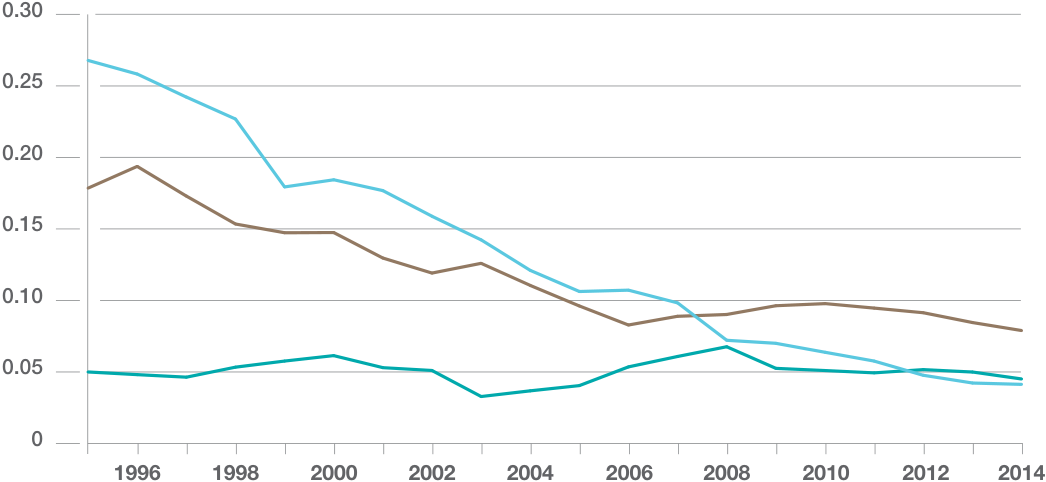
Section titled “Statistics say a word”(fig.1) Evolution of the three main accident categories from 1995
For decades, accident statistics have kept highlighting the three same accident types at the top of the list of contributors, namely: Loss Of Control In-flight (LOC-I), Controlled Flight Into Terrain (CFIT) and Runway Excursion (RE). If virtually all CFIT and LOC-I accidents lead to both fatalities and hull loss, other accident categories generate mainly only material damage. As an
example, 15% of RE accidents cause fatalities, and are the third source of fatal accidents. Yet, RE have become the main source of hull losses.
A closer look at the evolution of the figures and tendencies over the past 20 years shows that CFIT and LOC-I have significantly decreased whereas Runway Excursion remains relatively stable (fig.1).
In recent years, lateral runway excursions have emerged as a growing safety
concern. Is it because of or thanks to the progress made on the runway overrun front? Because they are more reported than before? For other reasons or any combination of reasons? Difficult to say, but through the events reported to Airbus by airlines, the trend is clear: the number of lateral runway excursions is increasing.
Therefore it is worth to try and reinforce prevention, and to start with, understand what lies behind real events.
WHEN REALITY HELPS SHAPE THE SCOPE TO CONSIDER: AFTER TOUCH-DOWN, YES, BUT NOT ONLY…
Section titled “WHEN REALITY HELPS SHAPE THE SCOPE TO CONSIDER: AFTER TOUCH-DOWN, YES, BUT NOT ONLY…”Thanks to airlines support, 31 in-service lateral runway excursion events were reported to Airbus over a 2012July 2014 period. A first analysis with a prevention objective in mind led to distinguish between several lateral runway excursions categories due to there being a variety of issues identified and therefore, a variety of potential corrective actions.
Within the defined scope of lateral runway excursion upon landing, 25 events from the initial 31 were considered as relevant and usable.
bigger and the results more robust.
They were studied with a main question in mind: is there a global or common signature for these events that could allow us to learn some generic prevention lessons? Interesting insights could be drawn from this work as we shall see later.
When searching for common contributing factors, two main families came out:
- weather environmental conditions - flying technique
Of course, the events studied were only those reported to Airbus and therefore, they represented a limited sample. However, they were corroborated by a study of the lateral runway excursion events reported to Airbus from 2007, making the sample much
These two aspects were found in a number of events, most of the time in combination with one another, but with variations as to their detailed nature. A closer look at these two fields allowed for refining the understanding of the underlying phenomena.
PROCEDURES
Section titled “PROCEDURES”
Weather environmental conditions
Section titled “Weather environmental conditions”(fig.2)
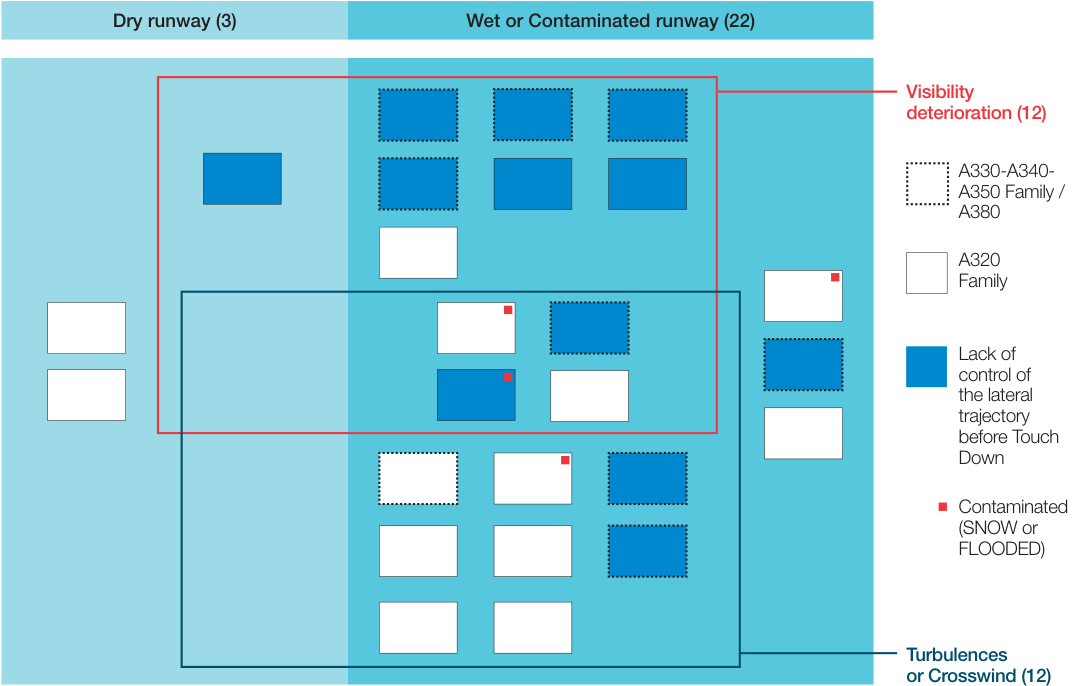
Section titled “(fig.2)”Categorization of RE events according to contributing weather conditions factors
Three main environmental factors came out of the analysis:
-
Runway state, wet or contaminated
-
Turbulences or cross-wind
-
Visibility deterioration
22 events out of 25 analyzed involved a wet or contaminated runway. In 19 out of the 25, there were at least two of the aforementioned environmental factors in the situation (fig.2).
Awareness Problem before Touch Down (1)
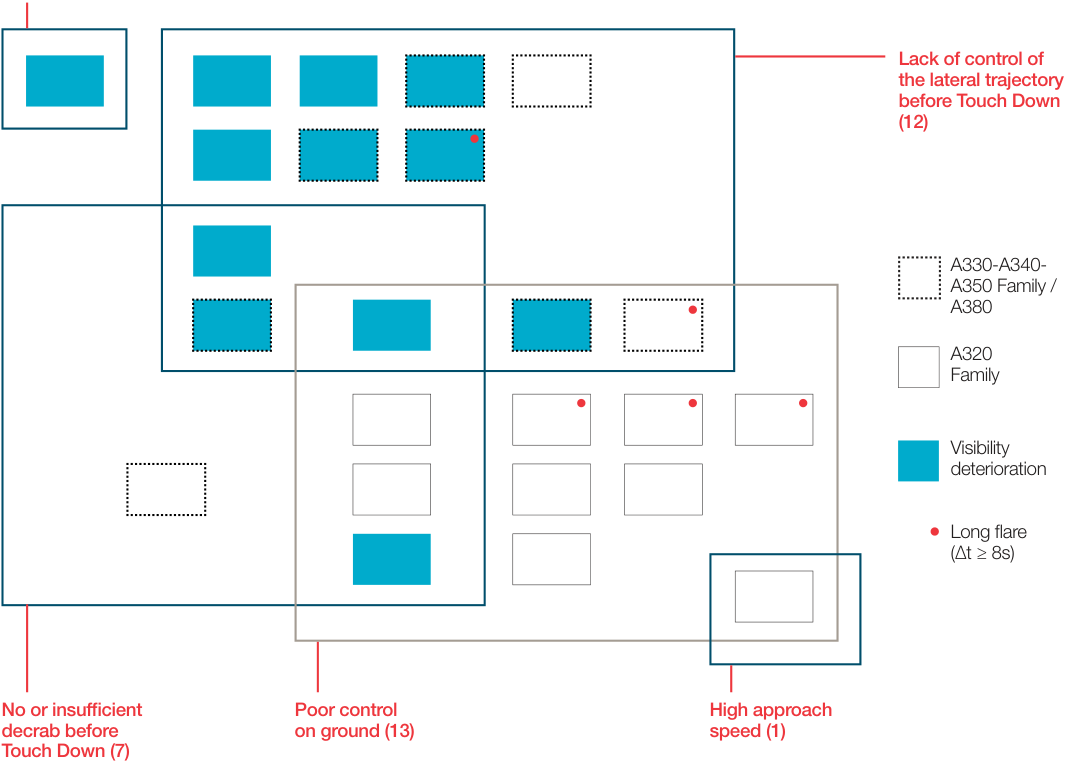
Regarding the flying technique in the environmental conditions mentioned earlier, three areas were identified as contributing factors to the events occurrence:
-
Control of the lateral trajectory before touch-down
-
Flare and decrab before touch-down
-
Ground control
In some situations, as illustrated in (fig.3) , there was a combination of them.
A major outcome of the analysis is the significant contribution of the airphase, before touch-down, to lateral runway excursions.
The next question, and more precisely, THE question is: With these insights from real events, how to enhance prevention of lateral runway excursions? If there is nothing we can do to change environmental conditions, it seems worth going back to some operational best practices.
(fig.3)
Section titled “(fig.3)”Categorization of RE events according to contributing flying technique factors
PROCEDURES
Section titled “PROCEDURES”PREVENTING LATERAL RUNWAY EXCURSIONS UPON LANDING: BEST OPERATIONAL PRACTICES
Section titled “PREVENTING LATERAL RUNWAY EXCURSIONS UPON LANDING: BEST OPERATIONAL PRACTICES”As stated earlier, handling issues turn out to be a significant contributor to lateral runway excursion events upon landing, especially under some difficult environmental conditions such as wet or contaminated runway or cross wind or turbulence.
What is the appropriate landing technique and why? Let’s prepare for landing and review the technique, including some explanations behind the scene, with a special focus on the conditions that were highlighted by the lateral runway excursion events analysis.
Landing technique: general principles
Section titled “Landing technique: general principles”The appropriate landing technique, whatever the weather conditions, is a “whole” that combines a variety of dimensions:
information and awareness (e.g. environmental conditions), state of mind & preparedness and handling skills.
1/ Before flare
Section titled “1/ Before flare”Be stabilized until the flare. If not, go-around.
As long as reversers are not selected, a goaround is always possible.
Be aware of the landing conditions
If landing with crosswind or on a contaminated runway rely on specific techniques, the first thing to make sure of is that:
-
the crosswind, if any, is and remains within the limits of the aircraft
-
the runway state allows for a safe landing and the runway braking coefficient is known.
Be correctly seated
During cruise, sometimes a long one, pilots may move their seat a bit. Yet, upon landing, the full deflection of all flight control and braking may be needed to control the situation. Therefore, make sure the pilot seat is in a position (both horizontally and vertically) to allow for those full deflections should they be necessary. This is a key preliminary condition to a safe landing.
Be stabilized
Section titled “Be stabilized”In a number of events, there was a localizer deviation away from the centerline. Beyond the lateral control before touch-down, it is essential that the aircraft be on the correct lateral and vertical flight path at the correct configuration and speed up to the initiation of the flare.
- Be Go-Around minded, as long as needed
Experience shows that some pilots are increasingly reluctant to initiate a go-around as the aircraft gets closer to the ground, even if the aircraft is not well aligned with the runway. Nevertheless, from a safety viewpoint, initiating a go-around close to the ground or even after a bounced landing is always better than performing an unsafe landing.
2/ From flare to touch-down
Section titled “2/ From flare to touch-down”Use proper flare and decrab (if needed) flying techniques
Landing in the correct zone, with the right alignment and at the right energy level is a good summary of what a pilot should aim at. Easier said than done?
In the case of crosswind, this requires specific techniques that will be detailed in the next section in this article.
3/ After touch-down
Section titled “3/ After touch-down”“Fly” until you vacate the runway
Do not relax immediately after touchdown. There is still work to do.
A number of lateral runway excursions resulted from poor ground control in the rollout phase. This is obviously more often the case when a crosswind
makes the day more difficult. Indeed, a number of physical phenomena come into play requiring specific actions to be managed. More details about these phenomena and how to maintain ground control with crosswind is provided in next section in this article.
Landing with crosswind
Section titled “Landing with crosswind”As general principles, the landing technique mentioned earlier remains valid. However, it is worth getting a bit further into details and background explanations when crosswind is involved in the landing conditions such as those underlined hereafter:
-
Be aware of the landing conditions
-
Be correctly seated
-
Be go-around minded as long as needed
-
Use proper fare and decrab fying techniques
-
“ ” Fly until you vacate the runway
Let’s examine how these three principles translate into practice in case of crosswind … and why.
- Be stabilized
Be stabilized
Section titled “Be stabilized”In crosswind situations, the major difference in technique lies in how to keep the aircraft on the correct lateral flight path. In order to do so, it is necessary to fly a wings level and crabbed
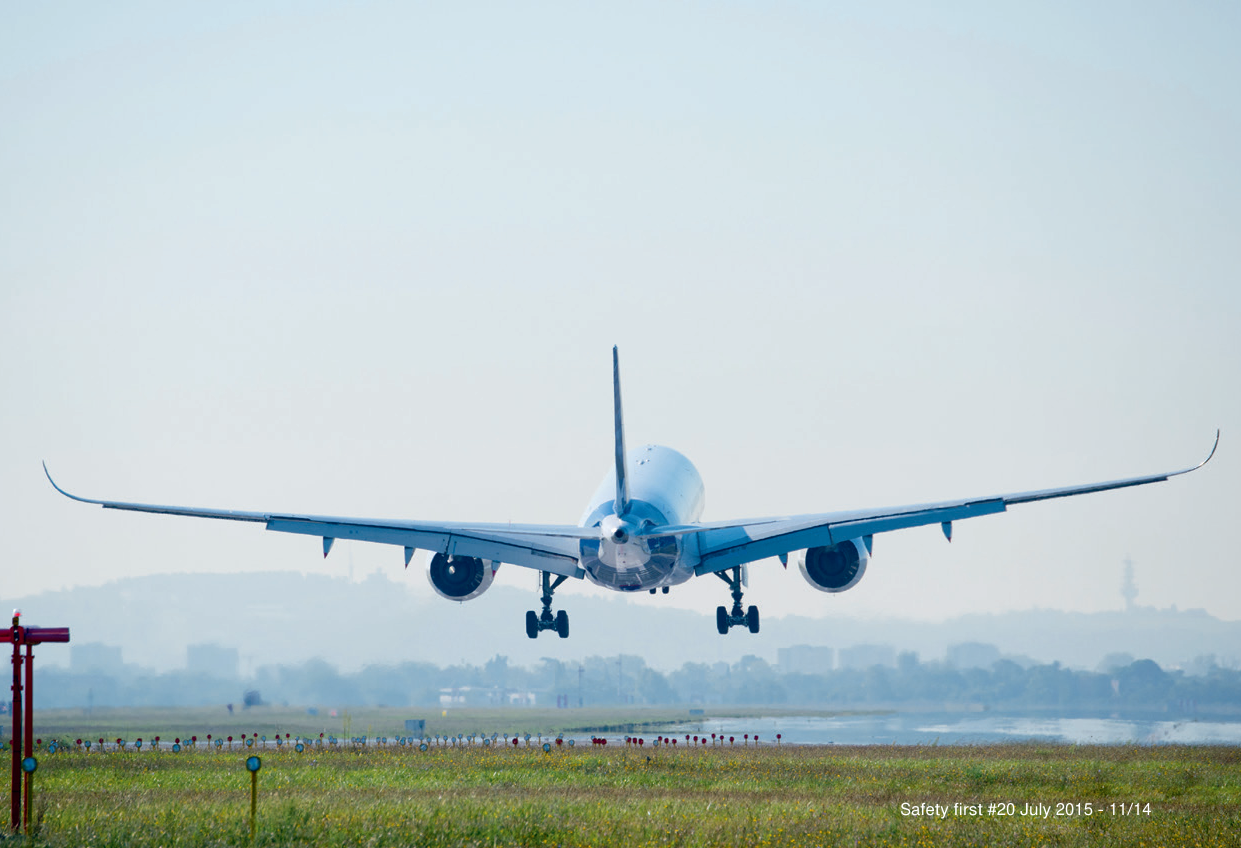
approach to correct for the crosswind component on the final trajectory to the runway. Adopting a crab angle allows the pilot to keep the aircraft trajectory along the runway axis (fig.4).
A CRABBED APPROACH
Section titled “A CRABBED APPROACH”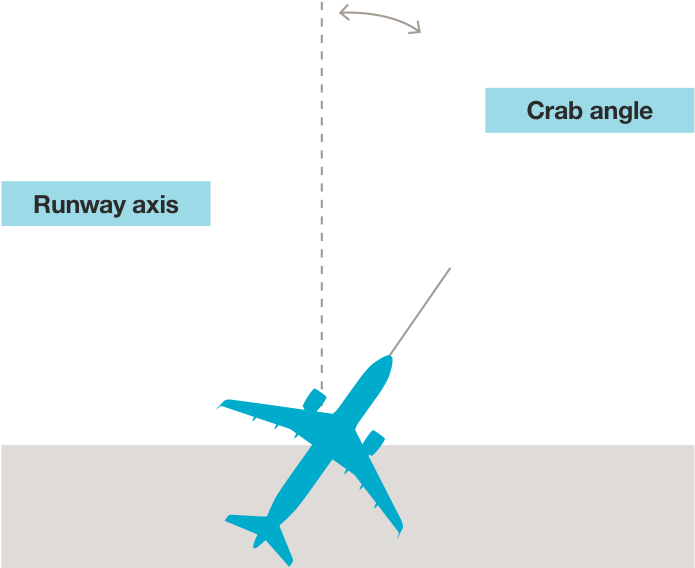
Aircraft attitude during a crabbed approach
PROCEDURES
Section titled “PROCEDURES”(fig.5) Location of the localizer antenna
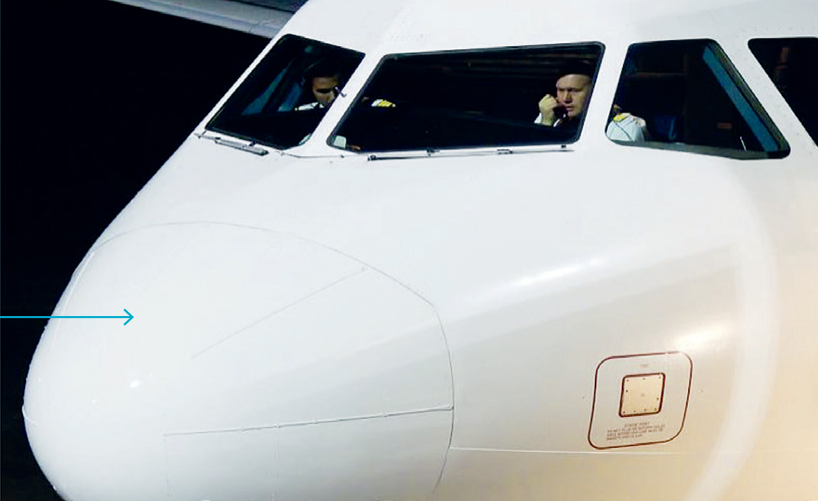
But what does correct lateral flight path mean precisely? What part of the aircraft needs to be aligned with the runway axis? The answer is the same whether the approach is flown manually or not, in visual conditions or not. The reference is the cockpit. Considering the location of the local-
izer antenna, under the radome, at the center of the nose of the aircraft below the cockpit (fig.5) , “correct lateral fight path” means localizer centered or nose of the aircraft trajectory aligned with the runway axis, thus ensuring the pilot’s eye is aligned with the runway axis.
The localizer antenna is located under the radome in the center of the aircraft
Some common tendencies to be avoided.
Section titled “Some common tendencies to be avoided.”- Experience shows that in some situa- When initially becoming visual tions, some pilots have tendencies to below a low cloud ceiling destabilize the aircraft approach trajec- When performing the decrab in the tory, especially along the lateral axis. It flare. happens mainly in these 3 cases: Let’s revisit the first two cases, see what
Let’s revisit the first two cases, see what happens behind the scene and then deal with the third case in more depth.
- When disconnecting the Auto Pilot (AP) for a manual landing.
When disconnecting the AP
Section titled “When disconnecting the AP”A tendency sometimes observed is that of making large inputs on the sidestick when disconnecting the AP. Yet, the aircraft attitude has no reason to change at this very moment compared
to what it was under AP. Therefore, it is key to analyze the stable trajectory before any stick input. This should avoid large inputs on the sidestick.
When becoming visual
Section titled “When becoming visual”When first seeing the runway, some pilots have a tendency to start an immediate decrab and align the aircraft with the runway axis. By doing so, the aircraft drifts due to the crosswind and moves away from the correct late-
ral flight path. Again, becoming visual makes no difference as to the correct aircraft trajectory. It is normal to keep a crabbed approach and see the runway from a certain angle.
Use proper flare and decrab flying techniques
Section titled “Use proper flare and decrab flying techniques”If the flare technique is not modified by the presence of crosswind, some aspects need to be particularly kept in mind in such situations, especially: - A high or extended flare significantly increases the landing distance, whereas, due to possible adverse reversers effects explained later in this article, it is even more important than usual to keep as much runway length as possible to decelerate after touch-down.
- In case of an extended flare, the decrease in the aircraft energy will make it even more sensitive to crosswind. Counteracting crosswind becomes more and more difficult as speed decays in the flare. Eventually, the crosswind may move the aircraft away from the centerline.
In summary, fare at normal height and do not look for a kiss landing.
Decrab
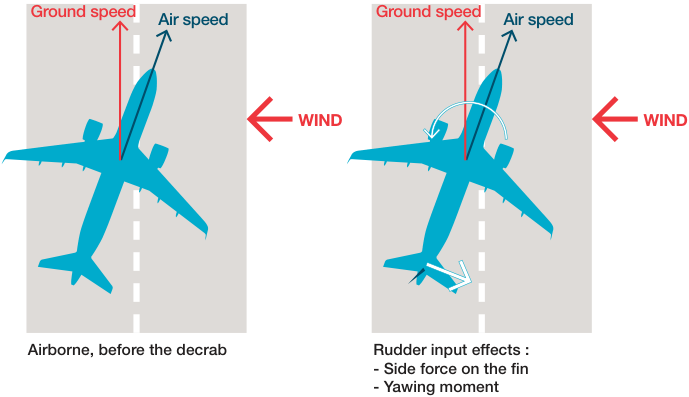
Section titled “Decrab”As mentioned earlier, keeping a crabbed approach is the only way to keep the aircraft on the correct lateral flight path. However, before touch-down, the aircraft needs to be decrabbed to align with the runway axis. The aircraft is to be decrabbed at the time of the fare, using the rudder.
However, it is worth going into further
detail to better understand what results from this action on the rudder. Indeed, when doing so, the aircraft will move a bit towards the wind. Why is it so? In fact, when pushing on the rudder, the aircraft will yaw around a vertical axis that is located a bit forward from the CG, the yaw axis. The moment induced will make the aircraft move slightly towards the wind as illustrated in (fig.6).
(fig.6) Forces and moments effects on aircraft during decrab
PROCEDURES
Section titled “PROCEDURES”FLARE AND DECRAB IN THE SPECIAL CASE OF HIGH CROSSWIND, ESPECIALLY ON CONTAMINATED RUNWAYS
Section titled “FLARE AND DECRAB IN THE SPECIAL CASE OF HIGH CROSSWIND, ESPECIALLY ON CONTAMINATED RUNWAYS”Why 5° maximum for the crab angle? Here again, it is an appropriate trade-off between maintaining the aircraft trajectory and experiencing an acceptable load at the landing gear on touch-down.
does not change immediately the CG speed vector. Therefore, if the aircraft lateral fl ight path starts drifting away from the runway centerline, using the rudder alone may not allow for an easy realignment of the aircraft.
In such situations, allowing a slight bank angle to maintain the runway axis, less than 5°, and a small crab angle, less than 5°, from the approach through to touchdown is the only way to keep the cockpit aligned with the runway axis.
Should such drift occur too close to the ground, the safe practice is to go-around. And as mentioned earlier, as long as reversers are not selected, a go-around is always possible!
A common tendency to be avoided
Section titled “A common tendency to be avoided”Why 5° maximum for the bank angle? It is the appropriate balance between the bank angle needed to keep the aircraft trajectory aligned with the runway centerline and the risk of hitting the runway with the wing tip or engine nacelle.
Some pilots appear to be reluctant to keep a bank angle, even a small one, prior to touch-down. They then try and compensate the crosswind impact using the rudder only. However, an action on the rudder
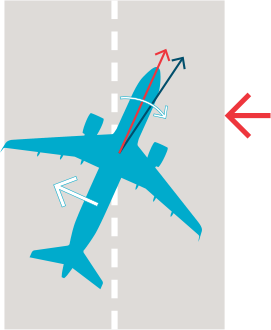
Without rudder pedal input, a large yawing moment will make the aircraft turn to the wind
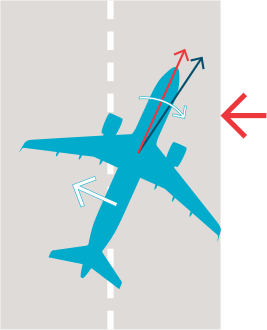
(fig.7) Counteracting the weathercock effect
When the main landing gear touches the ground with residual crab, a pivoting moment is created around a vertical axis located at the level of the main landing gear by the combined effect of the lateral friction of the tires on the surface and by the inertia force applied at the center of gravity. This moment tends to turn the aircraft so as to align the aircraft longitudinal axis with the ground speed vector. In short, wheels tend to be more willing to go in the same direction as the aircraft trajectory, more than to skid. The intensity of the pivoting moment depends a lot on runway friction.
However, the sideslip coming from the crosswind when the aircraft is decrabbed creates an opposite moment tending to yaw the aircraft
towards the wind direction by weathercock effect. Indeed, the effect of the wind on the aircraft fin aligned with the runway axis induces a rotation of the aircraft around a vertical axis located at the CG that yaws the aircraft nose back towards the wind. This opposite moment thus tends to move the aircraft upwind, away from the centerline. It needs to be counteracted by the rudder.
Nevertheless, as the aircraft speed decreases, the rudder efficiency drops. Therefore, the action on the rudder to counteract the weathercock effect needs to be amplified (fig.7). As speed further decreases, the rudder effect could become insufficient, therefore the pilot must be prepared to apply differential braking.
PROCEDURES
Section titled “PROCEDURES”(fig.8)
Section titled “(fig.8)”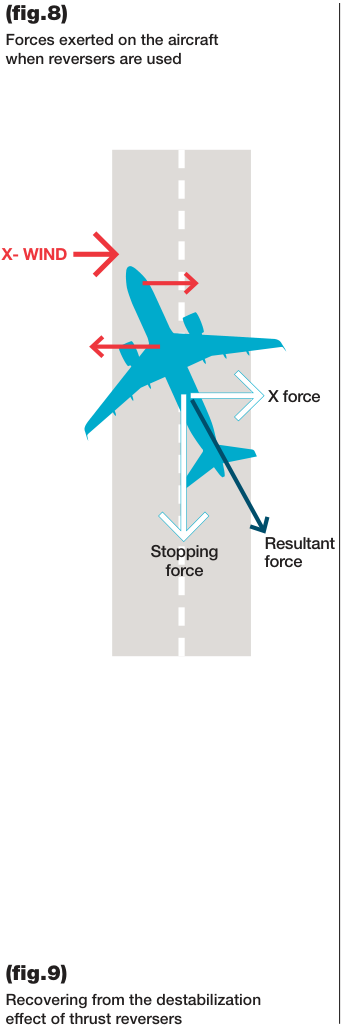
During the roll-out, the primary means to maintain the aircraft on the runway is the cornering force exerted on the wheels through the tires. However, in order to keep the aircraft on the runway, it is important to understand some wind and aircraft related aspects.
Auto Pilot disconnection effect
Section titled “Auto Pilot disconnection effect”As long as the Auto Pilot (AP) is connected, the aircraft automatically compensates the effects of crosswind with the rudder. As for the pedals, they remain in the neutral position. Yet, at AP disconnection after touch-down, since the pedals are at neutral position, the aircraft fin will naturally go back to a centered position, exposing the aircraft to weathercock effect, thus aircraft nose movement towards the wind, away from the centerline, unless immediately countered by the pilot. Countering the weathercock effect requires immediate inputs on rudder pedals, possibly large inputs. It may even be that differential braking is needed in addition to inputs on rudder pedals in case of high crosswind.
Therefore, at AP disconnection after touch-down it is key to:
-
Have your FEET UP on the pedals
-
Be ready for immediate and possibly large inputs on rudder pedals
-
Be ready to use differential braking in addition if needed and keep in mind that the rudder effectiveness reduces when speed decreases. Considering the difficulty in performing a balanced
braking on the pedals when they are not aligned, the use of Auto Brake is highly recommended.
Destabilizing reversers’ effect
Section titled “Destabilizing reversers’ effect”On slippery runways, the aircraft may start leaving the runway axis and going downwards the wind when reversers are used. Indeed, in slippery condition, the moment created by the tires friction that tend to align the aircraft fuselage on the runway axis, is not effective enough. And if the aircraft remains crabbed, the reverser thrust resultant force can be resolved in 2 components (fig.8) :
-
One parallel to the runway and actually stopping the aircraft.
-
One perpendicular to the runway, in the same direction as the wind, i.e. adding to that induced by crosswind.
This second force may make it more difficult to control the aircraft on the ground. Therefore, if a directional problem occurs:
-
Consider reducing reverse thrust.
-
If braking manually, consider reducing braking temporarily or use differential braking.
Once directional control is recovered and the aircraft is on the runway centerline again (fig.9) :
-
Manual braking can be re-applied
-
Reverse thrust can be re-applied (only the component parallel to the runway remains with no adverse effect on the lateral control of the aircraft).
014 Safety First #20 | July 2015 程序 侧向跑道偏出(着陆期间)
Section titled “014 Safety First #20 | July 2015 程序 侧向跑道偏出(着陆期间)”
侧向跑道偏出(着陆期间)长期以来在安全问题的排名中相对靠后。随着其他领域的显著改善,此类事件日益受到重视,值得密切关注。对真实案例的分析能够为这些事件提供有益的教训并加强预防措施。
MATTHIEU MAYOLLE 稳定性与控制工程师
SAMUEL PELLET 产品安全提升分析工程师
XAVIER LESCEU 试飞员
安全统计数据表明,跑道偏出已成为全球最常见的事故类型之一。虽然在防止纵向跑道偏出方面已投入大量努力,但侧向跑道偏出事件正日益引起关注。要有效应对这一问题,需要充分了解其成因及促成因素。
本文将重点关注在发生概率和后果严重性方面最关键的几类偏离事件,即:着陆期间的侧向跑道偏出。文章展示了对多个真实案例的深入分析成果,并回顾了防止着陆期间侧向跑道偏出的最佳操作实践。
着陆期间的侧向跑道偏出:日益关注的安全问题?
Section titled “着陆期间的侧向跑道偏出:日益关注的安全问题?”我们在讨论什么?
Section titled “我们在讨论什么?”在本文框架中,侧向跑道偏出定义为:任何飞机偏离跑道标线,无论是否完全离开跑道道面。这意味着起飞时和滑行期间的事件(如在跑道上进行 U 形转弯)不在本文讨论范围内。
此定义用于描述事实是有效的。然而,在提升安全性特别是预防方面,此定义的帮助有限。事实上,符合该定义的侧向跑道偏出事件涉及的情况差异很大,其底层现象完全不同,因此极难制定有效的缓解措施。
当然,会有许多情况导致飞机轨迹偏离跑道中心线和预期着陆路径,但其中许多从未偏离到离开跑道表面的程度,因此不会被归类为事故或事故征候。然而,分析此类”轻微”事件在未来可能是有益的,因为我们在寻求更多关于这一复杂问题的数据和信息。
飞机偏离跑道标线的事件需要根据其促成因素进行分类,从而确定可采取的预防措施。
一般来说,在安全关键性方面(基于发生概率和后果严重性)最严重的偏离事件是着陆期间的侧向跑道偏出,即飞机在接地时或在滑跑阶段偏离跑道标线。本文将重点关注此类事件。
统计数据说明
Section titled “统计数据说明”(图 1) 1995 年以来三大主要事故类别的演变
数十年来,事故统计数据持续突出表明三种相同的事故类型位居事故原因前列,即:飞行中失去控制(LOC-I)、可控飞行撞地(CFIT)和跑道偏出(RE)。如果说几乎所有 CFIT 和 LOC-I 事故都导致人员死亡和机体损失,其他事故类别则主要仅造成财产损失。例如,15% 的 RE 事故造成人员死亡,成为第三大致命事故原因。然而,RE 已成为机体损失的主要原因。
仔细观察过去 20 年数据的演变和趋势,CFIT 和 LOC-I 已显著减少,而跑道偏出相对保持稳定 (图 1)。
近年来,侧向跑道偏出已成为日益关注的安全问题。是由于还是在得益于跑道冲出方面取得的进展?是因为报告数量比以前增加了?还是由于其他原因或多种原因的组合?难以确定,但通过航空公司向空客报告的事件,趋势是明确的:侧向跑道偏出的数量正在增加。
因此,有必要加强预防,首先从了解真实事件背后的原因开始。
现实如何帮助界定考虑范围:接地之后,是的,但不仅如此……
Section titled “现实如何帮助界定考虑范围:接地之后,是的,但不仅如此……”在2012年7月至2014年7月期间,得益于航空公司的支持,空客共收到31起在役 lateral runway excursion 事件报告。以预防为目的的首次分析表明,由于识别出的问题种类繁多,相应的纠正措施也各不相同,因此需要将 lateral runway excursion 事件分为若干类别。
在已确定的着陆时 lateral runway excursion 范围内,初始31起事件中的25起被认为与本分析相关且可用。
他们带着一个主要问题进行研究:这些事件是否存在某种共性特征,能够让我们总结出通用的预防经验?正如后文将展示的,这项工作可以带来有价值的见解。
在寻找共同贡献因素时,两大类别浮现出来:
- 天气环境条件
- 飞行技术
当然,所研究的事件仅是报告给空客的那些,因此只是一个有限的样本。然而,这些发现与2007年以来报告给空客的 lateral runway excursion 事件研究相互印证,使样本量更大,结果更具说服力。
这两方面在多个事件中均有出现,且大多数时候是相互组合的,但在具体性质上存在差异。深入审视这两个领域有助于更好地理解其背后的现象。
天气环境条件
Section titled “天气环境条件”根据贡献天气条件因素对 RE 事件进行分类
分析中浮现出三个主要环境因素:
-
跑道状况,湿滑或污染
-
湍流或侧风
-
能见度下降
在分析的25起事件中,有22起涉及湿滑或污染的跑道。在25起事件中有19起出现了至少两种上述环境因素 (图2)。
接地前的意识问题 (1)
关于前述环境条件下的飞行技术,识别出三个促发事件的因素领域:
-
接地前的侧向轨迹控制
-
接地前的拉平与去偏流
-
地面控制
在某些情况下,如图3所示,这些因素是组合出现的。
分析的一个重要结论是,空中阶段——即接地之前——对 lateral runway excursion 的重大影响。
接下来的问题,更确切地说是核心问题是:基于这些真实事件的启示,如何加强对着陆时 lateral runway excursion 的预防?虽然我们无法改变环境条件,但回归一些操作最佳实践似乎是值得的。
根据贡献飞行技术因素对 RE 事件进行分类
预防着陆时的侧向跑道偏出:最佳操作实践
Section titled “预防着陆时的侧向跑道偏出:最佳操作实践”如前所述,处理问题是着陆时 lateral runway excursion 事件的重要促发因素,尤其是在湿滑或污染跑道、侧风或湍流等困难环境条件下。
什么是恰当的着陆技术,为什么?让我们为着陆做好准备,回顾相关技术,包括幕后的部分解释,特别关注 lateral runway excursion 事件分析中突出的条件。
着陆技术:一般原则
Section titled “着陆技术:一般原则”恰当的着陆技术,无论天气条件如何,是一个结合多种维度的“整体”:
信息与意识(例如环境条件)、心态与准备状态以及操作技能。
1/ 拉平之前
Section titled “1/ 拉平之前”保持稳定直到拉平。如果不稳定,则复飞。
只要未选择反推,复飞始终是可能的。
注意着陆条件
如果在侧风条件下或污染跑道上着陆,应依靠特定技术,首先要确保:
-
侧风(如有)在飞机限制范围内且保持在该范围内
-
跑道状况允许安全着陆,且跑道刹车系数已知。
正确就座
在巡航阶段,有时是长途飞行,飞行员可能会稍微移动座位。然而,在着陆时,可能需要全行程偏转所有飞行控制装置和制动来控制局面。因此,确保飞行员座位处于可以做出这些全行程偏转的位置(水平和垂直方向),以防需要时能够使用。这是安全着陆的一个关键先决条件。
在多起事件中,飞机出现了偏离跑道中心线的航向道偏移。在接地前的横向控制之外,至关重要的是飞机在进入拉平阶段前,必须处于正确的横向和垂直飞行轨迹,并保持正确的构型和速度。
- 保持复飞意识,必要时复飞
经验表明,随着飞机越来越接近地面,一些飞行员越来越不愿意执行复飞,即使飞机与跑道并未对准。然而,从安全角度来看,在低空复飞,甚至在跳跃接地后复飞,总是比执行不安全的着陆要好。
2/ 从拉平到接地
Section titled “2/ 从拉平到接地”使用正确的拉平和去侧滑(如需要)飞行技术
在正确的区域着陆,保持正确的对正角度,并处于适当的能量水平——这是飞行员应当追求的目标。说起来容易做起来难?
在侧风情况下,这需要特定的技术,下一节将详细阐述。
3/ 接地后
Section titled “3/ 接地后”“飞行”直到脱离跑道
接地后不要立即放松。还有工作要做。
许多横向跑道偏出事件是由于滑跑阶段地面控制不佳所致。当侧风使情况更加困难时,这显然更为常见。确实,多种物理现象会起作用,需要采取特定措施来控制。下一节将提供有关这些现象的更多细节,以及如何在侧风条件下保持地面控制。
作为一般原则,前述着陆技术仍然适用。但是,当侧风涉及以下所述的着陆条件时,有必要进一步详细说明和解释背景:
- 了解着陆条件
- 坐姿正确
- 保持复飞意识,必要时复飞
- 使用正确的拉平和去侧滑飞行技术
- “飞行”直到脱离跑道
让我们来探讨当存在侧风时——以及为什么——这三项原则如何转化为实际做法……
- 保持稳定
在侧风情况下,技术上的主要区别在于如何保持飞机在正确的横向飞行轨迹上。为此,必须采用机翼水平、蟹形进近的方式来修正最后进近轨迹中侧风分量的影响。采用蟹形角度使飞行员能够使飞机轨迹沿跑道轴线保持一致 (图4)。
蟹形进近时的飞机姿态
(图5) 航向道天线位置
但是,正确的横向飞行轨迹究竟意味着什么?飞机的哪一部分需要与跑道轴线对正?无论进近是手动飞行还是非手动飞行,是在目视条件下还是非目视条件下飞行,答案都是一样的。参考点是驾驶舱。考虑到航向道天线位于雷达罩下方、机身前部中心、驾驶舱下方 (图5),“正确的横向飞行轨迹”意味着航向道居中,或飞机机头轨迹与跑道轴线对正,从而确保飞行员视线与跑道轴线一致。
航向道天线位于机身前部中心的雷达罩下方
应避免的一些常见倾向
Section titled “应避免的一些常见倾向”- 经验表明,在某些情况下,- 在低云底高度目视发现跑道初始- 在拉平中执行去侧滑时一些飞行员有使飞机进近轨迹变得不稳定特别是横向轨迹不稳定的倾向。这主要发生在以下三种情况:
让我们回顾前两种情况,了解其背后发生了什么,然后深入讨论第三种情况。
- 在断开自动驾驶仪(AP)进行手动着陆时。
断开自动驾驶仪时
Section titled “断开自动驾驶仪时”有时观察到的一种倾向是,在断开AP时在侧杆上做出大输入。然而,在这一时刻,飞机的姿态没有理由与AP控制时有所不同。因此,在任何侧杆输入之前,关键是要分析稳定的轨迹。这应能避免在侧杆上做出大输入。
在首次看到跑道时,一些飞行员有立即去侧滑并使飞机与跑道轴线对正的倾向。这样做会导致飞机因侧风而漂移,并偏离正确的横向飞行轨迹。同样,目视发现对于正确的飞机轨迹没有任何影响。保持蟹形进近并从一定角度观察跑道是正常的。
使用正确的拉平与去侧偏技术
Section titled “使用正确的拉平与去侧偏技术”如果拉平技术不因侧风的存在而进行调整,在这种情况下需要特别注意以下几点:
-
过高或过长的拉平会显著增加着陆距离,而且,由于本文后文将解释的反推可能产生的不利影响,比平时更重要的是在接地后保留尽可能多的跑道长度来减速。
-
如果拉平时间过长,飞机动能的减小会使其对侧风更加敏感。在拉平过程中随着速度衰减,对侧风的修正会变得越来越困难。最终,侧风可能使飞机偏离中心线。
总之,在正常高度进行拉平,不要追求轻接地。
如前所述,保持带侧偏的进近是使飞机保持在正确侧向航迹上的唯一方法。然而,在接地前,飞机需要进行去侧偏以使机身对准跑道轴线。去侧偏应在拉平时使用方向舵完成。
然而,有必要进一步详细说明,以便更好地理解这一方向舵动作的效果。实际上,这样做时,飞机会略微向风的方向移动。为什么会这样?实际上,当踩方向舵时,飞机将绕位于重心前方一点的垂直轴——偏航轴发生偏转。产生的力矩将使飞机略微向风的方向移动,如图 (图6) 所示。
(图6) 去侧偏时作用于飞机的力和力矩
侧风较大且跑道污染这一特殊情况下的拉平与去侧偏
Section titled “侧风较大且跑道污染这一特殊情况下的拉平与去侧偏”为什么侧偏角最大为5°?再次说明,这是在保持飞机航迹和主起落架接地时承受可接受的载荷之间做出的适当权衡。
不会立即改变重心速度矢量。因此,如果飞机侧向航迹开始偏离跑道中心线,仅使用方向舵可能无法轻易使飞机重新对准。
在这种情况下,从进近到接地的整个过程中,保持小的坡度角(小于5°)和小侧偏角(小于5°)是使驾驶舱对准跑道轴线的唯一方法。
如果这种偏移发生在离地面太近的地方,安全做法是复飞。如前所述,只要未选择反推,复飞始终是可能的!
应避免的常见倾向
Section titled “应避免的常见倾向”为什么坡度角最大为5°?这是在保持飞机航迹对准跑道中心线与避免机翼尖或发动机短舱触碰跑道风险之间取得的适当平衡。
一些飞行员似乎不愿意在接地前保持坡度角,即使很小。然后他们尝试仅用方向舵来抵消侧风的影响。然而,方向舵的动作
不踩方向舵踏板,大的偏航力矩会使飞机转向风的去向
(图7) 抵消风标效应
当带有残余侧偏的主起落架接触地面时,会在主起落架高度处绕垂直轴产生一个旋转力矩,这是轮胎在道面上横向摩擦力与作用于重心的惯性力共同作用的结果。这个力矩倾向于使飞机旋转,使机身纵轴与地速矢量对齐。简而言之,轮胎更愿意沿飞机轨迹的同一方向前进,而不是侧滑。这个旋转力矩的大小很大程度上取决于跑道摩擦系数。
然而,在飞机去侧偏时,侧风产生的侧滑会产生一个相反的力矩,通过风标效应使飞机机头朝向风向偏转。实际上,当飞机去侧偏后对准跑道轴线时,风对垂直安定面的作用会在重心处绕垂直轴产生一个旋转,使机头朝向风的方向。这个相反的力矩因此会使飞机向迎风方向移动,远离中心线。需要用方向舵来抵消它。
然而,随着飞机速度减小,方向舵效率下降。因此,需要增强方向舵的动作来抵消风标效应 (图7)。随着速度进一步降低,方向舵效应可能变得不足,因此飞行员必须准备使用差动刹车。
(fig.8)
Section titled “(fig.8)”
在滑跑阶段,保持飞机在跑道上的主要方式是轮胎作用于机轮上的侧向力。然而,为了使飞机保持在跑道上,了解一些与风和飞机相关的特性非常重要。
自动驾驶仪断开的影响
Section titled “自动驾驶仪断开的影响”只要自动驾驶仪(AP)接通,飞机就会自动用方向舵补偿侧风的影响。脚蹬保持在中立位。然而,在着陆后自动驾驶仪断开时,由于脚蹬处于中立位,飞机垂直尾翼会自然回到中立位置,使飞机受到机头朝风偏转效应的影响,即机头向风的方向偏转,偏离跑道中心线,除非飞行员立即进行修正。要抵消机头朝风偏转效应,需要立即在方向舵脚蹬上进行输入,可能需要大幅度的输入。在强侧风情况下,甚至可能需要在方向舵脚蹬输入的基础上额外使用差动刹车。
因此,在着陆后自动驾驶仪断开时,关键是:
- 脚蹬抬起
- 准备好立即在方向舵脚蹬上进行输入,可能需要较大的输入
- 准备好在需要时额外使用差动刹车,并记住方向舵效率随速度降低而下降。考虑到脚蹬未对齐时难以进行平衡刹车,强烈建议使用自动刹车。
反推的不稳定效应
Section titled “反推的不稳定效应”在湿滑跑道上,使用反推时飞机会开始偏离跑道轴线并向下风方向偏移。实际上,在湿滑条件下,轮胎摩擦力产生的使飞机机身对齐跑道轴线的力矩不够有效。如果飞机保持偏流角飞行,反推推力的合力可以分解为两个分量 (fig.8):
- 一个平行于跑道,实际上用于减速飞机。
- 一个垂直于跑道,与风向相同,即增加侧风引起的偏移。
第二个力会使地面控制更加困难。因此,如果出现方向问题:
- 考虑减小反推。
- 如果手动刹车,考虑暂时减小刹车或使用差动刹车。
一旦方向控制恢复,飞机重新回到跑道中心线时 (fig.9):
- 可以重新使用手动刹车
- 可以重新使用反推(此时只有平行于跑道的分量存在,不会对飞机侧向控制产生不利影响)。