Overspeed Event with Crew Take-over and OEB49 Application
Source: Airbus Safety First URL: https://safetyfirst.airbus.com/overspeed-event-with-crew-take-over-and-oeb49-application/ Published: 2019-06-19 Magazine Issue: 2019-06 Category: Flight Ops PDF: Original PDF
Overspeed event with crew take-over and OEB49 application While fl ying at FL380, an A340 aircraft encountered a strong and overshoot abrupt tailwind decrease that triggered signifi cant MMO and overspeed warning.
The crew disconnected the AP, took over and inappropriately applied OEB49 (ADR2 & ADR3 set to OFF).
This article describes this event and presents two main aspects from its analysis: the management of an overspeed situation and the inappropriate OEB49 application.
It details the rationale for the OEB49 (on A330/A340 aircraft) and OEB48 (on A320 family) and their conditions of application. It explains why they must not be trained on simulator and recalls the aircraft modifi cations allowing to cancel the OEB.
ANALYSIS OF AN EVENT
Section titled “ANALYSIS OF AN EVENT”Event Description
Section titled “Event Description”Overspeed in cruise due to a tailwind drop
Section titled “Overspeed in cruise due to a tailwind drop”An A340 aircraft was flying at FL380 with a managed Mach number of 0.82 and a tailwind of around 64 kt. Prior to reaching top of descent, a sudden drop in tailwind of 41 kt in 14 seconds caused a significant airspeed increase and triggered an OVERSPEED warning for 9s despite the thrust reduction commanded by the autothrust (A/THR) (fig.1).
Manual AP disconnection with large pitch up sidestick input and selection of a low Mach target
Section titled “Manual AP disconnection with large pitch up sidestick input and selection of a low Mach target”The Captain reacted to the overspeed warning by manually disconnecting the autopilot (AP) and then by applying large pitch up inputs on the side stick. The speedbrakes were not used. The flight crew then selected a Mach number of 0.7, which actually corresponds to an airspeed below VLS. The aircraft consequently started to climb at a pitch rate of up to 5 700 ft/min. The speed was decreasing with the thrust at idle in accordance with the selected Mach.
Dual ADR switch OFF : Alternate law, loss of A/THR, protections and FD
Section titled “Dual ADR switch OFF : Alternate law, loss of A/THR, protections and FD”The flight crew erroneously applied the OEB49 procedure and switched off the ADR 2 and ADR 3 about 15 seconds after the autopilot disconnection. This caused the aircraft to revert to Alternate law, with the loss of the FD bars and disconnection of autothrust. As a consequence, the thrust remained at the current value which was still idle at that time (fig.2). Indeed the THR LK function at autothrust disconnection maintains the thrust at its current value until the thrust levers are moved again. This is indicated by the associated “ENG THRUST LOCKED ” ECAM alert that requests to move the thrust levers and the “THR LOCK” displayed on the FMA.
32 seconds of climb with idle thrust until reaching STALL warning
Section titled “32 seconds of climb with idle thrust until reaching STALL warning”After the A/THR disconnection, the thrust levers were not moved for 32 s. During this time, the aircraft therefore continued its climb with the thrust at idle and decreasing speed. While reaching FL399, four successive stall warnings triggered. The crew reacted by applying stall recovery maneuvers and sent a MAYDAY call.
ADRs switched back to ON
Section titled “ADRs switched back to ON”The flight crew finally switched ADR2 and ADR3 back to ON. This enabled the flight crew to reengage both the AP and A/THR. The aircraft resumed normal flight and landed without further incident.
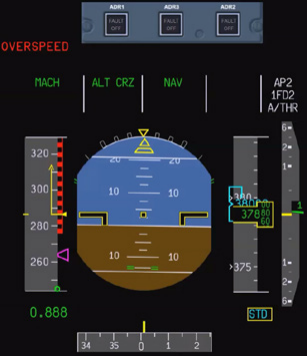
(fig.1) View of the PFD at the time of the overspeed
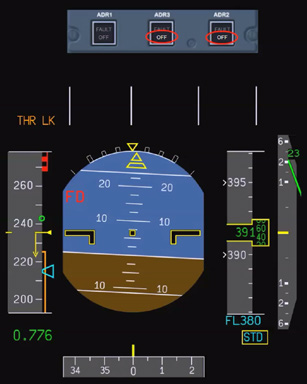
(fig.2) View of the PFD after switching off ADR2 and ADR3
Flight Data Analysis
Section titled “Flight Data Analysis”Analysis of the fl ight data highlights two main aspects of this event: the handling of overspeed and the improper application of the OEB49.
Overspeed handling
Section titled “Overspeed handling”Autopilot is robust to overspeed situations
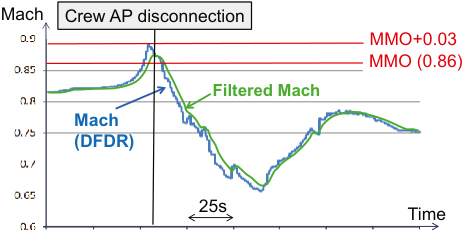
During this event, the flight crew disconnected the autopilot following the OVERSPEED warning However, the autopilot is robust to overspeed situations. The autopilot automatically disconnects only when the fi ltered Mach becomes higher than MMO + a margin (MMO + 0.03 on A330/A340 aircraft). The fi ltered Mach is a smoothed and slightly delayed Mach which dampens any abrupt variation of the current Mach and makes the autopilot even more robust against automatic disconnection.
Simulations show that if the autopilot had been left engaged, it would have remained engaged during this event (fi g.3). As a result, the aircraft would have stayed on its trajectory.
(fi g.3)
Section titled “(fi g.3)”Evolution of the fi ltered Mach versus the current Mach and versus the autopilot automatic disconnection threshold value (MMO+0.03)
(fi g.4)
Section titled “(fi g.4)”Comparison of the recorded Mach evolution with the simulated Mach evolutions if AP was kept ON with the selection of half and full S/B when the Vc trend arrow reached VMAX
Improper application of OEB49
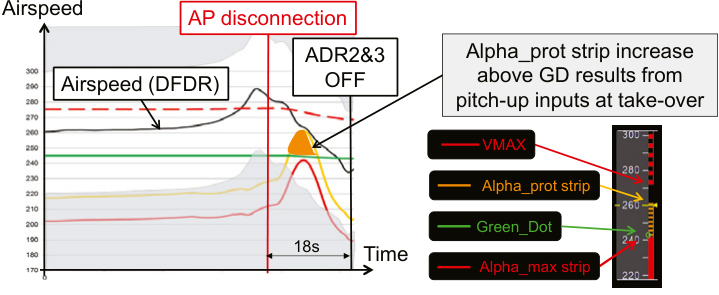
Section titled “Improper application of OEB49”During this event, the fl ight crew interpreted a rising of the alpha protection strip on the PFD as an entry condition of the “Abnormal V Alpha prot” OEB49 and switched off ADR2 and 3. However, none of the OEB entry conditions were actually encountered.
AVOIDING IMPROPER APPLICATION OF OEB48/49
Section titled “AVOIDING IMPROPER APPLICATION OF OEB48/49”Only 2 cases of improper AOA protection activation occurred since the introduction of Airbus fly-by-wire aircraft 31 years ago.
The first time was in November 2012 on an A330 aircraft after the introduction of conic AOA cover plates. All the conic plates were immediately removed subsequent to this event and the original flat cover plate design type was refitted.
The second event occurred 2 years later on an A321 equipped with the initial AOA flat cover plate design. This is the only case of undue AOA protection activation with this configuration which has accumulated more than 300 Million flight hours.
This is the only case of undue AOA protection activation with the flat cover plate configuration which has accumulated more than 300 Million flight hours
OEB48 for A320 family and OEB49 for A330/A340 family were however issued at that time to cover the risk of undue activation of AOA protection in case of multiple AOA blockage at a consistent high value.
These OEB request the flight crew to keep only one ADR ON and switch off the other two ADR. This forces reversion to alternate law which will disable flight envelope protections and thus prevent inappropriate activation of the high angle of attack protection.
OEB48/49 entry conditions
Section titled “OEB48/49 entry conditions”OEB48 and OEB49 have two types of entry conditions: one reactive entry and some preventive entries.
These OEB must be applied only if one of the entry conditions has been confirmed, remembering that only the reactive entry condition requires immediate action.
Reactive entry condition for OEB48 and OEB49: Incorrect activation of the AoA Protection
Section titled “Reactive entry condition for OEB48 and OEB49: Incorrect activation of the AoA Protection”The reactive entry condition is unique, simple and the same for the A320 family, A330 and A340 aircraft (fig.5). The OEB procedure must be immediately applied if the aircraft goes to a continuous nose down pitch rate that cannot be stopped with full backward sidestick inputs while flying at a speed above VLS.
Only the reactive entry condition requires immediate action
The reactive entry condition is unique, simple and the same for the A320 family, A330 and A340 aircraft
(fig.5)
Section titled “(fig.5)”Immediate actions of the OEB48/49 procedure
Preventive entries based on PFD speedscale monitoring
Section titled “Preventive entries based on PFD speedscale monitoring”These OEB also describe “preventive” entry conditions that enable to detect an abnormal overestimation of the α Prot strip on the PFD, which could lead to an undue activation of the AoA protection later in the flight. The flight crew must confirm that all the parameters of the preventive entry condition are true before applying the OEB.
The effects on the PFD speedscale differ depending on the aircraft type:
The flight crew must confirm that all the parameters of the preventive entry condition are true before applying the OEB
(fig.6)
Section titled “(fig.6)”Preventive entry conditions of the OEB49 for A330 and A340 aircraft
• A330/A340 aircraft (OEB49)
Section titled “• A330/A340 aircraft (OEB49)”On A330 or A340 aircraft, the preventive entry condition is when the α Prot strip continuously increases and exceeds Green Dot (GD) speed as the Mach increases in a stabilized wings-level flight path (typically during the climb phase) (fig.6).
In stabilized wings-level flight
Section titled “In stabilized wings-level flight”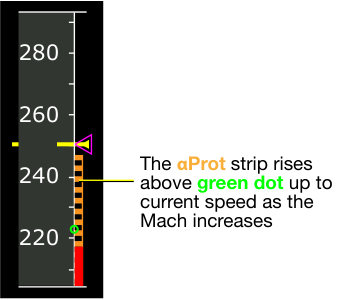
The preventive entry condition of the OEB49 was therefore not fulfilled. The reactive entry was not fulfilled either as the aircraft was climbing when the OEB was applied.
(fig.7)
Section titled “(fig.7)”Plot of the recorded airspeed, green dot speed, Valpha prot, Valpha max and Vmax during the event
On A320 family aircraft, by design, the α Prot strip is limited by VLS out of g-load conditions, so that an abnormal α Prot strip increase becomes visible only during manoeuvers (turn or pitch change)
-
1[st] preventive entry: The α Max strip completely hides the α Prot strip in a stabilized wings-level flight path (without an increase in load factor)
-
- 2[nd] preventive entry: With the Auto Pilot (AP) engaged and the speed brakes in the retracted position, the α Prot strip rapidly moves by more than 30 kt during flight maneuvers with an increase in load factor, for example turns or pitch variations.
In stabilized wings-level flight
Section titled “In stabilized wings-level flight”Turn or pitch change with AP ON and no speedbrake
Section titled “Turn or pitch change with AP ON and no speedbrake”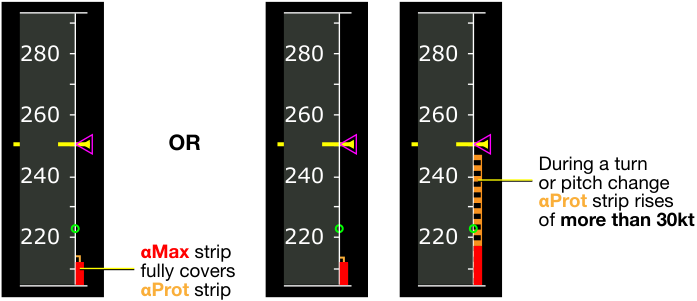
Preventive entry conditions of the OEB48 for A320 aircraft
No reported cases of proper application of OEB48 or OEB49
Section titled “No reported cases of proper application of OEB48 or OEB49”No cases of proper OEB48 or OEB49 application have been reported to Airbus since their publication in December 2014. However, there were six cases of improper application of these OEB procedures.
The OEB was applied in one event where the aircraft was already in alternate law when AOA protection is not available.
Two cases were reported on A320 family after a normal 20 kt α Prot strip increase during a turn with autopilot engaged.
Three cases, including the A340 event described, occurred in similar conditions. The OEB was improperly applied in an overspeed context, after take-over with significant pitch-up inputs applied.
Avoid negative training
Section titled “Avoid negative training”Improperly applying these OEB in overspeed situations could result from inappropriate training for the following reasons:
The current simulators cannot properly simulate the scenario requiring the application of these OEB. However some operators wrongly use some scenarios such as the dual “TOTAL PITOT BLOCKAGE” to train their pilots to switch off two ADRs following an undue activation of the High Speed Protection. This undoubtedly generates negative training and can impair the pilots’ understanding and trust of the flight envelope protection. The article “The Adverse Effects of Unrealistic Simulator Scenarios” explains why the use of the Dual “TOTAL PITOT BLOCKAGE” scenario in simulators is inappropriate and must not be used.
Ensuring that Flight crews understand the reasons for applying OEB48/49 and knowing their entry conditions is essential. Supporting training material, such as instructional videos, are available on the Airbus World portal. For more information on the material available, refer to Flight Operations Transmission (FOT) 999.0148/14 Rev 01 dated 23-DEC-2014 for A330/A340 aircraft and to FOT 999.0147/14 Rev 01 dated 23-DEC-2014 for A320 family aircraft.
The application of these OEB must not be trained in simulator. This is negative training and can impair the pilot’s trust of flight envelope protection
Supporting training material, such as instructional videos, are available on the Airbus World portal
Switching two ADR to OFF has a significant impact on the flight
Section titled “Switching two ADR to OFF has a significant impact on the flight”Switching two ADR to OFF has a significant consequences for the flight, especially in dynamic conditions.
Reversion to ALTERNATE law means the loss of the flight envelope protections including High angle of attack, bank angle and pitch attitude protections. The loss of autopilot and Flight Directors increases the workload of the flight crew. Finally, when the A/THR disconnects the thrust remains at this value as long as the thrust levers are not moved.
The OEB48/49 cancellation fix is available: upgrade your fleet
Section titled “The OEB48/49 cancellation fix is available: upgrade your fleet”Two modifications are now available that will cancel OEB48 & OEB49 when implemented on affected aircraft.
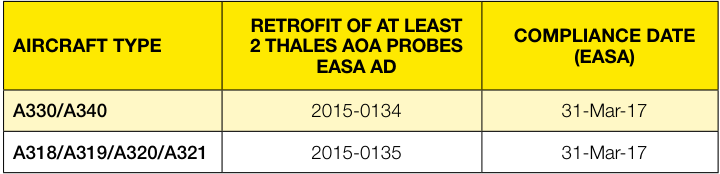
These modifications consists in installing at least two Thales AoA probes, which are more robust to potential blockage at high AoA value, and in a software update for the Flight Control Computers.
This software update introduces two additional monitoring functions:
- Reinforced AoA monitoring
Section titled “- Reinforced AoA monitoring”Updated monitoring will detect AoA probe blockages including multiple and consistent blockages and will reject the data of the concerned probe(s).
- “AoA protection watchdog” monitoring
Section titled “- “AoA protection watchdog” monitoring”This function is an additional independent monitoring that is active at high speeds. It detects inconsistencies between the actual aircraft behavior and the AoA protection activation. In the case of inconsistency, it disables the AoA protection. This independent monitoring would detect undue activation of the AoA protection caused by any possible unforeseen conditions.
Note: These two monitoring functions are already implemented on all A350 and A380 aircraft.
(fig.9)
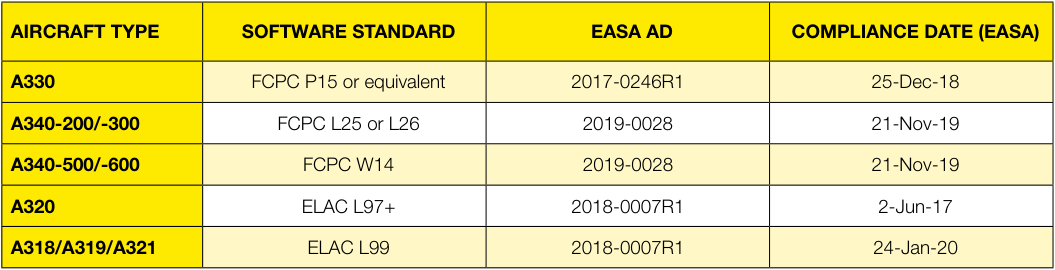
Section titled “(fig.9)”Summary of the relevant EASA Airworthiness Directives with their respective compliance date
The installation of the probes and of the software update is mandated by Airworthiness Directives on A320 family and A330/A340 aircraft and cancels the OEB48/49.
013
It is the operator’s responsibility to remove the OEB from the FCOM and QRH as soon as the corrective modifications are installed on the aircraft and inform flight crews that the OEB is cancelled and its procedure must not be applied anymore.
Once the OEB is cancelled, it must not be applied anymore
CONTRIBUTORS:
Section titled “CONTRIBUTORS:”Panxika CHARALAMBIDES Incident/Accident Investigator Product Safety
Capt. Gilbert SAVARY Head of Flight Operations Support and Training Standard pilots group
With thanks to the A330/A340 Handling qualities and Flight Control laws Engineering teams
The « abnormal Valpha prot » OEB48 and OEB49 have been issued following only one event of undue activation of the angle of attack protection in over 300 million flight hours.
No case of proper application of OEB48 or OEB49 has been reported to Airbus since they were published. However, six cases of improper application were reported.
Application of the OEB48/49 must not be trained in simulator since it can’t be adequately simulated. Instead, flight crews must understand the full context of theses OEB and be able to identify their entry conditions for proper application if required. Supporting training materials on these OEB have been made available to the flight operations division of all Airbus operators. They can still be downloaded from the Airbus World portal.
An improper application of OEB48 and OEB49 may have significant consequences, especially in dynamic flight conditions due to the loss of autopilot, Flight Directors, autothrust and reversion to alternate law with loss of flight envelope protections.
The OEB48 and OEB49 cancellation fix is mandated by Airworthiness Directive and available for both A320 and A330/A340 aircraft families. It is highly recommended to upgrade aircraft as soon as possible with these modifications. Remove the OEB from the documentation as soon as the fix is installed and ensure that flight crews will no longer apply them.
Safety fi rst, #28 June, 2019. Safety first is published by Airbus S.A.S. - 1, rond point Maurice Bellonte - 31707 Blagnac Cedex/France. Publisher and Editor: Yannick Malinge, Chief Product Safety Officer. Concept Design by Airbus Multi Media Studio 20190588. Reference: X00D16031905 Issue 28. Photos by Airbus.
超速事件与机组接管及OEB49应用
Section titled “超速事件与机组接管及OEB49应用”来源: Airbus Safety First 网址: https://safetyfirst.airbus.com/overspeed-event-with-crew-take-over-and-oeb49-application/ 发布日期: 2019-06-19 杂志期号: 2019-06 类别: 飞行运行 PDF: Original PDF
超速事件与机组接管及OEB49应用 一架A340飞机在FL380高度飞行时,遭遇强烈且急剧的顺风减小,导致MMO大幅超限并触发超速警告。
机组断开自动驾驶仪(AP)、人工接管,并错误地应用了OEB49(将ADR2和ADR3设置为OFF)。
本文描述此事件,并从分析中提出两个主要方面:超速情况的管理和OEB49的不当应用。
详述了OEB49(A330/A340飞机)和OEB48(A320系列飞机)的原理及其应用条件。解释了为何不能在模拟机中进行训练,并回顾了可取消该OEB的飞机改装。
顺风骤降导致的巡航超速
Section titled “顺风骤降导致的巡航超速”一架A340飞机在FL380高度以0.82的管理马赫数飞行,顺风约64节。在到达下降顶点前,顺风在14秒内突然下降41节,导致空速显著增加,尽管自动推力(A/THR)已发出推力减小指令,仍触发了持续9秒的超速警告**(图1)**。
人工断开自动驾驶仪、大量拉杆侧杆输入并选择低马赫数目标
Section titled “人工断开自动驾驶仪、大量拉杆侧杆输入并选择低马赫数目标”机长对超速警告作出反应,人工断开了自动驾驶仪(AP),然后在侧杆上施加了大量拉杆输入。减速板未使用。机组随后选择了0.7的马赫数,这实际上对应于低于VLS的真空速。飞机因此开始以高达5700英尺/分的俯仰率上升。速度随着处于慢车状态的推力而减小,符合所选马赫数。
双ADR电门关闭:备用法则、A/THR失效、保护功能和FD消失
Section titled “双ADR电门关闭:备用法则、A/THR失效、保护功能和FD消失”机组错误地应用了OEB49程序,在自动驾驶仪断开约15秒后关闭了ADR 2和ADR 3。这导致飞机进入备用法则,FD棒消失,自动推力断开。因此,推力保持在当时的当前值,即慢车状态**(图2)**。实际上,自动推力断开时的推力锁定(THR LK)功能将推力保持在当前值,直到推力手柄再次移动。相应的~~“ENG THRUST LOCKED”~~ ECAM警告会提示移动推力手柄,FMA上也会显示~~“THR LOCK”~~。
慢车推力爬升32秒直至触发失速警告
Section titled “慢车推力爬升32秒直至触发失速警告”自动推力断开后,推力手柄在32秒内未被移动。在此期间,飞机继续以慢车推力爬升,速度不断减小。当到达FL399时,连续触发了四次失速警告。机组通过执行失速改出动作进行反应,并发出了MAYDAY呼叫。
ADRs重新接通
Section titled “ADRs重新接通”机组最终将ADR2和ADR3重新接通。这使机组能够重新衔接自动驾驶仪和自动推力。飞机恢复正常飞行,并安全落地,无进一步异常。
(图1) 超速时的PFD视图
(图2) 关闭ADR2和ADR3后的PFD视图
飞行数据分析
Section titled “飞行数据分析”飞行数据分析突出了本事件的两个主要方面:超速处理和OEB49的不当应用。
自动驾驶仪对超速情况具有鲁棒性
Section titled “自动驾驶仪对超速情况具有鲁棒性”在本事件中,机组在收到超速警告后断开了自动驾驶仪。然而,自动驾驶仪对超速情况具有鲁棒性。自动驾驶仪仅在滤波马赫数超过MMO + 一个余量时才会自动断开(A330/A340飞机上为MMO + 0.03)。滤波马赫数是一个经过平滑和轻微延迟的马赫数,它能抑制当前马赫数的任何急剧变化,使自动驾驶仪在防止自动断开方面更加鲁棒。
模拟显示,如果保持自动驾驶仪接通,它在本事件中将保持接通状态**(图3)**。因此,飞机将保持在原航迹上。
(fi g.3)
Section titled “(fi g.3)”过滤马赫数与当前马赫数及自动驾驶仪自动断开阈值(MMO+0.03)的变化关系
(fi g.4)
Section titled “(fi g.4)”当Vc趋势箭头达到VMAX时,比较记录的马赫数变化与保持AP接通并选择半速和全速S/B的模拟马赫数变化
OEB49的不当应用
Section titled “OEB49的不当应用”在此事件中,机组将PFD上alpha保护条的上升解读为“异常V Alpha prot” OEB49的进入条件,并关闭了ADR2和ADR3。然而,实际上并未遇到任何OEB进入条件。
避免OEB48/49的不当应用
Section titled “避免OEB48/49的不当应用”自空客电传操纵飞机问世以来的31年间,仅发生了2起不正确的AOA保护激活事件。
第一次是2012年11月在A330飞机上引入锥形AOA盖板之后。事件发生后,所有锥形盖板立即被拆除,并重新装回了原始的平板盖板设计类型。
第二次事件发生在两年后的一架配备初始AOA平板盖板设计的A321飞机上。这是该配置(已累计超过3亿飞行小时)中唯一一起不当AOA保护激活事件。
这是平板盖板配置下唯一一起不当AOA保护激活事件,该配置已累计超过3亿飞行小时。
然而,OEB48(适用于A320系列)和OEB49(适用于A330/A340系列)当时已发布,以覆盖在多个AOA以一致的高值阻塞情况下不当激活AOA保护的风险。
这些OEB要求机组仅保持一个ADR接通,并关闭另外两个ADR。这将强制转换至备用法则,从而禁用飞行包线保护,防止高迎角保护的不当激活。
OEB48/49进入条件
Section titled “OEB48/49进入条件”OEB48和OEB49有两类进入条件:一类是反应性进入条件,另一类是预防性进入条件。
这些OEB必须在确认满足其中一项进入条件后才能执行,记住只有反应性进入条件需要立即采取行动。
OEB48和OEB49的反应性进入条件:AOA保护的不正确激活
Section titled “OEB48和OEB49的反应性进入条件:AOA保护的不正确激活”反应性进入条件是唯一的、简单的,且对于A320系列、A330和A340飞机是相同的(图5)。如果飞机在高于VLS的速度下出现无法通过全后拉侧杆输入停止的持续低头俯仰率,则必须立即执行OEB程序。
只有反应性进入条件需要立即采取行动
反应性进入条件是唯一的、简单的,且对于A320系列、A330和A340飞机是相同的
(fig.5)
Section titled “(fig.5)”OEB48/49程序的立即动作
基于PFD速度刻度监控的预防性进入条件
Section titled “基于PFD速度刻度监控的预防性进入条件”这些OEB还描述了“预防性”进入条件,用于检测PFD上α Prot条异常高估的情况,这可能在后续飞行中导致AOA保护的不当激活。机组必须在执行OEB之前确认预防性进入条件的所有参数均为真。
PFD速度刻度上的效果因飞机类型而异:
机组必须在执行OEB之前确认预防性进入条件的所有参数均为真
(fig.6)
Section titled “(fig.6)”A330和A340飞机OEB49的预防性进入条件
• A330/A340飞机(OEB49)
Section titled “• A330/A340飞机(OEB49)”在A330或A340飞机上,预防性进入条件是:当α Prot条在稳定平飞航径(通常在爬升阶段)中随马赫数增加而持续上升并超过绿点(GD)速度时(图6)。
在稳定平飞状态
Section titled “在稳定平飞状态”
因此,OEB49的预防性进入条件未满足。反应性进入也未满足,因为在执行OEB时飞机正处于爬升状态。
(fig.7)
Section titled “(fig.7)”事件期间记录的空速、绿点速度、Valpha prot、Valpha max和Vmax的变化曲线
在A320系列飞机上,由于设计原因,α Prot条在载荷条件外受VLS限制,因此异常的α Prot条增加仅在机动飞行中(转弯或俯仰变化)才可见
-
第1项预防性进入条件:在稳定平飞航径中(无载荷增加),α Max条完全遮挡α Prot条
-
第2项预防性进入条件:当自动驾驶仪(AP)接通且减速板处于收上位置时,α Prot条在带载荷增加的机动飞行中(例如转弯或俯仰变化)快速移动超过30节
在稳定平飞状态
Section titled “在稳定平飞状态”接通自动驾驶仪的转弯或俯仰变化且无减速板
Section titled “接通自动驾驶仪的转弯或俯仰变化且无减速板”
OEB48 针对 A320 系列飞机的预防性进入条件
尚无正确应用 OEB48 或 OEB49 的报告案例
Section titled “尚无正确应用 OEB48 或 OEB49 的报告案例”自 2014 年 12 月发布以来,空客尚未收到正确应用这些 OEB 程序的报告。然而,存在六起不正确应用这些 OEB 程序的案例。
在某一事件中,当 AOA 保护不可用时,飞机已进入备份法则状态,在此情况下应用了 OEB。
在 A320 系列飞机上有两起案例,发生在接通自动驾驶仪的转弯过程中,α Prot 正常增加 20 kt 之后。
包括 A340 事件在内,共有三起案例发生在类似条件下。OEB 在超速情况下被不当应用,机组接管后施加了显著的抬头输入。
避免负面培训
Section titled “避免负面培训”在这些超速情况下不正确应用这些 OEB 可能源于不适当的培训,原因如下:
当前的模拟机无法正确模拟需要应用这些 OEB 的场景。然而,一些运营商错误地使用某些场景(如双”总皮托管堵塞”)来训练飞行员在高速度保护异常启动后关闭两个 ADR。这无疑会产生负面培训,并可能损害飞行员对飞行包线保护的理解和信任。《不切实际的模拟场景的负面影响》一文解释了为什么在模拟机中使用双”总皮托管堵塞”场景是不适当的,不得使用。
确保飞行机组理解应用 OEB48/49 的原因及其进入条件至关重要。支持性培训材料(如教学视频)可在空客 World 门户网站上获取。如需了解更多可用材料的信息,请参阅 2014 年 12 月 23 日发布的 A330/A340 飞机飞行运营通报(FOT)999.0148/14 Rev 01,以及 A320 系列飞机飞行运营通报(FOT)999.0147/14 Rev 01。
不得在模拟机中训练这些 OEB 的应用。这是负面培训,会损害飞行员对飞行包线保护的信任。
支持性培训材料(如教学视频)可在空客 World 门户网站上获取。
关闭两个 ADR 对飞行有重大影响
Section titled “关闭两个 ADR 对飞行有重大影响”关闭两个 ADR 对飞行有重大影响,尤其是在动态条件下。
恢复至备份法则意味着飞行包线保护(包括大迎角、大坡度角和俯仰姿态保护)的丧失。自动驾驶仪和飞行指引仪的丧失增加了飞行机组的工作负荷。最后,当 A/THR 断开时,推力保持在该值,除非推力手柄被移动。
OEB48/49 取消修复方案已可用:升级您的机队
Section titled “OEB48/49 取消修复方案已可用:升级您的机队”目前有两项改装可用,在受影响的飞机上实施后将取消 OEB48 和 OEB49。
这些改装包括安装至少两个泰雷兹 AOA 探头,这些探头在迎角值较高时对潜在堵塞更具鲁棒性,并对飞行控制计算机进行软件更新。
该软件更新引入了两个额外的监控功能:
- 增强的 AOA 监控
Section titled “- 增强的 AOA 监控”更新后的监控将检测 AOA 探头堵塞,包括多重和一致的堵塞,并将拒绝相关探头的数据。
- “AOA 保护看门狗”监控
Section titled “- “AOA 保护看门狗”监控”此功能是一个额外的独立监控,在高速度下激活。它检测实际飞机行为与 AOA 保护启动之间的一致性。在不一致的情况下,它将禁用 AOA 保护。这一独立监控将检测由任何可能的意外情况导致的 AOA 保护异常启动。
注:这两项监控功能已在所有 A350 和 A380 飞机上实现。
(fig.9)
Section titled “(fig.9)”相关EASA适航指令及其各自符合日期汇总
皮托管探头的安装和软件更新由A320系列及A330/A340飞机适航指令强制要求,并取消OEB48/49。
013
运营商有责任在飞机上安装纠正改装后,从FCOM和QRH中删除OEB,并通知飞行机组该OEB已取消,其程序不得再被执行。
一旦OEB被取消,不得再执行。
Panxika CHARALAMBIDES 事故/事故调查员 产品安全
Capt. Gilbert SAVARY 飞行运行支援与培训标准飞行员组组长
感谢A330/A340操纵品质与飞行控制律工程团队
在超过3亿飞行小时中仅发生一次迎角保护不当启动事件后,空客发布了“异常迎角保护”OEB48和OEB49。
自发布以来,空客未收到关于正确应用OEB48或OEB49的报告。然而,收到六起不当应用的报告。
不得在模拟机中训练OEB48/49的应用,因为无法充分模拟。相反,飞行机组必须充分理解这些OEB的全部背景,并能够识别其触发条件,以便在需要时正确应用。所有空客运营商的飞行运行部门已获得关于这些OEB的支持性培训材料。这些材料仍可从空客World门户下载。
不当应用OEB48和OEB49可能产生重大后果,特别是在动态飞行条件下,因为会导致自动驾驶仪、飞行指引仪、自动推力的失效,并切换至备用法则而丧失飞行包线保护。
OEB48和OEB49的取消修复由适航指令强制要求,适用于A320和A330/A340飞机系列。强烈建议尽快使用这些改装升级飞机。修复安装后,立即从文件中删除OEB,并确保飞行机组不再应用。
Safety first, #28 2019年6月。Safety first由空中客车公司出版 - 1, rond point Maurice Bellonte - 31707 布拉尼亚克 Cedex/法国。出版人和编辑:首席产品安全官Yannick Malinge。概念设计:空客多媒体工作室 20190588。参考编号:X00D16031905 第28期。图片:空客。