Preparing Flight Crews to Face Unexpected Events
Source: Airbus Safety First URL: https://safetyfirst.airbus.com/preparing-flight-crews-to-face-unexpected-events/ Published: 2017-01-29 Magazine Issue: 2017-01 Category: Flight Ops, AoA, basics, EBT, effect, evidence, human, just culture, reporting, startle, training, winsdshear PDF: Original PDF
TRAINING
During an approach at night-time into Glasgow Airport, the crew of an easyJet A319 experienced a strong cross-wind and turbulent conditions, which created a WINDSHEAR alert and led them to perform a go-around.
As they did this, PFD information including Flight Modes Annunciator, Flight Director bars, and characteristic speeds all disappeared from both PFDs. In addition, the rudder travel limiter function became unavailable, and the auto-thrust disconnected. The crew was facing a very challenging situation, and needed to use their training in back-to-basics fl ying and effi cient Crew Resource Management.



PANXIKA CHARALAMBIDES Flight Safety Director
Section titled “PANXIKA CHARALAMBIDES Flight Safety Director”BRIAN TYRRELL
Head of Flight Operations, easyJet
CAPT. CHRISTIAN NORDEN Director Flight Operations & Training Policy

This article describes the event, and provides analysis of its root cause. It also explores the training, oversight and cultural objectives in place at easyJet that have contributed to the crew’s effective handling of an unforeseeable combination of factors. These were all key elements that helped the crew achieve a safe outcome.
A CREW EXPERIENCED A COMBINATION OF FACTORS THEY HAD NOT TRAINED FOR
Section titled “A CREW EXPERIENCED A COMBINATION OF FACTORS THEY HAD NOT TRAINED FOR”It was the crew’s fi rst sector of the day departing from London Gatwick for Glasgow. From the weather reported for Glasgow Airport, they were expecting turbulent conditions with cross-wind of approximately 26 knots and a wet runway.
The First Officer’s Probe Heat Computer was inoperative prior to the departure from Gatwick and so the aircraft was operated under an MEL
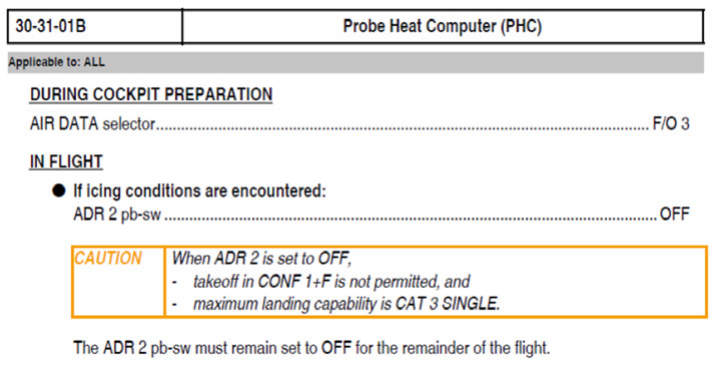
for the flight to Glasgow. The MEL procedure required the crew to select the Air Data selector to [FO ON 3] and set the ADR2 pushbutton switch to [OFF] prior to entering icing conditions. Icing conditions were expected during the fl ight, and so the ADR2 was set to [OFF] before the departure. The procedure also states that when the ADR2 has been switched [OFF], the ADR2 must remain set to [OFF] for the remainder of the fl ight (fi g.1).
Each ADR is part of the ADIRU, and provides anemometric parameters which they compute from their associated air data probe outputs.
The system architecture of A320 family aircraft includes three ADRs, called ADR1, ADR2 and ADR3.
(fi g.1)
Section titled “(fi g.1)”Application of MEL 30/31/01B for First Offi cer’s Probe Heat Computer (PHC) inoperative.
Instructions are to select the AIR DATA to [F/O ON 3] and set the ADR2 pushbutton switch to OFF prior to entering icing conditions.
TRAINING
Section titled “TRAINING”(fig.2)
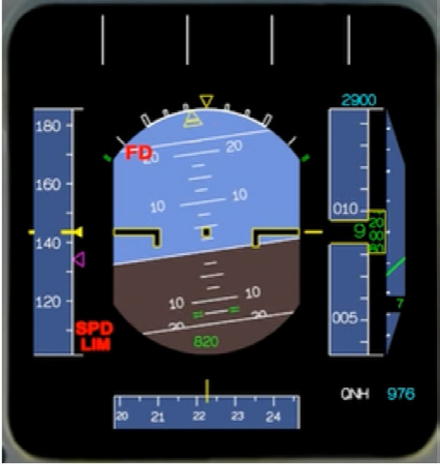
Section titled “(fig.2)”Primary Flight Display. [FD] and [SPD LIM] flags are displayed in red text. They respectively indicate the loss of Flight Director bars and the characteristic speed information.
Upon reaching 850 feet a reactive WINDSHEAR warning was triggered for 15 seconds. The crew evaded the WINDSHEAR and then conducted the go-around.
The crew handled this difficult situation well, performing efficient Crew Resource Management (CRM), and applying backto-basics in flying attitude and thrust to manage the go around phase.
After an uneventful flight from Gatwick, the crew reported turbulent conditions on the approach into Glasgow. They disconnected both auto-pilots while crossing one-thousand feet. The Captain was the pilot flying. Upon reaching 850 feet a reactive WINDSHEAR warning was triggered for 15 seconds.
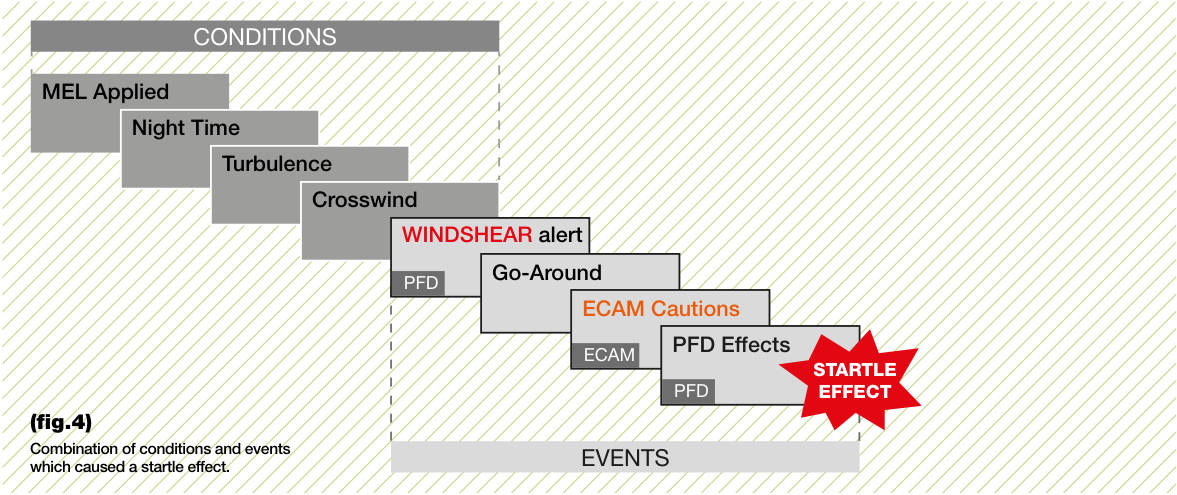
created a startle effect on the crew. With the increased workload, the crew missed the AUTO FLT RUD TRV LIM SYS ECAM warning and hence did not apply the associated procedure shown on the ECAM display (fig.3).
In retrospect, if the crew had applied the procedure displayed on the ECAM they would have reset FAC1 and FAC2, and recovered all of the functions previously lost. However, on the climb from 1900 feet through to 2300 feet, during the slats and flaps retraction, three VFE (maximum allowable airspeed with flaps extended) OVERSPEED warnings sounded within 20 seconds. At the time of the second VFE triggering, the crew switched the ADR2 to [ON], which was not part of the operating procedure but resulted in the characteristic speeds and rudder travel limiter function being available again in the FAC2. This also made the Flight Director (FD2) available and it reengaged automatically on both PFD as it was still selected. Similarly the auto-thrust (ATHR) was also now available and later reengaged by the crew.
The crew evaded the WINDSHEAR and then conducted the go-around as per standard operating procedures. However in the same instant the FMA became blank, the Flight Director (FD) bars disappeared from the Primary Flight Displays (PFD) and were replaced by the red [FD] flag (fig.2). The characteristic speed information were also no longer displayed on either PFD, and were replaced by the red [SPD LIM] flag, which was displayed at the bottom of the airspeed scale. The only information displayed on the airspeed scales were the current speed and the speed bug.
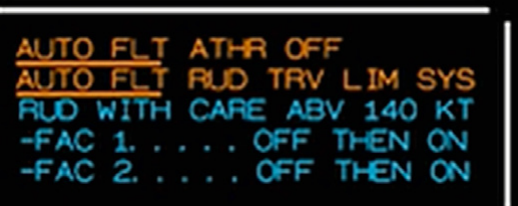
Additionally, two ECAM messages with the associated single-chime and master caution indicated they lost the AutoThrottle (ATHR) as well as the rudder travel limitation functions. As shown in Figure 3, the ECAM messages indicated were the AUTO FLT ATHR OFF and AUTO FLT RUD TRV LIM SYS amber messages (fig.3).
The crew successfully conducted the remainder of the flight and landed safely. Overall, the crew handled this difficult situation well, performing efficient Crew Resource Management (CRM), and applying back-to-basics in flying attitude and thrust to manage the go around phase.
As illustrated in (fig.4) , the combination of the windshear, chimes and alerts
(fi g.3)
Section titled “(fi g.3)”Ecam messages ‘AUTO FLT ATHR OFF’ and ‘AUTO FLT RUD TRV LIM SYS’. Associated operating procedure to reset FAC 1 & 2 displayed with master caution and single chime.
the same time that the WINDSHEAR alert was triggered. Why did the measured AOA3 increase signifi cantly more than the AOA1 at that time? What are the consequences of this?
easyJet and Airbus conducted a joint investigation into this event. Analysis of the Digital Flight Data Recorder (DFDR) showed a signifi cant discrepancy between the AOA1 and AOA3 measurements at
Angle of Attack and the Sideslip Effect Explained
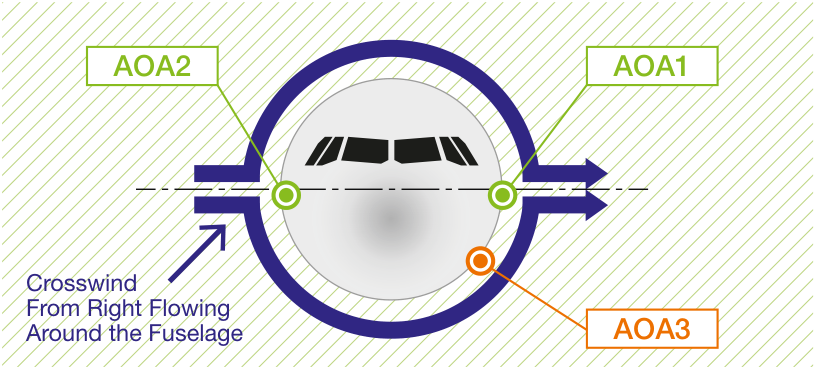
Section titled “Angle of Attack and the Sideslip Effect Explained”This aircraft is fi tted with three Angles of Attack probes that deliver three separate Angle of Attack measurements, so called AOA1, AOA2 and AOA3. The sensor vanes delivering AOA1 and AOA2 measurements are located symmetrically on the left and right sides of the aircraft close to the horizontal axis of symmetry. As illustrated in (fi g.5), these locations give them a low sensitivity to sideslip.
The AOA3 is located below the aircraft’s horizontal axis of symmetry. This position makes it more susceptible to sideslip because it is mainly exposed to the part of the lateral airfl ow which fl ows below the aircraft (fi g.5). This is why the crosswind gust that occurred at the same time as the triggering of the WINDSHEAR alert caused there to be a discrepancy between the measured defl ections of the AOA1 and AOA3 sensor vanes.
The AOA3 is located below the aircraft’s horizontal axis of symmetry and is therefore more susceptible to sideslip.
TRAINING
Section titled “TRAINING”(fi g.5)
Section titled “(fi g.5)”Lateral wind gusting across the fuselage during sideslip. AOA3 is more sensitive to sideslip defl ection, when compared to AOA1 and AOA2, due to its position below the horizontal symmetry axis of the aircraft.
In the Flight Augmentation Computers (FAC)
Section titled “In the Flight Augmentation Computers (FAC)”(fi g.6)
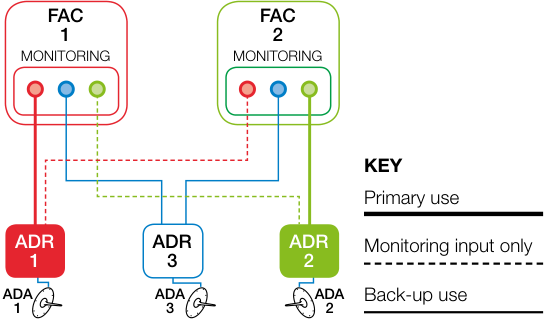
Section titled “(fi g.6)”Simplifi ed schematic diagram showing the system confi gurations for ADR1, ADR2 and ADR3 with the cross-comparison monitoring of ADR by FAC1 and FAC2 in a normal confi guration.
Both FAC1 and FAC2 monitor certain ADR parameters, and in particular they monitor the AOA by performing a cross-comparison monitoring of all three AOA measurements provided by their respective ADR (refer fi g. 6). In this event, where the applied MEL procedure called for the ADR2 to be switched to [OFF], the FACs were only monitoring for a difference between the measured values of AOA1 and AOA3.
and AOA3 ADR parameters being rejected by both FACs. When one ADR parameter is rejected by the FAC monitoring, then all parameters of its corresponding ADR are also rejected. Therefore, ADR1 and ADR3 were rejected by both FAC1 and FAC2. Consequently, there was now no ADR information available in either FAC.
In this condition, both FAC were no longer capable of computing the characteristic speeds, the FD bars, the auto-thrust, auto-pilot or rudder travel limiter function.
The discrepancy between AOA1 and AOA3 measurements at the time of crosswind gust led to AOA1
The sudden AOA3 increase had no consequences in the ELAC because the ELAC’s monitoring is slightly different to the FAC one due to different architecture. Therefore data
from both ADR1 and ADR3 remained valid in the ELAC, and normal laws including all fl ight envelope protections, continued to be computed throughout the fl ight.
On both PFD
Section titled “On both PFD”Officer’s sides respectively, the current speed, Mach and altitude parameters delivered by these computers were respectively displayed on both the Captain’s and First Officer’s PFD until the end of the flight.
The fact that ADR1 and ADR3 were rejected in FAC1 and FAC2 had no impact on the display of ADR parameters on the primary flight displays (PFD). Indeed, as the ADR1 and ADR3 were selected on the Captain’s and First
What are the consequences of turning ADR2 to [ON]?
Section titled “What are the consequences of turning ADR2 to [ON]?”Flight Director (FD2) and the autothrust (ATHR) became available again from channel 2.
At the time of the second V FE overspeed warning, the crew switched the ADR2 to [ON]. This led ADR2 parameters to be available again for functions computation in FAC2. Therefore the characteristic speeds, the rudder travel limiter function, the
However, the autopilot remained unavailable since FAC2 had only information from one ADR available.
ADR1 and ADR3 remained valid in the ELAC, and normal laws including all flight envelope protections, continued to be computed throughout the flight.
THE EASYJET FORMULA FOR AN ENHANCED SAFETY BENEFIT
Section titled “THE EASYJET FORMULA FOR AN ENHANCED SAFETY BENEFIT”easyJet continues to learn from events like the one analyzed in this article in order to prepare its pilots to face unexpected events and manage situations to have a safe outcome. It has a specific structure that it has put in place for managing
remote bases and this reinforces the dissemination of safety, technical and training materials. Through the development of its “Just” culture, crews have confidence to report events so that their experience can be shared.
The importance of encouraging pilots to practice manual flying skills
Section titled “The importance of encouraging pilots to practice manual flying skills”Practicing manual flying in various conditions and to use automation appropriately
Section titled “Practicing manual flying in various conditions and to use automation appropriately”easyJet recommends that all of its pilots regularly disengage the automation and practice their manual flying skills in various weather conditions. It is at the pilot’s discretion to choose when to fly without the auto-pilot or without auto-pilot and auto-thrust. easyJet places emphasis on using automation appropriately to reduce workload, and for the crew to fly manually when they feel they have the right conditions to do so without reducing their overall capacity. Manual handling skills are further reinforced in the easyJet simulator sessions.
The aim of encouraging regular practice of manual flying skills, both on the aircraft and in the simulators, is to ease the management of any unexpected events that could lead to less aircraft automation being available. Additionally, this reinforces the confidence of the pilots in their manual flying capabilities, which can help them to minimize the startle effect from unexpected events. In the flight described in this article, it was evident that the Captain was confident to manually fly the aircraft in the turbulent conditions on the approach into Glasgow as he disconnected the auto-pilot from one-thousand feet.
easyJet recommends that all of its pilots regularly disengage the automation and practice their manual flying skills in various weather conditions.
TRAINING
Section titled “TRAINING”The importance of “Just Culture”
Section titled “The importance of “Just Culture””Encouraging the reporting of events to share the lessons learned and enhance safety
Section titled “Encouraging the reporting of events to share the lessons learned and enhance safety”easyJet promotes a “Just Culture” for reporting events, which ensures that they can be objectively resolved and with a standardized recorded outcome. The reporting of an event by the crew and the subsequent investigation allows easyJet to collect all of the relevant facts in order to accurately rebuild the scenario. The aim is to share these experiences with other pilots, and to
recognize positive behaviors that the crew exhibited when faced with a rare and unpredictable event. For easyJet, a “Just culture” means that when their crews are capably acting with their best intentions, to the capacity of their knowledge and experience levels, they can perform their responsibilities without the worry of an inconsistent reproach from the easyJet management.
WHAT IS “JUST CULTURE”?
Section titled “WHAT IS “JUST CULTURE”?”“A culture in which front-line operators or other persons are not punished for actions, omissions or decisions taken by them that are commensurate with their experience and training, but in which gross negligence, willful violations and destructive acts are not tolerated.” This definition of “Just Culture”
was formally enacted by European Commission Regulation for the reporting, analysis and follow-up of occurrences in civil aviation.
The meaning is that under “Just Culture” conditions, individuals are not blamed for ‘honest errors’, but are only held accountable for willful violations and gross negligence.
Role of the Base Standards Captains in supporting event reporting and knowledge sharing amongst the pilots at a remote base
Section titled “Role of the Base Standards Captains in supporting event reporting and knowledge sharing amongst the pilots at a remote base”Base Standards Captains foster a supportive atmosphere at the base in which pilots can operate, share their experiences and report events, or seek out knowledge if required.
For the pilots who are located at bases away from the easyJet headquarters, a network of Base Standards Captains (BSCs) are in place. These BSCs distribute new procedures into each base in the easyJet route network, to ensure the procedures and other safety related changes are understood and adopted.
monitoring and standards assessments to ensure the continued capabilities of all pilots operating in their base. All of easyJet’s BSCs are line training Captains who are embedded within the day to day front line operation and therefore are best placed to engender a supportive atmosphere at the base in which pilots can operate, share their experiences and report events, or seek out knowledge if required.
A BSC will carry out regular performance
Importance of operators updating their training packages
Section titled “Importance of operators updating their training packages”Enhancement of training with the lessons shared from event reports to train for outcomes rather than from specifi c tasks
Section titled “Enhancement of training with the lessons shared from event reports to train for outcomes rather than from specifi c tasks”easyJet invests significantly in providing both remedial and supportive training packages for all of its crew and has over 10 years’ experience in using Alternative Training and Qualification Program (ATQP). This has provided more effective,
operations specifi c training packages. The packages are designed using data from both industry wide and specifi c company safety events, as well as statistical analysis of data in order to identify additional areas that need to be trained.
With over 400,000 sectors a year flown across the fleet, easyJet has a rich stream of internal flight data to analyze. Their training team can define additional training priorities based on what they see in both the operations and in simulator sessions. They also draw upon the available industry information, including the lessons learned and recommendations from accident and incident reports. These are made available to all easyJet pilots for review.
The easyJet system is designed to “train for outcomes” rather than for specific scenarios. It includes training for upset recovery in normal law and multiple training cases for unreliable airspeed, which are opportunities to emphasize importance of “pitch and thrust” flying. All of the easyJet pilots are immersed in this training philosophy.
Reinforcing safety of operations though training enhancements
Section titled “Reinforcing safety of operations though training enhancements”easyJet’s training highlights the importance of crews going back-tobasics to ensure a positive outcome for the safety of their flights, and the importance of efficient Crew Resource Management (CRM) when facing unexpected events.
applied back-to-basics attitude and thrust flying with the priorities to “Fly, Navigate and Communicate”. This allowed them to manage the situation and have a positive outcome to this startle effect event.
It is impossible to train every pilot in scenarios that will cover every potential threat. However, easyJet believes that by training their crews to ‘manage outcomes’ and to manage complex failures as a team for events, such as upset recovery or unusual attitude, they get an enhanced safety benefit across their entire fleet for all of their customers and crews.
For the event described by this article, it was clear for the First Officer as the pilot monitoring that his priority was to closely monitor the parameters, and in particular to always remain aware of the aircraft pitch attitude and bank angle during the go-around phase. The Captain as the pilot flying followed the standard operating procedures and
The easyJet system is designed to ‘train for outcomes’ rather than for specific scenarios. It includes training for upset recovery in normal law and multiple training cases for unreliable airspeed.
It is impossible to train every pilot in scenarios that will cover every potential threat.
TRAINING
Section titled “TRAINING”
EVIDENCE BASED TRAINING FOR AIRBUS PILOTS
Section titled “EVIDENCE BASED TRAINING FOR AIRBUS PILOTS”Airbus is a strong supporter of EBT and has started to include EBT elements in its pilots’ type rating courses.
IATA Evidence-Based Training Implementation Guide, 1st Edition Pg. 38 IATA Data Report for Evidence-Based Training – Montreal 2013 Appendix 16 IATA l.c. Pg. 85
The example of the easyJet event shows how a well-trained crew working in just-culture managed a challenging situation that had not been trained before. easyJet has practiced the UK CAA’s ‘Advanced Training & Qualification Programme’ (AQTP) for several years. The described event demonstrates the merits of this competency based training system compared to the conventional task based training philosophy.
Evidence Based Training (EBT) takes the concepts of the FAA’s Advanced Qualification Program (AQP) and EASA’s ATQP program further by structuring recurrent assessment and training according to evidence-based priorities, based on a comprehensive analysis of safety and training data from a wide variety of sources[1] . EBT was introduced by EASA in 2016 by ED Decision 2015/027/R for recurrent training.
Airbus is a strong supporter of EBT and has started to include EBT elements in its pilots’ type rating courses, even if it is not yet mandated by regulation.
The Airbus A350 Type Rating courses have been the first to receive EBT elements, making them competency and not task centered. EBT places emphasis on scenario-based training, adding the ‘surprise’ element, and
particularly focusing on the most critical training topics identified by EBT[2].
One of these critical training topics is the Go-Around, which was found through analysis of data from multiple operational and training sources to be a procedure with operational risks. The data indicated that crews may face challenges when conducting a Go-Around[3] . These findings highlighted to industry the need to raise flight-crew skills in performing Go-Arounds, through more and different training types.
Accordingly, starting with the A350, Airbus has intensified Go-Around training to cover a much broader scope. Besides training the still necessary oneengine inoperative manoeuvres, the training also assigns the following:
-
“Unexpected” go-arounds
-
Go-arounds from various altitudes different from MDA/DH
-
Go-arounds with relatively low gross weight, combined with low MISAP level off altitudes
-
Go-arounds in VMC with revisions to the (managed) flight path (“Join visual downwind”)
Type Rating training will receive a major revamp when the new EASA regulation currently under design will introduce EBT for the type training phase. This step beyond ICAO DOC 9995 can be expected for 2018.
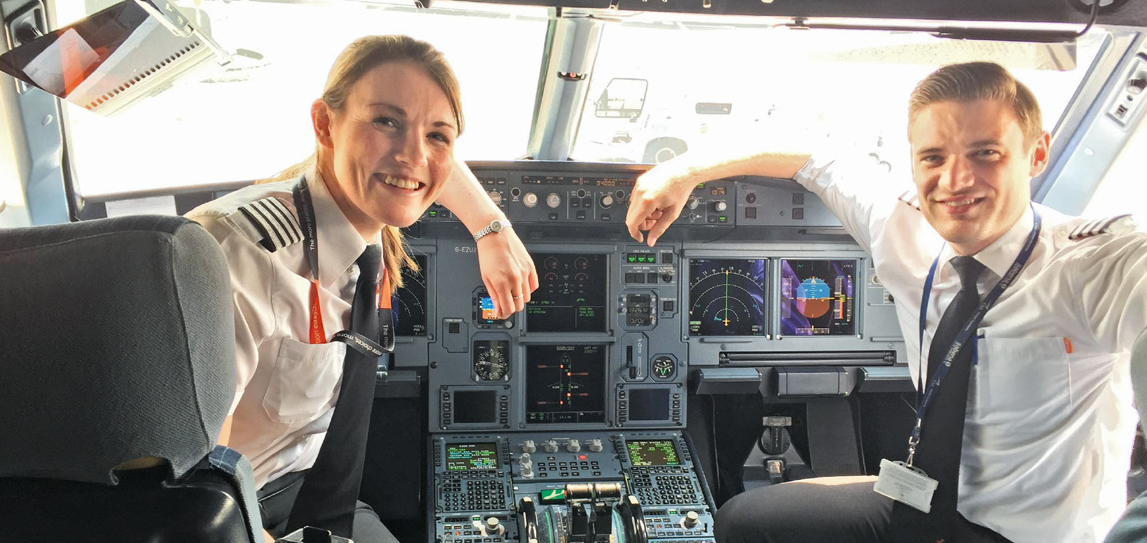

In the event described by this article, the crew clearly faced a scenario with a significant startle effect due to a combination of factors for which they had not been specifically trained. Despite this, the crew worked as a team and managed this challenging situation very well thanks to their general training.
easyJet’s training philosophy to “train for outcomes” is one element that was key in achieving a safe outcome when faced with such events. easyJet’s training program, which evolves with new data, highlights the importance of crews performing efficient crew resource management, to use automation appropriately, and to regularly practice manual flying skills.
Their supportive professional structure, which promotes “Just Culture” for reporting and sharing knowledge or experience is also a key element driving the evolution of their training programs, using reported experiences to prepare crew to face unexpected events.
Approaches to training are evolving across industry, with Evidence Based Training (EBT) for recurrent training being introduced by EASA in 2016. Rather than measuring a pilot’s performance during individual events or manoeuvres, EBT develops and assesses the overall capability of a pilot across a range of core competencies.
Starting with the A350, Airbus is evolving type rating courses to include elements of Evidence Based Training (EBT).
Safety first, #23 January, 2017. Safety first is published by Airbus S.A.S. - 1, rond point Maurice Bellonte - 31707 Blagnac Cedex/France. Publisher and Editor: Yannick Malinge, Chief Product Safety Officer. Concept Design by Airbus Multi Media Support 20162610. Reference: X00D16031905 Issue 23. Photos by Airbus, Lindner Fotografie, S. Ramadier, H. Goussé, P. Masclet, F. Lancelot, B. Lange, A, Doumenjou, C. Brinkmann, M. Lindner, E. Lafargue. Computer renderings by Fixion
TRAINING
一架易捷航空 A319 在夜间进近格拉斯哥机场时,机组遭遇强侧风和颠簸条件,触发了 WINDSHEAR(风切变)警告,导致执行复飞。
在复飞过程中,包括飞行方式信号牌(Flight Modes Annunciator)、飞行指引(Flight Director)杆和特征速度在内的 PFD 信息从两侧 PFD 上全部消失。此外,方向舵行程限制功能失效,自动推力(auto-thrust)断开。机组面临着极具挑战性的局面,需要运用其基础飞行技能训练和高效的机组资源管理(CRM)。
PANXIKA CHARALAMBIDES 飞行安全总监
Section titled “PANXIKA CHARALAMBIDES 飞行安全总监”BRIAN TYRRELL
易捷航空 飞行运营部负责人
机长 CHRISTIAN NORDEN 运营及培训政策总监
本文描述了这一事件,并对其根本原因进行了分析。文章还探讨了易捷航空在培训、监督和文化方面的举措,正是这些因素促成了机组对不可预见因素组合的有效处置。这些都是帮助机组实现安全结果的关键要素。
机组遭遇了未经训练的因素组合
Section titled “机组遭遇了未经训练的因素组合”这是该机组当天执飞的第一个航段,从伦敦盖特威克飞往格拉斯哥。根据格拉斯哥机场的天气预报,他们预期会有颠簸条件,侧风约 26 节,跑道湿滑。
起飞前,副驾驶的探头加温计算机(Probe Heat Computer)已不工作,因此飞机按照 MEL(最低设备清单)运营该格拉斯哥航班。MEL 程序要求机组在进入结冰条件前,将 Air Data(大气数据)选择器设置为 [FO ON 3],并将 ADR2 电门设置为 [OFF]。预计飞行中会出现结冰条件,因此在起飞前将 ADR2 设置为 [OFF]。程序还规定,当 ADR2 已设置为 [OFF] 后,必须在飞行剩余阶段保持 [OFF] 状态 (图 1)。
每个 ADR 都是 ADIRU 的组成部分,并提供从相应大气数据探头输出计算得出的气动参数。
A320 系列飞机的系统架构包含三个 ADR,分别为 ADR1、ADR2 和 ADR3。
最低设备清单(MEL)30/31/01B号关于副驾驶皮托管加热计算机(PHC)不工作的应用。
说明要求在进入结冰条件前,将空数据(AIR DATA)选择至[F/O ON 3],并将ADR2按钮开关设置为OFF。
主飞行显示(PFD)。[FD]和[SPD LIM]标志以红色文字显示。分别表示飞行指引仪(FD)符号的丢失和特征速度信息的丢失。
在到达850英尺高度时,触发了持续15秒的反应式风切变(WINDSHEAR)警告。机组避开了风切变,随后执行了复飞。
机组出色地处理了这一困难局面,展现了高效的机组资源管理(CRM),并运用基本的飞行姿态和推力管理来控制复飞阶段。
在从盖特威克起飞后经历了一段正常的飞行后,机组报告在进入格拉斯哥时遇到颠簸条件。他们在一千英尺高度交叉时断开了两部自动驾驶。机长担任操控飞行员。在到达850英尺高度时,触发了持续15秒的反应式风切变(WINDSHEAR)警告。
造成了机组的惊吓效应。在工作量增加的情况下,机组错过了AUTO FLT RUD TRV LIM SYS这一ECAM警告,因此没有执行ECAM显示屏上显示的相关程序**(图3)**。
事后看来,如果机组执行了ECAM上显示的程序,他们本应复位FAC1和FAC2,并恢复所有之前失去的功能。然而,在从1900英尺爬升至2300英尺的过程中,在缝翼和襟翼收起期间,20秒内三次触发VFE(最大放襟翼速度)超速警告。在第二次VFE触发时,机组将ADR2切换至[ON],这虽不属于操作程序,但却使特征速度和方向舵行程限制器功能在FAC2中再次可用。这也使飞行指引仪(FD2)可用,并因其仍处于选择状态而自动在两部PFD上重新接通。同样,自动推力(ATHR)此时也可用,随后由机组重新接通。
机组避开了风切变,随后按照标准操作程序执行了复飞。然而,就在FMA变为空白的同时,主飞行显示(PFD)上的飞行指引仪(FD)符号消失了,取而代之的是红色[FD]标志**(图2)**。特征速度信息也不再显示在两部PFD上,取而代之的是红色[SPD LIM]标志,显示在空速刻度的底部。空速刻度上唯一显示的信息是当前速度和速度标记。
此外,两条ECAM信息连同相关的单次音响警告和主警告灯指示他们失去了自动推力(ATHR)以及方向舵行程限制功能。如图3所示,ECAM显示的信息为AUTO FLT ATHR OFF和AUTO FLT RUD TRV LIM SYS琥珀色信息**(图3)**。
机组成功完成了剩余的飞行并安全着陆。总体而言,机组出色地处理了这一困难局面,展现了高效的机组资源管理(CRM),并运用基本的飞行姿态和推力管理来控制复飞阶段。
如图**(图4)**所示,风切变、音响警告和告警的组合
ECAM信息“AUTO FLT ATHR OFF”和“AUTO FLT RUD TRV LIM SYS”。显示复位FAC 1和2的相关操作程序,伴随主警告灯和单次音响警告。
与风切变(WINDSHEAR)警告触发的同时。为什么此时测得的AOA3比AOA1显著增加?其后果是什么?
easyJet和空中客车公司对此事件进行了联合调查。数字飞行数据记录器(DFDR)的分析显示,在
迎角与侧滑效应解释
Section titled “迎角与侧滑效应解释”该飞机装有三个迎角(AOA)探头,提供三个独立的迎角测量值,分别为AOA1、AOA2和AOA3。提供AOA1和AOA2测量值的传感器翼片对称安装在飞机左侧和右侧,靠近水平对称轴。如图**(图5)**所示,这些位置使其对侧滑的敏感度较低。
AOA3安装在飞机水平对称轴下方。这一位置使其更容易受到侧滑的影响,因为它主要暴露在流经飞机下方的横向气流中**(图5)**。这就是为什么在风切变(WINDSHEAR)警告触发时发生的侧风阵风导致AOA1和AOA3传感器翼片测得的偏转出现差异的原因。
AOA3安装在飞机水平对称轴下方,因此更容易受到侧滑的影响。
侧滑时机身受到的侧向阵风。AOA3 相对于 AOA1 和 AOA2 对侧滑偏转更为敏感,这是因为其安装位置低于飞机水平对称轴。
飞行增强计算机(FAC)中的处理
Section titled “飞行增强计算机(FAC)中的处理”简化原理图,展示正常构型下 ADR1、ADR2 和 ADR3 的系统构型,以及 FAC1 和 FAC2 对 ADR 的交叉比较监控。
FAC1 和 FAC2 监控某些 ADR 参数,特别是通过对各自 ADR 提供的三路 AOA 测量值进行交叉比较监控来监控 AOA(参见图6)。在本案例中,由于适用的 MEL 程序要求将 ADR2 切换至 [OFF],FAC 仅监控 AOA1 和 AOA3 测量值之间的差异。
侧向阵风导致 AOA1 和 AOA3 测量值之间出现差异,最终两路 ADR 参数均被两个 FAC 拒绝。当某一 ADR 参数被 FAC 监控功能拒绝后,该 ADR 对应的所有参数也一并被拒绝。因此,ADR1 和 ADR3 被 FAC1 和 FAC2 同时拒绝。结果,两个 FAC 中均不再有 ADR 信息可用。
在此情况下,两个 FAC 均无法再计算特性速度、飞行指引杆、自动推力、自动驾驶仪或方向舵行程限制器功能。
在两部 PFD 上
Section titled “在两部 PFD 上”在各自的副驾驶侧,当前由这些计算机提供的空速、马赫数和高度参数分别显示在机长和副驾驶的 PFD 上,直至飞行结束。
ADR1 和 ADR3 在 FAC1 和 FAC2 中被拒绝,对主飞行显示(PFD)上的 ADR 参数显示没有影响。事实上,由于 ADR1 和 ADR3 分别选在机长和副驾驶侧
将 ADR2 切换至 [ON] 会有什么后果?
Section titled “将 ADR2 切换至 [ON] 会有什么后果?”第二声道重新获得了飞行指引(FD2)和自动推力(ATHR)。
在第二次 V_FE 超速警告发生时,机组将 ADR2 切换至 [ON]。这使得 ADR2 参数重新可用于 FAC2 中的功能计算。因此,特性速度、方向舵行程限制器功能
然而,由于 FAC2 仅有一个 ADR 的可用信息,自动驾驶仪仍然不可用。
ADR1 和 ADR3 在 ELAC 中保持有效,正常法则包括所有飞行包线保护在整个飞行过程中持续计算。
easyJet 实现安全提升的公式
Section titled “easyJet 实现安全提升的公式”easyJet 持续从此类文章分析的事件中学习,以便让飞行员做好准备应对意外事件并管理情况以实现安全结果。该公司建立了专门的组织架构来管理远程基地,这强化了安全、技术和培训资料的传播。通过培养其”公正”文化,机组人员有信心报告事件,以便分享他们的经验。
鼓励飞行员练习手动飞行技能的重要性
Section titled “鼓励飞行员练习手动飞行技能的重要性”在各种条件下练习手动飞行并恰当地使用自动化
Section titled “在各种条件下练习手动飞行并恰当地使用自动化”easyJet 建议所有飞行员定期脱离自动控制,练习手动飞行技能,在各种天气条件下进行飞行。由飞行员自行决定何时在无自动驾驶仪或无自动驾驶仪和自动推力的状态下飞行。easyJet 强调要恰当地使用自动化来降低工作负荷,在机组认为条件合适且不影响整体能力的情况下进行手动飞行。手动飞行技能在 easyJet 的模拟机训练中进一步得到强化。
鼓励定期练习手动飞行技能的目的——无论是在飞机上还是在模拟机中——是为了便于管理任何可能导致可用自动化功能减少的意外事件。此外,这也有助于增强飞行员对自身手动飞行能力的信心,这可以帮助他们将对意外事件的惊吓效应降至最低。在本文所述的飞行中,可以明显看出机长在进近格拉斯哥时对湍流条件下手动驾驶飞机充满信心,因为他在1000英尺高度就断开了自动驾驶仪。
easyJet 建议所有飞行员定期脱离自动控制,练习手动飞行技能,在各种天气条件下进行飞行。
“公正文化”的重要性
Section titled ““公正文化”的重要性”鼓励报告事件以分享经验教训并提升安全
Section titled “鼓励报告事件以分享经验教训并提升安全”easyJet 推行“公正文化”用于报告事件,确保事件能够被客观地处理并获得标准化记录结果。机组报告事件并随后进行调查,使 easyJet 能够收集所有相关事实,以准确重现事件场景。目的是与其他飞行员分享这些经验,并表彰机组在面对罕见和不可预测事件时所表现出的积极行为。对于 easyJet 而言,“公正文化”意味着:当其机组凭借最佳意图,基于其知识和经验水平胜任地行动时,他们可以履行职责而无需担心受到 easyJet 管理层前后不一的责备。
什么是“公正文化”?
Section titled “什么是“公正文化”?”“一种文化,前线操作员或其他人员不会因其依据自身经验和培训所做出的行为、不作为或决定而受到处罚,但重大过失、故意违规和破坏性行为不被容忍。”这一“公正文化”定义已由欧盟委员会法规正式颁布,适用于民用航空事件的报告、分析和后续处理。
其含义是,在“公正文化”条件下,个人不会因“诚实错误”受到责备,但仅对故意违规和重大过失承担 Accountability。
基地标准机长在支持远程基地飞行员事件报告和知识共享中的作用
Section titled “基地标准机长在支持远程基地飞行员事件报告和知识共享中的作用”基地标准机长在基地营造支持性氛围,使飞行员能够安全运营、分享经验、报告事件或在需要时寻求知识。
对于位于 easyJet 总部以外基地的飞行员,easyJet 设有一支基地标准机长(BSC)网络。这些 BSC 将新程序分发到网络中的每个基地,确保程序和其他安全相关变更得到理解和采纳。
BSC 将进行定期绩效监控和标准评估,以确保在其基地运营的所有飞行员的持续能力。easyJet 的所有 BSC 都是航线带飞机长,融入日常一线运营,因此最适宜在基地营造支持性氛围,使飞行员能够安全运营、分享经验、报告事件或在需要时寻求知识。
运营商更新培训包的重要性
Section titled “运营商更新培训包的重要性”利用事件报告分享的经验教训增强培训,针对结果而非特定任务进行训练
Section titled “利用事件报告分享的经验教训增强培训,针对结果而非特定任务进行训练”easyJet 大力投资为所有机组提供补救性和支持性培训包,并拥有超过 10 年使用替代培训与资格认证计划(ATQP)的经验。这提供了更有效的运营特定培训包。这些培训包基于行业范围和公司特定安全事件的数据,以及统计分析数据来识别需要培训的额外领域。
easyJet 每年在整个机队执行超过 40 万个航段,拥有丰富的内部飞行数据可供分析。他们的培训团队能够根据运营和模拟机训练中观察到的情况定义额外培训优先级。他们还利用可获得的行业信息,包括事故和事故征候报告中的经验教训和建议。这些信息可供所有 easyJet 飞行员查阅。
easyJet 系统旨在“针对结果训练”而非针对特定场景。包括在正常法则下进行失控恢复训练,以及不可靠空速的多种训练案例,这些是强调“俯仰和推力”飞行重要性的机会。所有 easyJet 飞行员都沉浸在这一培训理念中。
通过培训增强强化运营安全
Section titled “通过培训增强强化运营安全”easyJet 的培训强调机组回归基本功以确保航班安全取得积极结果的重要性,以及在面对意外事件时高效机组资源管理(CRM)的重要性。
对于本文描述的事件,副驾驶作为监控飞行员,其优先级是密切监控参数,特别是在复飞阶段始终保持对飞机俯仰姿态和坡度角的警觉。机长作为操纵飞行员遵循标准操作程序,应用回归基本功的态度和推力飞行,优先遵循“飞行、导航和通信”。这使他们能够管理局面并对这一惊吓效应事件取得积极结果。
不可能对每位飞行员进行能够覆盖每种潜在威胁的场景训练。然而,easyJet 认为,通过培训其机组“管理结果”以及团队协作管理复杂故障(如失控恢复或非正常姿态),他们能够为所有客户和机组在整个机队中获得增强的安全效益。
easyJet 系统旨在“针对结果训练”而非针对特定场景。包括在正常法则下进行失控恢复训练和不可靠空速的多种训练案例。
不可能对每位飞行员进行能够覆盖每种潜在威胁的场景训练。
面向空客飞行员的基于证据的训练
Section titled “面向空客飞行员的基于证据的训练”空客是 EBT 的积极倡导者,已开始在其飞行员机型等级训练课程中融入 EBT 元素。
IATA《基于证据的训练实施指南》第1版 第38页 IATA《基于证据的训练数据报告》— 蒙特利尔 2013 附录16 IATA 同上 第85页
easyJet 事件的案例表明,一支训练有素、在公平文化(just-culture)下工作的机组成功应对了一次未曾专门训练过的严峻情况。easyJet 已践行英国民航局(CAA)的”高级培训与资质认证计划”(AQTP)多年。该案例彰显了这种基于能力的培训体系相对于传统基于任务的训练理念的优势。
基于证据的训练(EBT)进一步发展了 FAA 高级资质认证计划(AQP)和 EASA ATQP 计划的理念,依据来自多种来源的安全和训练数据的综合分析,按照基于证据的优先级来构建复训评估和培训[1]。EBT 由 EASA 于2016年通过 ED Decision 2015/027/R 引入,用于复训。
空客是 EBT 的积极倡导者,已开始在其飞行员机型等级训练课程中融入 EBT 元素,尽管目前尚无法规强制要求。
空客 A350 机型等级课程率先融入了 EBT 元素,使其以能力为中心而非以任务为中心。EBT 强调基于场景的训练,加入”意外”元素,并特别关注 EBT 识别出的最关键培训主题[2]。
这些关键培训主题之一是复飞,通过对多种运营和训练来源数据的分析发现,复飞是一个存在运营风险的程序。数据显示,机组在执行复飞时可能面临挑战[3]。这些发现向整个行业凸显了需要通过更多和不同类型的训练来提高机组执行复飞的能力。
因此,从 A350 开始,空客已加强复飞训练,覆盖更广泛的范围。除了必要的单发失效机动训练外,训练还包括以下内容:
-
“意外”复飞
-
不同于 MDA/DH 的各高度复飞
-
相对较低起飞重量结合较低 MISAP 高度层改平的综合复飞
-
VMC 条件下的复飞以及对(管理)飞行航径的修正(“加入目视下航线”)
当目前正在设计中的新版 EASA 法规将 EBT 引入机型训练阶段时,机型等级训练将迎来重大改革。这一超越 ICAO DOC 9995 的举措预计将于2018年实现。
本文所述事件中,机组明显面临了一个因多种因素组合而产生的重大冲击效应场景,而他们此前并未针对这些因素接受过专门训练。尽管如此,凭借其基础训练,机组团队协作出色地应对了这一严峻情况。
easyJet”以结果为导向训练”的训练理念是面对此类事件时实现安全结果的关键要素之一。easyJet 的培训计划随着新数据的出现而不断发展,强调机组执行有效资源管理、合理使用自动化以及定期练习手动飞行技能的重要性。
其支持性的专业结构倡导报告和分享知识或经验的”公平文化”(Just Culture),也是推动其培训计划演进的关键要素,利用报告的经验教训来帮助机组为应对意外事件做好准备。
整个行业的培训方法正在演进,EASA 于2016年引入了用于复训的基于证据的训练(EBT)。EBT 不再是测量飞行员在单个事件或机动动作中的表现,而是评估飞行员在一系列核心能力方面的整体能力。
从 A350 开始,空客正在将基于证据的训练(EBT)元素纳入机型等级课程。
Safety first, #23 2017年1月。Safety first 由空客 S.A.S.出版 — 1, rond point Maurice Bellonte - 31707 Blagnac Cedex/France。出版人和编辑:首席产品安全官 Yannick Malinge。概念设计由空客多媒体支持 20162610 完成。参考编号:X00D16031905 第23期。照片由空客、Lindner Fotografie、S. Ramadier、H. Goussé、P. Masclet、F. Lancelot、B. Lange、A. Doumenjou、C. Brinkmann、M. Lindner、E. Lafargue 提供。计算机渲染由 Fixion 完成。