Go-around handling
Source: Airbus Safety First URL: https://safetyfirst.airbus.com/go-around-handling/ Published: 2010-08-14 Magazine Issue: 2010-08 Category: Archive PDF: Original PDF
Safety
Capt. dr. Christian NORdEN
Section titled “Capt. dr. Christian NORdEN”Training Policy and Development – In Service Fleet
Go Around handling
Section titled “Go Around handling”1. Introduction
Section titled “1. Introduction”Recent serious incidents involved improperly conducted Go Around maneuvers. This article will briefly describe two of these occurrences. It will then make a short number of simple and important recommendations to help avoid the re-occurrence of this critical type of events.
2. description of incidents
Section titled “2. description of incidents”2.1. First event
Section titled “2.1. First event”On a hazy morning with low patches of cloud (Vis 3000m, SCT002, BKN003), the crew conducted a manual (flight and thrust) ILS approach. The crew had no visual contact at MDA (200 ft AAL). The Captain (PF), considering a low missed approach altitude of 170ft AAL, advanced the thrust levers progressively (within 5 seconds) but stopped the action when in the FLX/MCT notch. He increased the pitch to about 6° Aircraft Nose Up. The aircraft stopped descent at 150ft RA and CONF3 was selected. 4 seconds after setting the levers in the FLEX/MCT detent, the Autopilot (A/P) was engaged and the landing gear retracted. The aircraft – still in LAND mode, due to the lack of TOGA selection – immediately conducted a rapid pitch down to regain the glide slope. PF moved the thrust levers to the CLB detent. At 127ft RA and a pitch of 3.9˚ Nose Down, the EGPWS audio “SINK RATE” sounded. The PF disconnected the Auto Pilot and pulled almost full back on the stick. The aircraft had reached a minimum height of 76ft RA at an airspeed of 182kts, in CONF3, gears up.
2.2. Second event
Section titled “2.2. Second event”3. Technical considerations
Section titled “3. Technical considerations”On a foggy day the crew conducted an ILS approach A/P and ATHR on. There was no contact at the minimum. The crew initiated a Go Around at a Radio Altitude of 185ft, but the thrust levers were momentarily moved only to a position just forward of, before being retarded to the FLX/MCT detent. Three seconds later the Flaps were retracted to CONF3. The Captain disconnected the Autopilot at 57ft simultaneously EPGWS “DON’T SINK” alert sounded. The aircraft reached its lowest RA of 38ft.
On the Airbus Fly By Wire (FBW) aircraft, the common Go Around flight guidance modes of the Auto Flight System (AFS) are triggered by setting the thrust levers to TOGA. If the crew decides to go around and fails to set TOGA, the AFS status will depend on the type of approach:
q For an ILS approach , the A/P remains engaged in the currently selected AFS mode
q For a managed Non Precision Approach (FINAL APP), the AFS remains in FINAL APP mode. Disengage the Autopilot 50 ft below minimum and revert to the basic modes (depending on Mod Status)
q For a fully or partially selected NPA , the A/P remains engaged in the selected mode.
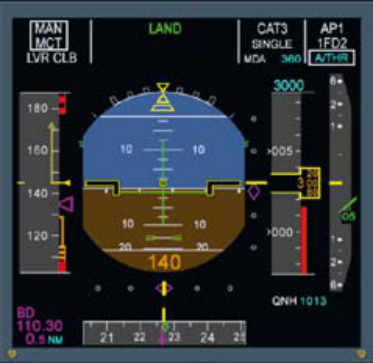
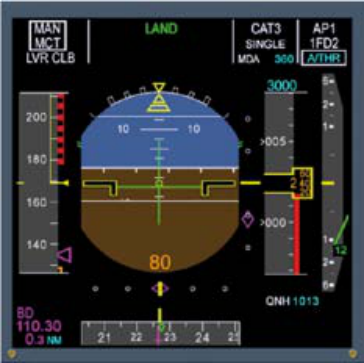
Figure 1 PFD (at 140ft and 80ft) after setting MCT instead of TOGA at 200ft during an ILS approach, (symbolic graphic – no direct reproduction of the described events)
4. Recommendations
Section titled “4. Recommendations”4.1. Applying TOGA in the proper way
Section titled “4.1. Applying TOGA in the proper way”Setting TOGA in Go Around (and in any other maneuver where maximum thrust is required instantly) should be a one-step intuitive action i.e. pushing the thrust levers rapidly up to the full forward mechanical stop. Pilots must not count the mechanical detents (clicks), like in setting thrust on Take-Off. Instructors in pilot training could emphasize this movement by the description of “firewalling it”, a term well known to most pilots from their early days of basic training. (fig. 2)
4.2. Monitoring the basic flying parameters, pitch/thrust
Section titled “4.2. Monitoring the basic flying parameters, pitch/thrust”Airbus Golden Rule N°2 “Fly, navigate …” applies also to the G/A phase :
Initiation of a rotation to get a positive rate of climb has priority (on the A320 for example, this translates to 15° of pitch with all engines and approximately 12,5° if one engine is out). Only then follow SRS Flight Director pitch bars orders if consistent with the intended flight path, and if the FMA has been checked.
4.5. Training recommendations
Section titled “4.5. Training recommendations”Academic training should ensure that crews understand that thrust levers in Airbus FBW have more than just the thrust function. They are not only used to control thrust in Manual or Auto mode, but serve also as “Mode Selectors” in certain stages of flight. The multiple additional functions of the thrust levers are for example the:
q Engaging of common modes when TOGA or FLEX (for T/O only) is set
q Sequencing of the FMS flight plan into the missed approach procedure when TOGA is set Figure 2 Thrust levers in q Retracting of the speed brakes, if TOGA position
q Retracting of the speed brakes, if extended when setting TOGA (fig. 3).
“Firewall it”
Section titled ““Firewall it””Thrust Levers are also Mode selectors
4.3. Checking and announcing the FMA
Section titled “4.3. Checking and announcing the FMA”Airbus Golden Rule N°5 requires: “Know your FMA at all times”. For the GA it means to verify that the expected mode (MAN TOGA/SRS/ GA TRK or MAN TOGA/SRS/ NAV) is displayed and announced immediately after the flap have been retracted one step and the flight path has been confirmed using raw data (see § 4.2).
4.4. Connecting the Ap only when the Fd shows the intended flight path
Section titled “4.4. Connecting the Ap only when the Fd shows the intended flight path”Before engaging the Autopilot (AP), the Flight Crew should follow the recommended practice: Fly the aircraft on the intended path, check on the FMA that the Flight Director is engaged with the appropriate modes.
Safety
Safety
Capt. dr. Christian NORdEn
Section titled “Capt. dr. Christian NORdEn”Training Policy and Development – In Service Fleet
近期多起严重事故涉及复飞机动动作执行不当。本文将简要描述其中两起事件,并提出若干简单而重要的建议,以帮助避免此类关键事件的再次发生。
2. 事故描述
Section titled “2. 事故描述”2.1. 事件一
Section titled “2.1. 事件一”一个朦胧的早晨,低云零散分布(能见度 3000m,散云 002,云底 003),机组执行人工(飞行和推力)ILS 进近。在 MDA(高于道面 200 ft)时,机组无目视接触。机长(PF)考虑到较低的复飞高度高于道面 170 ft,将推力手柄逐步前推(5 秒内),但在到达 FLEX/MCT 卡槽时停止了动作。飞机抬头至约 6°。飞机在无线电高度 150 ft 停止下降,并选择了形态 3。推力手柄置于 FLEX/MCT 卡槽 4 秒后,接通了自动驾驶仪(A/P)并收上了起落架。由于未选择 TOGA,飞机仍处于 LAND 模式,立即大幅低头以重新截获下滑道。PF 将推力手柄移至 CLB 卡槽。在无线电高度 127 ft、俯仰角 3.9° 低头时,EGPWS 音响 “SINK RATE” 响起。PF 断开了自动驾驶仪并几乎将侧杆拉至全后位置。飞机在形态 3、起落架收起、以 182 节空速飞行时,达到了最低无线电高度 76 ft。
2.2. 事件二
Section titled “2.2. 事件二”在大雾天,机组执行 ILS 进近,自动驾驶仪和自动推力接通。在最低高度时无目视接触。机组在无线电高度 185 ft 发起复飞,但推力手柄仅短暂移至稍前位置,随后即收至 FLEX/MCT 卡槽。3 秒后,襟翼收至形态 3。机长在 57 ft 同时断开自动驾驶仪,EGPWS “DON’T SINK” 警告响起。飞机达到最低无线电高度 38 ft。
3. 技术分析
Section titled “3. 技术分析”在空客电传飞行(FBW)飞机上,自动飞行系统(AFS)的常见复飞飞行指引模式通过将推力手柄设置至 TOGA 来触发。如果机组决定复飞但未设置 TOGA,AFS 的状态将取决于进近类型:
q 对于 ILS 进近,自动驾驶仪保持接通于当前选择的 AFS 模式
q 对于 管理式非精密进近(FINAL APP),AFS 保持 FINAL APP 模式。在最低高度以下 50 ft 断开自动驾驶仪,恢复基本模式(取决于构型状态)
q 对于 完全或部分选择性非精密进近,自动驾驶仪保持接通于所选模式。
图 1 在 ILS 进近中,200 ft 高度设置 MCT 而非 TOGA 时的 PFD(140 ft 和 80 ft),(示意图形——非所述事件的直接重现)
4.1. 正确使用 TOGA
Section titled “4.1. 正确使用 TOGA”在复飞(以及任何需要立即获得最大推力的机动)中设置 TOGA 应是一个一步到位的直觉动作,即将推力手柄快速推至前止动位。飞行员不应像起飞时设置推力那样去数机械卡位(咔嗒声)。教官在飞行员培训中可以通过 “推至防火墙” 这一描述来强调这一动作,这是大多数飞行员在早期基础训练中就已熟知的术语。(图 2)
4.2. 监控基本飞行参数:俯仰/推力
Section titled “4.2. 监控基本飞行参数:俯仰/推力”空客黄金法则第二条 “飞行、导航……” 同样适用于复飞阶段:
优先执行起始仰转以获得正上升率(例如在 A320 上,这意味着双发时约 15° 俯仰,单发时约 12.5°)。仅在此之后,若与预期航迹一致且已检查 FMA,方可跟随 SRS 飞行指引俯仰指令。
4.3. 检查并报出 FMA
Section titled “4.3. 检查并报出 FMA”空客黄金法则第五条要求:“随时知晓你的 FMA”。对于复飞,这意味着要在襟翼收一档后立即验证并报出所期望的模式(MAN TOGA/SRS/GA TRK 或 MAN TOGA/SRS/NAV),并使用原始数据确认航迹(见 § 4.2)。
4.4. 仅当 FD 显示预期航迹时再衔接自动驾驶仪
Section titled “4.4. 仅当 FD 显示预期航迹时再衔接自动驾驶仪”在衔接自动驾驶仪(AP)前,飞行机组应遵循建议做法:沿预期路径飞行,检查 FMA 确认飞行指引仪以适当模式接通。
4.5. 培训建议
Section titled “4.5. 培训建议”理论培训应确保机组理解,空客 FBW 飞机的推力手柄不仅仅具有推力功能。它们不仅用于手动或自动模式下控制推力,还在飞行某些阶段充当 “模式选择器”。推力手柄的多种附加功能例如:
q 设置 TOGA 或 FLEX(仅用于起飞)时接通常规模式
q 设置 TOGA 时触发 FMS 飞行计划进近至复飞程序的自动序列
q 设置 TOGA 时收回减速板(若已放出)
“推至防火墙”
推力手柄也是模式选择器