Performance Based Navigation RNP and RNP AR Approaches
Source: Airbus Safety First URL: https://safetyfirst.airbus.com/performance-based-navigation-rnp-and-rnp-ar-approaches/ Published: 2013-07-14 Magazine Issue: 2013-07 Category: Archive PDF: Original PDF
Matthias MAEdER
Section titled “Matthias MAEdER”Senior Director Flight Operations Support Airbus Training India Pvt. Ltd.
Performance Based Navigation: RNP and RNP AR Approaches
Section titled “Performance Based Navigation: RNP and RNP AR Approaches”1. Introduction
Section titled “1. Introduction”Performance based Navigation (PbN) is becoming more established in worldwide operations. It includes approaches called RNP APCH and RNP AR APCH, where RNP stands for Required Navigation Performance, APCH is simply an abbreviation for Approach and AR for Authorization Required.
RNP and RNP AR procedures allow crews to fly approaches using internal and very accurate navigation tools, instead of traditionally using external guidance aids. They also allow the replacement of visual and circling approaches by instrument approaches, thereby enhancing the safety of airline operations. They are non-precision approaches although they provide the crews with cues and
procedures similar to those used on precision approaches.
This article first describes how the performance of non-precision approaches has evolved over time; from the step down procedures to the Constant Descent Final Approach (CDFA) concept and finally how this evolution has led to RNP solutions and associated benefits.
All Airbus Fly-by-Wire (FbW) aircraft equipped with GPS are currently certified for RNP approaches, which will constitute the majority of cases. RNP AR capability will usually be necessary in marginal cases, where extra flexibility in approach design is needed. This will be illustrated by the following article in this magazine, dedicated to RNP AR operation.
2. Evolution of Non-Precision Approaches
Section titled “2. Evolution of Non-Precision Approaches”Advances in technology have modified the way non-precision approaches can be flown:
q The first technological step involved the move from the traditional step down approaches (also known as “dive-and-drive” approaches) to the CDFA concept, and the use of FMS systems to compute, then guide on the lateral and vertical approach paths.
q The second step implied the change over to RNAV/RNP approaches, primarily thanks to the introduction of GPS to civil aviation.
Safety
2.1 Step down Non-Precision Approaches
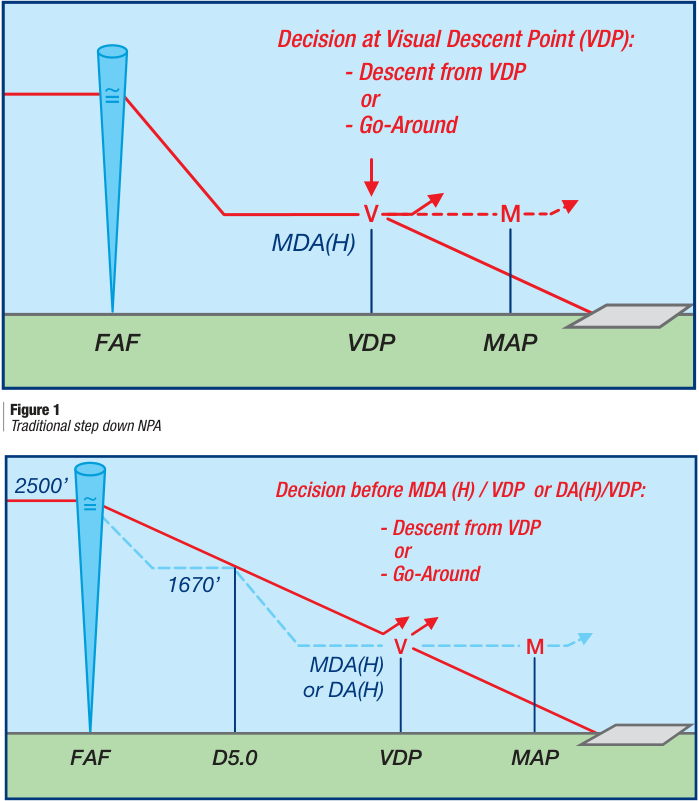
Section titled “2.1 Step down Non-Precision Approaches”q The aircraft reaches MDA(H) in quasi-level flight either before or after the Visual Descent Point (VDP). Consequently, the acquisition of visual references is affected by the pitch attitude of the aircraft. This pitch is significantly greater than the nominal pitch attitude observed when the aircraft is established on an e.g. -3° approach descent angle. This affects the perspective view of the runway.
The non-precision nature of the approach is characterized by the poor embodiment of the vertical path of the final approach. At the Final Approach Fix (FAF), the crew might be provided only with an assigned altitude and a distance to the Missed Approach Point (MAP). Thus, the crew awareness of the aircraft position versus the intended vertical flight path of the final approach is quite low (fig. 1).
q When acquiring visual references beyond the VDP, the pilot might be tempted to continue the final approach visually, which will result in a high descent rate during the visual segment of the approach.
This traditional step-down approach technique has the following drawbacks:
q The monitoring/advising task in these approaches is also very high but remains a critical element of a successful approach.
q The aircraft never stabilizes during the final approach. The pitch attitude needs to be changed even at low altitudes, thus the thrust and pitch have to be continuously adjusted.
2.2 Constant Angle Non-Precision Approaches (CdFA) concept
Section titled “2.2 Constant Angle Non-Precision Approaches (CdFA) concept”The CDFA concept addresses the key drawbacks of the step down procedure, mainly because the descent angle is constant throughout the final approach (fig. 2) , allowing:
q A stabilized final approach: pitch attitude, speed, thrust and pitch trim remain constant. The monitoring of the vertical flight path during the approach is simple and continuous.
q A smooth transition from instrument to visual flying, as the aircraft is established on a descent angle (e.g. 3°) and the crew keeps a constant perspective view of the runway.
q A safe approach up to the landing as the go-around decision is taken at the VDP, which is on the flight plan.
and therefore minimizes the risk of:
q Controlled Flight Into Terrain (CFIT)
q Landing short
q Runway Excursion due to landing long
The move from the step down to the CDFA concept was made possible thanks to Flight Management System (FMS) features, which are currently available on all Airbus aircraft by the use of TRK/V/S, TRK/ FPA, FINAL APP or FLS modes, when applicable.
3. RNP ANd RNP AR APPROACHES
Section titled “3. RNP ANd RNP AR APPROACHES”The CDFA concept was further adapted by RNAV (aRea NAVigation) approaches, which are described by a series of point-topoint trajectories where each point may be defined either by a bearing / distance to reference ground navigation aids (VOR – DME) or by a geographic position defined as a latitude / longitude. An altitude constraint is assigned to each waypoint. Therefore, RNAV approaches define both a lateral and a vertical trajectory.
The ICAO Document n° 9613 – PbN Manual - describes the navigation specifications for RNAV and RNP.
RNP and RNP AR approaches are basically defined as RNAV approaches within a performance based navigation concept. The main difference is that they do not require ground facilities for navigation as they use the navigation performance of the aircraft. This means that the aircraft is able to fly the RNAV approach trajectory meeting a required navigation performance, where the RNP value, e.g. RNP 0.3, designates the lateral navigational performance required associated with a procedure (in nautical miles).
This is achieved by adding the following systems to the aircraft:
q A Global Navigation Satellite System (GNSS), of which the US Global Positioning System (GPS) is currently the world’s most utilized type.
q An On board Performance Monitoring and Alerting system (ObPMA). The ObPMA is required to monitor the navigation system and will alert the crew in case of malfunction, e.g. GPS PRIMARY LOST and, therefore, allows the flight crew to determine whether the RNP system satisfies the navigation performance required.
3.1 RNP approches
Section titled “3.1 RNP approches”The first approaches using RNAV equipment have been developed before the definition of RNP. For this historical reason RNP approaches are commonly charte d as RNAV (GNSS) or RNAV (GPS).
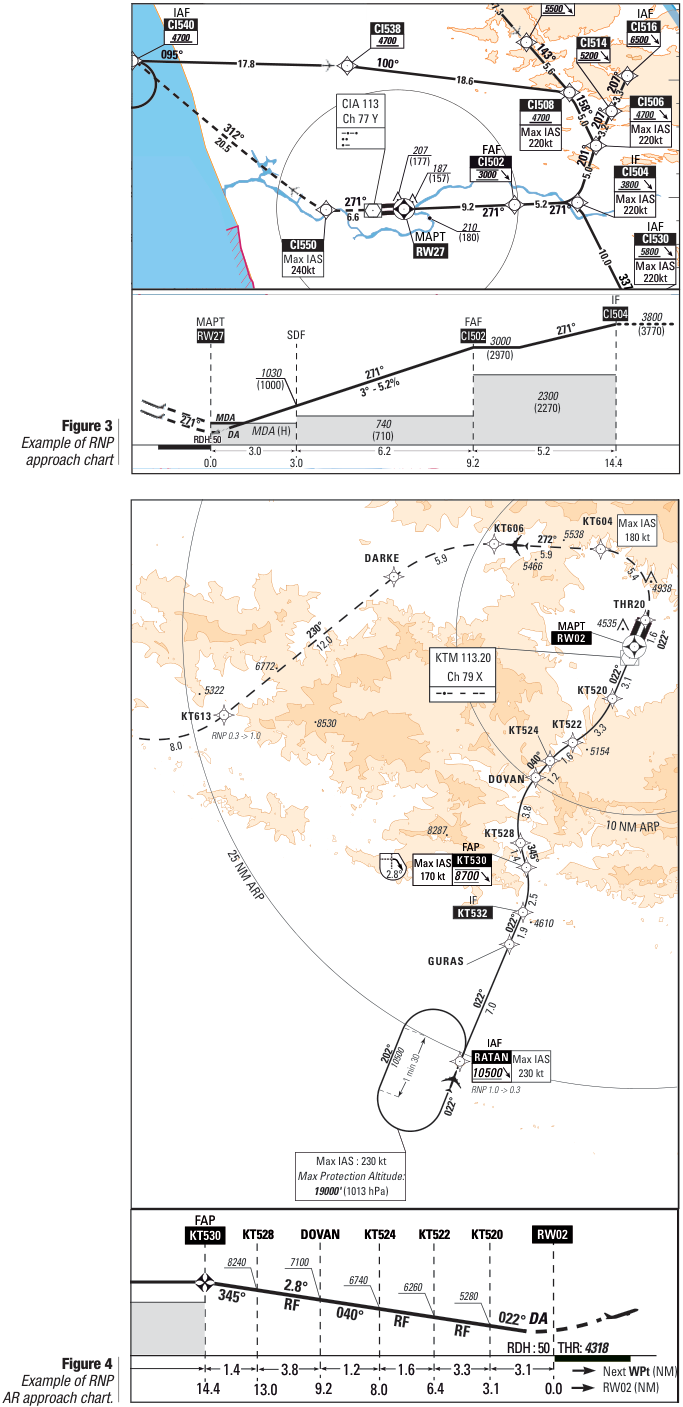
These RNP approaches are characterized by straight segments between the FAF and the runway (fig. 3).
3.2 RNP AR Approaches
Section titled “3.2 RNP AR Approaches”Compared to RNP approaches, where the segment between the FAF and the runway is straight, RNP with Authorization Required approaches might have “curved” final segments. These approaches are therefore colloquially called “curved approaches”. Furthermore, RNP AR approaches allow reduced obstacle clearance compared to RNP approaches (fig. 4) RNP AR* approaches are charted as RNAV (RNP).
* FAA terminology: RNP SAAAR (Special Aircrew and Aircraft Authorisation Required)
Safety
|---|---|---| |RNP Value < 0.3 (down to 0.1)||P| |Straight segment between FAp and RWY|P|P| |Curve between FAP and RWY||P| |Minima DA/DH could be as low as 250 ft|P*|P| |Departure and/or missed approach RNP Value < 1||P|
* MDA/MDH might be given as well (LNAV only Minima).
Figure 5 Respective characteristics of RNP and RNP AR approaches
Non-Precision Approach (NPA) GPS/GNSS used as navigation means RNP FMS computes final approach path RNP AR DA/DH minima(RNP AR) Similar approach monitoring Figure 6 Summary of some key elements for RNP and RNP AR approaches
3.2.1 RNP AR Implementation Requirements
Section titled “3.2.1 RNP AR Implementation Requirements”The specific nature of RNP AR operations call for the following additional requirements compared to RNP operations:
q Aircraft Certification
Section titled “q Aircraft Certification”Some RNP AR operations will require specific aircraft configurations. RNP certification have been granted to most Airbus types (A320 Family, A330 and A345/6). The aircraft capability appears in the AFM. For in service aircraft, application of a dedicated Service bulletin is required.
q Flight Operational Safety Assessment (FOSA)
Section titled “q Flight Operational Safety Assessment (FOSA)”RNP AR operations generally require a FOSA. The assessment should give proper attention to the inter-dependence of the elements of procedure design, aircraft capability, crew procedures and operating environment.
RNP AR procedures must be designed and tested in accordance with the design specificities and performance of the concerned aircraft.
q Training Programs
Section titled “q Training Programs”Airlines have to develop training programs dedicated to their RNP AR operations.
q Operational Approval
Section titled “q Operational Approval”RNP AR application packages include a full set of operational documentation, procedures and training programs, which need to be approved by the local Authority.
4. SAFETY BENEFITS
Section titled “4. SAFETY BENEFITS”4.1 RNP Approaches
Section titled “4.1 RNP Approaches”q Replacement of visual and circling approaches
Section titled “q Replacement of visual and circling approaches”RNP allows IFR procedures to be designed in environments, where previously no instrument approach could be envisaged. RNP approaches are particularly suited for (but not limited to) approaches in challenging areas (e.g. mountainous areas) and as a replacement for most existing circling approaches.
Compared to visual and circling approaches, the trajectory of the RNP approach is predictable. This enhances the preparation and briefing of the approach. Moreover, it facilitates the situational awareness and decision making. Flying these approaches fully managed in a lateral and vertical sense and in speed control makes energy management easy throughout the approach.
RNP approaches also ensure a simpler entry into a planned Go Around trajectory profile should one be required. This has always been a somewhat “difficult” aspect of circling approaches.
q Lower weather minima Lower minima allow a better transition to the visual segment when
5. CONCLuSION
Section titled “5. CONCLuSION”The Constant Angle Non-Precision Approach (CDFA) concept has replaced the non-stabilized final segments associated with the old step down Non-Precision Approaches (NPA).
RNP and RNP AR approaches are basically defined as RNAV approaches within a performance based navigation concept. The main difference is that they do not require ground facilities for navigation as they use the navigation performance of the aircraft.
For suitably equipped aircraft, RNP and RNP AR approaches provide an alternative “precision like” approach option for NPAs. All Airbus
aligned with the runway, thereby reducing the probability of having to go-around.
q Less communication needs The pilot workload is reduced as there is less need for communication.
q Assessment of Terrain Avoidance Warning System (TAWS) warnings
Section titled “q Assessment of Terrain Avoidance Warning System (TAWS) warnings”The required procedure validation for RNP approaches will assess the absence of TAWS warnings.
4.2 RNP AR Approaches in addition to RNP Approaches
Section titled “4.2 RNP AR Approaches in addition to RNP Approaches”q Improved flexibility
Section titled “q Improved flexibility”RNP AR approaches are expected to cover those cases where the procedure design limitations of RNP approaches do not allow to replace visual and circle to land procedures.
q Implementation of safety criteria The completion of a FOSA will ensure that for each specific set of operating conditions, aircraft and environment, all failure conditions are appraised and, where necessary, mitigations are implemented to meet the safety criteria.
FbW aircraft with GPS are currently certified to fly RNP approaches, which are suitable for the vast majority of airports.
In specific cases the added flexibility of RNP AR will be needed under certain terrain/approach and airfield situations.
Compared to visual and circling approaches the trajectory of the RNP/RNP AR approach is predictable, therefore facilitating situational awareness and decision making. The replacement of visual and circling approaches by RNP/RNP AR approaches is therefore a safety enhancement.
Safety
Matthias MAEdER
Section titled “Matthias MAEdER”高级总监 飞行运行支援 空客培训印度私人有限公司
基于性能的导航:RNP与RNP AR进近
Section titled “基于性能的导航:RNP与RNP AR进近”基于性能的导航(Performance Based Navigation,PbN)正在全球运行中日益普及。它包括RNP APCH和RNP AR APCH两类进近方式,其中RNP是所需导航性能(Required Navigation Performance)的缩写,APCH是进近(Approach)的缩写,AR则是授权所需(Authorization Required)的缩写。
RNP和RNP AR程序使机组能够使用机载的高精度导航工具来执行进近,而无需像传统方式那样依赖外部导航辅助设施。此外,这些程序还能将目视进近和盘旋进近替换为仪表进近,从而提升航空公司的运行安全性。尽管这些进近属于非精密进近,但却能为机组提供类似于精密进近的提示和程序。
本文首先阐述非精密进近的性能是如何随着时间演进的:从逐步下降程序到恒定下降最后进近(CDFA)概念,再到RNP解决方案及相关收益。
目前,所有配备GPS的空客电传飞机均已获得RNP进近认证,这在大多数情况下已能满足需求。RNP AR能力通常在特殊情况下才需要,例如进近设计需要额外灵活性时。这将在本期杂志的后续文章中加以说明,该文专门探讨RNP AR运行。
2. 非精密进近的演进
Section titled “2. 非精密进近的演进”技术的进步改变了非精密进近的飞行方式:
q 第一个技术阶段是从传统逐步下降进近(又称”俯冲-拉平”进近)转变为CDFA概念,并利用FMS系统计算并引导横向和垂直进近路径。
q 第二个阶段则是向RNAV/RNP进近的转变,这主要得益于GPS在民用航空中的应用。
安全性
2.1 逐步下降非精密进近
Section titled “2.1 逐步下降非精密进近”q 飞机在目视下降点(VDP)之前或之后以近似平飞姿态到达MDA(H)。因此,目视参考的获取会受到飞机俯仰姿态的影响。该俯仰角明显大于飞机沿例如-3°进近下降角建立时的标称俯仰角。这会影响跑道的透视视图。
进近的非精密特性表现为最后进近垂直路径的整合度较差。在最后进近点(FAF),机组可能仅获得一个指定的 altitude 和至复飞点(MAP)的距离。因此,机组对飞机位置与最后进近预期垂直飞行路径之间关系的意识相当低**(图1)**。
q 当在VDP之外获取目视参考时,飞行员可能会倾向于目视继续最后进近,这将导致在进近目视段产生较高的下降率。
这种传统的逐步下降进近技术存在以下缺点:
q 此类进近的监控/提示任务同样非常繁重,但仍是成功进近的关键要素。
q 飞机在最后进近过程中始终无法稳定。即使在低 altitude 也需要改变俯仰角,因此推力和俯仰必须持续调整。
2.2 常值角度非精密进近(CDFA)概念
Section titled “2.2 常值角度非精密进近(CDFA)概念”CDFA 概念解决了分段下降程序的主要缺陷,主要因为下降角在最后进近过程中保持恒定**(图 2)**,从而实现:
q 稳定进近:俯仰姿态、速度、推力和俯仰配平保持不变。在进近过程中对垂直航迹的监控简单且持续。
q 从仪表飞行到目视飞行的平滑过渡,因为飞机建立了恒定下降角(例如 3°),且机组保持对跑道的恒定视角。
q 安全进近至着陆,因为复飞决策在目视下降点(VDP)进行,VDP 在飞行计划中。
因此最大程度降低了以下风险:
q 可控飞行撞地(CFIT)
q 提前接地
q 因冲出跑道导致的跑道冲出
从分段下降程序到 CDFA 概念的转变得益于飞行管理系统(FMS)功能的实现,目前所有空客飞机均通过 TRK/V/S、TRK/FPA、FINAL APP 或 FLS 模式(如适用)实现。
3. RNP 和 RNP AR 进近
Section titled “3. RNP 和 RNP AR 进近”CDFA 概念进一步应用于区域导航(RNAV)进近,其描述为一系列点对点轨迹,其中每个点可由地面导航设施(VOR-DME)的方位/距离定义,或由地理坐标(经纬度)定义。每个航路点分配有高度限制。因此,RNAV 进近同时定义了横向和垂直轨迹。
国际民航组织文件第 9613 号——《基于性能导航手册》描述了 RNAV 和 RNP 的导航规范。
RNP 和 RNP AR 进近基本上被定义为基于性能导航概念内的 RNAV 进近。主要区别在于它们不需要地面导航设施,因为使用的是飞机的导航性能。这意味着飞机能够沿着 RNAV 进近轨迹飞行,满足所需的导航性能,其中 RNP 值(例如 RNP 0.3)表示与程序相关的所需横向导航性能(单位为海里)。
通过在飞机上增加以下系统实现:
q 全球导航卫星系统(GNSS),其中美国全球定位系统(GPS)是目前世界上使用最广泛的类型。
q 机上性能监控和告警系统(ObPMA)。ObPMA 用于监控导航系统,并在发生故障时提醒机组,例如 GPS 主系统失效(GPS PRIMARY LOST),从而使机组能够确定 RNP 系统是否满足所需的导航性能。
3.1 RNP 进近
Section titled “3.1 RNP 进近”首批使用 RNAV 设备的进近在 RNP 定义之前已开发。出于这一历史原因,RNP 进近通常标注为 RNAV(GNSS)或 RNAV(GPS)。
这些 RNP 进近的特点是在最后进近定位点(FAF)和跑道之间为直线路段**(图 3)**。
3.2 RNP AR 进近
Section titled “3.2 RNP AR 进近”与 RNP 进近不同,RNP 进近在 FAF 和跑道之间为直线路段,而需授权的 RNP 进近(RNP with Authorization Required)可能具有“曲线”最后航段。因此,这些进近俗称为“曲线进近”。此外,与 RNP 进近相比,RNP AR 进近允许缩小障碍物间隔**(图 4)**。RNP AR 进近标注为 RNAV(RNP)。
* FAA 术语:RNP SAAAR(特殊机组和航空器授权要求)
| --- | --- | --- |
|---|---|---|
| RNP 值 < 0.3(低至 0.1) | P | |
| FAF 与跑道之间为直线路段 | P | P |
| FAF 与跑道之间为曲线 | ||
| 最低决断高度/高可低至 250 ft | P* | P |
| 起飞和/或复飞 RNP 值 < 1 | P |
* 也可能给出 MDA/MDH(仅 LNAV 最低标准)。
图 5 RNP 和 RNP AR 进近的各自特点
非精密进近(NPA)GPS/GNSS 用作导航手段 RNP FMS 计算最后进近航道 RNP AR 决断高度/高(DA/DH)最低标准(RNP AR)类似的进近监控 图 6 RNP 和 RNP AR 进近的关键要素摘要
3.2.1 RNP AR 实施要求
Section titled “3.2.1 RNP AR 实施要求”RNP AR 运行的特殊性质要求在 RNP 基础上增加以下额外要求:
q 航空器认证
Section titled “q 航空器认证”某些 RNP AR 运行需要特定的飞机构型。大多数空客机型(A320 系列、A330 和 A345/6)已获得 RNP 认证。飞机能力标注在飞行手册(AFM)中。对于在役飞机,需要申请执行专用服务通告。
q 飞行运行安全评估(FOSA)
Section titled “q 飞行运行安全评估(FOSA)”RNP AR 运行通常需要 FOSA。评估应适当关注程序设计、航空器能力、机组程序和运行环境要素之间的相互依存关系。
RNP AR 程序必须根据相关飞机的设计特性和性能进行设计和验证。
q 培训计划
Section titled “q 培训计划”航空公司必须制定与其 RNP AR 运行相关的培训计划。
q 运行批准
Section titled “q 运行批准”RNP AR 申请包包含全套运行文档、程序和培训计划,需经当地当局批准。
4. 安全效益
Section titled “4. 安全效益”4.1 RNP 进近
Section titled “4.1 RNP 进近”q 替代目视和盘旋进近
Section titled “q 替代目视和盘旋进近”RNP 使仪表飞行程序能够在以前无法设想的环境中进行设计。RNP 进近特别适用于(但不限于)困难区域(如山区)的进近,以及作为大多数现有盘旋进近的替代方案。
与目视进近和盘旋进近相比,RNP 进近的航迹是可预测的。这增强了进近的准备和简令工作。此外,它还有助于提高情景意识和决策。在横侧向和垂直方向上完全采用管理飞行方式并控制速度,使整个进近过程中的能量管理变得简单。
RNP 进近还确保在需要复飞时能够更简单地进入计划好的复飞轨迹剖面。这一直是盘旋进近中一个较为”困难”的方面。
q 更低的天气最低标准 更低的最低标准允许在
恒定角度非精密进近(CDFA)概念已取代了与旧式逐步下降非精密进近(NPA)相关的非稳定最后航段。
RNP 和 RNP AR 进近基本上被定义为基于性能导航概念中的 RNAV 进近。主要区别在于它们不需要地面导航设施,因为它们使用的是飞机的导航性能。
对于装备适当的飞机,RNP 和 RNP AR 进近为 NPA 提供了一种可选的”类精密”进近方案。所有空客
与跑道对齐,从而减少复飞的概率。
q 减少通信需求 飞行员工作负荷降低,因为通信需求减少。
q 地形感知警告系统(TAWS)警告的评估
Section titled “q 地形感知警告系统(TAWS)警告的评估”RNP 进近所需的程序验证将评估 TAWS 警告的不存在情况。
4.2 RNP AR 进近(除 RNP 进近外)
Section titled “4.2 RNP AR 进近(除 RNP 进近外)”q 提高灵活性
Section titled “q 提高灵活性”RNP AR 进近预计将涵盖 RNP 进近的程序设计限制不允许替代目视和盘旋着陆程序的情况。
q 安全标准的实施 FOSA 的完成将确保对于每组特定的运行条件、飞机和环境,所有失效状况都得到评估,并在必要时实施缓解措施以满足安全标准。
装有 GPS 的 FbW 飞机目前已获认证可以飞行 RNP 进近,这些进近适用于绝大多数机场。
在特定情况下,在某些地形/进近和机场情况下将需要 RNP AR 的额外灵活性。
与目视进近和盘旋进近相比,RNP/RNP AR 进近的航迹是可预测的,因此有助于提高情景意识和决策能力。因此,用 RNP/RNP AR 进近替代目视进近和盘旋进近是一种安全增强措施。
安全