The Airbus TCAS Alert Prevention (TCAP)
Source: Airbus Safety First URL: https://safetyfirst.airbus.com/the-airbus-tcas-alert-prevention-tcap/ Published: 2012-01-14 Magazine Issue: 2012-01 Category: Archive PDF: Original PDF
Paule BOTArGuES
Section titled “Paule BOTArGuES”Engineer, Automatic Flight Systems Research, Engineering Department
1. Introduction
Section titled “1. Introduction”The Traffic Alert and Collision Avoidance System, known as TCAS, has been introduced in the 90’s to prevent the risk of mid-air collisions. Today this safety goal has globally been reached.
However, a recurrent side-effect of TCAS introduction can be observed. This side-effect is what we call the ‘nuisance’ Resolution Advisories (RAs) or the operationally ‘undesired’ RAs, which occur during 1000ft separation level-off manoeuvres.
A new Safety Initiative has been launched by Airbus to solve this issue: The TC AS A lert P revention (TCAP), a new altitude capture enhancement to minimize cases of TCAS level-off RAs.
The objective of this new TCAP feature is twofold:
q To reduce the number of undesired TCAS RAs occurring during 1000ft level-off encounters. This is done by adapting the altitude capture law, so as to soften the aircraft arrival to an intended altitude when traffic is confirmed in the vicinity.
q Not to degrade the aircraft performance, in particular in descent, by a premature and excessive reduction of the vertical speed to reach the altitude target, when it is not justified.
2. Level-Off rAs
Section titled “2. Level-Off rAs”Level-off RAs occur during 1000ft level-off manoeuvres while everything is correctly done by the crew with regards to operations and clearance.
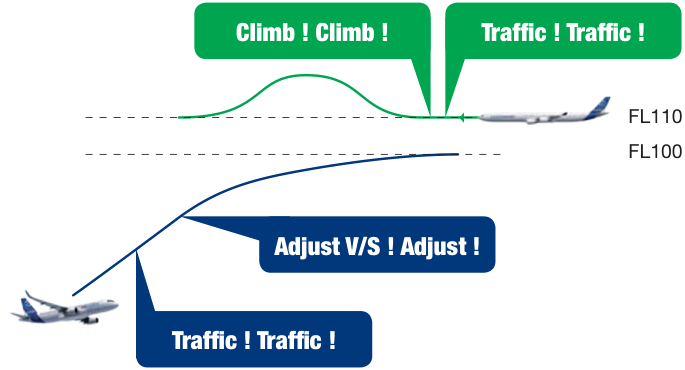
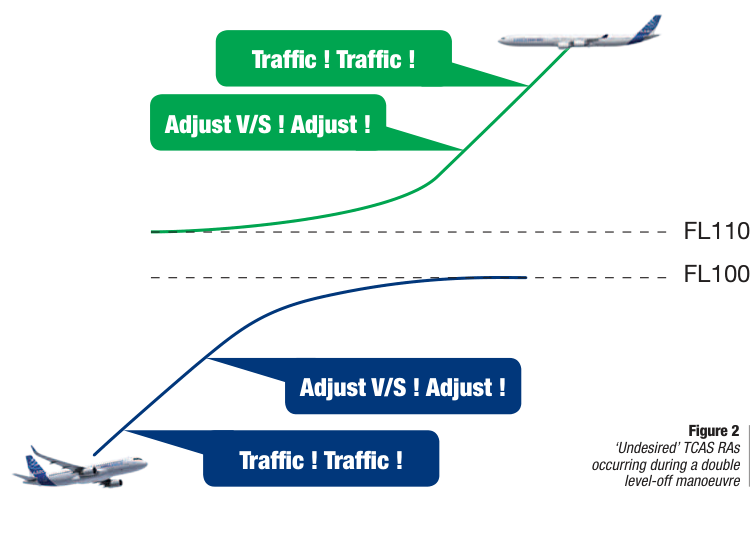
These operationally ‘undesired’ RAs can be characterised by the two following typical encounter geometries:
q One aircraft (in blue on fig. 1 ) is intending to level-off at a given level while another aircraft (in green on fig. 1 ) is already levelled at the adjacent level (1000ft above or below the first aircraft’s intended level):
Safety
q One aircraft is climbing to leveloff at a given level while another aircraft is descending to level-off at the adjacent level, 1000ft above the first aircraft’s intended level (fig. 2).
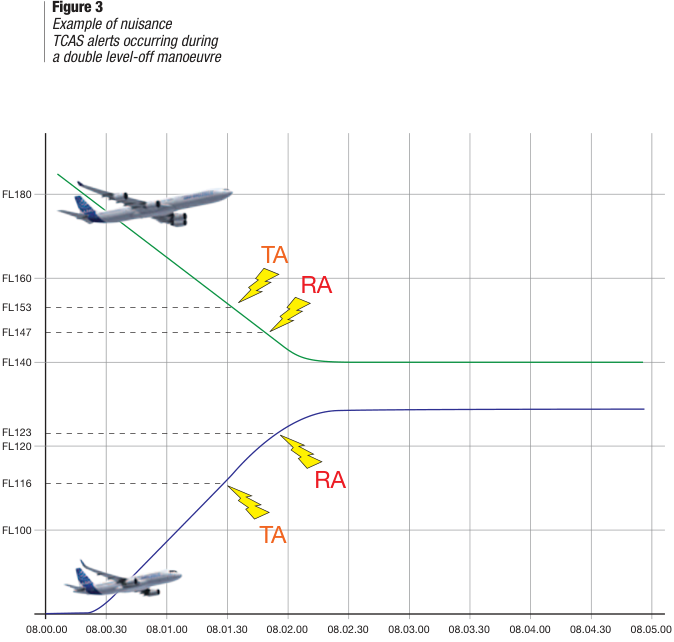
Although these RAs do not imply a ‘real’ collision risk, they remain very stressful alerts. Above all, they impose - by procedure - an avoidance manoeuvre to both aircraft, leading to unnecessary deviations from initial trajectories and to potential repercussive traffic perturbations.
Let us take the example of an A320 (medium weight/CG, selected speed 300kt) climbing to FL130 with a rate of climb of 2800ft/min, while an A340-600 (light weight/medium CG, selected speed VMO-20kt) is descending to FL140 with a rate of descent of 2200 ft/min.
3. recommendations to Prevent these rAs
Section titled “3. recommendations to Prevent these rAs”The first recommendation calls for pilots to reduce the vertical speed when approaching the assigned altitude or flight level.
This preventive action limits the vertical convergence between aircraft and thus prevents crossing the TCAS alert triggering thresholds.
As shown on table 1, the preventive rates to apply vary slightly depending on who is expressing the rule:
q Airbus (FCOM) recommend to limit the vertical speed to 1500 ft/min during the last 2000ft of a climb or descent.
q The FAA (AC20-151A, Appendix A Section III) call for a reduction of the vertical speed to between 500 and 1500ft/min, when between 1000 and 2000ft above or below the assigned altitude.
q ICAO (PANS-OPS Doc. 8168) recommend to adopt a vertical speed below 1500ft/min throughout the last 1000ft of climb or descent to the assigned altitude.
q Table 1 also includes the limits in vertical speed from three other sources.
As a matter of fact, these recommendations are rarely applied. Several airlines do not have them incorporated in their operational recommendations. Even when they are, some pilots confess they are not always applied. As a result there is still a significant number of undesired RAs observed during 1000ft level-off manoeuvres.
The second set of recommendation has been expressed by the French accident investigation authority Bureau d’Enquête et d’Analyses (BEA) following a mid-air incident, in March 2003, where a wrong response to an “ADJUST V/S” RA was observed in a context of a 1000ft level-off encounter. The BEA recommended that aircraft manufacturers study the possibility of taking into account TCAS alert triggering thresholds into their altitude capture laws.
This recommendation was followed by EUROCONTROL within the ACAS Bulletins and by several airlines who requested a modification of the altitude capture control laws with an earlier reduction of the vertical rate to prevent such recurrent undesired RAs.
4. The TcAP Function
Section titled “4. The TcAP Function”In response to these requests for improvement, Airbus launched the feasibility study of a new system called TCAS Alert Prevention or TCAP.
The objective of this new TCAP feature is twofold:
q To reduce the number of undesired TCAS RAs occurring during 1000ft level-off encounters. This is done by adapting the altitude capture law, so as to soften the aircraft arrival to an intended altitude when traffic is confirmed in the vicinity.
|---|---|---| |FAA|500-1500 ft/min|1000-2000 ft| |ICAO|1500 ft/min|1000 ft| |EUROCONTROL ACAS and RVSMprograms|1000 ft/min|1000 ft| |Swiss Regulation|1500 ft/min|1500 ft|
Table 1 Recommendations to prevent level-off RAs
Figure 5 FMA upon TCAP activation when initially in OP CLB
TA
TCAP Control/Law
q Not to degrade the aircraft performance, in particular in descent, by a premature and excessive reduction of the vertical speed to reach the altitude target, when it is not justified.
• If the aircraft is initially in a vertical guidance mode other than the altitude capture mode (for example in a climb or descent mode), the vertical mode automatically reverts to the altitude capture mode (ALT* for Airbus HMI) with the new TCAP altitude control law active (ALT*TCAP control law) (fig. 5).
The TCAP activation logic is based on the Traffic Advisory (TA) triggered by the TCAS, which clearly confirms the presence of traffic in the aircraft vicinity.
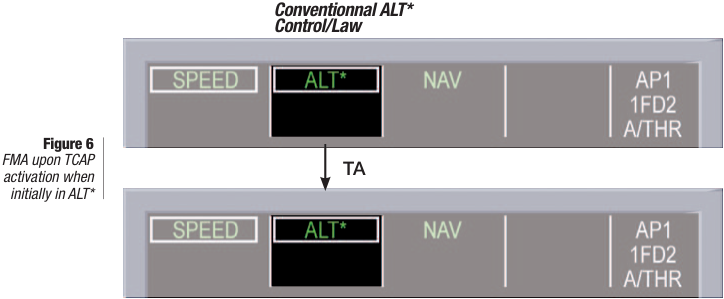
- If the vertical mode is initially the altitude capture mode (ALT* with the conventional altitude capture control law active), the vertical mode remains the altitude capture mode but with the new ALTTCAP control law active. The Flight Mode Annunciator still displays ALT (fig. 6).
The activation of TCAP is fully transparent to the pilot who will note the same mode changes with TCAP as without TCAP. The TCAP case only resulting in an earlier reduction of the Rate Of Descent/ Rate Of Climb (ROD/ROC). This means that upon TCAP activation at TA:
Safety
Once activated, the ALTTCAP control law remains active till the end of the capture (with ALT mode engaged) even if the triggering TA ceases. This is to avoid triggering a new TA.
Finally, it is important to note that TCAP activation does not impact the lateral trajectory and associated lateral guidance mode, nor the AutoPilot, Flight Director and AutoThrust engagement status.
5. Adapted TcAP Altitude capture control Law (ALT*TcAP)
Section titled “5. Adapted TcAP Altitude capture control Law (ALT*TcAP)”The objective of the Alt*TCAP control law is to acquire and hold one or several consecutive vertical speed targets until the aircraft reaches its intended altitude by adopting a classical 0.05g parabola profile.
When in ALTTCAP control law, a vertical load factor of 0.15g is applied to ensure a rapid reduction of the vertical speed and thus a more efficient prevention of the RAs. It also gives a reliable sensorial feedback to the crew to indicate TCAP function activation if ALT mode was previously engaged.
The ALT*TCAP vertical speed targets have been defined so as to efficiently prevent level-off RAs while minimizing the increase of the altitude capture phase duration. They are function of current aircraft vertical speed and distance to targeted level at the time of the TA and are computed in decreasing sequence in case of consecutive vertical speed targets (e.g. if a new TA occurs).
The average impact on the altitude capture time is an increase of 40 seconds compared to the conventional altitude capture law, remembering that TCAP control law activation is limited to a TA occurrence.
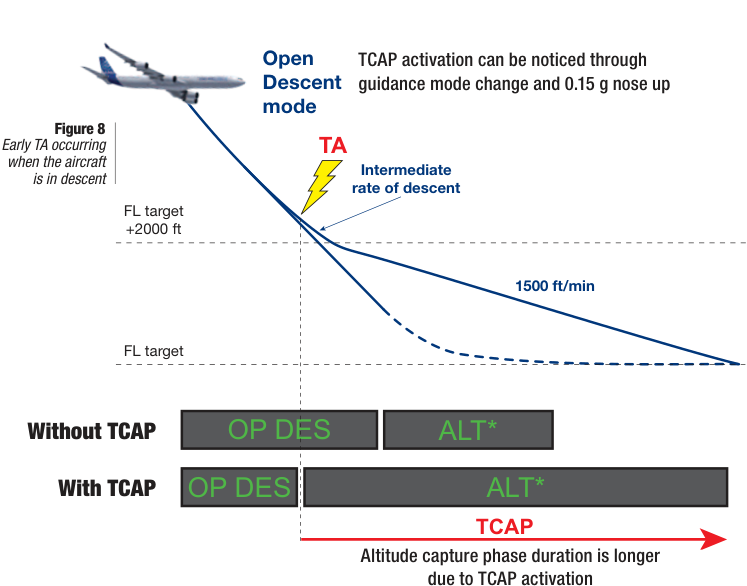
The aircraft is descending in OP DES mode when a TA occurs above the last 2000ft. The ALT* mode immediately engages with ALT*TCA control law active and an associated vertical load factor of 0.15g: the rate of descent is reduced to an intermediate vertical speed target greater than 1500ft/min till reaching the last 2000ft, where the vertical speed target becomes 1500ft/min (fig. 8).
Before
Section titled “Before”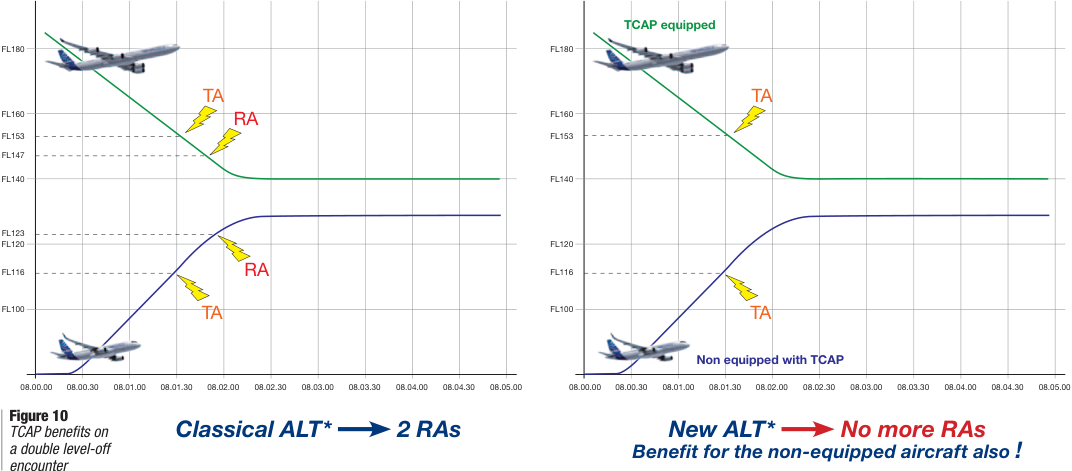
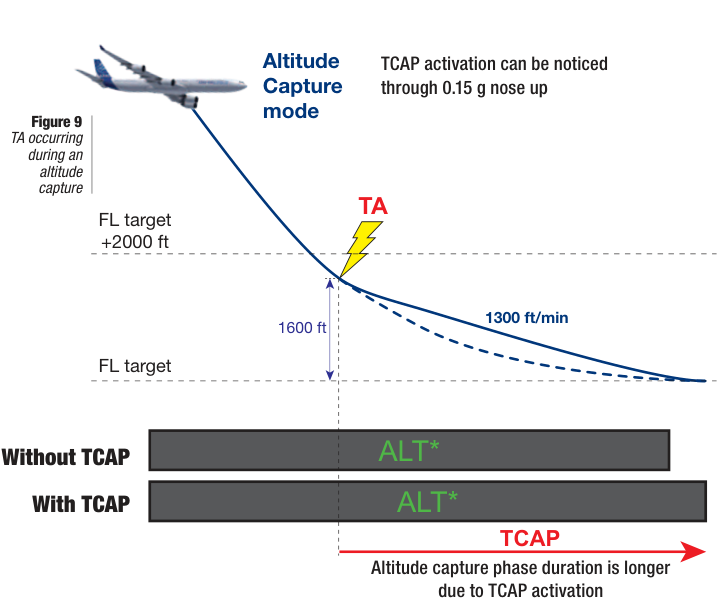
The aircraft is performing an altitude capture on the conventional 0.05g parabola capture profile (ALT* mode) when a TA occurs. The ALTTCAP law automatically activates to quickly reduce the rate of descent, shortcutting the parabola with a vertical load factor of 0.15g (ALT mode remains engaged).
The rate of descent is reduced to a vertical speed target between 1200ft/ min and 1500ft/min depending on the aircraft’s distance to the target flight level at the time of the TA till the end of the capture (fig. 9).
6. Expected Benefits
Section titled “6. Expected Benefits”An operational and safety performance assessment was performed in the frame of the Single European Sky ATM Research (SESAR) project to assess the impact of the new Airbus TCAP solution, based on a large encounter model representative of operations in Europe.
The assessment showed that more than 95% of the 1000ft level-off
RAs were avoided through the use of TCAP. Since 1000ft level-off RAs represent more than 55% of all RAs, the project concluded that TCAP may halve the overall number of RAs for an equipped aircraft.
7. conclusion
Section titled “7. conclusion”With significant operational benefits such as more than 95% level-off RAs avoided, leading to an overall number of RAs cut by two without debasing safety, TCAP establishes as a promising standard.
These benefits will be associated to the following outcomes:
q For the crew: less stress due to a reduced number of RA situations,
q For ATC: less unnecessary traffic perturbations due to ‘undue’ avoidance manoeuvres.
The TCAP will also contribute to the crew workload alleviation: even
Another observed relevant result was that only one aircraft of the encounter needs to be equipped with TCAP to allow RAs prevention on both aircraft (fig. 10).
though pilots still have to maintain awareness and vigilance over near by traffic, they will not have to reduce ROC/ROD as a precautionary measure. The pilots will just have to monitor the Auto Pilot or the Flight Director and to verify its reaction in accordance with their expectations.
This new TCAP altitude capture enhancement will be available on all Airbus Fly-By-Wire aircraft, including the A380 and A350, in the near future. The certification targets are anticipated between end 2011 and mid 2013, depending on the aircraft type.
Safety
来源: Airbus Safety First 网址: https://safetyfirst.airbus.com/the-airbus-tcas-alert-prevention-tcap/ 发布日期: 2012-01-14 期刊期号: 2012-01 类别: 档案 PDF: 原始 PDF
Paule BOTArGuES
Section titled “Paule BOTArGuES”自动飞行系统研究工程师,工程部
Traffic Alert and Collision Avoidance System(空中交通告警与防撞系统),即 TCAS,于 20 世纪 90 年代引入,旨在防止空中碰撞风险。如今,这一安全目标已在全球范围内基本实现。
然而,TCAS 的引入也带来了一种反复出现的副作用,即所谓的”误触发”决断咨询(Resolution Advisories,简称 RA),或在运行层面”非预期”的 RA,这些情况发生在 1000ft 高度层平飞改平机动过程中。
为空客启动了一项新的安全举措来解决这一问题:TC AS A lert P revention(TCAS 告警预防,简称 TCAP),这是一种新的高度捕获增强功能,旨在最大程度减少 TCAS 平飞改平 RA 的发生。
这一新 TCAP 功能的目标是双重的:
q 减少在 1000ft 平飞改平遭遇过程中出现非预期 TCAS RA 的次数。通过调整高度捕获法则来实现这一目标,即当确认附近有空中交通时,柔和地接近目标高度。
q 不降低飞机性能,特别是在下降过程中,避免因不必要地过早且过度降低垂直速度以达到高度目标而影响性能。
2. 平飞改平 RA
Section titled “2. 平飞改平 RA”平飞改平 RA 发生在 1000ft 平飞改平机动过程中,此时机组在操作和放行方面均已正确执行。
这些在运行层面”非预期”的 RA 可由以下两种典型遭遇几何形态来表征:
q 一架飞机(图中用蓝色表示,参见图 1)计划在某高度层平飞改平,而另一架飞机(图中用绿色表示,参见图 1)已在相邻高度层平飞(高于或低于第一架飞机的目标高度层 1000ft):
安全
q 一架飞机正在爬升至某高度层平飞改平,而另一架飞机正在下降至相邻高度层平飞改平,且高于第一架飞机的目标高度层 1000ft(图 2)。
尽管这些 RA 并未涉及”真实”的碰撞风险,但它们仍构成非常紧张的告警。最重要的是,根据程序规定,它们要求两架飞机都执行避让机动,导致偏离初始轨迹的不必要偏差,并可能引发连锁性的交通扰动。
让我们以一个实例来说明:一架 A320(中等重量/CG,选速 300kt)以 2800ft/min 的爬升率爬升至 FL130,同时另一架 A340-600(轻重量/中等 CG,选速 VMO-20kt)以 2200ft/min 的下降率下降至 FL140。
3. 防止此类 RA 的建议
Section titled “3. 防止此类 RA 的建议”第一项建议呼吁飞行员在接近指定高度或飞行高度层时降低垂直速度。
这一预防性措施可限制飞机之间的垂直汇聚,从而防止触发 TCAS 告警阈值。
如表 1 所示,根据规则来源的不同,所适用的预防性垂直速度略有差异:
q 空客(FCOM)建议在爬升或下降的最后 2000ft 阶段将垂直速度限制在 1500ft/min 以内。
q FAA(AC20-151A,附录 A 第三节)要求在高于或低于指定高度 1000 至 2000ft 时,将垂直速度降至 500 至 1500ft/min 之间。
q ICAO(PANS-OPS Doc. 8168)建议在爬升至指定高度的最后一 1000ft 阶段全程采用低于 1500ft/min 的垂直速度。
q 表 1 还包含了其他三个来源的垂直速度限制。
事实上,这些建议很少被执行。有多家航空公司的运营建议中并未纳入这些内容。即使已纳入,也有部分飞行员承认并非总是执行。因此,在 1000ft 平飞改平机动过程中仍观察到数量可观的非预期 RA。
第二套建议由法国事故调查局 Bureau d’Enquête et d’Analyses(BEA)在一次空中碰撞事故后提出。2003 年 3 月发生的一起事件中,在 1000ft 平飞改平遭遇情况下观察到对”ADJUST V/S”RA 的错误响应。BEA 建议飞机制造商研究将 TCAS 告警触发阈值纳入高度捕获法则的可能性。
EUROCONTROL 在 ACAS Bulletin 中采纳了这一建议,多家航空公司也响应了这一建议,要求修改高度捕获控制法则,在更早阶段降低垂直速率,以防止此类反复出现的非预期 RA。
4. TCAP 功能
Section titled “4. TCAP 功能”作为对这些改进请求的回应,空客启动了一项名为 TCAS 告警预防(TCAP)的新系统可行性研究。
这一新 TCAP 功能的目标有两个方面:
q 减少 1000ft 水平飞行过程中出现的不期望的 TCAS RA 事件数量。通过调整高度捕获逻辑,在确认附近存在活动冲突时,柔和地接近预定高度。
|---|---|---| |FAA|500-1500 ft/min|1000-2000 ft| |ICAO|1500 ft/min|1000 ft| |EUROCONTROL ACAS and RVSMprograms|1000 ft/min|1000 ft| |Swiss Regulation|1500 ft/min|1500 ft|
表 1 防止水平飞行 RA 的建议措施
图 5 初始处于 OP CLB 模式时 TCAP 激活时的 FMA
TA
TCAP 控制/逻辑
q 不因过早且过度地降低垂直速度以达到高度目标而降低飞机性能,尤其是在下降阶段——当这种性能降低并不必要时。
• 如果飞机初始处于高度捕获模式以外的垂直引导模式(例如爬升或下降模式),垂直模式将自动转换至高度捕获模式(空客 HMI 中的 ALT*),并启用新的 TCAP 高度控制逻辑(ALT*TCAP 控制逻辑)(图 5)。
TCAP 激活逻辑基于 TCAS 触发的交通咨询(TA),该 TA 明确确认了飞机附近存在活动冲突。
- 如果初始垂直模式即为高度捕获模式(ALT* 且conventional altitude capture control law active),垂直模式保持高度捕获模式,但启用新的 ALTTCAP 控制逻辑。飞行模式指示器仍显示 ALT (图 6)。
TCAP 的激活对飞行员完全透明,飞行员将注意到与无 TCAP 时相同的模式变化。TCAP 情况仅导致垂直下降/爬升率(ROD/ROC)更早地降低。这意味着在 TA 时 TCAP 激活后:
安全
一旦激活,ALTTCAP 控制逻辑将保持激活状态直至捕获结束(ALT 模式衔接),即使触发的 TA 消失也是如此。这是为了避免触发新的 TA。
最后,需要注意的是,TCAP 激活不会影响横向轨迹及相关横向引导模式,也不会影响自动驾驶仪、飞行指引仪和自动推力的衔接状态。
5. 适配后的 TCAP 高度捕获控制逻辑(ALT*TCAP)
Section titled “5. 适配后的 TCAP 高度捕获控制逻辑(ALT*TCAP)”ALT*TCAP 控制逻辑的目标是通过采用经典的 0.05g 抛物线轨迹,获取并保持一个或多个连续的垂直速度目标,直至飞机到达其预定高度。
当处于 ALTTCAP 控制逻辑时,施加 0.15g 的垂直载荷因子以确保垂直速度的快速降低,从而更有效地防止 RA 事件。同时,当 ALT 模式之前已衔接时,这也会给机组提供可靠的感官反馈以指示 TCAP 功能已激活。
ALT*TCAP 垂直速度目标已定义,以在有效防止水平飞行 RA 的同时,将高度捕获阶段的持续时间增加降至最低。这些目标基于 TA 发生时当前飞机垂直速度及距目标高度的垂直距离,并在出现连续垂直速度目标时按递减顺序计算(例如当新的 TA 发生时)。
对高度捕获时间的影响平均增加 40 秒,相比 conventional altitude capture law,但需注意 TCAP 控制逻辑的激活仅限于 TA 发生的情况。
飞机在 OP DES 模式下下降时,在最后 2000ft 以上发生 TA。ALT* 模式立即衔接,ALT*TCAP 控制逻辑激活并施加 0.15g 的相关垂直载荷因子:下降率降低至大于 1500ft/min 的中间垂直速度目标,直至到达最后 2000ft,此时垂直速度目标变为 1500ft/min (图 8)。
当发生 TA 时,飞机正在按传统 0.05g 抛物线捕获剖面执行高度捕获(ALT* 模式)。ALTTCAP 法则自动激活,迅速减小下降率,以 0.15g 的垂直载荷系数截断抛物线(ALT 模式保持接通)。
下降率减小至 1200ft/min 至 1500ft/min 之间的垂直速度目标值,具体取决于 TA 发生时飞机至目标飞行高度的距离,直至捕获结束 (图 9)。
6. 预期收益
Section titled “6. 预期收益”为评估空客 TCAP 解决方案的影响,基于具有欧洲运行代表性的冲突遭遇模型,在单一欧洲天空 ATM 研究计划(SESAR)框架下进行了运营和安全性能评估。
评估表明,使用 TCAP 可避免超过 95% 的 1000ft 改平 RA。由于 1000ft 改平 RA 占全部 RA 的 55% 以上,项目得出结论:TCAP 可使装备飞机的 RA 总数减半。
凭借超过 95% 改平 RA 被避免这一显著的运营收益,使 RA 总数减半且不影响安全性,TCAP 成为一项前景广阔的标准。
这些收益将带来以下成果:
- 对于机组:RA 情况减少,降低压力,
- 对于 ATC:因”不当”避让机动导致的交通扰动减少。
TCAP 还将减轻机组工作负荷:尽管飞行员仍需保持对邻近交通的警觉和注意,但无需作为预防措施减小爬升率/下降率。飞行员只需监控自动驾驶仪或飞行指引仪,并核实其响应是否符合预期。
这一新的 TCAP 高度捕获增强功能将在不久的将来适用于所有空客电传操纵飞机,包括 A380 和 A350。认证目标时间预计为 2011 年底至 2013 年中期,具体取决于飞机型号。
Safety