A320 Family / A330 - Prevention and Handling of Dual Bleed Loss
Source: Airbus Safety First URL: https://safetyfirst.airbus.com/a320-family-a330-prevention-and-handling-of-dual-bleed-loss/ Published: 2012-01-14 Magazine Issue: 2012-01 Category: Archive PDF: Original PDF
Xavier JOLIVET
Section titled “Xavier JOLIVET”Director of Flight Safety
Xavier VILLAIN
Section titled “Xavier VILLAIN”Group Manager A320/A330/A340 Standards Flight Operations Support & Services
Laurent SEGuY
Section titled “Laurent SEGuY”Group Manager Bleed-Inerting-Fire, Ice & Rain Protection Engineering Support
A320 Family / A330 Prevention and Handling of Dual Bleed Loss
Section titled “A320 Family / A330 Prevention and Handling of Dual Bleed Loss”1. Introduction
Section titled “1. Introduction”Dual Bleed Loss (DBL) may impact flight operations, as it often results in either in-flight turn back or emergency descent followed by flight diversion.
Many of these DBL events could be avoided by applying currently available solutions, which include design modifications, as well as maintenance and operational procedures. In-service experience shows that the introduction of these mitigation measures have led to a clear decrease in the number of occurrences.
A DBL requires a quick identification of the situation and a rapid reaction. To simplify the crew’s task, a new standardized procedure has been introduced, that covers all cases of Dual Bleed Loss.
The aim of this article is to:
q Remind maintenance/engineering personnel and pilots of the existing solutions and
q Present crews with the new DBL ECAM/QRH procedure.
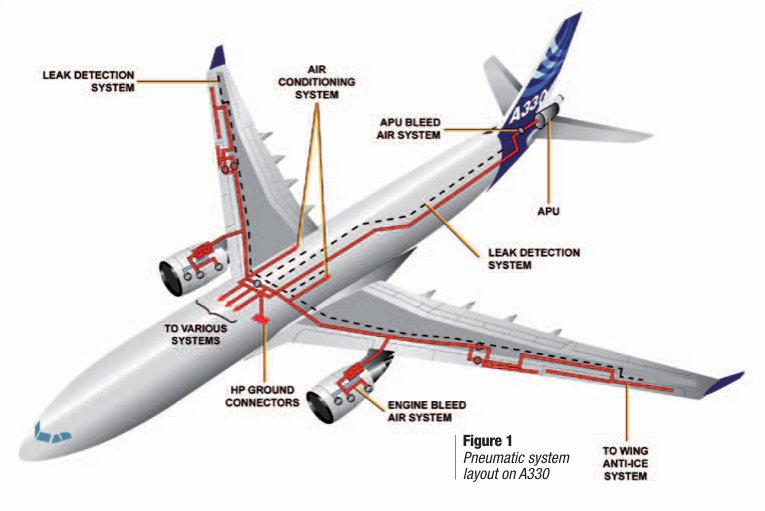
The bleed system supplies pressure and temperature regulated air to the aircraft systems. The main users are the air conditioning system, which ensures air regulation for both cabin pressurization and temperature, and the wing anti-ice system (fig. 1).
ating conditions, air is taken from the engines and the flight crew has no action to perform on the system.
On ground, under normal operation, the APU can supply bleed air for cabin comfort or for engine start. In flight, under abnormal procedure when the engine bleed systems are no longer available, the APU bleed can also supply air for cabin pressurization (below the APU ceiling).
On the A320 Family and A330, the regulation of the bleed system is purely pneumatic and operates automatically. Under normal oper-
Safety
3. Failure Scenarios and Mitigations
Section titled “3. Failure Scenarios and Mitigations”A Dual Bleed Loss situation corresponds to the loss of both engine bleed air systems. The non availability of the first bleed system may be triggered by various causes, including dispatch under MMEL, and is monitored and investigated as part of the bleed system reliability. A single remaining engine bleed system is capable of supplying all the bleed functions. Under these circumstances, a fault on this second system triggers the DBL situation. The analysis of DBL events is focused on the loss of the second engine bleed system.
3.1 A320 Family
Section titled “3.1 A320 Family”Historically, as indicated in the Safety First article “A320: Avoiding Dual Bleed Loss” published in issue n°7 (February 2009), the overwhelming majority of second bleed losses on the A320 Family were caused by an overtemperature condition.
3.1.1 Maintenance and design Enhancements
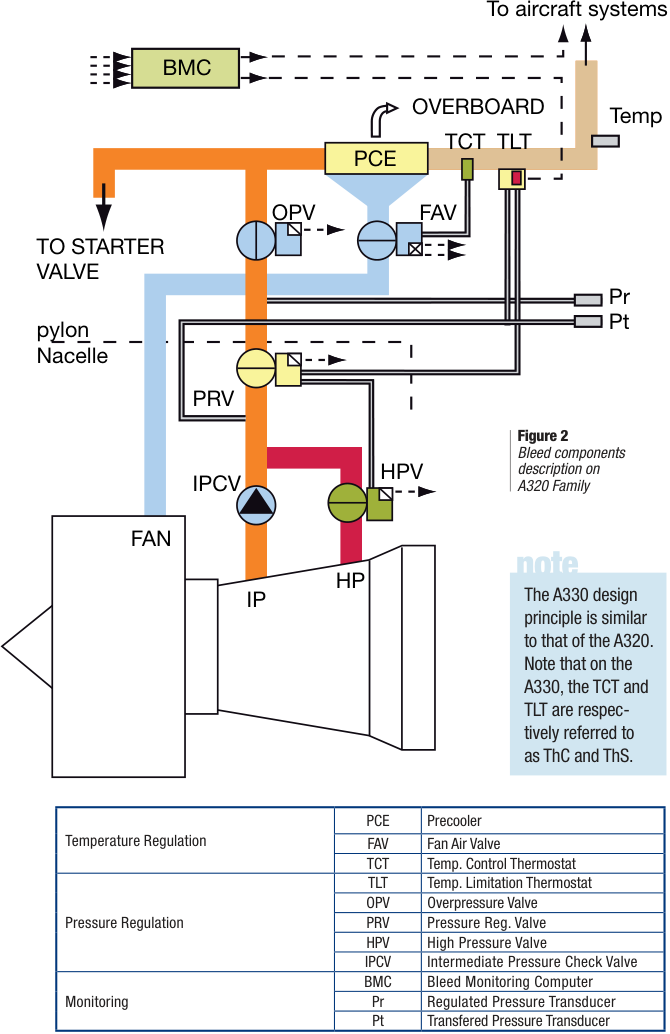
Section titled “3.1.1 Maintenance and design Enhancements”In 2008, Airbus introduced new maintenance procedures and designed a “Dual Bleed Loss package” (ref. A). This package includes a new Temperature Control Thermostat (TCT), a new Fan Air Valve (FAV) and a new Temperature Limitation Thermostat (TLT).
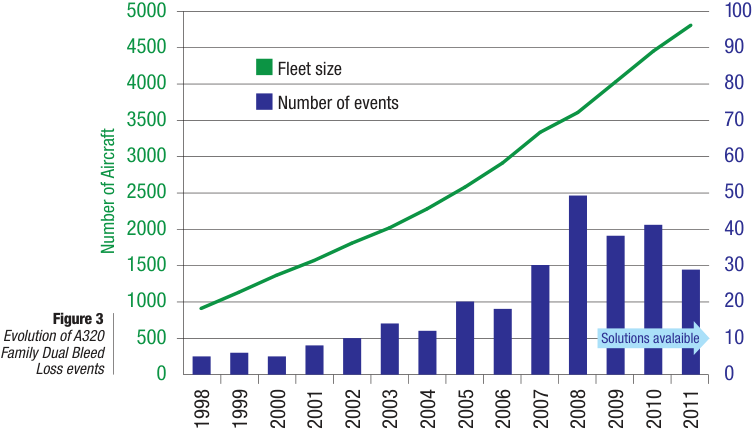
Today, this DBL package equips more than 70% of the A320 Family fleet (either from production or by retrofit) and no reported Dual Bleed Loss has been due to the failure of these new components (fig. 3). A specific retrofit policy has been offered to support a prompt inservice implementation. The few DBL events reported on this upgraded fleet were due to installation issues, such as senseline leakage between TCT and FAV or TCT filter clogging (ref. B).
Importance of Logbook Recording
Section titled “Importance of Logbook Recording”Dual Bleed Loss events are generally preceded by single bleed fault occurrences. Recurrent and unsolved single bleed faults increase exposure to Dual Bleed Losses. Any fault in flight reflects an abnormal system behaviour and must be taken into account, even if cleared by a reset. Proper troubleshooting of the fault is necessary in order to reduce the probability of reoccurrence.
An early investigation of each single bleed fault is the most efficient action to prevent a dual bleed fault. This therefore requires a systematic logbook recording to allow timely troubleshooting of each single bleed fault detected in flight.
3.1.2 Operational improvements
Section titled “3.1.2 Operational improvements”The Operational Engineering Bulletin (OEB) 40 (former OEB 203/1 issued in March 2010) was introduced to provide recommendations to monitor the temperature on the remaining engine bleed in order to prevent overheat from occurring. If the temperature increases above 240°C, the flight crew has to reduce the demand on this bleed by switching OFF one pack or the wing anti-ice system.
The Flight Warning Computer (FWC) F6 standard, planned for certification beginning 2012, will include a new ECAM AIR ENG 1(2) BLEED HI TEMP caution that triggers when one engine bleed is OFF and the temperature of the remaining engine bleed exceeds 240°C. The associated ECAM procedure calls for one pack or the wing anti-ice to be switched OFF (fig. 4). Embodiment of the FWC F6 standard will cancel the OEB 40.
3.2 A330
Section titled “3.2 A330”3.2.1 Bleed Overpressure
Section titled “3.2.1 Bleed Overpressure”In contrast to the A320, the main cause for Dual Bleed Loss on the A330 is bleed overpressure (ref. C). GE mounts are particularly affected by this phenomenon. The two most common scenarios are as follows:
q Pressure overshoot at thrust increase during takeoff, due to degraded reactivity of the Pressure Regulating Valve (PRV). The overpressure peak increases if the takeoff is performed with the air conditioning packs selected OFF, due to the no flow (demand) condition (refer to adjacent notes).
q Erroneous measurement of regulated pressure (Pr) due to frozen condensed water in the pressure transducers, leading the Bleed Monitoring Computer (BMC) to shut off the affected bleed system. This failure mode typically occurs in cruise or at the start of descent after a long cruise period at very low temperature (Static Air temperature lower than -60°C).
Operational note
Section titled “Operational note”Engineering note
Section titled “Engineering note”a) The AIR ENG 1(2) BLEED FAULT caution generally appears when passing 1500ft as it is inhibited by the Flight Warning Computer during phase 5.
The closure threshold of the OverPressure Valve (OPV) is being optimized to prevent early closure in case of PRV pressure overshoot at takeoff and subsequent loss of bleed system. The new OPV setting will be introduced through a VSB to be released by Q1 2012 (follow-up through ref. C).
b) Exposure to this failure mode may be reduced by taking off with packs ON. (FCOM PRO-NOR-SOP-Before Takeoff) and by complying with the Standard Operating Procedure for two-step takeoff thrust setting (FCOM PRO-NOR-SOPTakeoff).
Safety
The geometry of the pressure measurement chamber has been redesigned (improved drainage and bigger chamber volume) to allow more robustness. The new part number ZRA691-00 is installed in production by MOD 202028 from MSN 1254. For in-service aircraft a specific retrofit policy already applies to aircraft fitted with GE mounts (ref. D).
3.2.2 Bleed Overtemperature
Section titled “3.2.2 Bleed Overtemperature”The overtemperature occurrences are mainly driven by the ageing of the:
q Thermostat Controller (ThC) and/or
q Fan Air Valve (FAV)
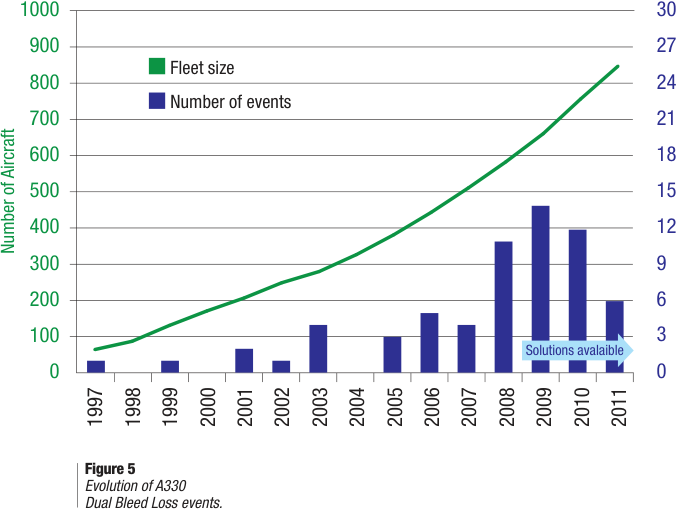
The following technical solutions (ref. E) have significantly reduced the number of bleed losses due to overtemperature (fig. 5) :
q Improved maintenance and design of the Thermostat Controller
Section titled “q Improved maintenance and design of the Thermostat Controller”A key parameter to maintain an optimum serviceability of the component is to adjust the interval for ThC filters cleaning or replacement, depending on the severity of the operating environment. Implementation of this preventive maintenance procedure and customization of the interval are available from MPD and via specific SIL (ref. B).
The ThC has also been redesigned with a new clapper/guide material in order to further improve its reliability. This improvement is covered by a Part Number change and is fitted in production starting at MSN 1274. For the in-service fleet, the Liebherr VSB 398-36-05 released in Nov 2011 applies.
q Enhanced Fan Air Valve test procedures
Section titled “q Enhanced Fan Air Valve test procedures”New functional test procedures have been developed to allow an earlier detection of the drift as well as an easier detection of faulty components. Specific health monitoring of the FAV is also recommended at the same interval as the ThC filters cleaning.
A Dual Bleed Loss requires a quick identification of the situation and a rapid reaction.
Performing more than one reset would unnecessarily delay the initiation of the descent.
Airbus has performed an operational review of in-service events, which led to the standardization of the existing Dual Bleed Loss procedures. In order to simplify the crew’s task, the DBL procedures now give similar instructions whatever the cause of the Dual Bleed Loss.
q If the reset is unsuccessful, rapid initiation of the descent, when above FL100
Section titled “q If the reset is unsuccessful, rapid initiation of the descent, when above FL100”In case of Dual Bleed Loss at or close to cruise altitude, the typical fuselage leak rate leads to a cabin altitude increase of up to around 1000 ft/min. Any delay in the descent initiation will increase exposure to an ECAM CAB PR EXCESS CAB ALT warning, which requires a mandatory emergency descent.
In essence the new procedure calls for:
q A single reset of each engine bleed (provided there is no bleed leak)*
Section titled “q A single reset of each engine bleed (provided there is no bleed leak)*”q APU start
Section titled “q APU start”A reset may clear a fault on a bleed system if that fault was as a result of a temporary parameter fluctuation. Typically, this can be due to a failure of the system to properly regulate the bleed pressure or temperature due to engine thrust variation. In such a case, a bleed reset may allow recovery of normal operation provided the parameter is back within its normal regulation range.
In case of dual engine bleed failure, the backup bleed source is the APU.
q APU bleed selection when within the APU bleed envelope
At lower altitude (FL220/200 depending on APU standard) the APU bleed enables supply of the air conditioning system, thus ensuring cabin pressurization and preventing a descent to FL100.
* In case of bleed leak, a specific procedure will apply.
q A second reset at lower altitude
Section titled “q A second reset at lower altitude”A QRH procedure (called at the end of the ECAM procedure) will provide the flight crew with a second reset procedure. The reason for this second attempt is that a reset is more likely to be successful at lower altitude.
4.1 New EcAM AIr ENG 1+2 Bleed Fault Procedure
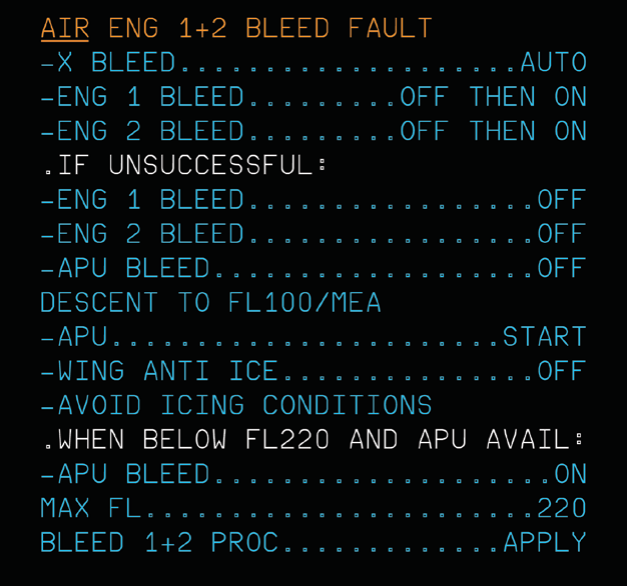
Section titled “4.1 New EcAM AIr ENG 1+2 Bleed Fault Procedure”A new ECAM AIR ENG 1+2 BLEED FAULT caution and procedure was designed (fig. 6).
Implementation is planned as follows: q A320 Family: on the Flight Warning Computer (FWC) F8 standard, certification Q4 2015
q A330: on the FWC T5 standard, certification planned Q4 2012.
Figure 6 Typical new ECAM AIR ENG 1+2 BLEED FAULT caution and procedure
4.2 New Qrh AIr ENG 1+2 Bleed Fault Procedure
Section titled “4.2 New Qrh AIr ENG 1+2 Bleed Fault Procedure”Pending the implementation of the new ECAM procedure, the QRH current AIR DUAL BLEED FAULT procedure will be enhanced to be in line with the new ECAM and renamed as AIR ENG 1+2 BLEED FAULT (Q1 2012).
5. cONcLuSION
Section titled “5. cONcLuSION”The consequences of Dual Bleed Loss occurrences range from in-flight turn backs to cabin depressurization events followed by flight diversions.
Technical solutions have been devised, which are summarized in this article. They include new maintenance and operational procedures as well as redesigned components available via retrofit. These solutions have proved efficient as the number of events has started to decrease, both for the A320 Family as for the A330, in the face of ever increasing fleets.
The handling of DBL events, should they occur, will now be made easier. A single and simple ECAM procedure will cover all cases of Dual Bleed Loss. This will assist crews in the identification and management of these events in the most appropriate manner (recovering bleed system when possible, avoiding excessive cabin altitude, continuing the flight to destination or to a most suitable diversion airport). An updated QRH procedure will be published pending the retrofit of the new FWC standards.
references
Section titled “references”-
q Ref. A: A320 DBL Package (TFU 36.11.00.059 and SIL 36-057)
-
q Ref. B: A320/A330 Preventive Cleaning / Replacement of the Temperature Control Thermostat Filter (SIL 36-055)
-
q Ref. C: A330 Solutions for Overpressure (TFU 36.11.00.069)
-
q Ref. D: New Pressure Transducer (SB A330-36-3039 and RIL 36-3039)
-
q Ref. E: A330 Solutions for Overtemperature (TFU 36.11.00.065)
Safety
Xavier JOLIVET
Section titled “Xavier JOLIVET”飞行安全总监
Xavier VILLAIN
Section titled “Xavier VILLAIN”A320/A330/A340 标准飞行运营支援与服务部门经理
Laurent SEGuY
Section titled “Laurent SEGuY”引气-惰化-防火-结冰与防雨保护工程支援部门经理
A320 系列/A330 - 双引气失效的预防与处置
Section titled “A320 系列/A330 - 双引气失效的预防与处置”双引气失效(Dual Bleed Loss,DBL)可能影响飞行运营,因为它往往导致返航或紧急下降后改航。
许多此类 DBL 事件可以通过应用现有解决方案加以避免,这些方案包括设计改进、维护程序和运营程序。服役经验表明,这些缓解措施的实施已显著降低了事件发生率。
DBL 需要快速识别情况和迅速反应。为简化机组人员的工作,已引入一套涵盖所有双引气失效情况的新标准化程序。
本文的目的是:
q 提醒维护/工程人员和飞行员注意现有解决方案,并
q 向机组人员介绍新的 DBL ECAM/QRH 程序。
引气系统为飞机系统提供压力和温度调节的空气。主要用户是空调系统,它确保客舱增压和温度调节的空气,以及机翼防冰系统 (图 1)。
在飞行条件下,空气从发动机获取,飞行机组无需对系统进行操作。
在地面正常运行时,APU 可以提供引气用于客舱舒适性或发动机启动。在飞行中,当发动机引气系统不再可用时,APU 引气也可用于客舱增压(在 APU 适用高度以下)。
在 A320 系列和 A330 上,引气系统的调节完全是气动式的,自动运行。在正常运行条件下
飞行安全
3. 故障场景与缓解措施
Section titled “3. 故障场景与缓解措施”双引气失效情况对应两个发动机引气系统的失效。第一个引气系统的不可用可能由多种原因触发,包括按 MMEL 放行,并作为引气系统可靠性的一部分进行监控和调查。单个剩余的发动机引气系统能够供应所有引气功能。在此情况下,第二个系统的故障触发 DBL 情况。DBL 事件的分析集中在第二个发动机引气系统的失效。
3.1 A320 系列
Section titled “3.1 A320 系列”历史上,如安全优先文章”A320:避免双引气失效”(第 7 期,2009 年 2 月)所述,A320 系列上绝大多数第二次引气损失是由超温状况引起的。
3.1.1 维护和设计改进
Section titled “3.1.1 维护和设计改进”2008 年,空客推出了新的维护程序并设计了”双引气失效套件”(参考 A)。该套件包括新的温度控制恒温器(TCT)、新的风扇空气活门(FAV)和新的温度限制恒温器(TLT)。
目前,该 DBL 套件已装备超过 70% 的 A320 系列机队(无论是生产时安装还是改装),且没有报告的双引气失效是由这些新组件故障引起的 (图 3)。已提供具体的改装政策以支持快速服役实施。少数改装后机队报告的 DBL 事件是由安装问题引起的,例如 TCT 和 FAV 之间的传感管泄漏或 TCT 滤网堵塞(参考 B)。
飞行日志记录的重要性
Section titled “飞行日志记录的重要性”双引气失效事件通常先有单引气故障发生。反复出现且未解决的单引气故障会增加双引气失效的风险。任何飞行中的故障都反映系统异常行为,必须予以重视,即使通过复位清除。故障的正确排除对于降低再次发生概率是必要的。
每起单引气故障的早期调查是防止双引气故障的最有效行动。这因此需要系统性的飞行日志记录,以允许对每个飞行中检测到的单引气故障进行及时故障排除。
3.1.2 运营改进
Section titled “3.1.2 运营改进”运营工程通告(OEB)40(原 OEB 203/1,于 2010 年 3 月发布)是为了提供关于监控剩余发动机引气温升的建议,以防止超温发生。如果温度升至 240°C 以上,飞行机组必须通过关闭一个组件或机翼防冰系统来减少对该引气的需求。
计划于 2012 年初获得认证的飞行警告计算机(FWC)F6 标准,将包含一个新的 ECAM AIR ENG 1(2) BLEED HI TEMP 警告,当一个发动机引气关闭且剩余发动机引气温度超过 240°C 时触发。关联的 ECAM 程序要求关闭一个组件或机翼防冰系统 (图 4)。FWC F6 标准的实施将取消 OEB 40。
3.2 A330
Section titled “3.2 A330”3.2.1 引气超压
Section titled “3.2.1 引气超压”与 A320 不同,A330 发生双引气丧失的主要原因是由引气超压引起的(参见参考文献 C)。GE 发动机支架受此现象影响尤为明显。以下两种情况最为常见:
q 推力增加时的压力超调——起飞过程中,由于压力调节活门(PRV)反应特性退化所致。若起飞时空调组件选择 OFF,由于无流量(无需求)状态,超压峰值会进一步增大(参见右侧注释)。
q 调节压力(Pr)测量错误——压力传感器内冷凝水结冰导致,引气监控计算机(BMC)据此关闭受影响的引气系统。此类故障模式通常发生在巡航阶段或长时间低温巡航(静温低于 -60°C)后开始下降时。
a) AIR ENG 1(2) BLEED FAULT 警告通常在通过 1500ft 时出现,因为在阶段 5 该警告被飞行警告计算机抑制。
超压活门(OPV)的关闭阈值正在优化中,以防止 PRV 起飞时压力超调导致引气系统提前关闭而造成引气丧失。新的 OPV 设置将通过 VSB 引入,预计于 2012 年第一季度发布(参见参考文献 C 跟进)。
b) 通过带组件 ON 起飞可减少此类故障模式的发生概率。(FCOM PRO-NOR-SOP-Before Takeoff)并遵守两步起飞推力设置标准操作程序(FCOM PRO-NOR-SOP-Takeoff)。
安全性
压力测量腔室的几何结构已重新设计(改进排水设计并增大腔室容积),以提高稳健性。新型零件号 ZRA691-00 已通过 MOD 202028 从 MSN 1254 开始装机。对于在役飞机,已对装有 GE 支架的飞机制定了专门的改装政策(参见参考文献 D)。
3.2.2 引气超温
Section titled “3.2.2 引气超温”超温事件主要由以下部件老化引起:
q 恒温控制器(ThC)和/或 q 风扇空气活门(FAV)
以下技术方案(参考文献 E)已显著减少了因超温导致的引气丧失次数**(图 5)**:
q 改进恒温控制器的维护和设计
Section titled “q 改进恒温控制器的维护和设计”保持部件最佳可用性的关键参数是根据运行环境恶劣程度调整 ThC 滤芯清洁或更换间隔。此预防性维护程序的实施及间隔定制可从 MPD 和专项 SIL(参考文献 B)获取。
ThC 也经过重新设计,采用新型拍门/导轨材料以进一步提高可靠性。此改进涉及零件号变更,从 MSN 1274 开始装机。对于在役机队, Liebherr 于 2011 年 11 月发布的 VSB 398-36-05 适用。
q 增强风扇空气活门测试程序
Section titled “q 增强风扇空气活门测试程序”开发了新的功能测试程序,以实现对漂移的更早检测以及对故障部件的更便捷识别。建议在与 ThC 滤芯清洁相同的间隔对 FAV 进行专项健康监控。
双引气丧失需要快速识别情况并迅速作出反应。
多次复位会不必要地延迟开始下降的时机。
空中客车公司对在役事件进行了运营审查,导致现有双引气丧失程序的标准化。为简化机组操作,无论双引气丧失的原因为何,现行 DBL 程序均提供相似的指令。
q 如果复位不成功,在 FL100 以上时迅速开始下降
Section titled “q 如果复位不成功,在 FL100 以上时迅速开始下降”若在或接近巡航高度发生双引气丧失,典型机身泄漏率导致客舱高度上升速率高达约 1000 ft/min。延迟开始下降将增加触发 ECAM CAB PR EXCESS CAB ALT(客舱压力过高)警告的风险,该警告要求强制执行紧急下降。
新程序的核心要点如下:
q 对每台发动机引气进行单次复位(前提是无引气泄漏)*
Section titled “q 对每台发动机引气进行单次复位(前提是无引气泄漏)*”q 启动 APU
Section titled “q 启动 APU”如果引气系统故障是由参数暂时波动造成的,复位可能清除该故障。通常情况下,这可能是由于系统未能正确调节引气压力或温度(由发动机推力变化引起)。在这种情况下,若参数已恢复到正常调节范围内,复位引气可恢复正常运行。
若双发动机引气失效,备用引气来源为 APU。
q 在 APU 引气包线范围内时选择 APU 引气
Section titled “q 在 APU 引气包线范围内时选择 APU 引气”在较低高度(根据 APU 标准,FL220/200),APU 引气可为空调系统供电,从而确保客舱增压并防止下降至 FL100。
* 如发生引气泄漏,将执行专用程序。
■ 在更低高度进行第二次复位
Section titled “■ 在更低高度进行第二次复位”ECAM程序结束时调用的QRH程序将为飞行机组提供第二次复位程序。进行第二次尝试的原因是在更低高度复位更有可能成功。
4.1 新的ECAM AIR ENG 1+2 BLEED FAULT程序
Section titled “4.1 新的ECAM AIR ENG 1+2 BLEED FAULT程序”设计了新的ECAM AIR ENG 1+2 BLEED FAULT警戒和程序(图6)。
实施计划如下:■ A320系列:适用于飞行警告计算机(FWC)F8标准,认证时间为2015年第四季度
■ A330:适用于FWC T5标准,计划于2012年第四季度完成认证。
图6 典型的新型ECAM AIR ENG 1+2 BLEED FAULT警戒和程序
4.2 新的QRH AIR ENG 1+2 BLEED FAULT程序
Section titled “4.2 新的QRH AIR ENG 1+2 BLEED FAULT程序”在新ECAM程序实施之前,QRH当前的AIR DUAL BLEED FAULT程序将进行增强以与新ECAM保持一致,并更名为AIR ENG 1+2 BLEED FAULT(2012年第一季度)。
双引气失效事件的后果从返航着陆到客舱减压事件导致航班改航不等。
已制定技术解决方案,本文对此进行了总结。这些方案包括新的维护和操作程序以及可通过改装获取的重新设计的部件。这些解决方案已被证明是有效的,无论是对A320系列还是A330,随着机队的不断增加,相关事件数量已开始下降。
对于可能发生的双引气失效事件的处理将变得更加简便。单一且简单的ECAM程序将涵盖所有双引气失效情况。这将有助于飞行机组以最恰当的方式识别和管理这些事件(在可能的情况下恢复引气系统、避免客舱高度过高、继续飞往目的地或最合适的备降机场)。在完成新FWC标准的改装之前,将发布更新的QRH程序。
-
■ 参考文献A:A320双引气失效一揽子方案(TFU 36.11.00.059和SIL 36-057)
-
■ 参考文献B:A320/A330温度控制恒温器滤网的预防性清洁/更换(SEL 36-055)
-
■ 参考文献C:A330超压解决方案(TFU 36.11.00.069)
-
■ 参考文献D:新型压力传感器(SB A330-36-3039和RIL 36-3039)
-
■ 参考文献E:A330超温解决方案(TFU 36.11.00.065)
Safety