A320 - Dual hydraulic loss
Source: Airbus Safety First URL: https://safetyfirst.airbus.com/a320-dual-hydraulic-loss/ Published: 2007-06-29 Magazine Issue: 2017-06 Category: Archive PDF: Original PDF
By: Michel PALOMEQUE Flight Safety Advisor A318/A319/A320/A321 program
1 Introduction
Section titled “1 Introduction”The A320 may experience a series of dual hydraulic loss when, at low altitude, a leak in the green hydraulic system causes the loss of the yellow circuit.
To understand how this may happen, this article will first describe the aircraft’s hydraulic system and explain the respective roles of the Power Transfer Unit (PTU) and ECAM caution in case of pressure differential between the green and yellow systems.
The second part of the article will describe how the combination of a major leak in the green circuit and the ECAM inhibition below 1,500 feet may lead to the dual hydraulic loss.
The third and last part will develop on the corrective actions proposed to avoid this type of occurrences.
2 General overview
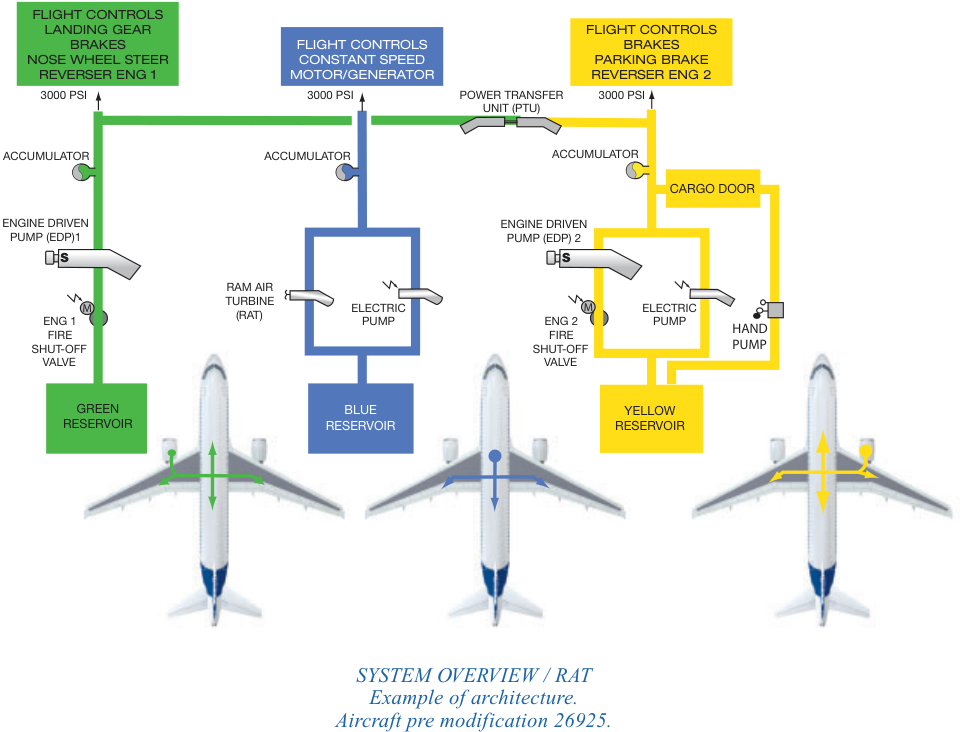
Section titled “2 General overview”The A320 hydraulic system is composed of three different and fully independent circuits: Green, Yellow & Blue. The users are shared between the systems in order to ensure the control of the aircraft, even when one system is inoperative.
Speed Motor/ Generator (CSM/G) is used to provide aircraft electrical power in case of emergency.
On the green & yellow systems, the normal source of pressure is the Engine Driven Pump (EDP) and the auxiliary source is the Power Transfer Unit (PTU). The PTU is a hydraulic motor pump which transfers hydraulic power between the green and yellow systems without transfer of fluid.
It operates automatically, whenever the pressure differential between the two systems reaches 500 PSI.
In case of low fluid level in either the green or yellow system, an amber caution is triggered on the ECAM, which requests the pilot to switch off the PTU as well as the EDP. This to avoid having the PTU running at maximum speed and causing the overheating and loss of the properly functioning hydraulic system.
According to the Airbus philosophy of not overloading the flight crew during the critical phases of flight, the above amber caution is inhibited below 1,500 feet.
The figure below shows all the systems, which are interconnected to the hydraulic systems:
On the blue hydraulic system, the normal source of pressure is the electrical pump, and the auxiliary source is the Ram Air Turbine (RAT). The Constant
3 Dual hydraulic loss scenario
Section titled “3 Dual hydraulic loss scenario”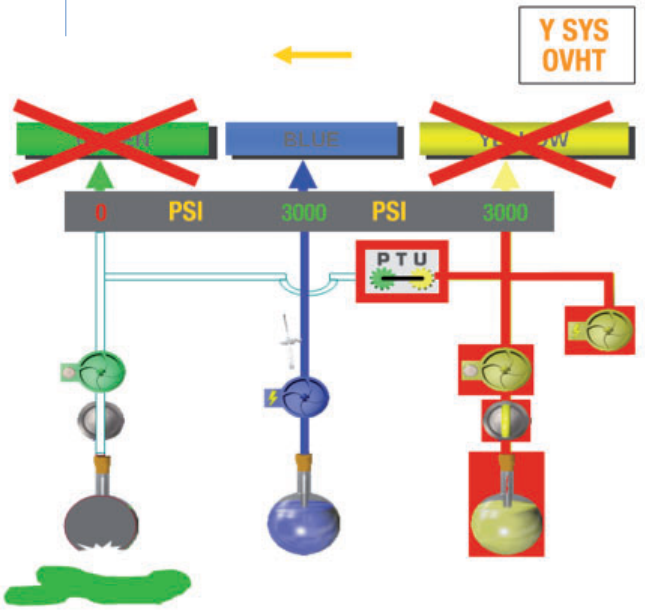
The scenario of the dual hydraulic loss is the following:
-
- During takeoff, a leak in the gear retraction circuit leads to the loss of the green hydraulic system. This loss stops the retraction of the landing gear.
-
- The 500 PSI pressure differential between the green and yellow hydraulic pressure is reached and the PTU automatically switches ON.
-
- The loss of the green system normally triggers the corresponding ECAM caution, which requests the crew to switch off the PTU.
-
- However, below 1,500 feet, the ECAM caution is inhibited.
-
- The PTU therefore remains ON, and operates at its maximum speed.
-
In case of green low level, if PTU is not switched off this will lead to
-
A Yellow overheat (around 2 minutes later)
-
Then to a double G+Y hydraulic failure
-
- As a consequence of the non retraction of the landing gear, the crew may be busy communicating with ATC and managing the situation, leaving the aircraft flying below 1,500 feet longer than usual, and thus keeping the ECAM caution inhibited.
4 Corrective actions
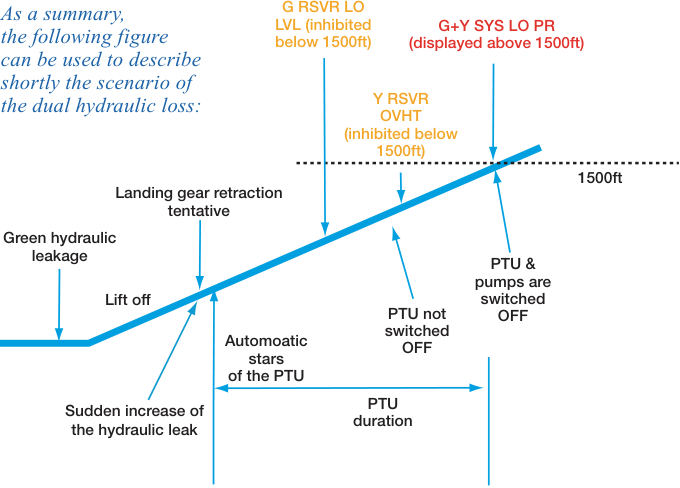
Section titled “4 Corrective actions”This scenario already occurred in-service, leading to the following design change: Below 1,500 feet the PTU is automatically switched to OFF.
5 Conclusion
Section titled “5 Conclusion”The scenario of dual hydraulic loss occurred inservice.
-
l The green hydraulic system was lost during gear retraction.
-
l The PTU automatically switched ON.
This solution was preferred to the following alternatives:
-
l Upgrading the ECAM caution to a red warning.
-
l Cancelling the inhibition of the ECAM warning below 1,500 feet.
Indeed, red warnings require immediate action, which is not justified in this case, and cancelling the inhibition would only overload the crew during a busy flight phase.
The operational consequences of such change are described below:
In case of hyd leak in flight:
Section titled “In case of hyd leak in flight:”-
No longer risk of dual hydraulic loss if no rapid crew action.
-
Follow “G(Y) SYS LO PR” ECAM caution when triggered.
Note: the ECAM procedure requests a manual confirmation to switch off the PTU.
In case of hyd leak on ground:
Section titled “In case of hyd leak on ground:”- No PTU logic change: Follow “G(Y) SYS LO PR” ECAM caution
In case of single engine taxi, or hydraulic pump failure or engine failure…:
Section titled “In case of single engine taxi, or hydraulic pump failure or engine failure…:”-
l The ECAM warning requesting to switch OFF the PTU remained inhibited below 1,500 feet.
-
l The aircraft remained below that altitude for more than two minutes after the start of the operation of the PTU, which led the yellow system to overheat and caused its loss.
A design change has been developed, which consists in the automatic switching of the PTU to OFF below 1,500 feet.
This change is covered by the following modifications.
MOD 34236 + 35879 / SB 29-1115:
Install provisions for new PTU inhibition logic
MOD 35938 / SB 29-1126: Activate new PTU inhibition logic
Modifications 34236 & 35879
are now standard on production lines from MSN2740.
Modification 35938 is optional, and must be requested.
We therefore encourage airlines to retrofit these modifications.
- No change : PTU runs to recover the normal pressure in the affected system.
No ECAM change with new PTU logic:
-
ECAM still requests to switch OFF the PTU – Only Pilot confirmation (in flight) with new logic
-
– Common ECAM definition with old logic
作者:Michel PALOMEQUE,A318/A319/A320/A321 项目飞行安全顾问
A320 可能在低空时经历一系列双液压系统失效的情况,当绿色液压系统发生泄漏时会导致黄色液压系统失效。
为理解此现象的发生机制,本文将首先介绍飞机的液压系统,并解释在绿色和黄色系统之间出现压力差时,动力传输组件(PTU)和 ECAM 警戒的各自作用。
本文第二部分将描述绿色管路大量泄漏与 1,500 英尺以下 ECAM 抑制相结合如何导致双液压系统失效。
第三部分也是最后一部分,将阐述为避免此类事件发生而提出的纠正措施。
2 总体概述
Section titled “2 总体概述”A320 液压系统由三个相互独立且完全分离的管路组成:绿色、黄色和蓝色。各用户系统在管路之间共享,以确保即使某个系统失效时仍能保持对飞机的控制。
恒速马达/发电机(CSM/G)用于在紧急情况下为飞机提供电力。
在绿色和黄色系统上,正常压力来源是发动机驱动泵(EDP),辅助压力来源是动力传输组件(PTU)。PTU 是一种液压马达泵,可在绿色和黄色系统之间传输液压动力,但不进行液体交换。
当两个系统之间的压力差达到 500 PSI 时,PTU 自动启动工作。
如果绿色或黄色系统出现液位过低,ECAM 会触发琥珀色警戒,提示飞行员关闭 PTU 以及 EDP。这是为避免 PTU 以最大转速运转而导致过热,进而造成正常工作的液压系统失效。
根据空客在飞行关键阶段不过度增加机组工作负荷的理念,上述琥珀色警戒在 1,500 英尺以下被抑制。
下图展示了与液压系统相互连接的所有系统:
在蓝色液压系统上,正常压力来源是电动泵,辅助压力来源是冲压空气涡轮(RAT)。
3 双液压系统失效场景
Section titled “3 双液压系统失效场景”
双液压系统失效场景如下:
-
- 起飞时,起落架收上管路的泄漏导致绿色液压系统失效。此失效使起落架收上动作停止。
-
- 绿色和黄色液压压力之间达到 500 PSI 压差,PTU 自动接通。
-
- 绿色系统失效通常会触发相应的 ECAM 警戒,提示机组关闭 PTU。
-
- 然而,在 1,500 英尺以下,ECAM 警戒被抑制。
-
- 因此 PTU 保持接通,并以最大转速运转。
-
如果绿色液位低且 PTU 未关闭,将导致
-
黄色系统过热(约 2 分钟后)
-
然后导致绿色+黄色双液压系统失效
-
- 由于起落架未能收上,机组可能忙于与空中交通管制(ATC)通信并处理情况,使飞机在 1,500 英尺以下飞行时间比平时更长,从而保持 ECAM 警戒处于抑制状态。
4 纠正措施
Section titled “4 纠正措施”此场景已在实际运营中发生过,由此引出以下设计更改:在 1,500 英尺以下,PTU 自动切换至 OFF。
双液压系统失效的场景已在实际运营中发生过。
-
l 绿色液压系统在起落架收上过程中失效。
-
l PTU 自动接通。
选择此方案而非以下替代方案:
-
l 将 ECAM 警告升级为红色警告。
-
l 取消 1,500 英尺以下 ECAM 警告的抑制。
事实上,红色警告要求立即采取行动,在此情况下并不合理;而取消抑制只会使机组在繁忙的飞行阶段承受额外负荷。
此类更改的操作后果如下所述:
飞行中液压泄漏时:
Section titled “飞行中液压泄漏时:”-
若机组未迅速采取行动,不再存在双液压系统失效的风险。
-
按触发时的 ECAM 警告 “G(Y) SYS LO PR” 执行。
注:ECAM 程序要求人工确认以关闭 PTU。
地面液压泄漏时:
Section titled “地面液压泄漏时:”- PTU 逻辑不变:按 ECAM 警告 “G(Y) SYS LO PR” 执行
单引擎滑行、液压泵故障或发动机失效……时:
Section titled “单引擎滑行、液压泵故障或发动机失效……时:”-
l ECAM 警告请求关闭 PTU 的功能在 1,500 英尺以下仍被抑制。
-
l 飞机在该高度以下停留超过 PTU 启动后两分钟,导致黄色系统过热并失效。
已开发一项设计更改,即在 1,500 英尺以下自动将 PTU 切换至 OFF。
此更改涉及以下改装:
MOD 34236 + 35879 / SB 29-1115:
安装新 PTU 抑制逻辑的准备工作
MOD 35938 / SB 29-1126:启用新 PTU 抑制逻辑
改装 34236 和 35879
目前已成为从 MSN2740 起的生产线标准。
改装 35938 为可选项目,须另行申请。
因此,我们鼓励航空公司改装这些改装件。
- 无更改:PTU 运行 以恢复受影响系统的正常压力。
新 PTU 逻辑下无 ECAM 更改:
-
ECAM 仍请求关闭 PTU – 新逻辑下仅需飞行员确认(飞行中)
-
– 与旧逻辑相同的 ECAM 定义