Managing Severe Turbulence
Source: Airbus Safety First URL: https://safetyfirst.airbus.com/managing-severe-turbulence/ Published: 2019-11-18 Magazine Issue: 2019-11 Category: Cabin Ops, Flight Ops, cabin, load, meteorology, overspeed, storm, vortex, wake, weather PDF: Original PDF
Severe turbulence encounters may cause injuries to passengers and cabin crew. If turbulence is unavoidable, using best practices, applying recommended techniques and following procedures will help to reduce the risk of injuries.
This article is about turbulence encounters, their risks and tips for how to avoid them. It provides references and links to the relevant publications. It also highlights how communication between the fl ight crew and cabin crew can be most effective to manage the risks and recalls procedures and best practices to apply in the case of severe turbulence.
ANALYSIS OF AN EVENT
Section titled “ANALYSIS OF AN EVENT”Severe turbulence during approach
Section titled “Severe turbulence during approach”An A320 aircraft was facing severe thunderstorms on approach into its destination airport. Trying to fi nd their way to the fi nal approach path, the crew passed the boundary of one of the thunderstorms by approximately 4 NM. The aircraft was suddenly caught by a signifi cant updraft followed by a downdraft, resulting in a g-load close to zero and the disconnection of the autopilot. Both pilots were surprised by the shift of the g-loads but they did not react on the sidestick. Assessing and accepting the minor altitude deviations, the fl ight crew then reengaged the autopilot and landed safely. There were no injuries to any passengers or crew.
Event analysis
Section titled “Event analysis”The fl ight crew actions were in accordance with the FCTM recommended techniques when encountering turbulence. After the initial updraft and AP disconnection the fl ight crew resisted the potential instinctive reaction to use manual inputs on their sidesticks to fi ght against the turbulence. This limited the risk of over-control on the sidestick, allowing the A320’s fl ight control laws to cope with the effects of the turbulence.
The cabin was already secured for landing with everybody seated and seatbelts fastened, which was a key factor in the prevention of injuries to passengers and cabin crew.
WHAT CAUSES TURBULENCE AND HOW TO AVOID IT?
Section titled “WHAT CAUSES TURBULENCE AND HOW TO AVOID IT?”Several phenomenons create turbulence. Here is a list of the main contributors and how to anticipate, detect and avoid them when possible.
Convective weather
Section titled “Convective weather”The fi rst and most obvious is the convective weather where air is heated by the earth’s surface. Hot air rises and causes strong air displacements. Convection associated with high humidity leads to the formation of thunderstorms that can cause turbulence.
Using weather forecasts to predict convective weather
Section titled “Using weather forecasts to predict convective weather”Flight crew must anticipate any potential route deviation and plan extra fuel to avoid any expected storms shown on the weather forecast analysis during their pre-fl ight preparation. The weather forecast should be regularly updated, especially during long haul fl ights, because meteorological conditions can be changeable.
Using the weather radar to detect and avoid convective weather
Section titled “Using the weather radar to detect and avoid convective weather”For more information about the use of the on-board weather radar, refer to:
-
FCOM AIRCRAFT SYSTEMS – SURVEILLANCE - Weather radar
-
FCTM AIRCRAFT SYSTEMS – WEATHER RADAR
-
Pilot’s guide from the radar manufacturer
-
“Optimum use of weather radar” article published in Safety first #22“ in july 2016
-
“Getting to grips with surveillance” brochure issue 2 (2018)
-
“RDR-4000 IntuVue™ Weather Radar Pilot Training for Airbus Aircraft” video from HONEYWELL.
For more information on avoidance of convective weather, refer to the “Avoidance of convective threats” video from the Airbus Destination 10X sharing platform.
Storms contain a large quantity of liquid water that can be detected with the on-board weather radar . Knowing the capabilities and limitations of the weather radar installed on the aircraft is essential as well as being familiar with the techniques for using the weather radar to optimize the chance to detect convective weather.
Avoiding Storms
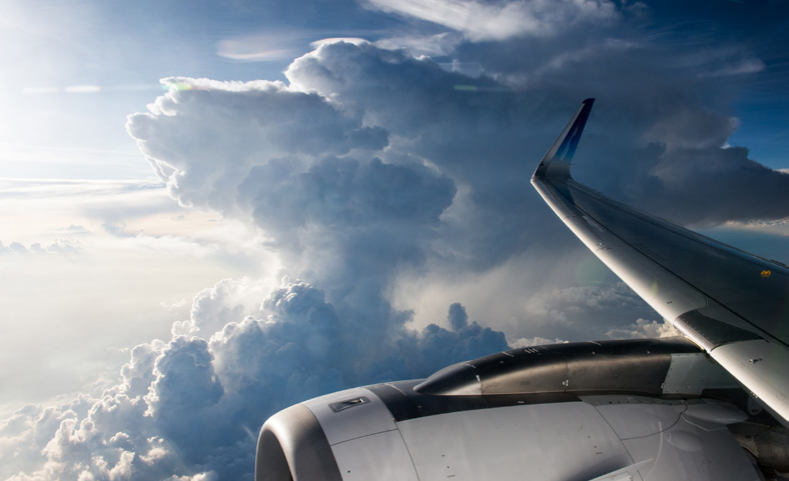
Section titled “Avoiding Storms”Severe turbulence can be met inside a cumulonimbus cloud. However, it can also be met outside of the cloud as we have seen in the event described above where the aircraft was 4 NM outside the boundary of the storm. As a rule of thumb, storm cells should be avoided by 20 NM laterally and preferably upwind to avoid risk of encountering hail. A storm cell must not be overflown by less than 5000ft separation. Avoiding the storm cell by flying around it is preferred because turbulence can extend well above the visible top of a cumulonimbus. High vertical expansion cells with top over 25,000 ft should not be overflown due to potential of strong turbulence.
Clear Air Turbulence
Section titled “Clear Air Turbulence”Clear Air Turbulence (CAT) is due to the difference of speed of air masses at high altitude. Severe turbulence is generally encountered at altitudes higher than 15,000ft when flying across the boundary between the two masses.
Using weather forecast and pilot reports
Section titled “Using weather forecast and pilot reports”The on-board weather radar cannot detect CAT as it does not contain water droplets. Using the weather forecast is the main method to predict when CAT may be encountered during a flight. Flight crews may also be informed of the potential to encounter CAT from pilot reports sent from aircraft that have previously flown through the affected areas to ATC and to the Operators’ operations control centre. There are turbulence information sharing platforms that have been developed by airlines or third parties to share turbulence data and provide real time information to flight crews about the locations of turbulence.

Mountain waves
Section titled “Mountain waves”Windy conditions in mountainous areas can cause air to be directed upwards by the face of the mountain that causes a wave effect downwind of the mountain range. Severe turbulence may be encountered when flying through theses waves. The effects of mountain waves can be felt up to 100 NM downwind of the mountain range and up to the cruise altitude of airliners.
(fig.1)
Section titled “(fig.1)”Lenticular clouds indicating the presence of mountain waves
Anticipating mountain waves
Section titled “Anticipating mountain waves”Mountain waves are predictable in certain mountainous areas when there are specific meteorological conditions. it is important that operators inform flight crews when the conditions are likely to cause mountain waves on the planned flight path. Pilot reports are also invaluable to help inform other aircraft that may be approaching an area where there are mountain waves.
Lenticular clouds observed downwind of a mountain range is a good indicator that mountain waves may be encountered in the area.
Wake vortices
Section titled “Wake vortices”The pressure difference between the upper and the lower side of an aircraft’s wing creates a wake vortex at its wing tips. Wake vortex may cause severe turbulence depending on the weight of the aircraft generating the vortices and the distance from it. The typical signature of a severe wake vortex encounter is a small roll initiated in one direction followed by a much more significant roll in the opposite direction.
To reduce the risk of a wake turbulence encounter, the flight crew must comply with the aircraft separation minima.
An upwind lateral offset can be used to avoid entering wake turbulence if the flight crew suspects that the aircraft may encounter it.
For more information on wake vortices, refer to:
-
FCTM PROCEDURES-NORMAL PROCEDURES-Supplementary Procedures-Adverse weatherWake Turbulence
-
“Wake vortices” article published in Safety fi rst #21 in january 2016.
-
“Wake vortices” briefi ng on the Airbus Worldwide Instructor News (WIN) website.
Perturbation due to ground obstacles and boundary layer effect
Section titled “Perturbation due to ground obstacles and boundary layer effect”Ground obstacles such as mountains or buildings can create turbulence that can affect aircraft trajectory at lower altitudes in windy conditions during takeoff and landing phases.
Some airports are known to be susceptible to turbulence in certain wind conditions due to its surrounding infrastructure, hills or mountain ranges in close proximity . Operators should ensure that their pilots are kept informed when turbulent conditions are expected at the departure and/or arrival airports.
EFFICIENT COMMUNICATION BETWEEN THE COCKPIT AND THE CABIN IS KEY
Section titled “EFFICIENT COMMUNICATION BETWEEN THE COCKPIT AND THE CABIN IS KEY”Effi cient coordination and communication between fl ight crew and cabin crew is essential to safely manage turbulence. It begins with using common terminology in precise and specifi c communication, both before and during the fl ight.
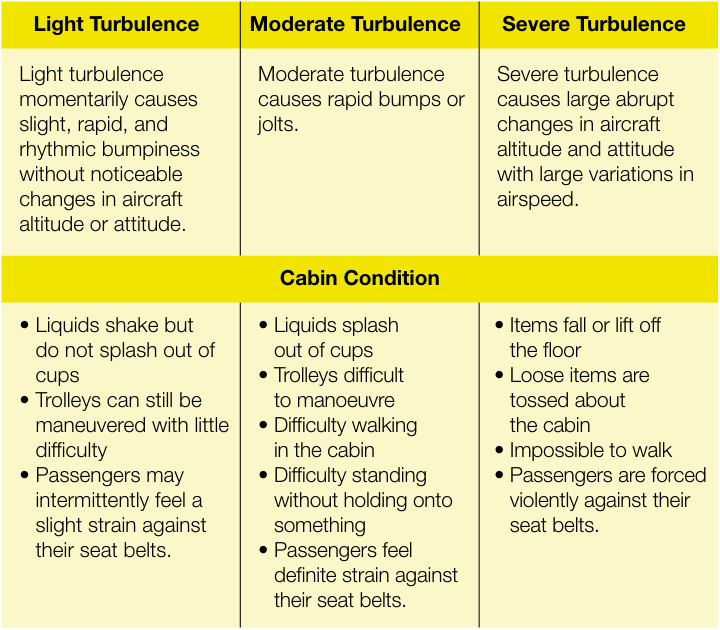
The Turbulence Scale
Section titled “The Turbulence Scale”Turbulence is classifi ed into three categories. To ease identifi cation, each category is based on the impact to the aircraft’s trajectory and the effects felt in the cabin. Using common terminology ensures that the fl ight crew and the cabin crew share the same understanding of the level of turbulence expected. This enables the cabin crew to perform the appropriate duties in order to effectively manage the cabin during turbulence.
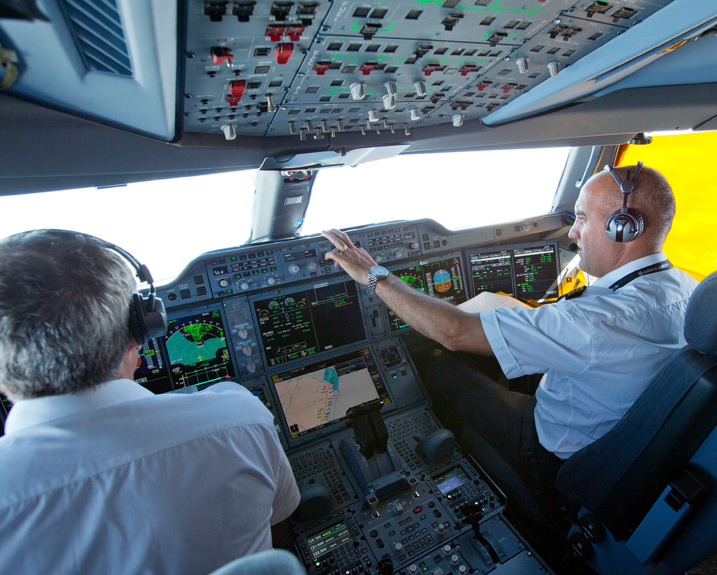
The preflight briefing is the opportunity for flight and cabin crews to discuss the forecasted weather and the possible effects on flight conditions together.
The flight crew will inform the cabin crew of any expected turbulence events and provide the estimated flight times and locations of possible turbulence.
Anticipated severe turbulence
Section titled “Anticipated severe turbulence”When approaching an anticipated area of turbulence:
-
The flight crew should advise the cabin crew on how much time is available to secure the cabin and galleys, as well as informing them of the level and expected duration of the turbulence encounter.
-
A Passenger Address announcement requesting the passengers to return to their seat and fasten their seatbelt should be made.
-
The cabin crew should ensure they inform the flight crew when the cabin is secured.
Unanticipated severe turbulence
Section titled “Unanticipated severe turbulence”When entering an unexpected area of turbulence, the flight crew must switch the seatbelt sign ON and make an announcement to the cabin requesting passengers and crew to fasten seatbelts immediately using the Passenger Address system.
After a severe turbulence encounter
Section titled “After a severe turbulence encounter”It is important that the flight crew informs the cabin crew when the aircraft is clear of the severe turbulence so that cabin crew can check for passenger injuries, give first aid if necessary, calm and reassure passengers and check for any cabin damage. The purser should then provide a cabin status to the flight crew detailing the number of injuries and any cabin damage.
MANAGING SEVERE TURBULENCE FROM THE COCKPIT
Section titled “MANAGING SEVERE TURBULENCE FROM THE COCKPIT”Autopilot is designed to cope with turbulence
Flying through turbulence is sometimes unavoidable despite the best efforts to prevent this. The flight crew must use the recommended procedure to limit the impact of the turbulence on the aircraft’s trajectory and limit the risk of injury to passengers and cabin crew.
Prepare the cockpit before entering an anticipated severe turbulence area
Section titled “Prepare the cockpit before entering an anticipated severe turbulence area”Any loose objects in the cockpit must be cleared or secured before entering an area where turbulence is expected. Shoulder harnesses should be firmly fastened and locked.
Keep autopilot ON
Section titled “Keep autopilot ON”Autopilot is designed to cope with turbulence and will keep the aircraft close to the intended flight path without the risk of overcorrection. The recommendation is to keep autopilot ON during a turbulence encounter. A pilot may be tempted to “fight against turbulence” when manually flying the aircraft and may overreact to sudden changes in the trajectory in some cases.
The flight crew should consider autopilot disconnection if autopilot does not perform as desired.
Keep autothrust ON (except A300/A310) and use the QRH turbulence penetration speed if turbulence is severe
Section titled “Keep autothrust ON (except A300/A310) and use the QRH turbulence penetration speed if turbulence is severe”The turbulence penetration speed/Mach, also known as Rough Air speed/Mach (VRA/MRA), can be found in the QRH. This speed provides the best protection against reaching structural limits due to gust effect whilst maintaining a sufficient margin above VLS.
VRA/MRA should be used in severe turbulence. Managed speed can be kept when in light or moderate turbulence.
On A300/A310 aircraft, the flight crew should disconnect the autothrust and set the target thrust to maintain VRA/MRA.
On fly-by-wire aircraft, use manual thrust when autothrust variations become excessive
Section titled “On fly-by-wire aircraft, use manual thrust when autothrust variations become excessive”If the autothrust variations become excessive on fly-by-wire aircraft, the flight crew should disconnect autothrust and manually adjust thrust to the value provided in the QRH.
In cruise, consider descent to a lower Flight Level
Section titled “In cruise, consider descent to a lower Flight Level”Choosing a lower FL enables the flight crew to increase the aircraft’s margins before buffet onset.
the pilot should only make careful and considered corrections to counter any significant deviation from the intended flight path
Advantage of the fly-by-wire technology in manual flight
Section titled “Advantage of the fly-by-wire technology in manual flight”If the autopilot disconnects on a fly-by-wire aircraft, the flight crew can still utilize the advantages of the fly-by-wire technology to cope with turbulence. If the sidestick remains in its neutral position, the aircraft’s flight control system will compensate for turbulence effects by aiming for a 1g flight path and a constant roll attitude. Therefore, if the pilot is only making careful and considered corrections to counter any significant deviation from the intended flight path, this will allow the flight controls to stabilize the aircraft, whereas continuous pilot sidestick inputs could induce further destabilization.
Do not “fight the turbulence”
Section titled “Do not “fight the turbulence””The pilot must not “fight the turbulence” in manual flight to maintain the aircraft’s trajectory or altitude. Only applying smooth sidestick/control column inputs and allowing some reasonable variations from the intended flight path will reduce the risk of overcorrection that can cause unnecessary accelerations, which may increase the risk of injury to passengers and cabin crew.
For more information on the handling of turbulence, refer to the FCTM “PROCEDURES - NORMAL PROCEDURES - Supplementary Procedures - Adverse weather - Weather Turbulence”
For more details on the handling of overspeed in cruise, refer to:
-
FCTM PROCEDURES - ABNORMAL AND EMERGENCY PROCEDURES - Miscellaneous - Overspeed
-
“Management of Overspeed events in cruise” article published in Safety first #28 in July 2019
-
“What About Overspeed Prevention and Recovery?” briefing from the Airbus Worldwide Instructor News (WIN) website.
For more information on the Ground Speed Mini function, refer to the “Control your speed during descent, approach and landing” article published in Safety first #24 in July 2017.
Do not use rudder
Section titled “Do not use rudder”Do not use rudder to counter the turbulence if in manual flight. Violent rudder inputs can cause additional aircraft trajectory destabilization and stress on the aircraft structure.
Don’t overreact to temporary overspeed excursion
Section titled “Don’t overreact to temporary overspeed excursion”The flight crew may observe temporary overspeed situations when encountering severe turbulence due to the changes in wind intensity or direction. The flight crew must not overreact to temporary overspeed excursion since the use of VRA/MRA ensures sufficient margins to structural limits. The recommendation is to keep the autopilot ON and autothrust ON and accept the temporary overspeed excursion.
In final approach, use autothrust
Section titled “In final approach, use autothrust”The use of autothrust and managed speed in final approach enables the aircraft to benefit from the Ground Speed Mini function that will adapt the managed target speed to the wind variation close to the ground.
Severe turbulence reporting
Section titled “Severe turbulence reporting”The flight crew must make a logbook entry to report any severe turbulence encounter so that maintenance crew are alerted to perform the necessary inspections of the aircraft before the next flight.
It is also recommended to report severe turbulence events to Airbus to assess the effects of the high loads on the aircraft and assess what checks may be necessary before commencing the next flight.
MANAGING SEVERE TURBULENCE FROM THE CABIN
Section titled “MANAGING SEVERE TURBULENCE FROM THE CABIN”Anticipated severe turbulence: a prioritized preparation
Section titled “Anticipated severe turbulence: a prioritized preparation”Once advised by the flight crew of an anticipated turbulence, the cabin crew should prioritize their duties based on the time available before the turbulence encounter in order to best prepare the cabin, as per CCOM recommended procedure:
For more information on turbulence event reporting, refer to the “High Load Event Reporting” article published in Safety first #26 in July 2018.
-
First, they must stow and secure large items such as trolleys and remove bottles from the cabin and galley surfaces. Any hot liquid must be safely disposed of
-
The cabin crew must then secure the cabin and ensure all lavatories are unoccupied
-
Once the cabin is secured, the cabin crew must secure the galleys
-
Cabin crew must then return to their station, fasten their seatbelt and inform the purser that the passengers and themselves are secured
-
Then the purser must inform the flight crew that the cabin is secured.
Unanticipated severe turbulence: ensure personal safety first
Section titled “Unanticipated severe turbulence: ensure personal safety first”Most injuries in the cabin happened to passengers or crew members not seated with their seatbelt fastened during severe turbulence. Cabin crews are more exposed to risk of injury due to sudden turbulence because they are often standing during service. The cabin crew must ensure their own personal safety first if sudden severe turbulence is encountered. The cabin crew must take the nearest available seat and securely fasten the seat belt. The nearest seat may be a passenger seat.
The cabin crew must ensure their own personal safety first if sudden severe turbulence is encountered.
BEST PRACTICE
Section titled “BEST PRACTICE”Tidy cabin and galleys for safe flights
Section titled “Tidy cabin and galleys for safe flights”Any loose object in the cabin can become a projectile during turbulence. Keeping the cabin and galley tidy throughout the flight reduces the risk of injuries and damage to the cabin should an unexpected turbulence event occur.
Passenger awareness on the use of seatbelt
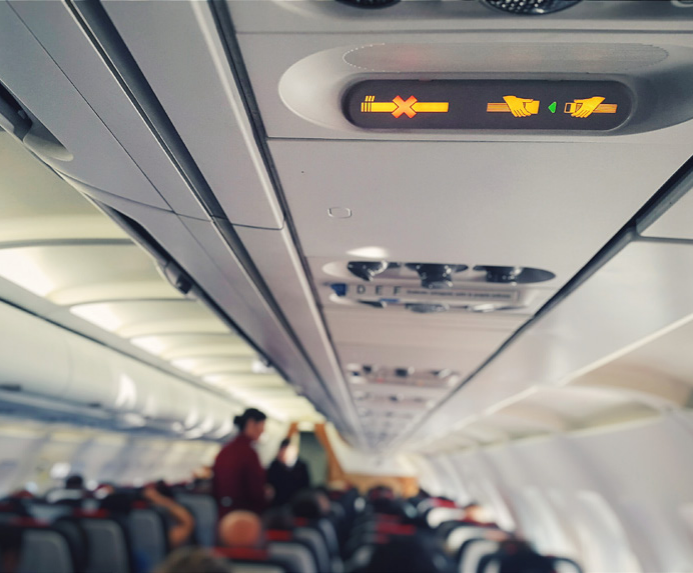
Section titled “Passenger awareness on the use of seatbelt”The most effective way to prevent injuries during turbulence is to keep seatbelts fastened. It is therefore key that passengers are aware of this and are encouraged to keep their seatbelt fastened at all times.
It is key that passengers are encouraged to keep their seatbelt fastened at all times.
Passengers must be made aware that they are obliged to comply with the FASTEN SEATBELT sign at all times when set to ON.
For more information on the handling of turbulence in the cabin, refer to:
-
CCOM:
-
ABNORMAL/EMERGENCY PROCEDURES – TURBULENCE MANAGEMENT
-
ABNORMAL/EMERGENCY PROCEDURES – SAFETY OPERATIONAL AWARENESS
-
TURBULENCE THREAT AWARENESS
-
“TURBULENCE MANAGEMENT” Chapter of the “Getting to Grips with Cabin safety” brochure published in 2015 by the Airbus Flight Operations Support department.
An Analysis of Reported Severe Turbulence
Section titled “An Analysis of Reported Severe Turbulence”240 severe turbulence events were reported to Airbus between 2014 and 2018.
Injuries to passengers and cabin crew occurred on:
• 30 % of long haul flights where severe turbulence events were reported • 12 % of short haul flights where severe turbulence events were reported.
Passengers tend to unfasten their seatbelt during long haul flights to move around the cabin and use the lavatories more during long haul flights and this is likely to be the reason for the higher rate of injuries when compared to the figures for short haul flights. Furthermore, the majority of the injuries that are reported on short haul flights mainly affects cabin crew whereas both cabin crew and passenger injuries are reported for long haul flight severe turbulence events.
It is further evidence of the need to inform passengers on the importance of having their seatbelts fastened during the flight and for the crew to manage the cabin and secure themselves appropriately in anticipation of severe turbulence and during the event.
Post turbulence cabin duties
Section titled “Post turbulence cabin duties”When the flight crew confirms that the aircraft is clear of the turbulence, the cabin crew can leave their seat, check with passengers for any reports of injury, provide first aid if necessary and reassure other passengers. The cabin should then be checked for damage.
Once the situation assessment is done, the purser must report any injury or damage to the flight crew.

CONTRIBUTORS:
Section titled “CONTRIBUTORS:”Robert GRAEF
Section titled “Robert GRAEF”Expert pilot Flight Operations Support
Jean Paul VIEU
Section titled “Jean Paul VIEU”Cabin Operations Engineer - Cabin Safety Enhancement Flight Operations Support
Severe turbulence can cause injuries to passengers and cabin crew as well as damage to the cabin. Flight crew must ensure they are aware of and use all available means to prevent flying through areas where turbulence will be encountered. If turbulence is unavoidable then FCOM procedures and recommended techniques must be applied to limit risks of injury to passengers or cabin crew and damage to the cabin:
-
Keep autopilot ON
-
Keep autothrust ON and use the QRH turbulence penetration speed if turbulence is severe
-
If the autopilot is disconnected, only use careful and considered inputs on the sidestick and take advantage of the fly-by-wire capability to cope with turbulence.
-
Do not use rudder to counter turbulence
-
Use manual thrust when autothrust variations become excessive
-
In cruise, consider descent to a lower Flight Level and don’t overreact to temporary overspeed excursion.
-
In final approach, use autothrust to benefit from the ground speed mini function
-
Report any severe turbulence encounter to the Maintenance at the end of the flight with a logbook entry.
Communication between the flight crew and the cabin crew enables safe and efficient management of the cabin before and during turbulence events.
Cabin crew should remember that they must first ensure their own safety by immediately seating in the closest available seat and securely fasten their seatbelt in the case of sudden severe turbulence. Assisting other cabin crew or passengers should only be resumed when the flight crew confirms that the aircraft is clear of turbulence.
Encouraging the passengers to keep their seat belts fastened at all times when they are seated and ensuring that the cabin and galleys remain tidy during the flight is the most effective means to limit the risk of injury to passengers and cabin crew in the case of unexpected turbulence.
Safety fi rst, #29 November, 2019. Safety fi rst is published by Airbus S.A.S. - 1, rond point Maurice Bellonte - 31707 Blagnac Cedex/France. Publisher and Editor: Yannick Malinge, Chief Product Safety Offi cer. Concept Design by Airbus MultiMedia Studio 20192534. Reference: X00D16031905 Issue 29. Photos by S. Ramadier, C. Koshorst, P. Maslet, J. Cahill, Mirko Macari / EyeEm.
Source: Airbus Safety First URL: https://safetyfirst.airbus.com/managing-severe-turbulence/ Published: 2019-11-18 Magazine Issue: 2019-11 Category: Cabin Ops, Flight Ops, cabin, load, meteorology, overspeed, storm, vortex, wake, weather PDF: Original PDF
严重颠簸可能导致乘客和客舱乘务组受伤。如果颠簸不可避免,采用最佳做法、应用推荐技术并遵循程序将有助于降低受伤风险。
本文涉及颠簸事件、其风险及避免颠簸的建议。文章提供了相关出版物的参考资料和链接,还重点说明了飞行机组与客舱乘务组之间如何进行有效沟通以管理风险,并回顾了在严重颠簸情况下的程序和最佳做法。
进近期间的严重颠簸
Section titled “进近期间的严重颠簸”一架A320飞机在飞往目的地机场的进近过程中遭遇了严重雷雨。机组试图寻找最后进近航道,经过其中一处雷雨边界约4海里处。飞机突然遭遇了强烈的上升气流,随后是下降气流,导致接近零的过载并使自动驾驶仪断开。两位飞行员对过载的变化感到意外,但他们没有操控侧杆进行反应。评估并接受了轻微的高度偏差后,飞行机组重新接通了自动驾驶仪并安全着陆。乘客和乘务组均未受伤。
飞行机组在遭遇颠簸时采取的行动符合FCTM推荐的技巧。在初始上升气流和自动驾驶仪断开后,飞行机组抵制了可能出于本能反应而使用侧杆进行手动输入以对抗颠簸的冲动。这限制了侧杆过度控制的风险,使A320的飞行控制法则能够应对颠簸的影响。
客舱已为着陆做好准备,所有人就座并系好安全带,这是防止乘客和客舱乘务组受伤的关键因素。
什么导致颠簸?如何避免?
Section titled “什么导致颠簸?如何避免?”多种现象会产生颠簸。以下是主要诱因清单,以及如何预测、探测并在可能时避开它们。
第一个也是最明显的是对流天气,即空气被地球表面加热。热空气上升并导致强烈的空气位移。与高湿度相关联的对流会导致雷雨形成,从而引发颠簸。
使用天气预报预测对流天气
Section titled “使用天气预报预测对流天气”飞行机组必须在预飞准备期间,根据天气预报分析显示的任何预期风暴,提前规划潜在的航线偏离并携带额外燃油。天气预报应定期更新,尤其是在远程飞行期间,因为气象条件可能变化不定。
使用机载气象雷达探测和避开对流天气
Section titled “使用机载气象雷达探测和避开对流天气”有关机载气象雷达使用的更多信息,请参阅:
-
FCOM 飞机系统 – 监视 - 气象雷达
-
FCTM 飞机系统 – 气象雷达
-
雷达制造商提供的飞行员指南
-
2016年7月出版的《安全优先》第22期“优化使用气象雷达”文章
-
2018年版第2期《应对监视》手册
-
霍尼韦尔公司制作的《RDR-4000 IntuVue™ 气象雷达空客飞机飞行员培训》视频
有关避开对流天气的更多信息,请参阅空客Destination 10X分享平台的“避开对流威胁”视频。
风暴包含大量可被机载气象雷达探测到的液态水。了解飞机所装气象雷达的能力和限制至关重要,同时熟悉使用气象雷达的技术以优化探测对流天气的机会。
严重颠簸可能发生在积雨云内部。然而,如上文所述的事件中,飞机距离风暴边界4海里的地方也可能遭遇颠簸。作为经验法则,风暴单体应保持20海里的侧向距离避开,并建议在上风侧飞行以避免遭遇冰雹风险。穿越风暴单体时的垂直间隔不得小于5000英尺。由于颠簸可延伸至积雨云可见云顶以上,绕飞风暴是首选方式。顶部超过25,000英尺的高垂直扩展单体不应飞越,因为存在强颠簸的可能性。
晴空颠簸(CAT)是由于高空不同气团速度差异所致。飞机穿越两个气团边界时,通常在 15,000ft 以上高度会遇到严重颠簸。
使用天气预报和飞行员报告
Section titled “使用天气预报和飞行员报告”机载气象雷达无法探测晴空颠簸,因为其中不含水滴。使用天气预报是预测飞行中何时可能遇到晴空颠簸的主要方法。飞行机组也可能通过先前飞越受影响区域的飞机发送给空中交通管制和航空公司运行控制中心的飞行员报告,获知可能遭遇晴空颠簸的信息。航空公司或第三方已开发了颠簸信息共享平台,用于共享颠簸数据,并向飞行机组提供有关颠簸位置的实时信息。
山区的大风条件可能导致空气被山体正面抬升,在山脉下风向产生波动效应。穿越这些波动时可能会遇到严重颠簸。山地波的影响范围可达山脉下风向 100 海里以内,并延伸至大型客机的巡航高度。
表明存在山地波的荚状云
在特定气象条件下,某些山区可以预测山地波。当条件可能在计划飞行路径上产生山地波时,运营商应及时通知飞行机组。飞行员报告对于帮助可能接近山地波区域的其它飞机也极具价值。
在山脉下风向观测到的荚状云是可能在该区域遇到山地波的良好指标。
飞机机翼上下表面的压力差在翼尖处产生尾涡。尾涡是否会导致严重颠簸,取决于产生涡流的飞机重量以及与涡流的距离。严重尾涡遭遇的典型特征是:先向一个方向产生小幅横滚,随后向相反方向产生更为剧烈的横滚。
为降低遭遇尾涡的风险,飞行机组必须遵守飞机间隔最小标准。
如果飞行机组怀疑可能遭遇尾涡,可使用上风方向横向偏置来避开尾涡。
有关尾涡的更多信息,请参阅:
-
FCTM 程序-正常程序-补充程序-不利天气 尾涡湍流
-
2016 年 1 月《Safety First》第 21 期发表的《尾涡》文章。
-
空客全球教官新闻网(WIN)网站上的《尾涡》简报。
地面障碍物和边界层效应引起的扰动
Section titled “地面障碍物和边界层效应引起的扰动”mountain 或 buildings 等地面障碍物在起飞和着陆阶段的大风条件下会产生扰动,可能影响低空飞行的飞机轨迹。
某些机场因周围基础设施、丘陵或近距离山脉,在特定风向条件下容易发生颠簸。运营商应确保在预计出发和/或目的地机场可能出现颠簸条件时,及时通知飞行员。
驾驶舱与客舱之间的有效沟通至关重要
Section titled “驾驶舱与客舱之间的有效沟通至关重要”飞行机组与客舱机组之间的有效协调与沟通对于安全应对颠簸至关重要。这始于在飞行前和飞行中使用精确且具体的通用术语进行沟通。
颠簸分为三个等级。为便于识别,每个等级均基于对飞机轨迹的影响和客舱内的感受来划分。使用通用术语可确保飞行机组和客舱机组对预期颠簸等级形成一致的认知。这使客舱机组能够执行适当的职责,以有效管理颠簸期间的客舱。
飞行前简报是飞行机组和客舱机组共同讨论预报天气及其对飞行条件可能影响的机会。
飞行机组将告知客舱机组任何预期的颠簸事件,并提供可能发生颠簸的预计飞行时间和位置。
预见性严重颠簸
Section titled “预见性严重颠簸”当接近可预见的颠簸区域时:
-
飞行机组应告知客舱机组可用的客舱和厨房固定时间,同时告知颠簸等级和预计持续时间。
-
应通过旅客广播系统发布公告,要求旅客返回座位并系好安全带。
-
客舱机组应确保在客舱固定完毕后通知飞行机组。
非预见性严重颠簸
Section titled “非预见性严重颠簸”进入意外颠簸区域时,飞行机组必须打开安全带指示灯,并通过旅客广播系统发布公告,要求旅客和机组人员立即系好安全带。
严重颠簸后的处置
Section titled “严重颠簸后的处置”飞行机组在飞机脱离严重颠簸区域后通知客舱机组非常重要,以便客舱机组检查旅客是否受伤,必要时提供急救,安抚旅客,并检查客舱是否有损坏。随后,乘务长应向飞行机组报告客舱状况,详细说明受伤人数和客舱损坏情况。
驾驶舱内严重颠簸管理
Section titled “驾驶舱内严重颠簸管理”自动驾驶仪的设计可应对颠簸
尽管采取了最佳预防措施,穿越颠簸区域有时仍不可避免。飞行机组必须使用建议的程序来限制颠簸对飞机轨迹的影响,并降低旅客和机组人员受伤的风险。
进入可预见的严重颠簸区域前做好驾驶舱准备
Section titled “进入可预见的严重颠簸区域前做好驾驶舱准备”进入预期颠簸区域前,必须清除或固定驾驶舱内的所有松散物品。肩带应牢固系好并锁止。
保持自动驾驶仪接通
Section titled “保持自动驾驶仪接通”自动驾驶仪的设计可应对颠簸,将使飞机保持在预期飞行轨迹附近,不存在过度修正的风险。建议在颠簸过程中保持自动驾驶仪接通。飞行员在人工飞行时可能会“对抗颠簸”,在某些情况下可能对轨迹的突然变化反应过度。
如果自动驾驶仪性能不达预期,飞行机组应考虑断开自动驾驶仪。
保持自动推力接通(A300/A310除外),严重颠簸时使用QRH颠簸穿越速度
Section titled “保持自动推力接通(A300/A310除外),严重颠簸时使用QRH颠簸穿越速度”颠簸穿越速度/Mach,也称为颠簸飞行速度/Mach(VRA/MRA),可在QRH中找到。该速度在保持足够VLS余量的同时,提供了抵御阵风效应导致超出结构限制的最佳保护。
VRA/MRA应在严重颠簸时使用。轻度或中度颠簸时可保持管理速度。
在A300/A310飞机上,飞行机组应断开自动推力并设置目标推力以保持VRA/MRA。
在电传操纵飞机上,当自动推力变化过大时使用人工推力
Section titled “在电传操纵飞机上,当自动推力变化过大时使用人工推力”如果电传操纵飞机上的自动推力变化过大,飞行机组应断开自动推力,并人工将推力调整至QRH中提供的数值。
在巡航阶段,考虑下降至较低高度层
Section titled “在巡航阶段,考虑下降至较低高度层”选择较低的FL使飞行机组能够在抖杆边界之前增加飞机的余量。
飞行员只应进行仔细审慎的修正,以抵消与预期飞行轨迹的任何显著偏差
人工飞行中电传操纵技术的优势
Section titled “人工飞行中电传操纵技术的优势”如果电传操纵飞机上的自动驾驶仪断开,飞行机组仍可利用电传操纵技术的优势来应对颠簸。如果侧杆保持在其中立位置,飞机的飞行控制系统将通过瞄准1g飞行轨迹和恒定横滚姿态来补偿颠簸效应。因此,如果飞行员仅进行仔细审慎的修正以抵消与预期飞行轨迹的任何显著偏差,这将允许飞行控制使飞机稳定下来,而持续的飞行员侧杆输入可能导致进一步的 destabilization。
不要“对抗颠簸”
Section titled “不要“对抗颠簸””在人工飞行中,飞行员不得“对抗颠簸”以保持飞机的轨迹或高度。只进行平滑的侧杆/驾驶杆输入,并允许与预期飞行轨迹有合理的偏差,将降低可能导致不必要加速的过度修正风险,从而增加旅客和机组人员受伤的风险。
有关颠簸处理的更多信息,请参阅FCTM “PROCEDURES - NORMAL PROCEDURES - Supplementary Procedures - Adverse weather - Weather Turbulence”
有关巡航阶段超速处理的更多详情,请参阅:
-
FCTM PROCEDURES - ABNORMAL AND EMERGENCY PROCEDURES - Miscellaneous - Overspeed
-
“Management of Overspeed events in cruise” 一文,发表于2019年7月 Safety first #28
-
“What About Overspeed Prevention and Recovery?” 简报,来自Airbus Worldwide Instructor News (WIN) 网站。
有关地速最小值功能的更多信息,请参阅2017年7月 Safety first #24 发表的 “Control your speed during descent, approach and landing” 一文。
不要使用方向舵
Section titled “不要使用方向舵”在人工飞行中,不要使用方向舵来对抗颠簸。剧烈的方向舵输入可能导致额外的飞机轨迹 destabilization 和对飞机结构的应力。
不要对临时超速过度反应
Section titled “不要对临时超速过度反应”飞行机组在遭遇严重颠簸时,由于风速或风向的变化,可能会观察到临时超速情况。飞行机组不得对临时超速过度反应,因为使用 VRA/MRA 已确保了足够的结构极限裕度。建议保持自动驾驶仪接通、自动推力接通,并接受临时超速。
在最后进近时使用自动推力
Section titled “在最后进近时使用自动推力”在最后进近时使用自动推力和管理速度,使飞机能够受益于地速最小功能,该功能将根据近地时的风向变化调整管理目标速度。
严重颠簸报告
Section titled “严重颠簸报告”飞行机组必须进行日志记录,以报告任何严重颠簸遭遇,从而提醒维修人员在下次飞行前对飞机进行必要的检查。
同时建议向空客报告严重颠簸事件,以评估高载荷对飞机的影响,并评估在开始下次飞行前可能需要进行的检查。
客舱内严重颠簸的管理
Section titled “客舱内严重颠簸的管理”预知严重颠簸:优先准备
Section titled “预知严重颠簸:优先准备”一旦收到飞行机组关于预知颠簸的通知,乘务组应根据距离颠簸发生前的时间进行职责优先排序,以按照 CCOM 建议程序最好地准备客舱:
有关颠簸事件报告的更多信息,请参阅 2018 年 7 月《Safety First》第 26 期发表的 “High Load Event Reporting” 文章。
- 首先,必须收好和固定大型物品,如餐车,并将瓶子从客舱和厨房台面上移除。任何热液体必须安全处理
- 乘务组随后必须固定客舱,确保所有洗手间无人使用
- 客舱固定完成后,乘务组必须固定厨房
- 乘务组随后必须返回座位,系紧安全带,并通知乘务长乘客和自身均已就位
- 然后乘务长必须通知飞行机组客舱已固定完毕
突发严重颠簸:首先确保个人安全
Section titled “突发严重颠簸:首先确保个人安全”客舱中大多数受伤发生在严重颠簸期间未系好安全带的乘客或机组人员。乘务组由于在服务期间经常站立,在遇到突发颠簸时面临更高的受伤风险。如果遇到突发严重颠簸,乘务组必须首先确保自身个人安全。乘务组必须就近坐下并系紧安全带。最近的座位可能是乘客座位。
如果遇到突发严重颠簸,乘务组必须首先确保自身个人安全。
保持客舱和厨房整洁以确保安全飞行
Section titled “保持客舱和厨房整洁以确保安全飞行”客舱中任何松散物品在颠簸时都可能成为抛射物。在整个飞行过程中保持客舱和厨房整洁,可以减少意外颠簸事件发生时受伤和客舱损坏的风险。
乘客对安全带使用的意识
Section titled “乘客对安全带使用的意识”防止颠簸期间受伤的最有效方法是始终系好安全带。因此,关键是要让乘客意识到这一点,并鼓励他们始终系好安全带。
关键是鼓励乘客始终系好安全带。
必须让乘客知晓,当”系好安全带”标志亮起时,他们必须遵守该规定。
有关客舱颠簸处理的更多信息,请参阅:
-
CCOM:
-
ABNORMAL/EMERGENCY PROCEDURES – TURBULENCE MANAGEMENT
-
ABNORMAL/EMERGENCY PROCEDURES – SAFETY OPERATIONAL AWARENESS
-
TURBULENCE THREAT AWARENESS
-
空客飞行运营支持部门于 2015 年发布的 “Getting to Grips with Cabin Safety” 手册中的 “TURBULENCE MANAGEMENT” 章节
报告的严重颠簸事件分析
Section titled “报告的严重颠簸事件分析”2014 年至 2018 年期间,共向空客报告了 240 起严重颠簸事件。
乘客和乘务组受伤发生在:
• 报告严重颠簸事件的远程航班占 30% • 报告严重颠簸事件的短程航班占 12%
乘客在远程航班中倾向于解开安全带在客舱内走动,并更多地使用洗手间,这可能是与短程航班相比受伤率更高的原因。此外,短程航班报告的大多数受伤主要影响乘务组,而远程航班严重颠簸事件则同时报告了乘务组和乘客受伤。
这进一步证明,有必要告知乘客在飞行中系好安全带的重要性,并要求机组人员在预知严重颠簸时以及在颠簸事件发生期间适当管理客舱并保护自身安全。
颠簸后的客舱职责
Section titled “颠簸后的客舱职责”当飞行机组确认飞机已脱离颠簸区域后,乘务组可以离开座位,询问乘客是否有受伤报告,必要时提供急救,并安抚其他乘客。然后应检查客舱是否有损坏。
完成情况评估后,乘务长必须向飞行机组报告任何受伤或损坏情况。
Robert GRAEF
Section titled “Robert GRAEF”专家飞行员 飞行运行支援
Jean Paul VIEU
Section titled “Jean Paul VIEU”客舱运营工程师 - 客舱安全提升 飞行运行支援
严重颠簸可能导致乘客和客舱乘务员受伤,并对客舱造成损坏。飞行机组必须确保了解并使用所有可用手段,以避免飞入将遭遇颠簸的区域。若颠簸不可避免,则必须遵循 FCOM 程序和建议技术,以降低乘客或客舱乘务员受伤及客舱损坏的风险:
-
保持自动驾驶接通
-
保持自动推力接通,若颠簸严重则使用 QRH 颠簸穿行速度
-
若自动驾驶断开,仅可对侧杆进行谨慎和深思熟虑的输入,并利用电传操纵能力应对颠簸
-
不要使用方向舵对抗颠簸
-
当自动推力变化过大时,使用人工推力
-
在巡航阶段,考虑下降至较低的飞行高度层,对于暂时的超速偏差不要过度反应
-
在最后进近阶段,使用自动推力以利用地速最小功能
-
在飞行结束时,向维修部门报告任何严重颠簸遭遇,并在飞行日志中记录
飞行机组与客舱乘务员之间的沟通能够在颠簸事件前和期间实现客舱的安全和高效管理。
客舱乘务员应记住,在遇到突发严重颠簸时,必须首先通过立即就近坐在可用座位上并系紧安全带来确保自身安全。只有在飞行机组确认飞机已脱离颠簸后,方可恢复帮助其他客舱乘务员或乘客。
在飞行中鼓励乘客就座时始终系好安全带,并确保客舱和厨房保持整洁,是降低遭遇意外颠簸时乘客和客舱乘务员受伤风险的最有效手段。
Safety first, #29 November, 2019. Safety first 由 Airbus S.A.S. 出版 - 1, rond point Maurice Bellonte - 31707 Blagnac Cedex/France。出版商和编辑:Yannick Malinge,首席产品安全官。概念设计:Airbus MultiMedia Studio 20192534。参考编号:X00D16031905 第 29 期。照片:S. Ramadier, C. Koshorst, P. Maslet, J. Cahill, Mirko Macari / EyeEm。