Use of Non-Certified Equipment on Cockpit Windows
Source: Airbus Safety First
URL: https://safetyfirst.airbus.com/use-of-non-certified-equipment-on-cockpit-windows/
Published: 2026-05-27
Category: Flight Ops, acrylic, suction cups, sunshade, tablet, windshield
PDF: Original PDF
CASE STUDY
Section titled “CASE STUDY”Event Description
Section titled “Event Description”An A320 aircraft was in cruise when the ANTI ICE R WINDOW ECAM alert triggered. The flight crew had previously installed a sunshade, purchased online by one crew member, on the right sliding cockpit window.
The flight crew did not observe any immediate problems on the right windows after the ECAM alert triggering. However, after a short period, the right sliding window became hot and started to become distorted.
The flight crew checked the COCKPIT WINDSHIELD / WINDOW CRACKED and COCKPIT WINDSHIELD / WINDOW ARCING procedures from the QRH, and decided to initiate a descent and perform a diversion. They pulled the circuit breaker connected to that window ( ANTI-ICE/WINDOWS R ).
During final approach, when passing through 1 000 ft, the flight crew heard a crack in the right window. They landed safely at the diversion airport.
Postflight inspection found severe damage to the right sliding window. The sunshade that was covering the window also displayed heat damage (fig.1).
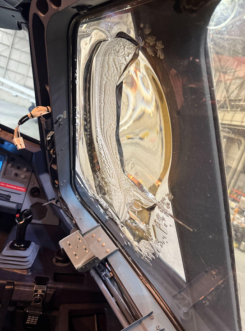
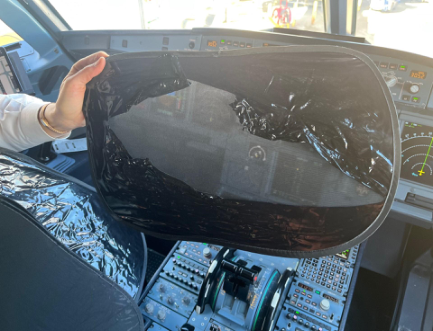
(fig.1) Damage observed on the RH sliding window and on the sunshade (pictures from the Operator)
Event Analysis
Section titled “Event Analysis”The damaged window was removed from the aircraft and sent to the windows manufacturer for investigation.
Damage to inner ply caused by excessive heat
Section titled “Damage to inner ply caused by excessive heat”Detailed inspection by the manufacturer revealed that “the window experienced excessive temperature at the inner ply. The excessive temperatures had caused thermal relaxation of the inner ply to such an extent that the inner ply had fully relaxed back to expose the interlayer over a large area.”
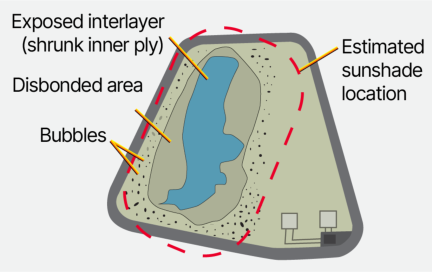
(fig.2) Mapping of the damage of the sliding window
Outer ply was not damaged
Section titled “Outer ply was not damaged”The windows manufacturer also described that “Non-destructive thickness measurements taken of the outer ply in conjunction with visual assessment concluded this ply to be undamaged. As such the window can be considered to remain failsafe.” The structural integrity of the window was therefore still maintained.
First contributor to the overheat: A faulty window heating system
Section titled “First contributor to the overheat: A faulty window heating system”The heating film adjacent to the active[(] *[)] temperature sensor was found to be inoperative. This failure on this type of window can cause the window heating system to incorrectly estimate the temperature of the window, resulting in an increase in temperature of the window areas with a functional heating film.
(*) On this type of window only one sensor is active at a time. The second sensor can be activated by maintenance if the other sensor fails.
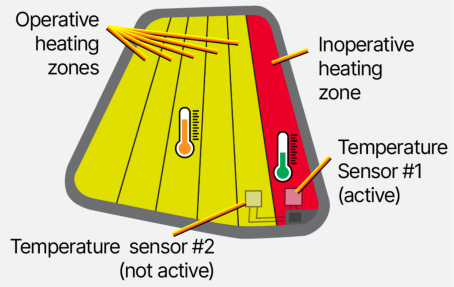
(fig.3) An inoperative heating zone caused a dysfunction of the window temperature regulation
Second Contributor to the overheat: Thermal barrier caused by the sunshade
Section titled “Second Contributor to the overheat: Thermal barrier caused by the sunshade”The sunshade applied on the window acted as a thermal barrier, preventing natural cooling of the inner side of the window by convection of the cabin air on the window surface (fig.4).
Shrink-back effect on the inner ply
Section titled “Shrink-back effect on the inner ply”The combination of the overheating, caused by the faulty heating system with the thermal barrier effect created by the sunshade resulted in the temperature of the inner ply to go above the acrylic materialʼs glass transition temperature. This caused the inner ply to be affected by a shrink-back effect causing the damage.
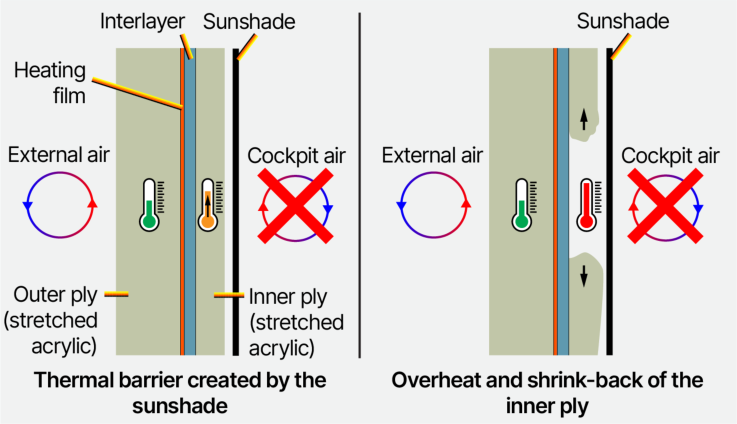
(fig.4) The sunshade prevented the natural cooling by the cockpit air circulation, causing the overheat and shrink back of the inner ply
More information about the shrink-back effect caused by high temperature on a stretched-acrylic window can be found in the “Under the spotlights” Safety first article published in September 2024.
COCKPIT WINDOWS
Section titled “COCKPIT WINDOWS”Glass or stretched acrylic
Section titled “Glass or stretched acrylic”Cockpit windshields of all Airbus aircraft are made of glass. Cockpit side windows of A220, A300, A310, A330, A340, A350, and A380 aircraft are also made of glass, with the exception of A320 family aircraft that can have side windows made of glass or of stretched acrylic.
Typical structure
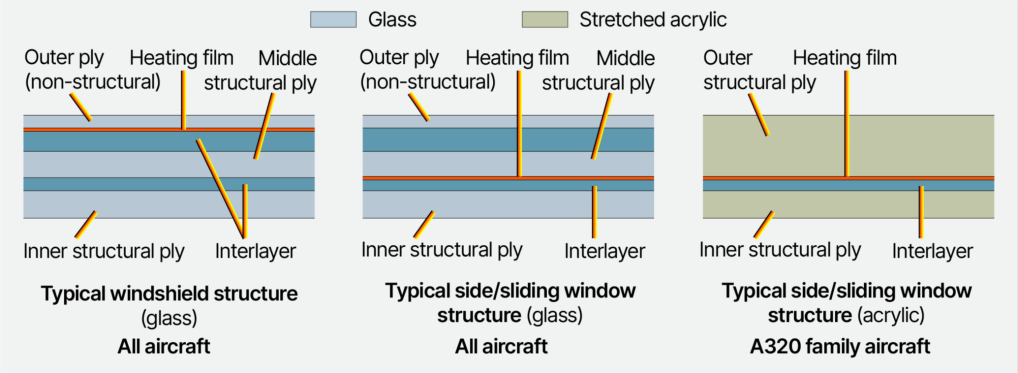
Section titled “Typical structure”Regardless of the material they are made of, two structural plies ensure the integrity of the window thanks to a fail-safe concept: each structural ply is able to sustain two times the maximum differential pressure on its own. A supplementary protective outer ply is used on glass windows to protect the structural plies against FOD damage (fig.5).
A heating film provides anti-ice/anti-fog capability to the window. Its location may change depending on the type of window.
(fig.5) Typical cockpit windows structure
RISKS OF USING NON-CERTIFIED EQUIPMENT ON COCKPIT WINDOWS
Section titled “RISKS OF USING NON-CERTIFIED EQUIPMENT ON COCKPIT WINDOWS”Installation of equipment preventing natural cooling of the windows may cause damage
Section titled “Installation of equipment preventing natural cooling of the windows may cause damage”The event described earlier in this article illustrates the thermal barrier effect of a sunshade. However, suction cups used to attach different types of equipment on the windows can also act as a thermal barrier. This can affect the local cooling of the covered area. When combined with a loss of the temperature regulation of a window, this can cause significant damage to the window (fig.6).
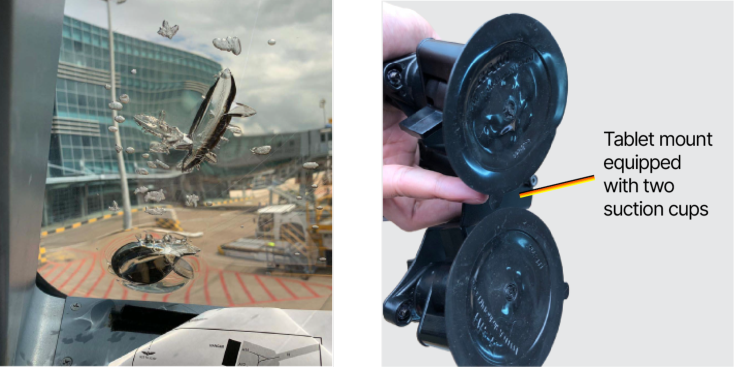
(fig.6) Example of damage caused by a loss of the temperature regulation of an acrylic sliding window combined with the use of a tablet mount equipped with two suction cups (pictures from the Operator)
Possible damage on glass windows
Section titled “Possible damage on glass windows”Even if glass windows are not at risk of shrinking, equipment acting as a thermal barrier still creates a local overheat that may have an impact on the service life of the window. Overheat can cause bubbling of the interlayer next to the heating film, causing damage to the window heating system or affecting visibility.
Risk of fall
Section titled “Risk of fall”Suction cups may not be strong enough to maintain the equipment in place in the case of vibrations. Equipment falling from a cockpit window may obstruct cockpit controls and affect the safety of the flight, particularly in critical flight phases like takeoff and landing.
Risk of interference with cockpit operations
Section titled “Risk of interference with cockpit operations”Non-certified equipment used on cockpit windows may affect visibility and cockpit operations, like, for example, the use of the oxygen mask, roller blind operation, or accessibility to emergency equipment. It can also affect the opening of a sliding window during an emergency evacuation.
OPERATIONAL CONSIDERATIONS
Section titled “OPERATIONAL CONSIDERATIONS”In general, flight crews should avoid attaching any equipment to the inner surface of the cockpit windows. This practice is advised to prevent the risks previously described.
No requirement for additional UV protection
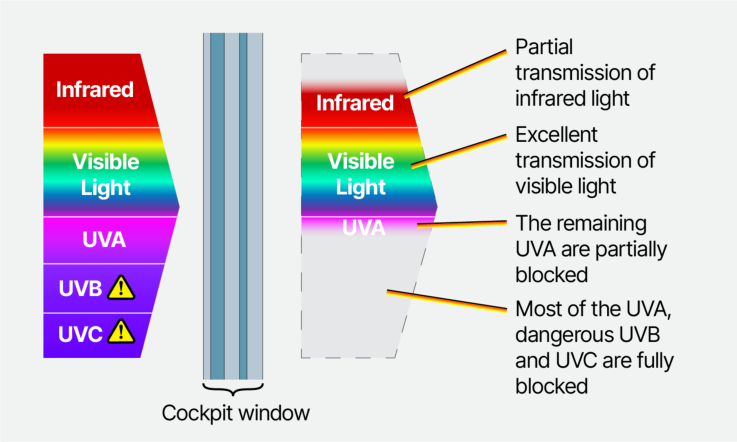
Section titled “No requirement for additional UV protection”Both glass and acrylic cockpit windows protect the flight crew against the most dangerous Ultra-Violet (UV) radiation (fig.7). There is therefore no requirement to use additional equipment to protect flight crew members against UV radiation.
Use sun visors and roller blinds
Section titled “Use sun visors and roller blinds”Flight crews should use the sun visors and roller blinds installed in the cockpit. They reduce the quantity of light entering the cockpit, while still enabling sufficient cooling of the windowʼs inner side. Sun visors and roller blinds are designed so that their filtering capability enables direct vision of the sun through them.
Due to the complex shape of the cockpit windows, sun visors and roller blinds cannot cover their entire surface. This results in sunlight leaks inside the cockpit. If the protection against excessive light provided by the existing devices is considered to not be sufficient, flight crew can consider using sunglasses as an additional safeguard. However, they should make sure to use the appropriate type of sunglasses to prevent reducing the visibility of the flight instruments.
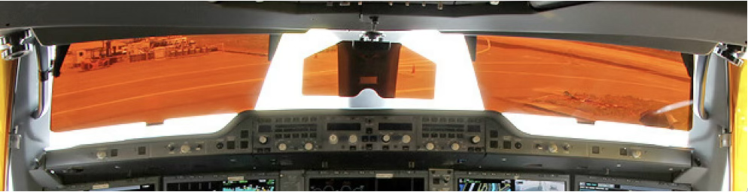
(fig.7) Radiation protection provided by cockpit windows
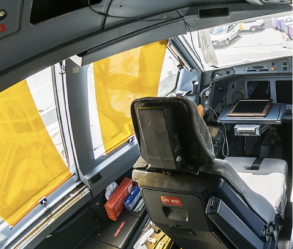
(fig.8) Roller blinds of an A320 family aircraft
(fig.9) Sun visors of an A350 aircraft
AVAILABLE ENHANCEMENTS
Section titled “AVAILABLE ENHANCEMENTS”Certified cockpit mounts for tablets are available
Section titled “Certified cockpit mounts for tablets are available”Airbus developed specific cockpit mounts for A320 family, A330, A340, A350 and A380 aircraft. These mounts can be installed as an option on newly built aircraft or in retrofit on in-service aircraft (fig.10). They are attached to the windowʼs frame and were tested to safely hold tablets in position in every condition. They are EASA and FAA approved, and designed taking into account their integration in the cockpit, and ensuring compatibility with normal and emergency operations (use of oxygen masks, accessibility to flashlight, emergency evacuation, etc…).
Operators wishing to install these mounts should contact their Customer Support Director.
STC alternatives
Section titled “STC alternatives”Supplemental Type Certificate (STC) alternative products are also available on the market, providing approved solutions attached to the windowʼs frame that can safely support tablets and prevent damage to the windows.
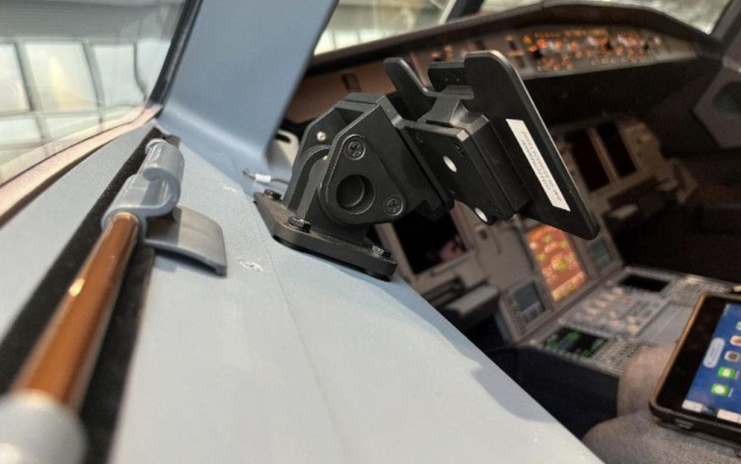
(fig.10) Example of a cockpit mount for tablets recommended as an option on A320 family aircraft
Contributors:
Section titled “Contributors:”Benoît Colombel
Section titled “Benoît Colombel”Systems Sales Marketing
Jean Denoyer
Section titled “Jean Denoyer”Cockpit Windows System Designer Design Office
Nicolas Ferrere
Section titled “Nicolas Ferrere”Cockpit Layout Responsible - Seats and Sunprotections Work Package Leader Design Office
Christophe Gaches
Section titled “Christophe Gaches”Flight Operations Support Engineer Customer Support
The use of non-certified equipment, like sunshades or suction cup mounted devices, on the inner surface of cockpit windows may create a risk to aircraft safety and window integrity. These items can act as a thermal barrier, resulting in excessive heat and possibly causing severe damage on stretched-acrylic windows. These effects can reduce the service life of glass windows. In addition, non-certified equipment may interfere with essential cockpit operations and reduce visibility, or it may fall and interfere with flight controls.
To ensure safety, flight crews should avoid attaching any equipment to the inner surface of the cockpit windows. The flight crew should instead rely on certified solutions like the sun visors and roller blinds already installed in the cockpit. For tablet use, certified cockpit mounts are available from Airbus and through Supplemental Type Certificate (STC) alternatives. These approved mounts are designed to be attached securely to the window frame, preventing window damage and ensuring compatibility with normal and emergency operations.
Chloé Girou
Section titled “Chloé Girou”Cockpit Windows System Designer Design Office
Gilles Marquet
Section titled “Gilles Marquet”Expert for Cockpit Layout and Physical Design Design Office
Christophe Rocache
Section titled “Christophe Rocache”A220 Cockpit Airframe Integration Design Office
Ismaïl Talaalout
Section titled “Ismaïl Talaalout”Customer Engineering Support Engineer Customer Support
With thanks to Josep Boada Bauxell from the Aviation Safety team.
Safety first, 2026. Safety first is published by Airbus S.A.S. 1, rond point Maurice Bellonte - 31707 Blagnac Cedex/France.
Editor: Yannick Malinge, SVP Aviation Safety.
Editorial team: Guillaume Estragnat, Javier Martinez Marina, Vanessa Sadi, Eliza Pal, Gwyneth Duggan, Agathe Sanz, Bruno Fargeon.
Photos by Airbus.
驾驶舱窗户上未经认证设备的使用
Section titled “驾驶舱窗户上未经认证设备的使用”来源: Airbus Safety First 网址: https://safetyfirst.airbus.com/use-of-non-certified-equipment-on-cockpit-windows/ 发布日期: 2026-05-27 类别: 飞行运营、丙烯酸材质、吸盘、遮阳帘、平板电脑、风挡 PDF: 原始 PDF
一架 A320 飞机在巡航阶段,右窗防冰系统触发了 ANTI ICE R WINDOW(右侧窗户防冰)ECAM 警戒。此前,部分飞行机组成员在网上购买了一个遮阳帘并安装在右侧滑动式驾驶舱侧窗上。
ECAM 警戒触发后,飞行机组没有立即观察到右侧窗户出现异常。然而,一段时间后,右侧滑动式窗户开始发热并出现变形。
飞行机组查阅了 QRH 中的 COCKPIT WINDSHIELD / WINDOW CRACKED(风挡/窗户裂纹) 和 COCKPIT WINDSHIELD / WINDOW ARCING(风挡/窗户放电) 程序,决定开始下降并执行备降。他们拉下了连接该窗户的断路器(ANTI-ICE/WINDOWS R)。
在最后进近过程中,当高度通过 1000 ft 时,飞行机组听到右侧窗户发出爆裂声。他们在备降机场安全着陆。
飞行后检查发现右侧滑动式窗户存在严重损伤。覆盖在窗户上的遮阳帘也出现了受热损坏的迹象**(图1)**。
(图1) 右侧滑动式窗户和遮阳帘上观察到的损伤(图片由运营人提供)
受损的窗户从飞机上拆下后送至窗户制造商进行调查。
内层因过热而损坏
Section titled “内层因过热而损坏”制造商的详细检查表明:“该窗户内层经历了过高温度。过高温度导致内层发生热弛豫,其程度使得内层大面积回弹,暴露出中间层。”
(图2) 滑动式窗户损伤分布图
窗户制造商还描述道:“通过对非破坏性测量外层厚度并结合目视检查,结论是该层未受损。因此,该窗户可视为仍满足失效安全要求。” 因此,窗户的结构完整性仍然得以保持。
第一个导致过热的因素:窗户加温系统故障
Section titled “第一个导致过热的因素:窗户加温系统故障”与主动温度传感器[(*)]相邻的加热膜被发现处于不工作状态。这种类型的窗户出现此故障会导致窗户加温系统错误估算窗户温度,造成具有功能加热膜的窗户区域温度升高。
(*) 这种类型的窗户每次只有一个传感器处于工作状态。如果另一个传感器发生故障,可由维修人员激活第二个传感器。
(图3) 一个加热区域不工作导致窗户温度调节功能失常
第二个导致过热的因素:遮阳帘形成的热屏障
Section titled “第二个导致过热的因素:遮阳帘形成的热屏障”贴在窗户上的遮阳帘形成了热屏障,阻止了驾驶舱空气通过窗户表面对流而对窗户内侧进行自然冷却**(图4)**。
内层回缩效应
Section titled “内层回缩效应”加温系统故障导致的过热与遮阳帘产生的热屏障效应共同作用,使得内层温度超过了丙烯酸材质的玻璃化转变温度。这导致内层受到回缩效应的影响而产生损伤。
(图4) 遮阳帘阻止了驾驶舱空气循环的自然冷却作用,导致内层过热和回缩
关于拉伸丙烯酸窗户因高温导致回缩效应的更多信息,请参阅 2024 年 9 月发布的 “Under the spotlights” Safety First 技术文章。
玻璃或拉伸丙烯酸材质
Section titled “玻璃或拉伸丙烯酸材质”所有空客飞机的驾驶舱风挡均采用玻璃材质制造。A220、A300、A310、A330、A340、A350 和 A380 飞机的驾驶舱侧窗也采用玻璃材质,但 A320 系列飞机的侧窗可能采用玻璃或拉伸丙烯酸材质。
无论材料如何,舷窗凭借失效安全理念由两层结构层确保完整性:每层结构层均能独立承受两倍最大压差。玻璃舷窗上还设有额外的保护外层,用于防止外来物损伤结构层 (图5)。
加热膜为舷窗提供防冰/防雾功能。其位置因舷窗类型而异。
(图5) 典型驾驶舱舷窗结构
驾驶舱舷窗使用未经认证设备的风险
Section titled “驾驶舱舷窗使用未经认证设备的风险”安装阻止舷窗自然散热的设备可能导致损坏
Section titled “安装阻止舷窗自然散热的设备可能导致损坏”本文前面描述的事件说明了遮阳帘的热屏蔽效应。然而,用于将不同类型设备固定在舷窗上的吸盘也会产生热屏蔽作用。这会影响被覆盖区域的局部散热。当与舷窗温度调节功能丧失相结合时,可能导致舷窗严重损坏 (图6)。
(图6) 丙烯酸滑动舷窗温度调节功能丧失与配备两个吸盘的平板电脑支架组合使用造成损坏的示例(图片由运营方提供)
玻璃舷窗可能出现的损坏
Section titled “玻璃舷窗可能出现的损坏”尽管玻璃舷窗不存在收缩风险,但起热屏蔽作用的设备仍会产生局部过热,可能影响舷窗使用寿命。过热会导致加热膜附近的夹层起泡,造成舷窗加温系统损坏或影响视线。
吸盘的强度可能不足以在振动情况下保持设备固定。设备从驾驶舱舷窗脱落可能阻挡驾驶舱控制装置,影响飞行安全,尤其在起飞和着陆等关键飞行阶段。
干扰驾驶舱操作的风险
Section titled “干扰驾驶舱操作的风险”驾驶舱舷窗上使用的未经认证设备可能影响视线和驾驶舱操作,例如氧气面罩的使用、卷帘操作或紧急设备的取用。该设备还可能影响紧急撤离时滑动舷窗的开启。
运营注意事项
Section titled “运营注意事项”一般而言,飞行机组应避免将任何设备固定在驾驶舱舷窗内侧。提出此建议是为了预防前述风险。
无需额外紫外线防护
Section titled “无需额外紫外线防护”玻璃和丙烯酸驾驶舱舷窗均能保护飞行机组免受最危险的紫外线(UV)辐射 (图7)。因此,无需使用额外设备来保护飞行机组免受紫外线辐射。
使用遮阳板和卷帘
Section titled “使用遮阳板和卷帘”飞行机组应使用驾驶舱内安装的遮阳板和卷帘。这些装置可减少进入驾驶舱的光线,同时仍允许舷窗内侧充分冷却。遮阳板和卷帘的设计使其滤光能力允许通过它们直接观看太阳。
由于驾驶舱舷窗形状复杂,遮阳板和卷帘无法覆盖其全部表面。这会导致阳光泄漏进入驾驶舱。如果认为现有设备提供的防强光保护不足,飞行机组可考虑使用太阳镜作为额外防护措施。但他们应确保使用合适的太阳镜类型,以防止降低飞行仪表的可见性。
(图7) 驾驶舱舷窗提供的辐射防护
(图8) A320系列飞机的卷帘
(图9) A350飞机的遮阳板
可用的增强措施
Section titled “可用的增强措施”平板电脑认证驾驶舱支架有售
Section titled “平板电脑认证驾驶舱支架有售”空客为A320系列、A330、A340、A350和A380飞机开发了专用驾驶舱支架。这些支架可作为选装项目在新生产飞机上安装,或对在役飞机进行改装 (图10)。它们固定在舷窗框架上,并经过测试可在各种条件下安全固定平板电脑。它们已获得EASA和FAA认证,设计时考虑了与驾驶舱的集成,并确保与正常和应急操作的兼容性(氧气面罩使用、手电筒取用、紧急撤离等)。
希望安装这些支架的运营商应联系其客户支持总监。
补充型号合格证(STC)替代方案
Section titled “补充型号合格证(STC)替代方案”市场上也有补充型号合格证(STC)替代产品,提供经批准的固定在舷窗框架上的解决方案,可安全支撑平板电脑并防止舷窗损坏。
(图10) A320系列飞机推荐选装的平板电脑驾驶舱支架示例
Benoît Colombel
Section titled “Benoît Colombel”系统销售营销
Jean Denoyer
Section titled “Jean Denoyer”驾驶舱窗户系统设计师 设计部门
Nicolas Ferrere
Section titled “Nicolas Ferrere”驾驶舱布局负责人——座椅与遮阳装置工作包负责人 设计部门
Christophe Gaches
Section titled “Christophe Gaches”飞行运营支持工程师 客户支持
在驾驶舱窗户内表面使用非认证设备(如遮阳帘或吸盘安装装置)可能对飞机安全和窗户完整性造成风险。这些物品会起到热屏障的作用,导致过热,并可能对拉伸丙烯酸玻璃窗户造成严重损坏。这些影响会缩短玻璃窗户的使用寿命。此外,非认证设备可能干扰关键的驾驶舱操作并降低视野,或者可能脱落并影响飞行控制。
为确保安全,飞行机组应避免在驾驶舱窗户内表面安装任何设备。飞行机组应转而使用驾驶舱内已安装的认证解决方案,如遮阳板和卷帘。对于平板电脑的使用,空客提供认证的驾驶舱支架,也可通过补充型号合格证(STC)方案获取。这些经批准的支架被设计为牢固地安装在窗户框架上,可防止窗户损坏,并确保与正常和应急操作的兼容性。
Chloé Girou
Section titled “Chloé Girou”驾驶舱窗户系统设计师 设计部门
Gilles Marquet
Section titled “Gilles Marquet”驾驶舱布局与物理设计专家 设计部门
Christophe Rocache
Section titled “Christophe Rocache”A220 驾驶舱机体集成 设计部门
Ismaïl Talaalout
Section titled “Ismaïl Talaalout”客户工程支持工程师 客户支持
特别感谢 Aviation Safety 团队的 Josep Boada Bauxell。
Safety first, 2026。Safety first 由空中客车公司出版。1, rond point Maurice Bellonte - 31707 Blagnac Cedex/France。
编辑:Yannick Malinge,航空安全高级副总裁。
编辑团队:Guillaume Estragnat、Javier Martinez Marina、Vanessa Sadi、Eliza Pal、Gwyneth Duggan、Agathe Sanz、Bruno Fargeon。
图片由空客提供。