Closing MEL Items: Why Sooner is Better
Source: Airbus Safety First URL: https://safetyfirst.airbus.com/closing-mel-items-why-sooner-is-better/ Published: 2024-09-10 Category: Flight Ops, Maintenance, ADOM, AOG, dispatch, failure, MEL, MMEL, multiple failures, spares, system PDF: Original PDF

It is not always possible to repair a system failure before the next flight. The MEL permits the dispatch of an aircraft with inoperative equipment or functions for a limited period of time, and under specific conditions, while maintaining an acceptable level of safety.
Current in-service data shows an increase in the number of requests for MEL extension indicating an increase of departures with multiple open MEL items. Even if dispatch under MEL always guarantees an acceptable level of safety, it increases the risk of to failures with their inherent exposure multiple operational consequences.
This article recalls the importance of fixing MEL items at the earliest opportunity to reduce this risk of exposure to multiple failures, and provides best practices where MEL extensions are necessary to maintain the highest possible margin of safety.
Check the latest version of this article on safetyfrst.airbus.com and on the Safety first app for iOS and Android devices.
CASE STUDY
Section titled “CASE STUDY”Event Description
Section titled “Event Description”An A330 aircraft was dispatched on a non-ETOPS flight under MEL item 36-11-01A ENGINE BLEED AIR SUPPLY SYSTEM on engine 1. Before departure, ENG 1 BLEED push button switch was set to OFF, the X BLEED selector set to OPEN and APU and APU BLEED were confirmed as operative, as per the dispatch condition of the MEL item (fig.1).
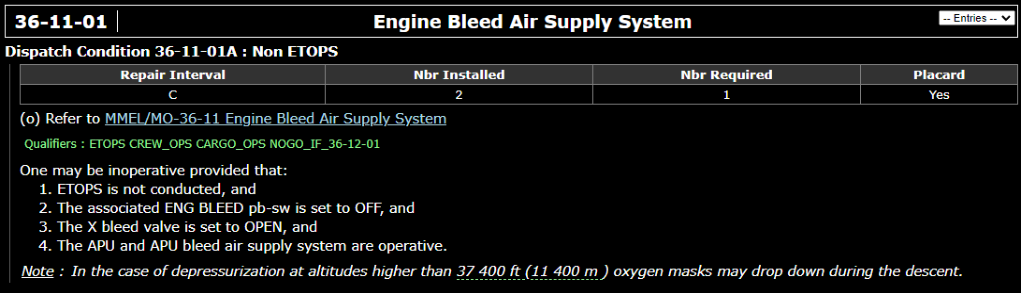
During the cruise phase at FL390, the AIR ENG 1+2 BLEED FAULT ECAM alert (fig.1) MEL item triggered. The flight crew followed the ECAM instructions and managed to reset the 36-11-01 Engine Bleed ENG 2 bleed system. 20 seconds later, the AIR ENG 1+2 BLEED FAULT ECAM alert Air System triggered again. The flight crew attempted to reset the ENG 2 bleed system but the reset was unsuccessful. The flight crew then declared a PAN PAN situation to ATC and requested to descend to FL100. The CAB PR EXCESS CAB ALT ECAM alert triggered. The flight crew put on their oxygen masks and performed an emergency descent. Passenger oxygen masks automatically deployed during the descent. At FL190, the flight crew started the APU and set APU BLEED to ON. The APU bleed remained ON until the end of the flight. At FL100, the flight crew again attempted a reset of the ENG 2 bleed system, which was successful. A decision to divert was taken and the aircraft climbed to FL170, then performed an approach and landed without further events.
Event Analysis
Section titled “Event Analysis”Significant operational impact
With the MEL applied for the inoperative ENG 1 bleed air supply system, the failure of the ENG 2 bleed air supply system during the flight led to the loss of cabin pressure at cruise altitude requiring an emergency descent and diversion. This had a notable operational impact, including the impression on the passengers who were aware of the sudden descent and observed the deployment of the oxygen masks in the cabin. An acceptable margin of safety Despite the significant operational impact, an acceptable margin of safety was maintained throughout this event thanks to the correct application of the MEL item dispatch conditions and operational procedures by the flight crew. The impacts of one inoperative engine bleed system, combined with a subsequent failure of the other engine bleed system, are described and addressed in the dispatch conditions and operational procedures of the MEL item. The condition of an
operative APU BLEED, and the likelihood of passenger oxygen masks deploying when at cruise altitude above 37 400 ft, are also described.
The dispatch conditions are defined following a 3-step safety methodology that is detailed in a previous Safety first article “A Recall on the Correct Use of the MEL” and which ensures that an acceptable level of safety is always maintained.
POSSIBLE BUT TEMPORARY SOLUTIONS TO FACE DISPATCH CHALLENGES
Section titled “POSSIBLE BUT TEMPORARY SOLUTIONS TO FACE DISPATCH CHALLENGES”Raise of Dispatch Challenges
Section titled “Raise of Dispatch Challenges”An increase of the operational pressure to fly is observed. In addition, various operational constraints such as supply chain disruption affecting parts availability or the lack of qualified maintenance personnel may make it difficult to repair or replace the equipment within the time frame allowed by the MEL. This leads to an increase of the number of aircraft dispatched with open MEL items and therefore an increased exposure to multiple failure situations as described in the case study.
In-service reports also show that the number of incorrectly applied MEL items is increasing.
The Safety first article “A Recall on the Correct Use of the MEL” describes how to use the MEL and gives recommendations on how to identify the correct MEL item associated with the failure.
MMEL/MEL Extension Management
Section titled “MMEL/MEL Extension Management”In limited cases, the initial MEL repair interval time can be extended to face the dispatch challenges described above.
One-time extension of an MEL
Section titled “One-time extension of an MEL”A one-time extension of standard repair intervals (B, C, D) is possible as defined by regulations (EASA Part-ORO.MLR.105(f), CS MMEL.135 and TCCA CASA 2022-02 for repair intervals B, C and D; FAA OpsSpecD095 for repair intervals B and C). Where applicable, this one-time extension is taken into account in the safety analysis of each MMEL item. An acceptable level of safety is therefore maintained for such cases. A dedicated process for the application of one-time extensions must be defined with the operator’s national airworthiness authority.
Operations outside MEL conditions but still within the MMEL
Section titled “Operations outside MEL conditions but still within the MMEL”The MEL defined by the operator for their aircraft is either as restrictive or more restrictive than the MMEL provided by the OEM for the aircraft type. An operator has the option to operate the aircraft outside the conditions of their MEL provided it complies with the equivalent conditions of the MMEL. An acceptable level of safety is maintained as the dispatch remains within the certified MMEL scope. It is however considered as a deviation from the operator’s MEL and formal approval must be given by their relevant national aviation authority each time this option is required.
In AOG situations
Section titled “In AOG situations”To avoid AOG situations, under exceptional circumstances, Airbus has developed a process called A pproved D eviation to O SD- M MEL (ADOM). It is a document issued by Airbus to support operators if they need to urgently dispatch an aircraft outside of the scope of the MMEL. For each ADOM, a safety analysis is performed following the same safety methodology as for the development of the MMEL items refined to the actual aircraft status and the planned mission to ensure that sufficient safety margins are maintained. Additional limitations can be required.
An ADOM is an EASA approved document and can be used only for deviation from the EASA MMEL. It cannot be applied for the FAA MMEL or the TCCA MMEL. For the FAA MMEL, extensions for intervals A and D and additional extensions can be granted on a case-by-case basis by the FAA according to FAA AC 120-125 and FAA Order 8900.1 Vol 4, Chap 4, Section 3, 4-688.
ADOM can be used:
-
to further extend the repair interval A or the other intervals B, C and D following the first extension, or
-
to dispatch the aircraft with a combination of open MEL items not permitted by MMEL , or
-
when the operational or maintenance procedure cannot be applied.
It is a document issued by Airbus on a case-by-case basis following analysis of the specific aircraft configuration and conditions. It is valid for a limited period of time and operators have to obtain authorisation from their relevant national aviation authority to apply the MEL deviation in accordance with the ADOM.
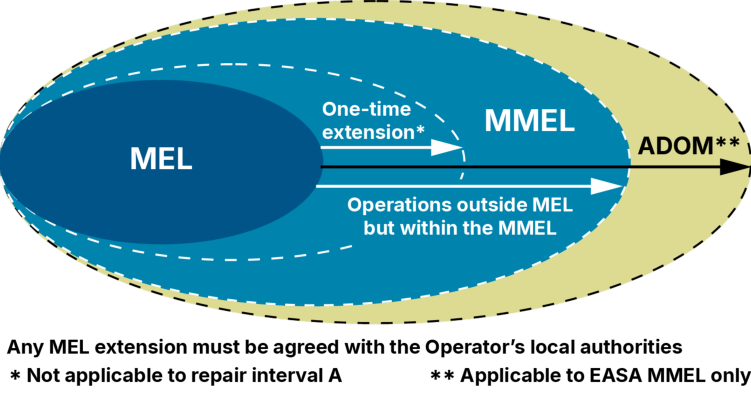
(fig.2) Possible MMEL/MEL extensions
The ADOM is only issued if the safety analysis demonstrates that an acceptable level of safety margin can still be maintained.
Increase of ADOM Requests
Section titled “Increase of ADOM Requests”The number of ADOM requests has increased significantly each year since 2021. One reason is the difficulty to obtain parts due to the post pandemic supply chain challenges. This can further delay the repair or replacement of the affected equipment, increasing the exposure to multiple failure situations as described in the case study above.
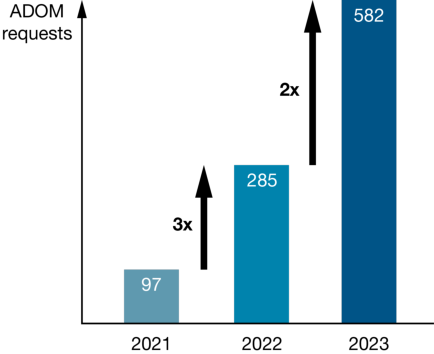
(fig.3) Evolution of the number of ADOM requests between 2021 and 2023
The ADOM has to be used on an exceptional basis.
BEST PRACTICES FOR SAFE DISPATCH
Section titled “BEST PRACTICES FOR SAFE DISPATCH”Dispatch with open MEL items requires specific attention from both flight crews and maintenance crews with dedicated tasks. In case of extended MEL items and multiple MEL items, those tasks can take more time, be more complex and have a significant impact on the crew’s workloads.
Best Practices for Flight Crews
Section titled “Best Practices for Flight Crews”Aircraft acceptance
Section titled “Aircraft acceptance”It is the responsibility of the flight crew to review all open MEL items, confirm that the associated dispatch conditions and limitations are taken into account, and are compatible with the flight and the crew workload. It is also necessary to confirm that any applicable maintenance procedures described in the MEL dispatch conditions have been performed and are recorded in the technical logbook. The flight crew have to also assess the consequences of the inoperative equipment in combination with other possible, or multiple, failures. The complexity of their tasks can increase with multiple open MEL items. The captain has the final decision to accept the aircraft or can refuse to depart if they conclude that the number of open MEL items is impacting too much on the flight crew workload during a flight or erodes the margin of safety.
Best Practices for Maintenance Crews
Section titled “Best Practices for Maintenance Crews”As part of the dispatch, the maintenance crew has to define an equipment repair or replacement strategy at the earliest opportunity and order the necessary parts as soon as possible. It is important to confirm the time limited MELs do not expire before the next confirmed maintenance opportunity. They should also take actions to prevent accumulation of multiple open MEL items, especially where they can directly impact the flight crew workload and increase the risk of multiple failure situations.
Extended MEL items and the number of open MEL items can increase the workload and the complexity of these monitoring actions of the maintenance crews.
It is important that both the maintenance crew, who are responsible to apply and close the MEL items, and the flight crew, who manage the dispatch conditions of the open MEL items during the flight, are aware of each other’s tasks. They can better assess the operational consequences of their decisions and find more appropriate solutions to reduce the risks associated with multiple open MEL items situations.
Contributors:
Section titled “Contributors:”Xavier BARRIOLA
Section titled “Xavier BARRIOLA”Incident/Accident Investigator
Aviation Safety
Olivier FERRAN
Section titled “Olivier FERRAN”MMEL Expert
Customer Support
Ian GOODWIN
Section titled “Ian GOODWIN”Safety Enhancements Expert
Aviation Safety
Dispatch of aircraft with MEL items is a common practice in operations. It enables the repair and replacement of inoperative equipment at a next maintenance opportunity within a defined timeframe. Each MEL item is assessed to ensure that an acceptable level of safety is always maintained when it is applied.
Certain situations, such as spares availability issues, may cause a delay in the repair or replacement of the inoperative equipment. Aviation authorities and Airbus have defined possibilities to extend the MEL time limit on a case-by case basis. These include operating outside the MEL conditions, but within the constraints of the MMEL, or requesting an ADOM, which is an approved document issued by Airbus to temporarily operate beyond the MMEL conditions. Both of these actions must be authorized by the operator’s own national aviation authority.
In-service reports show that the number of ADOM requests received by Airbus is increasing, as is the number of dispatches of aircraft with multiple open MEL items. This requires extra vigilance, especially to anticipate the potential consequences of multiple failure situations in flight. Communication and collaboration between the maintenance crew and the flight crew is essential to understand and to mitigate these risks together.
Safety first, 2024. Safety first is published by Airbus S.A.S. 1, rond point Maurice Bellonte - 31707 Blagnac Cedex/France.
Editor: Yannick Malinge, SVP Aviation Safety.
Editorial team: Guillaume Estragnat, Vanessa Sadi, Gwyneth Duggan, Javier Martinez Marina, Tim Roach.
Photos by Airbus.
来源: Airbus Safety First 网址: https://safetyfirst.airbus.com/closing-mel-items-why-sooner-is-better/ 发布日期: 2024-09-10 类别: 飞行运行、维修、ADOM、AOG、放行、故障、MEL、MMEL、多重故障、备件、系统 PDF: 原始 PDF
并非总是能够在下一航班前修复系统故障。最低设备清单允许在符合特定条件且在有限时间内,放行带有不工作设备或功能的飞机,同时保持可接受的安全水平。
当前在役数据显示,MEL 延期申请数量有所增加,表明携带多个未关闭 MEL 项目起飞的情况有所增多。即使按 MEL 放行始终保证可接受的安全水平,但这会增加发生多重故障的风险,以及随之而来的运营后果。
本文回顾了在最早时机修复 MEL 项目以降低多重故障暴露风险的重要性,并在确需 MEL 延期时提供了最佳实践,以保持尽可能高的安全裕度。
请在 safetyfirst.airbus.com 及 iOS 和 Android 版 Safety first 应用上查看本文最新版本。
一架 A330 飞机在 1 号发动机 MEL 项目 36-11-01A 发动机引气系统下以非 ETOPS 运行方式放行。起飞前,根据 MEL 项目的放行条件,将 ENG 1 BLEED 电门设置为 OFF,X BLEED 选择器设置为 OPEN,并确认 APU 和 APU BLEED 工作正常**(图 1)**。
在 FL390 巡航阶段,触发了 AIR ENG 1+2 BLEED FAULT ECAM 警告**(图 1)**。机组遵循 ECAM 指令,成功重置了 36-11-01 发动机引气系统中的 ENG 2 引气系统。20 秒后,AIR ENG 1+2 BLEED FAULT ECAM 警告再次触发。机组尝试重置 ENG 2 引气系统,但未成功。机组随后向 ATC 宣布 PAN PAN 情况,并请求下降至 FL100。随后触发了 CAB PR EXCESS CAB ALT ECAM 警告。机组戴上氧气面罩并执行紧急下降。在下降过程中,旅客氧气面罩自动释放。在 FL190,机组启动 APU 并将 APU BLEED 设置为 ON。APU 引气保持 ON 直至航班结束。在 FL100,机组再次尝试重置 ENG 2 引气系统并获得成功。随后决定改航,飞机爬升至 FL170,然后进近并着陆,期间无进一步异常。
重大运营影响
由于对 1 号发动机引气系统不工作应用了 MEL,该引气系统在空中失效导致在巡航高度丧失客舱压力,需要紧急下降并改航。这产生了显著的运营影响,包括给乘客留下的不良印象——他们意识到突然下降并目睹了客舱内氧气面罩的释放。可接受的安全裕度尽管运营影响重大,但整个事件过程中,由于机组正确应用了 MEL 项目的放行条件和运行程序,安全裕度得以保持。MEL 项目中已描述并解决了单一发动机引气系统不工作与另一发动机引气系统随后失效相结合的影响。APU BLEED 工作正常的条件,以及在巡航高度高于 37,400 ft 时旅客氧气面罩可能释放的概率,也已加以描述。
放行条件按照三步安全方法论制定,该方法论在之前的 Safety First 文章”正确使用 MEL 的再回顾”中有详细说明,并确保始终维持可接受的安全水平。
应对放行挑战的可行但临时解决方案
Section titled “应对放行挑战的可行但临时解决方案”放行挑战的增加
Section titled “放行挑战的增加”观察到运行压力增加的趋势。此外,各种运行限制,如影响备件供应的供应链中断,或缺乏合格维修人员,可能难以在 MEL 规定的时间内修复或更换设备。这导致携带未关闭 MEL 项目放行的飞机数量增加,因此如案例研究所述,增加了暴露于多重故障情况的概率。
在役报告还显示,应用不当的 MEL 项目数量正在增加。
Safety First 文章”正确使用 MEL 的再回顾”描述了如何使用 MEL,并就如何识别与故障相关的正确 MEL 项目给出了建议。
MMEL/MEL 延期管理
Section titled “MMEL/MEL 延期管理”在有限情况下,可以延长初始 MEL 修复间隔时间以应对上述放行挑战。
MEL 一次性延期
Section titled “MEL 一次性延期”根据法规规定,可以对标准修复间隔(B、C、D)进行一次性延期(EASA Part-ORO.MLR.105(f)、CS MMEL.135 及 TCCA CASA 2022-02 针对 B、C 和 D 类修复间隔;FAA OpsSpec D095 针对 B 和 C 类修复间隔)。在适用情况下,此一次性延期已纳入每个 MMEL 项目的安全分析中。因此,在此类情况下仍可维持可接受的安全水平。必须与运营人的国家航空当局商定一次性延期申请的专门程序。
运营超出 MEL 条件但仍在 MMEL 范围内
Section titled “运营超出 MEL 条件但仍在 MMEL 范围内”运营商为其飞机制定的 MEL 要么与该机型 OEM 提供的 MMEL 同样严格,要么更为严格。运营商可以选择在不符合其 MEL 条件的情况下运营飞机,但须符合 MMEL 的等效条件。由于放行仍在其认证的 MMEL 范围内,因此仍可维持可接受的安全水平。但这仍被视为偏离运营商自身的 MEL,每次需要此选项时都必须获得相关国家航空当局的正式批准。
在 AOG 情况下
Section titled “在 AOG 情况下”为避免 AOG 情况,空客在特殊情况下开发了一个流程,称为Approved Deviation to OSD-MMEL(ADOM)。这是空客发布的文件,用于在运营商需要紧急放行超出 MMEL 范围的飞机时提供支持。对于每个 ADOM,都会按照与 MMEL 项目开发相同的安全方法进行安全分析,并根据实际飞机状态和计划任务进行调整,以确保维持足够的安全裕度。可能需要额外的限制条件。
ADOM 是一份经 EASA 批准的文件,仅可用于偏离 EASA MMEL。 该文件不适用于 FAA MMEL 或 TCCA MMEL。对于 FAA MMEL,可根据 FAA AC 120-125 和 FAA Order 8900.1 Vol 4, Chap 4, Section 3, 4-688,由 FAA 按个案批准间隔 A 和 D 的延长以及其他额外延期。
ADOM 可用于:
- 在首次延期后进一步延长维修间隔 A 或其他间隔 B、C 和 D,或
- 使用超出 MMEL 允许范围的开放 MEL 项目组合放行飞机,或
- 当无法执行运营或维修程序时
这是空客在分析特定飞机构型和条件后按个案签发的文件。该文件在有限期限内有效,运营商必须获得相关国家航空当局的授权,才能按照 ADOM 的规定应用 MEL 偏差。
(图 2) 可能的 MMEL/MEL 延期
只有当安全分析表明仍可维持可接受的安全裕度时,才会签发 ADOM。
ADOM 请求的增加
Section titled “ADOM 请求的增加”自 2021 年以来,ADOM 请求数量每年显著增加。原因之一是后疫情时代供应链挑战导致零部件获取困难。这可能进一步延迟受影响设备的维修或更换,增加上述案例研究中描述的多种失效情况的暴露风险。
(图 3) 2021 至 2023 年间 ADOM 请求数量变化
ADOM 必须仅在特殊情况下使用。
安全放行的最佳实践
Section titled “安全放行的最佳实践”使用开放 MEL 项目放行需要飞行机组和维修机组给予特别关注,并执行专门的任务。对于延长的 MEL 项目和多个 MEL 项目,这些任务可能耗时更长、更加复杂,并对机组工作负荷产生重大影响。
飞行机组最佳实践
Section titled “飞行机组最佳实践”飞行机组有责任审查所有开放的 MEL 项目,确认已考虑相关的放行条件和限制,并确认其与飞行和机组工作负荷兼容。同时有必要确认 MEL 放行条件中描述的任何适用维修程序已完成,并记录在技术记录本中。飞行机组还必须评估失效设备与其他可能或多种失效组合的后果。随着开放的 MEL 项目增多,其任务的复杂性可能增加。机长有权最终决定是否接收飞机,如果认为开放的 MEL 项目数量对飞行期间飞行机组工作负荷影响过大或削弱了安全裕度,则可以拒绝起飞。
维修机组最佳实践
Section titled “维修机组最佳实践”作为放行的一部分,维修机组必须在最早时机确定设备维修或更换策略,并尽快订购必要的零部件。重要的是确认有时间限制的 MEL 项目在下一个确认的维修时机之前不会到期。他们还应采取措施防止多个开放 MEL 项目的累积,特别是当这些项目可能直接影响飞行机组工作负荷并增加多种失效情况风险时。
延长的 MEL 项目和开放的 MEL 项目数量可能增加维修机组监控工作负荷和复杂性。
维修机组(负责执行和关闭 MEL 项目)和飞行机组(在飞行中管理开放 MEL 项目的放行条件)双方都必须了解彼此的任务。他们可以更好地评估其决策的运营后果,并找到更合适的解决方案来降低多种开放 MEL 项目情况的相关风险。
Xavier BARRIOLA
Section titled “Xavier BARRIOLA”事故/事故调查员
航空安全
Olivier FERRAN
Section titled “Olivier FERRAN”MMEL 专家
客户支持
Ian GOODWIN
Section titled “Ian GOODWIN”安全增强专家
航空安全
使用 MEL 项目放行飞机是运营中的常见做法。它使得在规定时间内于下一次维修时机对不工作设备进行修理或更换。每个 MEL 项目均经过评估,以确保在应用时始终保持可接受的安全水平。
某些情况(如航材可用性问题)可能导致延迟对不工作设备进行修理或更换。航空当局和空客已定义了逐例延长 MEL 时限的可能性,包括在 MEL 条件之外但在 MMEL 限制范围内运行,或申请 ADOM(经批准的运营手册偏差),这是空客签发的批准文件,允许在 MMEL 条件之外临时运行。这两种操作均须经运营商所在国航空当局授权。
现场报告显示,空客收到的 ADOM 申请数量不断增加,同时带多个未关闭 MEL 项目放行的飞机数量也在增加。这需要格外警惕,特别是在飞行中预测多重失效情况潜在后果方面。维修人员与飞行人员之间的沟通与协作对于共同理解和降低这些风险至关重要。
Safety first,2024 年。Safety first 由空中客车公司出版。1, rond point Maurice Bellonte - 31707 Blagnac Cedex/法国。
编辑:Yannick Malinge,航空安全高级副总裁。
编辑团队:Guillaume Estragnat、Vanessa Sadi、Gwyneth Duggan、Javier Martinez Marina、Tim Roach。
照片由空客提供。