Protecting Aircraft and Passengers from Cargo Fires
Source: Airbus Safety First URL: https://safetyfirst.airbus.com/protecting-aircraft-and-passengers-from-cargo-fires/ Published: 2018-01-29 Magazine Issue: 2018-01 Category: Ground Ops, Maintenance, Cargo, Cargo panels, decompression panels, lining, ULD PDF: Original PDF
Aircraft certifi cation requirements for cargo compartment fi re protection have evolved in response to a number of tragic events. Today’s design standard for lower deck cargo holds relies on the fl ame-proof and air-tight properties of the compartment liner. Inspecting the liner and making repairs when needed is important to keep it in good condition.
CARGO COMPARTMENT FIRES & THE EVOLUTION OF DESIGN STANDARDS
Section titled “CARGO COMPARTMENT FIRES & THE EVOLUTION OF DESIGN STANDARDS”Origins of the fi re containment principle
Section titled “Origins of the fi re containment principle”Regulations providing design criteria for cargo compartments in commercial aircraft were introduced in 1946, prior to the introduction of the fi rst jet aircraft into commercial aviation. At this time, the criteria considered that cargo compartments would either be accessible to the crew and a fi re would be manually extinguished, or inaccessible and equipped with fi re detection and extinguishing systems.
Changes to regulations introduced in 1952 allowed for new types of inaccessible cargo holds called ‘Class D’ compartments. Designs were permitted to rely purely on fi re containment principles, by having linings designed to be capable of restricting the supply of oxygen into the compartment, without needing any fi re detection and suppression systems.
In 1952 fi re containment designs relying on restricting oxygen supply became permitted
With the introduction of larger passenger jets, the size of Class D compartments grew beyond that for which the 1952 regulations had originally been intended. Larger compartments introduced new risks, including larger quantities of combustible material, and the presence of a larger volume of oxygen.
The combination of these two factors created the possibility that a fi re starting in such a hold could burn for suffi cient time or with suffi cient strength that it would penetrate the cargo hold linings. Penetration of the linings would of course lead to availability of an increased oxygen supply, and an uncontrollable fi re.
In-service events
Section titled “In-service events”A number of uncontrolled fi res have occurred in cargo compartments, which contributed to an evolution of airworthiness regulations. The FAA’s ‘Lessons Learnt from Civil Aviation’ website identifi es two tragic fatal accidents which were pivotal in driving this evolution.
In 1980 in Riyadh, shortly after take-off of a second generation wide-body aircraft, an uncontrollable fi re occurred in the rear cargo hold. Tragically, all 301 passengers and crew died in the event.
In 1980 an uncontrollable fi re occurred in the rear cargo hold of a second generation widebody aircraft
The accident report of the Saudi Presidency of Civil Aviation included the conclusion that “Investigative evidence and testing indicates that the C-3, Class D compartment of the L-1011 did not meet the intent of the FAR 25.857 (d) and that the FAR is inadequate for purpose”.
In 1996 in the Everglades near Miami, a second generation single-aisle aircraft experienced an uncontrolled fire in its forward cargo compartment shortly after takeoff, leading to the death of all 110 passengers and crew.
In 1996, a second generation single-aisle crashed after takeoff with the death of 110 passengers & crew
The accident investigation report written by the US NTSB identified the following findings related to the design standard of the aircraft type:
“[…] a smoke/fire warning device would have more quickly alerted the pilots to the fire and would have allowed the more time to land the airplane”
“If the plane had been equipped with a fire suppression system, it might have suppressed the spread of the fire […] and it would have delayed the spread of the fire, and in conjunction with an early warning, it would likely have provided time to land the airplane safely.”
Hence, these and similar accidents highlighted the need to update Part 25 airworthiness regulations regarding the means of fire protection in cargo holds, including through design of the compartment lining as well as by detection and suppression systems.
Changes to regulations
Section titled “Changes to regulations”New legislation established more stringent flame resistance standards for liner materials
Following the accident in Riyadh, amendment 25-60 to Part 25 airworthiness regulations was made effective in 1986 by the FAA. This amendment established more stringent flame resistance standards for compartment linings, to take account of the findings of a series of full-scale tests by the FAA to investigate the capability of different liner materials.
A retrofit activity was mandated to some of the existing fleets of the time in order to ensure cargo compartment panel linings were upgraded. This completion date of this retrofit was established by the legislation as March 1991.
It was subsequent to the Everglades accident in 1996 that the limitations of the principle of relying purely on containment by oxygen starvation were acknowledged. In particular it was recognised that new risks needed to be considered, including potential explosions of consumer aerosol products which could damage the integrity of cargo compartment linings.
Fire detection and suppression systems became mandatory
Recognising that under such circumstances, the only way to contain a fire would be through active fire detection and suppression, in 1998 the FAA introduced new legislation through Amendment 25-93 to 14 CFR 25.855, which removed the Class D cargo compartment category.
This meant that all new designs of aircraft, as well as existing aircraft in-service, were to be equipped to the standards of Class C compartments, or Class E compartments for freighter aircraft. In particular, fire detection system capable of alerting the flight crew within 1 minute of the fire starting became necessary, together with Halon gas fire suppression systems. The limit date for retrofits of existing fleets was set at March 2001.
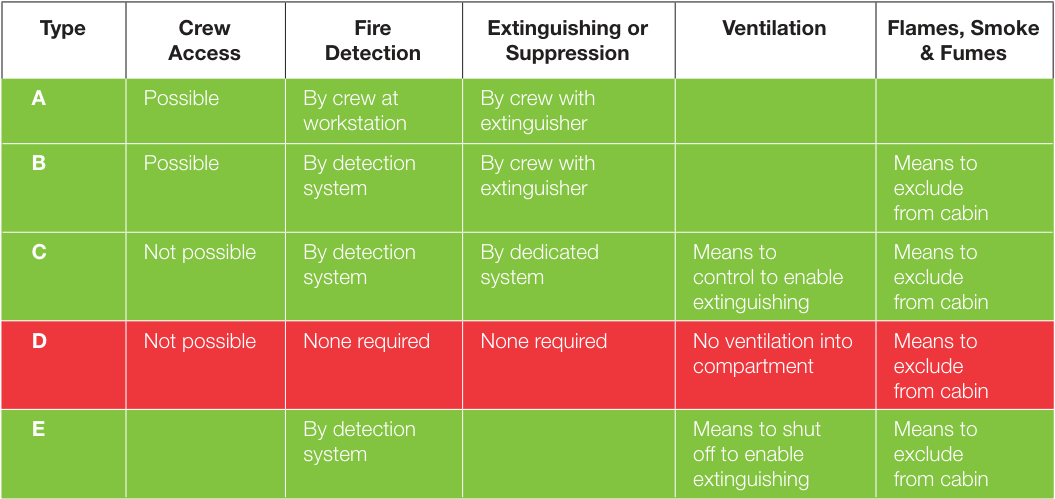
Cargo Compartment Types
Post 25-93, types A, B, C & E remain Post 25-93, type D compartments no in use in commercial aircraft longer exist in 25.855
CURRENT DESIGNS OF LOWER DECK CARGO COMPARTMENTS
Section titled “CURRENT DESIGNS OF LOWER DECK CARGO COMPARTMENTS”Following the tragic events described earlier in this article, the design standard of lower deck cargo compartments was revised across the air transport industry, with Class C type compartments and cargo compartment panel fireproofing improvements being mandated.
This industry wide action significantly improved the fire protection level of commercial aircraft through the equipping of the commercial fleet with key features:
Cargo compartments must be air-tight and resistant to burning
- Air-tight & fire-proof cargo holds • Cargo fire detection systems • Cargo fire suppression systems
These three features are all necessary and must all work together in order to ensure that the aircraft and its occupants is protected from a cargo fire.
Making the cargo hold air-tight
Section titled “Making the cargo hold air-tight”The volume of lower deck cargo holds on Airbus aircraft varies significantly depending upon the aircraft type and hold, but can range from as low as 7.0m³ (250ft³) on an A318 to 143m³ (5050ft³) on an A340-600. Enclosing such voluminous spaces obviously requires the use of many components.
- 1 Ceiling panels
2 Decompression panels
Section titled “2 Decompression panels”- 3 Vertical sidewall panels
4 Sloping sidewall panels
Section titled “4 Sloping sidewall panels”- 5 Floor panels
6
- Partition
7 Door
Section titled “7 Door”The air-tight lining of the cargo compartment is created by composite panels together with their fasteners, secondary structure and the cargo door.
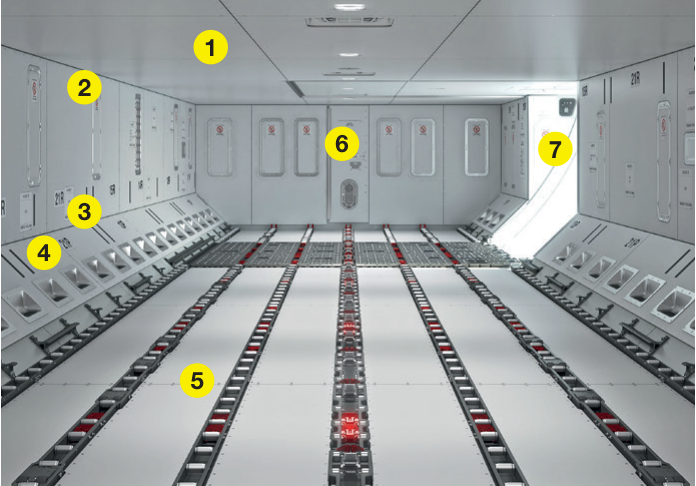
Together with their fasteners, secondary structure, and the cargo door, these panels create the liner of the cargo hold lining. This liner is required to provide the two fire protection functions of air-tightness and fire-proofing.
Air-tightness limits the available oxygen to any fire occurring within the cargo hold compartment. It is a key safety measure which allows to suffocate a fire, as well as to ensure that fire suppression systems have the required effect by creating an enclosed space within which the Halon gas can act.
Air-tight seals between the panels and the structure are achieved by the use of self-adhesive elastomer foam tapes applied to the rear of the panels. The seal is made when these tapes are compressed during tightening of the fasteners.
Fire-proofing the cargo hold
Section titled “Fire-proofing the cargo hold”The second fire protection function of the liners and panels is to withstand burning. This function ensures that the passenger cabin is kept free of fire, as well as any hazardous smoke and gases. Clearly, in the case of any fire, flame resistance of the linings is essential to maintaining air-tightness.
Panels and all materials used in construction of the cargo compartment liner are required by aircraft certification regulations CS-25.855 to meet flame resistance properties are defined by airworthiness regulations.
The process to demonstrate compliance with this regulation is detailed and rigorous, involving specific test equipment and the exposure of sets of production standard panels to flames at a temperature of 927°C / 1700°F.
Detecting & suppressing a fire
Section titled “Detecting & suppressing a fire”Fire detection systems are designed to alert flight crew on the cockpit within 1 minute of a fire starting. Based on the information provided by the detection warnings, flight crew initiate the suppression of any fire by discharge of Halon gas into the affected cargo compartments.
Halon is a very effective suppression agent which operates by chemically reacting with the radicals generated by a fire, to inhibit the reaction.
To achieve the extinguishing effect, sufficient Halon needs to be released to achieve a volumetric concentration of 5% of the compartment air as a first shot, for a fire knock-down effect. Following this, a concentration of 3% must be continuously maintained for the rest of flight. With this approach, lower deck cargo compartment fires can be suppressed for up to 360 minutes on wide-body aircraft.
Any damage or mis-installation of the cargo compartment lining can degrade the performance of the fire suppression system
Nevertheless, maintaining the concentration of Halon is crucial to the effectiveness of the system, and therefore it is essential that the cargo compartment remains air-tight. Any damage or mis-installation of the cargo compartment lining can degrade the performance of the fire suppression system, and therefore has the potential to make a key defence against on-board fires ineffective.
Certification of the A350-1000 fire suppression system
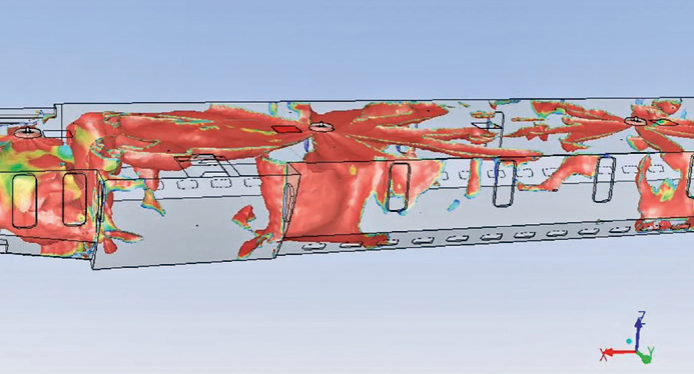
Section titled “Certification of the A350-1000 fire suppression system”To comply with the airworthiness authorities’ certification requirements, aircraft manufacturers must prove that a new aircraft type’s fire suppression system can maintain the required amount of Halon present in a cargo compartment over time. Traditionally, this activity has only been possible by flight test, usually requiring five individual flights.
For the certification of the A350-1000, Airbus has taken advantage of the successful flight test campaign performed for the A350-900 and developed a Computational Fluid Dynamic (CFD) model of the cargo hold together with its Halon release system. Both EASA and the FAA have accepted this model as an acceptable means of compliance. This significant advancement will enable Airbus to perform more complex analyses in the support of Safety objectives.
CFD simulation of halon discharge into the aft cargo hold of the A350-1000
MAKING SURE THE CARGO COMPARTMENT IS IN GOOD CONDITION
Section titled “MAKING SURE THE CARGO COMPARTMENT IS IN GOOD CONDITION”Cargo unloading and loading operations are a crucial part of the often time constrained ground handling operations, so it hardly needs to be mentioned that the cargo compartment can experience rough treatment. Whilst cargo compartment liners are designed to be tolerant of such an environment, damages do occur.
To make sure that the crucial fire protection function of the cargo compartment lining is assured, regular maintenance inspections are required by the Maintenance Planning Document. Additionally, the IATA Ground Operations Manual specifies that a cargo hold inspection should be completed after each unloading operation.
Scheduled inspections
Section titled “Scheduled inspections”The Maintenance Planning Document (MPD) of all Airbus aircraft specifies a regular visual inspection of each cargo hold. The maintenance procedures associated with the MPD tasks specify a general visual inspection of the entire compartment, including all types of panels identified in figure 1, to identify any damage or deformation, or any panels which are in the wrong position.
Other elements which must be inspected include panel seals, fastener assemblies, and the position of decompression panels.
| Program | MPD Revision | MPD Task Number | Interval |
|---|
Inspections during cargo loading operations
Section titled “Inspections during cargo loading operations”KEYPOIN T
Section titled “KEYPOIN T”The IATA Ground Operations Manual (GOM) states that ground crew must complete a final check of all holds to inspect for damage
On a daily basis, it is clear that the people who will have the most opportunity to identify any damages or other issues with the cargo hold linings are ground operatives.
There are no mandatory inspection requirements for ground operatives to complete during cargo loading. However, ground operations procedures such as those defined by IATA in the Ground Operations Manual (IGOM) provide a reference for recommended safe practices during cargo loading operations, and in practice also inform the expectations of local authorities.
IATA IGOM section 4.11 ‘Aircraft Loading’ contains a dedicated section 4.11.5 ‘Cargo Hold Inspections’, with the following key recommendations in relation to damage to the cargo holds:
-
When an offload is completed, a final check of ALL cargo holds must be conducted to inspect each cargo hold for damage to the compartment […]
-
If any damage is found to the compartment […] it must be immediately reported to a supervisor, the flight crew, and/or a company representative as required by the operating airline
-
Any damage to the structure or linings of containerised or bulk holds may lead to specific loading limitations. Therefore, any damage must be reported. The load controller shall be informed accordingly.
In addition to section 4.11.5, cargo hold inspections are also specified in section 6 ‘Airside Safety Operational Oversight’. This section of the GOM deals with the activities which are expected to be performed by trained and qualified supervision personnel of airlines and their subcontractors.
KEYPOINT
Section titled “KEYPOINT”The IGOM includes a checklist item for turnaround supervision staff, to ‘Ensure all cargo holds offloaded according to LIR (Load Instruction report) and inspected for damage’.
Turnaround Coordination/Supervision Requirements are defined in section 6.3 by the use of a checklist table, the primary purpose of which is to prevent unsafe acts. Checklist item 11 states ‘Ensure all cargo holds offloaded according to LIR (Load Inspection Report) and inspected for damage’.
TYPICAL REPORTS OF CARGO COMPARTMENT DAMAGE AND THEIR CAUSES
Section titled “TYPICAL REPORTS OF CARGO COMPARTMENT DAMAGE AND THEIR CAUSES”Typical abnormalities found during cargo compartment inspections are identifiable from reports sent to Airbus by operator airlines. A study of reports over the period 2015-2017 reveals that types of abnormalities are generally quite consistent according to their source.
Damage to sidewall panels, ceiling panels or cargo doors from cargo operations
Section titled “Damage to sidewall panels, ceiling panels or cargo doors from cargo operations”The majority of damage to cargo compartments are caused during cargo loading or unloading operations. Reports of such damage total around 65% of reports to Airbus, and include cases of damage to vertical or sloping sidewall panels, ceiling panels or doors.
About 65% of damages identified on widebody aircraft are related to the use of out of contour cargo containers.
Typical damage identified on widebody aircraft types are related to out of contour cargo containers or pallets impacting and/or scratching the sidewalls, with ceilings being damaged less frequently. Damage to the cargo door linings are also typically caused by impact with out-of-contour containers, and often result in cracking of the panel around fixation holes upon door closure.
Additionally, poor maintenance of containers can make them more susceptible to warping of the contour when under flight loads, leading to damage of sidewalls and doors.
On A320 Family aircraft, both ceilings and sidewalls can be damaged during bulk loading operations. This damage is usually due to abnormal impacts from bags and suitcases under manual handling, and typically results in delamination or puncturing of the top layer of the panels, or crushing of the honeycomb core.

CARGO LININGS PROTECT AGAINST FIRE
Section titled “CARGO LININGS PROTECT AGAINST FIRE”Keeping aircraft cargo linings in good condition is key to ensuring aircraft are protected from cargo hold fi res
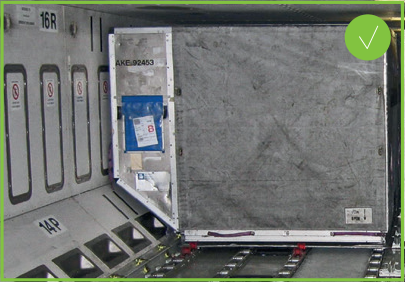
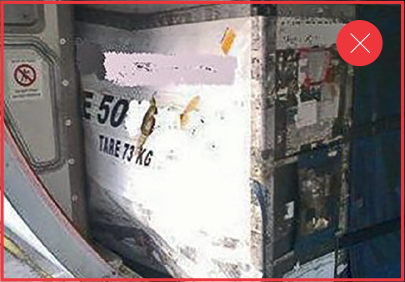
Don’t load out of contour ULDs (containers or pallets)
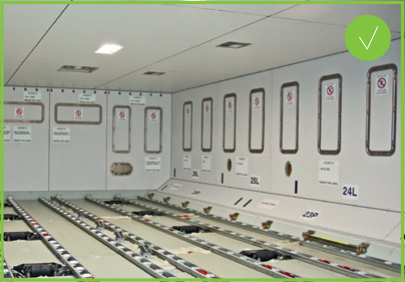
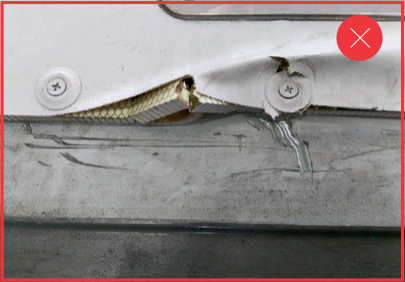
Report any damage to the lining
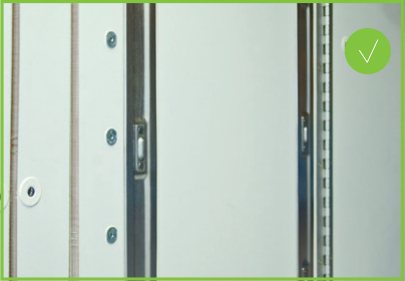
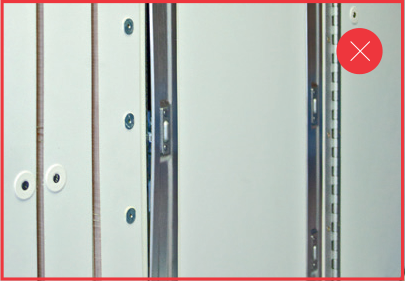
Check decompression panels and catches are in the correct position
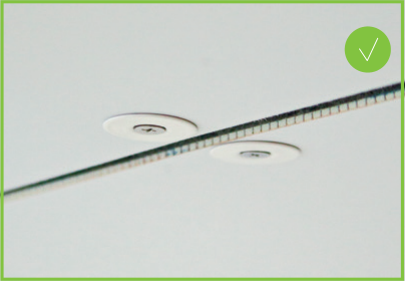
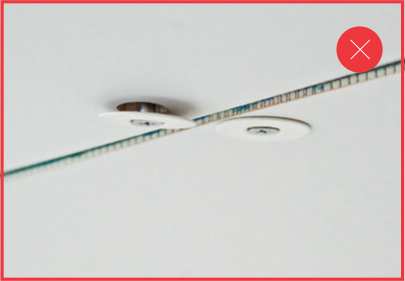
Ensure fasteners are present, tightened, and fl at on the panel
Damage to decompression panels when incorrectly used as access panels
Section titled “Damage to decompression panels when incorrectly used as access panels”Damage to decompression panels comprise about 25% of reports to Airbus about damage to the cargo compartment. Whilst some of these reports are attributed to damage caused during cargo loading operations, the majority are attributed to the use of decompression panels as access panels during aircraft maintenance.
Typical damage is found around at the edge of the cut-out for the decompression panel (e.g. on the upper assembly, where the decompression panels attaches to the vertical sidewall).These reports are often due to a removal and installation of the decompression panel by pushing on it, without properly unlocking the catch. Other findings include missing or dislodged panels, or incorrectly latched panels.
About 25% of reports to Airbus of lining damage are due to incorrect use of decompression panels as access panels
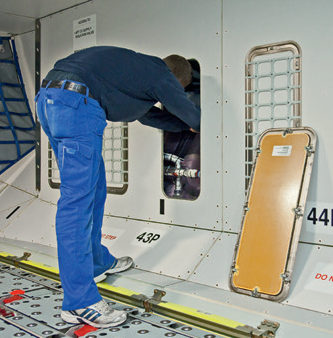
Decompression panels are clearly identified with placards mentioning ‘DO NOT PUSH’ and ‘DO NOT REMOVE’. In case any panel is found partially or totally dislodged, it must be reinstalled as per AMM procedures in order to avoid additional damage. These require removal of the sidewall panel upper assembly for proper completion.
Loose or missing panel fasteners
Section titled “Loose or missing panel fasteners”All lower deck cargo compartment lining panels are attached to the structure and/or systems by a quick release fastening system (fasteners). About 10% of reports of damages to the cargo hold are related to either missing, or incorrectly installed fasteners. The reports principally impact the ceiling panels.
Investigations into these reports allowed Airbus to identify clear recommendations for fastener tightening and cargo lining installation. The appropriate torque value to be applied when tightening a fastener is between 0.055 and 0.060 m.daN (4.87 and 5.31 lbf.in).
About 10% of reports of damage to the cargo hold are about missing or incorrectly installed fasteners
KEYPOINT
Section titled “KEYPOINT”The correct torque to be applied when tightening a fastener is between 0.055 and 0.060 m.daN (4.87 and 5.31 lbf.in)
Cargo Hold Visual Inspection tasks
Section titled “Cargo Hold Visual Inspection tasks”The number and location of missing fasteners which are permitted is contained within the relevant Cargo Hold Visual Inspection tasks of the maintenance documentation.
A300/A310:
Section titled “A300/A310:”AMM 25-50-00 PB 601 A320 Family: AMM 25-50-00-200-002-A
A330/A340 (fwd): AMM 25-52-00-210-801-A
A330/A340 (aft): AMM 25-53-00-210-801-A A330/A340 (bulk): AMM 25-54-00-210-801-A
A350 XWB:
Section titled “A350 XWB:”MP 50-13-XX-00001-310A-A A380 (fwd): AMM 50-13-00-210-801-A
A380 (aft): AMM 50-14-00-210-801-A A380 (bulk): AMM 50-15-00-210-801-A
ACTIONS TO TAKE WHEN ANY LINING DAMAGE IS FOUND
Section titled “ACTIONS TO TAKE WHEN ANY LINING DAMAGE IS FOUND”Regulations for fl ight with damaged cargo hold linings are stringent, since any failure of the air-tight and/or fl ame-proof features of the cargo lining can lead to an uncontrolled fi re on board.
For this reason, operational constraints can be triggered when any damages are found to the cargo lining, particularly fl ying with the cargo hold empty under MMEL.
Once any damage has been identifi ed and alerted to the operator, it is the responsibility of maintenance staff to classify the damage and initiate the appropriate corrective actions. The maintenance manuals contain the appropriate procedures for visual inspection, damage classifi cation, and general repair of panels.
Abnormalities which are not considered as damage
Section titled “Abnormalities which are not considered as damage”Small dents to the skin of the lining panels are not considered as damage as long as the upper skin is not damaged, and there is no visual debonding of the upper skin from the panel core.
Additionally, a small number of missing fasteners for ceiling, sidewall and partition linings (but not decompression panels) are often considered temporarily acceptable, as per limits defi ned in the Cargo Hold Visual Inspection tasks. Pending replacement of the fastener within the specifi ed time period, the holes left by the missing fasteners must be sealed in line with the maintenance procedures.
Damages for which repairs can be scheduled
Section titled “Damages for which repairs can be scheduled”On A320, A330/A340, and A380 Families, when damage to ceiling, sidewall or partition linings are within the damage limits defi ned in the AMM Repair/ Protection tasks, a limited number of small damage affecting the upper skin only, can be scheduled to be completed rather than be completed immediately. The dimensional and time limits of these small ‘not-through’ damages are also listed in the AMM Repair/Protection tasks.
Similar repair scheduling allowances exist for door linings, as long as the damage is to edge of the lining only, and within dimensional and time limits specifi ed in the Cargo Door Lining General Repair tasks.
Repair/ Protection tasks Ceiling, sidewall linings
Section titled “Repair/ Protection tasks Ceiling, sidewall linings”The dimensional limits which apply for assessment of repairs to damage of ceiling and sidewall linings can be found in the procedures listed below
A300/A310:
Section titled “A300/A310:”Damages requiring immediate repairs
Section titled “Damages requiring immediate repairs”Protection of the aircraft and its passengers from fi re means maintaining in good condition, the components which assure the air-tight and fi re-proof properties required by aircraft certification. When these components are damaged, immediate repairs are therefore often required.
Damages to ceiling, sidewall or partition linings in the following categories must be rectifi ed before fl ight, either with a panel repair or with a replacement panel:
- Damage to the edge of panel
AMM 25-00-00 PB 801 A320 Family: AMM 25-50-00 PB 801 A330/A340: AMM 25-50-00 PB 801 A350:
MP 50-13-XX-0M001-685A-A A380: AMM 50-10-00 PB 801
-
Damage which goes through both faces of a panel
-
Not-through damage, larger than the limited allowances defined in AMM Repair/Protection tasks for repairs which can be scheduled (see previous section)
Since door linings are not made of honeycomb composite materials, the conditions for immediate repair or replacement are different than those above. The relevant assessment conditions can be found in the Cargo Door Lining General Repair tasks.
Repair/ Protection tasks Cargo door linings
Section titled “Repair/ Protection tasks Cargo door linings”The dimensional limits which apply for assessment of repairs to damage of cargo door linings can be found in the procedures listed below
If repairs cannot be made immediately
Section titled “If repairs cannot be made immediately”A300/A310:
Section titled “A300/A310:”If panel repair or replacement cannot be completed immediately, the aircraft can be dispatched under MMEL with the relevant cargo hold empty, or not containing fl ammable or combustible materials. If a fl y-away kit box is present, the operator must ensure that it doesn’t contain fl ammable or combustible materials.
AMM 52-30-13 PB 801 A320 Family: AMM 52-31-13 PB 801 A330/A340 (fwd): AMM 52-31-15-300 PB 801 A330/A340 (aft): AMM 52-32-15-300 PB 801 A330/A340 (bulk): AMM 52-33-15-300 PB 801 A350:
MP 50-13-XX-0M001-685A-A A380 (fwd): AMM 52-31-15 PB 801 A380 (aft): AMM 52-32-15 PB 801 A380 (bulk): AMM 52-33-15 PB 801
CONTRIBUTORS:
Section titled “CONTRIBUTORS:”Juergen NEUMANN Ground Handling Expert Engineering
Dr. Konstantin KALLERGIS Senior Fire Protection Expert Engineering
Dr. Andre FREILING Fire Protection Expert Engineering
Susanne KIRCHNER Maintenance Engineer Engineering
Andreas BARTH
Section titled “Andreas BARTH”HO Freight and Cargo Definition Programmes
Dominique GRISEL Cargo Definition Engineer Programmes
Ioanna KOURANTI
Section titled “Ioanna KOURANTI”Operations Safety Advisor Customer Services
Today’s design standard for cargo compartment fire protection is encoded in airworthiness regulations, having evolved to take into account Safety lessons learnt following a number of tragic events.
The key features of cargo hold design that today protect passengers and aircraft from a cargo hold fire are fire detection and suppression systems, combined with an air-tight and fire-proof cargo compartment lining. A cargo compartment lining comprises not only the various composite panels of the ceiling, sidewall, floor, and partition, but the panel fasteners, and the cargo door lining.
Keeping the cargo compartment lining in good condition is an important activity for safety. In addition to regular scheduled checks of the lining, checks should also be made at each aircraft turnaround by ground operatives.
The largest cause of damage to the lining is the use of out-of-contour or poorly maintained cargo containers. Damage on decompression panels is also reported from the incorrect use of these panels as access panels during aircraft maintenance activities.
Any failure of the air-tight and fire-proof features of the cargo lining can lead to an uncontrolled fire on-board. For this reason, operational restrictions can be triggered when any damages to the cargo lining are identified, including flying with the cargo hold empty, or not containing flammable or combustible materials, under MMEL.
Cyril MONTOYA Safety Enhancement Manager Customer Services
Yannick DUMOLLARD MMEL Expert Flight Operations Support
Nicolas DENEVE
Section titled “Nicolas DENEVE”Cargo Product Leader Customer Services
Safety fi rst
Section titled “Safety fi rst”Safety fi rst, #25 January, 2018. Safety fi rst is published by Airbus S.A.S. - 1, rond point Maurice Bellonte - 31707 Blagnac Cedex/France. Publisher and Editor: Yannick Malinge, Chief Product Safety Offi cer. Concept Design by Airbus Multi Media Support 20172357. Reference: X00D16031905 Issue 25. Photos by Airbus, A. Tchaikovski, S. Ramadier, P. Masclet, Lindner Fotografi e, P. Pigeyre, JB. Accariez, A. Doumenjou. Computer renderings by Fixion.
来源: Airbus Safety First 网址: https://safetyfirst.airbus.com/protecting-aircraft-and-passengers-from-cargo-fires/ 发布日期: 2018-01-29 杂志期号: 2018-01 类别: 地面操作、维修、货物、货舱壁板、减压面板、衬板、集装箱
针对多起悲惨事故,飞机型号合格证对货舱防火的要求也在不断发展。如今下层货舱的设计标准依赖于舱室衬板的阻燃和气密性能。检查衬板并在需要时进行维修,对于保持其良好状态至关重要。
货舱火灾与设计标准的发展
Section titled “货舱火灾与设计标准的发展”防火隔离原则的起源
Section titled “防火隔离原则的起源”1946 年,针对商用飞机货舱的设计标准法规正式出台,早于喷气式飞机投入商业运营。当时的考虑是:货舱要么可供机组人员进入并人工灭火,要么为不可进入式并配备火警探测和灭火系统。
1952 年的法规修订允许出现一种名为”D 类”货舱的新型不可进入式货舱。设计可完全依赖防火隔离原则,即通过具有限制氧气进入货舱能力的衬里设计,而无需配备任何火警探测和灭火系统。
1952 年,依赖限制氧气供应的防火隔离设计获得批准
随着大型客机的引入,D 类货舱的尺寸超出了 1952 年法规最初设计的范围。更大的舱室带来了新的风险,包括更多的可燃物含量,以及更大体积的氧气。
这两个因素的结合,使得在这样的货舱中发生的火灾有可能燃烧足够长的时间或达到足够的强度,从而烧穿货舱衬里。衬里一旦被烧穿,自然会导致氧气供应的增加,使火灾变得无法控制。
运营中发生的事件
Section titled “运营中发生的事件”多起货舱失控火灾的发生推动了适航规章的演进。美国联邦航空局(FAA)的”民用航空经验教训”网站记录了两起在推动这一演进过程中起关键作用的致命事故。
1980 年,在利雅得,一架第二代宽体飞机起飞后不久,后货舱发生了失控火灾。悲惨的是,机上全部 301 名乘客和机组人员全部遇难。
1980 年,一架第二代宽体飞机的后货舱发生失控火灾
沙特民航总局的事故报告得出结论:“调查证据和测试表明,L-1011 的 C-3、D 类货舱不符合 FAR 25.857(d) 的意图,且 FAR 对此目的而言不够充分。”
1996 年,在迈阿密附近的埃弗格莱兹,一架第二代单通道飞机起飞后不久,前货舱发生失控火灾,导致机上全部 110 名乘客和机组人员遇难。
1996 年,一架第二代单通道飞机起飞后坠毁,110 名乘客和机组人员遇难
美国国家运输安全委员会(NTSB)撰写的事故调查报告提出了以下与该机型设计标准相关的结论:
”[…] 如果配备烟雾/火警警告装置,本可以更快地提醒飞行员注意火灾,并有更多时间着陆”
“如果该飞机配备了灭火系统,可能已经抑制了火势蔓延[…]并延缓了火势蔓延,加上提前预警,很可能为安全着陆争取了时间。”
因此,这些以及类似的事故凸显了更新 25 部适航规章中关于货舱防火措施的规定的必要性,这些措施包括货舱衬里的设计,以及火警探测和灭火系统。
新法规对衬里材料的阻燃性能制定了更严格的标准
在利雅得事故发生后,FAA于1986年实施了第25部适航规章修正案25-60。该修正案对舱室衬里的阻燃性能制定了更严格的标准,该标准参考了FAA为研究不同衬里材料性能而进行的一系列全尺寸试验结果。
法规要求对当时部分现役机队进行改装,以确保货舱舱壁衬里得到升级。该改装完成期限在法规中规定为1991年3月。
1996年大沼泽地事故之后,人们认识到单纯依靠缺氧窒息来控制火灾这一原则存在局限性。人们特别认识到需要考虑新的风险,包括消费类气雾产品可能发生的爆炸,这种爆炸可能损坏货舱衬里的完整性。
火警探测和灭火系统成为强制性要求
认识到在这种情况下,控制火灾的唯一方式是通过主动的火警探测和抑制系统,FAA于1998年通过14 CFR 25.855修正案25-93引入了新法规,取消了D类货舱分类。
这意味着所有新设计的飞机以及在役飞机都需要达到C类舱室的标准,货机则需要达到E类舱室的标准。特别是,飞机必须配备能够在火灾发生后1分钟内警告飞行机组的火警探测系统,以及Halon气体灭火系统。现有机队改装的最后期限设定为2001年3月。
货舱类型
25-93修正案后,A、B、C和E类保留 25-93修正案后,D类货舱在25.855中不再存在
当前下层货舱的设计
Section titled “当前下层货舱的设计”在本文前述的悲剧事件之后,整个航空运输行业修订了下层货舱的设计标准,要求采用C类货舱并改进货舱舱壁的防火性能。
整个行业的这一行动通过为商用机队配备以下关键功能,显著提高了商用飞机的防火等级:
货舱必须气密并能抵抗燃烧
- 气密且防火的货舱
- 货舱火警探测系统
- 货舱灭火系统
这三项功能缺一不可,必须协同工作,才能确保飞机及其乘员免受货舱火灾的危害。
空客飞机下层货舱的容积因飞机类型和货舱而异,范围从A318的7.0m³(250ft³)到A340-600的143m³(5050ft³)不等。封闭如此大的空间显然需要使用许多组件。
-
1 顶板
-
2 释压板
-
3 垂直侧壁板
-
4 倾斜侧壁板
-
5 地板
-
6 隔板
-
7 舱门
这些面板与其紧固件、二次结构和货舱门共同构成了货舱的衬里。该衬里需要提供气密和防火两项防火保护功能。
气密性限制了货舱内任何火灾可用的氧气。这是一项关键的安全措施,可以使火灾窒息,同时通过创建一个封闭空间使Halon气体发挥作用,确保灭火系统达到预期效果。
面板与结构之间的气密密封通过在面板背面贴附自粘性弹性体泡沫胶带来实现。这些胶带在紧固件紧固时被压缩,从而形成密封。
货舱的防火处理
Section titled “货舱的防火处理”衬里和面板的第二项防火功能是耐燃。这一功能确保客舱免受火灾以及任何危险烟雾和气体的侵害。显然,在任何火灾情况下,衬里的阻燃性能对于维持气密性至关重要。
根据飞机认证法规CS-25.855的要求,货舱衬里所使用的面板及所有材料必须符合适航规章规定的阻燃性能。
证明符合该法规的过程是详细而严格的,需要使用专用试验设备,并将一套标准生产面板暴露在927°C/1700°F的火焰中进行测试。
火灾探测与抑制
Section titled “火灾探测与抑制”火灾探测系统设计用于在火灾发生后的1分钟内提醒驾驶舱内的飞行机组。基于探测警告提供的信息,飞行机组通过向受影响的货舱释放哈龙(Halon)气体来启动火灾抑制程序。
哈龙是一种非常有效的灭火剂,它通过与火灾产生的自由基发生化学反应来抑制燃烧反应。
为达到灭火效果,需要释放足够的哈龙以在货舱空气中达到5%的体积浓度作为首次释放,以获得灭火击倒效果。此后,必须在整个飞行剩余时间内持续维持3%的浓度。通过这种方法,宽体飞机的下层货舱火灾可以抑制长达360分钟。
货舱衬板的任何损坏或安装不当都可能降低灭火系统的性能。
然而,维持哈龙浓度对系统的有效性至关重要,因此货舱必须保持气密。货舱衬板的任何损坏或安装不当都可能降低灭火系统的性能,因此有可能使机上防火的关键防线失效。
A350-1000灭火系统的认证
Section titled “A350-1000灭火系统的认证”为满足适航当局的认证要求,航空器制造商必须证明新型飞机的灭火系统能够在一定时间内维持货舱内所需的哈龙量。传统上,这项工作只能通过飞行测试来完成,通常需要五次单独飞行。
对于A350-1000的认证,空客利用了A350-900成功的飞行测试数据,并开发了货舱及其哈龙释放系统的计算流体动力学(CFD)模型。欧洲航空安全局(EASA)和美国联邦航空管理局(FAA)均已接受该模型作为可接受的合规方式。这一重大进展将使空客能够执行更复杂的分析以支持安全目标。
A350-1000后货舱哈龙释放CFD模拟
确保货舱处于良好状态
Section titled “确保货舱处于良好状态”货物的卸机和装货作业通常是时间紧迫的地面保障作业的关键部分,因此货舱难免会受到粗暴对待。虽然货舱衬板的设计能够承受这种环境,但仍会发生损坏。
为确保货舱衬板的关键防火功能得到保障,维护计划文件要求定期进行维护检查。此外,国际航空运输协会(IATA)地面作业手册规定,应在每次卸机作业完成后完成货舱检查。
所有空客飞机的维护计划文件(MPD)都规定了对每个货舱进行定期目视检查。与MPD任务相关的维护程序规定了对整个货舱(包括图1中识别的所有类型面板)进行一般目视检查,以识别任何损坏或变形,或任何位置错误的面板。
必须检查的其他部件包括面板密封件、紧固件组件以及释压板的位置。
| 程序 | MPD修订版本 | MPD任务编号 | 间隔 |
|---|
货物装载作业期间的检查
Section titled “货物装载作业期间的检查”IATA地面作业手册(GOM)规定,地勤人员必须完成所有货舱的最终检查以检查损坏情况
每天,很明显,最有机会发现货舱衬板任何损坏或其他问题的人是地面作业人员。
地勤人员在货物装载期间没有强制性的检查要求。然而,地面作业程序(如IATA地面作业手册(IGOM)中所定义的)为货物装载作业期间的推荐安全做法提供了参考,实际上也指导了当地监管机构的预期。
IATA IGOM第4.11节”航空器装载”包含专门章节4.11.5”货舱检查”,其中与货舱损坏相关的关键建议如下:
-
完成卸机后,必须对所有货舱进行最终检查,以检查每个货舱的舱室损坏情况[…]
-
如果发现舱室有任何损坏[…]必须立即按照运营航空公司的要求向主管、飞行机组和/或公司代表报告
-
集装箱货舱或散装货舱的结构或衬板损坏可能导致特定的装载限制。因此,任何损坏都必须报告。载重配平员应相应地获知。
除第4.11.5节外,货舱检查也在第6节”机坪安全运营监督”中规定。该GOM章节涉及由航空公司及其分包商的经培训和合格监督人员执行的预期活动。
综合地面作业手册(IGOM)包含一项针对过站监督人员的检查单项目,要求”确保所有货舱按照装载指令报告(LIR)卸货,并检查是否有损坏”。
第 6.3 节通过检查单表格定义了过站协调/监督要求,其主要目的是防止不安全行为。检查单第 11 项要求”确保所有货舱按照装载指令报告(LIR)卸货,并检查是否有损坏”。
货舱损坏的典型报告及其原因
Section titled “货舱损坏的典型报告及其原因”在货舱检查过程中发现的典型异常情况可从运营商航空公司发送给空客的报告中进行识别。对 2015-2017 年期间报告的研究表明,异常类型根据其来源通常相当一致。
货舱作业导致的侧壁板、天花板板或货舱门损坏
Section titled “货舱作业导致的侧壁板、天花板板或货舱门损坏”货舱损坏大多发生在货物装卸作业期间。此类损坏报告约占向空客报告的 65%,包括垂直或倾斜侧壁板、天花板板或货舱门的损坏案例。
在宽体飞机上,约 65% 的损坏与使用超外形集装器有关。
在宽体飞机类型上发现的典型损坏与超外形集装器或集装板撞击和/或刮擦侧壁有关,天花板损坏较少见。货舱门内衬的损坏也通常由超外形集装箱撞击造成,常导致门关闭时面板固定孔周围开裂。
此外,集装箱维护不良会使其在飞行载荷下更容易发生外形翘曲,从而导致侧壁和舱门损坏。
在 A320 系列飞机上,天花板和侧壁都可能在散货装载作业中损坏。这种损坏通常是由于手工搬运过程中行李和手提箱的异常撞击造成的,通常表现为面板表层分层或刺穿,或蜂窝芯被压碎。
货舱内衬可防止火灾
Section titled “货舱内衬可防止火灾”保持飞机货舱内衬处于良好状态是确保飞机免受货舱火灾影响的关键
请勿装载超外形的集装器(集装箱或集装板)
报告任何内衬损坏
检查释压板和卡扣是否处于正确位置
确保紧固件存在、紧固到位且与面板平齐
误将释压板用作通道面板时造成的损坏
Section titled “误将释压板用作通道面板时造成的损坏”释压板损坏约占向空客报告的货舱损坏的 25%。虽然其中一些报告是由于货物装载作业过程中造成的损坏,但大多数是由于在飞机维护期间将释压板用作通道面板所致。
典型损坏发现于释压板切口边缘(例如上部组件处,释压板在此处连接到垂直侧壁)。这些报告通常是由于在未正确解锁卡扣的情况下通过推压方式拆装释压板造成的。其他发现包括面板缺失或脱落,或面板未正确锁止。
向空客报告的内衬损坏中约 25% 是由于将释压板误用作通道面板所致
释压板上有明确的标牌标识,写有”请勿推压”和”请勿拆卸”。如发现任何面板部分或完全脱落,必须按照维护手册(AMM)程序重新安装,以避免进一步损坏。正确完成该操作需要拆卸侧壁板上部组件。
松脱或缺失的面板紧固件
Section titled “松脱或缺失的面板紧固件”所有下货舱衬板均通过快卸紧固系统(紧固件)连接到结构和/或系统上。大约10%的货舱损坏报告与紧固件缺失或安装不当有关。这些报告主要影响天花板面板。
通过对这些报告的调查,空客制定了紧固件拧紧和货舱衬板安装的明确建议。拧紧紧固件时的适当扭矩值为0.055至0.060 m.daN(4.87至5.31 lbf.in)。
约10%的货舱损坏报告涉及紧固件缺失或安装不当
拧紧紧固件时的正确扭矩值为0.055至0.060 m.daN(4.87至5.31 lbf.in)
货舱目视检查任务
Section titled “货舱目视检查任务”维护文件中货舱目视检查任务规定了允许的缺失紧固件数量和位置。
A300/A310: AMM 25-50-00 PB 601 A320系列: AMM 25-50-00-200-002-A
A330/A340(前): AMM 25-52-00-210-801-A
A330/A340(后): AMM 25-53-00-210-801-A A330/A340(散装): AMM 25-54-00-210-801-A
A350 XWB: MP 50-13-XX-00001-310A-A A380(前): AMM 50-13-00-210-801-A
A380(后): AMM 50-14-00-210-801-A A380(散装): AMM 50-15-00-210-801-A
发现衬板损坏时需采取的措施
Section titled “发现衬板损坏时需采取的措施”有关损坏货舱衬板飞行限制的规定非常严格,因为货舱衬板密封和/或防火性能的失效可能导致机上不可控火灾。
因此,当发现货舱衬板损坏时,特别是在最低设备清单空舱飞行的情况下,可能会触发运行限制。
一旦发现损坏并通知运营商,维护人员有责任对损坏进行分类并启动适当的纠正措施。维护手册包含了目视检查、损坏分类和面板一般维修的适当程序。
不视为损坏的异常情况
Section titled “不视为损坏的异常情况”只要衬板表皮的上层未受损,且上层表皮与面板芯材无视觉可见的脱粘,表皮上的小凹陷不视为损坏。
此外,对于天花板、侧壁和隔板衬板(但不包括释压面板),少量缺失的紧固件通常被视为可暂时接受,具体按照货舱目视检查任务中定义的限制。在规定时间内更换紧固件之前,缺失紧固件留下的孔洞必须按照维护程序进行密封。
可安排维修的损坏
Section titled “可安排维修的损坏”在A320、A330/A340和A380系列上,当天花板、侧壁或隔板衬板的损坏在AMM维修/保护任务规定的损坏限制范围内时,影响上层表皮的有限数量的小型损坏可以安排时间完成,而不必立即完成。这些小型”未贯穿”损坏的尺寸和时间限制也在AMM维修/保护任务中列出。
门衬板也有类似的维修安排允许条件,只要损坏仅限于衬板边缘,并在货舱门衬板一般维修任务中规定的尺寸和时间限制内。
维修/保护任务 天花板、侧壁衬板
Section titled “维修/保护任务 天花板、侧壁衬板”天花板和侧壁衬板损坏维修评估的尺寸限制可在以下列出的程序中找到
A300/A310: AMM 25-00-00 PB 801 A320系列: AMM 25-50-00 PB 801 A330/A340: AMM 25-50-00 PB 801 A350: MP 50-13-XX-0M001-685A-A A380: AMM 50-10-00 PB 801
需要立即维修的损坏
Section titled “需要立即维修的损坏”保护飞机及其乘客免受火灾意味着要保持飞机认证所要求的密封和防火性能部件处于良好状态。当这些部件损坏时,因此通常需要立即维修。
以下类别的天花板、侧壁或隔板衬板损坏必须在飞行前修复,可通过面板维修或更换面板:
- 面板边缘损坏
- 贯穿面板双面的损坏
- 未贯穿损坏,但大于AMM维修/保护任务中为可安排维修的损坏所定义的有限允许范围(见上一节)
由于门衬板不是蜂窝复合材料制成,立即维修或更换的条件与上述不同。相关评估条件可在货舱门衬板一般维修任务中找到。
保护飞机和乘客免受货舱火灾
Section titled “保护飞机和乘客免受货舱火灾”维修/防护任务 货舱门内衬
Section titled “维修/防护任务 货舱门内衬”货舱门内衬损坏维修评估所适用的尺寸限制可参见下列程序。
如果无法立即进行维修
Section titled “如果无法立即进行维修”A300/A310:
Section titled “A300/A310:”如果无法立即完成内衬板的维修或更换,可根据最低设备清单(MEL)放行飞机,但相关货舱必须为空舱,或不装载任何易燃或可燃材料。如果存在飞行应急工具箱,运营人必须确保其中不包含任何易燃或可燃材料。
AMM 52-30-13 PB 801 A320 系列: AMM 52-31-13 PB 801 A330/A340(前货舱): AMM 52-31-15-300 PB 801 A330/A340(后货舱): AMM 52-32-15-300 PB 801 A330/A340(散装货舱): AMM 52-33-15-300 PB 801 A350:
MP 50-13-XX-0M001-685A-A A380(前货舱): AMM 52-31-15 PB 801 A380(后货舱): AMM 52-32-15 PB 801 A380(散装货舱): AMM 52-33-15 PB 801
Juergen NEUMANN 地面操作专家 工程部
Dr. Konstantin KALLERGIS 防火专家 工程部
Dr. Andre FREILING 防火专家 工程部
Susanne KIRCHNER 维修工程师 工程部
Andreas BARTH 货邮项目定义 程序部
Dominique GRISEL 货邮定义工程师 程序部
Ioanna KOURANTI 运营安全顾问 客户服务部
Cyril MONTOYA 安全改进经理 客户服务部
Yannick DUMOLLARD 最低设备清单(MEL)专家 飞行运营支持
Nicolas DENEVE 货邮产品经理 客户服务部
如今的货舱防火设计标准已编入适航规章,这些标准是在吸取多起悲剧事件的安全教训后逐步完善的。
如今保护乘客和飞机免受货舱火灾的设计关键要素包括:火灾探测和抑制系统,以及气密防火货舱内衬。货舱内衬不仅包括天花板、侧壁、地板和隔板的各种复合面板,还包括面板紧固件和货舱门内衬。
保持货舱内衬处于良好状态是一项重要的安全活动。除定期计划检查内衬外,地勤人员还应在每次飞机过站时进行检查。
内衬损坏的最大原因是使用了轮廓变形或维护不当的集装箱。据报告,释压板在飞机维修活动中被错误地用作检修板时也会造成损坏。
货舱内衬的气密和防火功能一旦失效,可能导致机上发生失控火灾。因此,当发现货舱内衬损坏时,可能触发运营限制,包括根据最低设备清单(MEL)在货舱为空或不装载任何易燃或可燃材料的情况下飞行。
Safety first
Section titled “Safety first”Safety first, #25 2018年1月。Safety first 由空中客车公司出版发行——地址:1, rond point Maurice Bellonte, 31707 Blagnac Cedex, France。出版人和编辑:首席产品安全官 Yannick Malinge。概念设计:空中客车多媒体支持 20172357。文件编号:X00D16031905 第25期。图片由空中客车公司、A. Tchaikovski、S. Ramadier、P. Masclet、Lindner Fotografie、P. Pigeyre、JB. Accariez、A. Doumenjou 提供。电脑渲染图由 Fixion 提供。