Low fuel situations awareness
Source: Airbus Safety First URL: https://safetyfirst.airbus.com/low-fuel-situations-awareness/ Published: 2008-07-29 Magazine Issue: 2008-07 Category: Archive PDF: Original PDF
By: Frédéric MARANI
Section titled “By: Frédéric MARANI”Manager, Safety Strategy Development Product Integrity
1 Introduction
Section titled “1 Introduction”-
Air Traffic Control constraints modifying the scheduled flight plan
-
Meteorological factors
One easily understands that lack of fuel may seriously impair the safety of a flight. Monitoring the fuel status all along a mission is therefore one of the critical tasks of the crew. The challenge of this monitoring is that fuel status may be adversely affected by a very wide variety of factors. This article will briefly review the factors affecting fuel status, and will then stress :
-
The importance of fuel checks, developed to ensure timely detection of a low fuel situation
-
• The limits in the use of the FMS in Fuel On Board projections under degraded conditions
This article is a complement to the presentation titled “Detecting and managing situations of low usable fuel” given during the 14[th] Flight Safety Conference in Barcelona on October 2007.
-
Congestion at the destination airport leading to holding or diverting.
-
And those linked with the aircraft like :
-
Airplane ageing: mainly the engines, but also the airframe and nacelles
-
Airplane flying under conditions of the Minimum Equipment List (MEL) or Configuration Deviation List (CDL)
-
Aircraft speed not in accordance with the scheduled flight plan
-
Overweight compared to flight plan but also
-
In-flight failures with an effect on fuel consumption
-
In-flight failures with an effect on the fuel available for the mission (e.g. fuel leaks leading to fuel being trapped).
2 Fuel status variables
Section titled “2 Fuel status variables”The factors affecting the fuel status may be sorted out in two classes.
- Those linked with the operating context such as : - Delays induced by ground operations factors at departure airport
3 Standard O eratin p g Procedures (SOPs)
Section titled “3 Standard O eratin p g Procedures (SOPs)”Because of the variety of causes that may lead to a low fuel situation, and in view of the configuration of the fuel system, several means must be used to maximise the chance of an early detection.
According to the SOPs for the cruise phase, 3 types of check have to be performed when over flying a waypoint, or every 30 minutes:
-
Fuel On Board
-
FMS Fuel prediction
-
Fuel On Board/Fuel Used
The above checks need to be performed as well each time a FUEL IMBALANCE procedure is necessary, and they should be performed before applying the Fuel Imbalance procedure.
- Note: On the A300-600/A310/A320family/ A330/A340 and A380 aircraft, FUEL IMBALANCE detection is available as an “advisory” message associated with the Fuel System page on the System Display. On the A340-500/600 and A380, it triggers as well an amber caution appearing on the ECAM. No such alarm is available on the A320 family for the time being.
3.1 First check: Fuel On Board
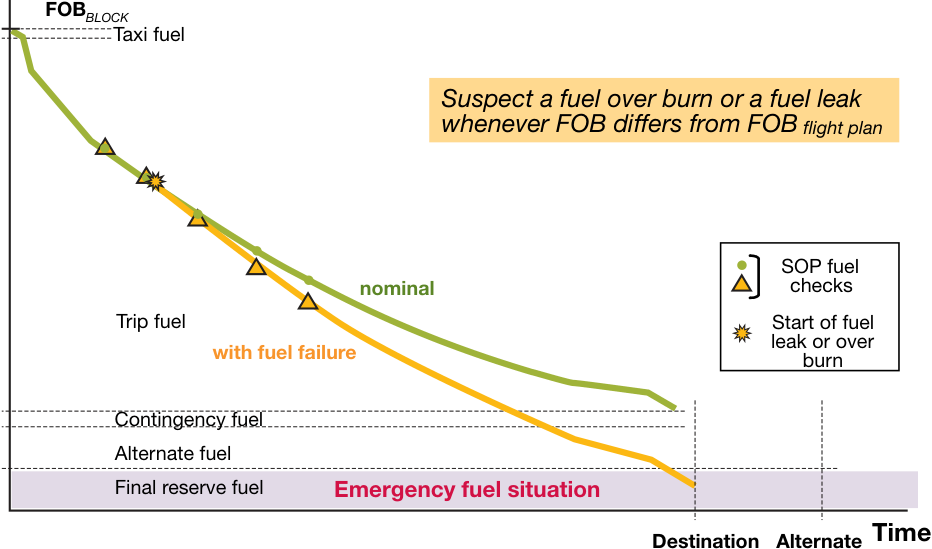
Section titled “3.1 First check: Fuel On Board”Cruise SOP FCOM 3.03.15 P1 (SA/LR) FCOM 2.03.15 P1 (WB)[1] : “Check Fuel on Board (ECAM)… and compare with the computer flight plan or the FCOM In-Cruise Quick-Check Table.”
Any marked difference in FOB quantity compared to the flight plan prediction may reveal either:
-
A fuel over-burn, which may be explained by: - Some significant deviations from the initial flight plan, due for instance to restrictions from Air Traffic Control, degradations of meteorological conditions, engine failure
-
An airplane configuration degradation, due for instance to an aerodynamic drag increase coming from flight control surfaces permanently deflected, a landing gear or gear doors partially extended, ice accretion.
-
An external fuel leakage
3.2 Second check: FMS Fuel prediction
Section titled “3.2 Second check: FMS Fuel prediction”Cruise SOP FCOM 3.03.15 P1 (SA/LR) FCOM 2.03.15 P1 (WB):
“Check… fuel prediction (FMGC) and compare to the computer flight plan or the FCOM In-Cruise Quick-Check Table.”
The FMS is able to make FOB predictions at point along the flight plan: waypoints, destination (DEST EFOB) or alternates. It considers the entered flight plan and assumes a nominal aircraft (potentially customized to monitored performance level through individual PERF factor) i.e. without failure. It is updated permanently from the measured FOB and from modifications of the flight plan entered into the FMS, if any. In nominal conditions, without flight plan update, DEST EFOB should not show any marked evolution throughout the flight. Hence, in case of fuel over-burn due, for instance, to a drag increase, DEST EFOB will decrease permanently at the same rate the actual FOB is drifting away from the initial flight plan prediction. The same behaviour would happen for a fuel leak.
Important note:
Section titled “Important note:”FMS prediction is a projection of actual FOB that never takes into account any degraded state of the aircraft, even when due to a failure that is monitored and shown on the cockpit panel or ECAM displays.
This rule has only one exception: engine failure, once confirmed in the FMS.
Decreasing DEST EFOB indication is a sign of degrading fuel situation.
For the above-mentioned reasons, it also means that the displayed DEST EFOB value cannot be used to anticipate the fuel status at destination. The same is true for all other EFOB projections, like at waypoints or alternates.
Note: DEST EFOB displayed on FMS pages turn to amber if it becomes lower than the sum of Alternate and Final reserves fuel entered in the FMS: it indicates that contingency fuel and extra fuel reserves are no more available.
3.3 Third check: Fuel On Board/Fuel Used
Section titled “3.3 Third check: Fuel On Board/Fuel Used”Cruise SOP FCOM 3.03.15 P1 (SA/LR) FCOM 2.03.15 P1 (WB):
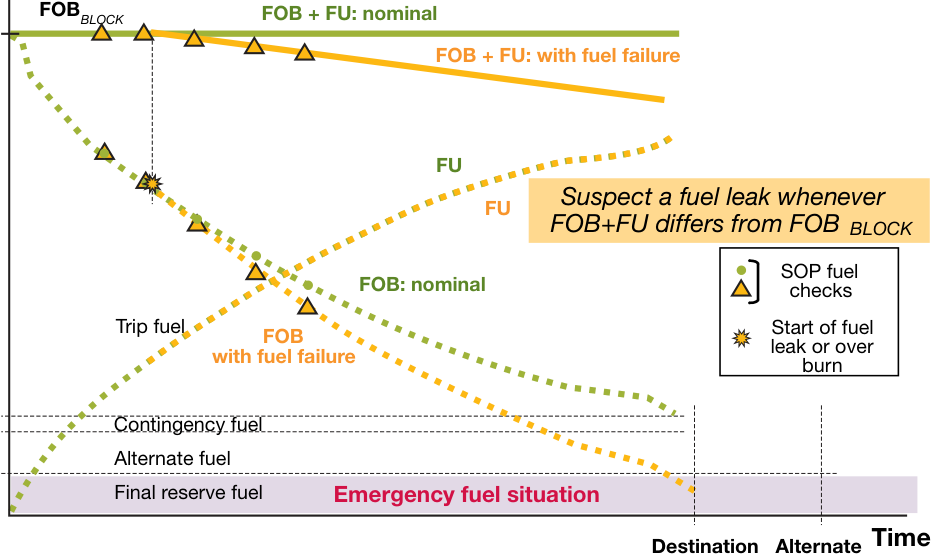
”Check that the sum of the Fuel On Board and the Fuel Used is consistent with the Fuel On Board at departure… If the sum is either unusually smaller than the FOB at departure, or if it decreases, suspect a fuel leak.”
A higher sum may provide the indication of a frozen fuel quantity parameter leading to a wrong FOB data.
- Note: The amber caution F. USED/FOB DISAGREE exists basically on the A340500/600 and A380. On the A330 and A340-200/300, they have to be activated, provided the aircraft are equipped with the following minimum standards: FCMC 9.0 and FWC K5-5 (A330) or L8-0 (A340). This caution does not replace the SOP check, but may allow an earlier detection of a fuel leak.
A fuel leak downstream of the Flow Meter will not be detected through this check. It will, however, be revealed through an excessive fuel flow on one of the engines.
Indeed, an unexpected engine fuel flow level may be caused by:
-
A fuel leak, downstream of the Flow Meter, sometimes confirmed by:
-
Fuel spray visible from the cabin coming from engine or pylon
-
Fuel smell in the cabin
-
But also a fuel over-burn associated with a failure impacting the aircraft aerodynamics or engine performance with the following possible indications:
-
Step or steep increase of engine control parameter
-
Difficulty to maintain ceiling or Mach number
-
Time or distance increase during step climbs
-
Aircraft asymmetry along roll or yaw axis visible sometimes only through compensation by control surfaces
-
Noise, buffet vibrations.
4 Fuel On Board versus available fuel
Section titled “4 Fuel On Board versus available fuel”The three checks described above all assume that the FOB is available to fly the aircraft. This may not always be the case as some fuel may be trapped or transferring too slowly due to an anomaly in the transfer sequence such as :
-
Non operating transfer device (blocked or clogged transfer valve etc…)
-
Ruptured or cracked transfer line in a fuel tank.
These situations may be detected through :
-
A faulty equipment message on the Fuel page of the System Display
-
A developing fuel imbalance when one of the wing tanks is affected
-
A deviation in the fuel transfer sequence.
5 Conclusion
Section titled “5 Conclusion”The FOB, Fuel prediction and FOB/FU checks in cruise provide powerful means for detecting an abnormal fuel situation. These checks, included in the cruise phase SOPs, should be adhered to without exceeding the indicated interval of 30 minutes.
These checks should be performed as well after detection of an abnormal fuel status.
They will allow, after the corrective measures have been taken, to ensure that the procedures applied have reached the expected results.
It is also important to bear in mind that:
-
FMS EFOB predictions do not take into account non-nominal aircraft conditions (except engine failures once confirmed in the FMS) and have to be corrected to take into account the consequences of excessive fuel consumption or fuel leaks.
-
FOB/FU checks will not detect fuel leaks or excessive fuel burn downstream of the Flow Meter and should therefore be complemented by engine fuel flow checks.
With the rising price of fuel, there is a high chance for extra fuel reserves to be more and more challenged: in this evolving context, it is certainly worth developing crew awareness in terms of fuel monitoring to maintain a high level of safety in aircraft operation.

低油量情况意识
Section titled “低油量情况意识”来源: Airbus Safety First 网址: https://safetyfirst.airbus.com/low-fuel-situations-awareness/ 发布于: 2008-07-29 杂志期号: 2008-07 分类: Archive PDF: 原始 PDF
作者:Frédéric MARANI
Section titled “作者:Frédéric MARANI”产品完整性安全策略发展经理
-
空管限制导致航班计划变更
-
气象因素
众所周知,燃油不足可能会严重影响航班安全。因此,在整个飞行任务中监控燃油状态是机组的关键任务之一。燃油监控的挑战在于,燃油状态可能受到多种因素的不利影响。本文将简要回顾影响燃油状态的因素,然后重点阐述:
-
燃油检查的重要性,旨在确保及时发现低油量情况
-
在不利条件下使用 FMS 燃油携带量预测的局限性
本文是对2007年10月在巴塞罗那举行的第14届飞行安全大会上发表的题为”检测和管理可用燃油低情况”的演讲的补充。
-
目的地机场拥堵导致等待或备降
-
以及与飞机相关的因素,如:
-
飞机老化:主要为发动机,但也包括机身和短舱
-
飞机按照最低设备清单 (MEL) 或构型缺损清单 (CDL) 运行
-
飞机速度与预定飞行计划不符
-
相比飞行计划超重,也可能
-
影响燃油消耗的飞行中故障
-
影响任务可用燃油的飞行中故障(如燃油泄漏导致燃油被困)。
2 燃油状态变量
Section titled “2 燃油状态变量”影响燃油状态的因素可分为两类。
- 与运营环境相关的因素,如:- 起飞机场地面运行因素造成的延误
3 标准操作程序 (SOP)
Section titled “3 标准操作程序 (SOP)”由于导致低油量情况的原因多种多样,加之燃油系统的构型,必须采用多种方法来最大化早期发现的机会。
根据巡航阶段的标准操作程序,在飞越航路点时或每30分钟必须进行三类检查:
-
机上燃油
-
FMS 燃油预测
-
机上燃油/已用燃油
在需要进行燃油不平衡程序时也需要进行上述检查,且应在执行燃油不平衡程序之前完成。
- 注:在 A300-600/A310/A320 系列/A330/A340 和 A380 飞机上,燃油不平衡检测以系统显示上的燃油系统页面的”咨询”信息形式提供。在 A340-500/600 和 A380 上,还会触发 ECAM 上的琥珀色警告。目前 A320 系列尚无此类警报。
3.1 首次检查:机上燃油
Section titled “3.1 首次检查:机上燃油”巡航标准操作程序 FCOM 3.03.15 P1 (SA/LR) FCOM 2.03.15 P1 (WB)[1]:“检查机上燃油 (ECAM)…并与计算机飞行计划或 FCOM 巡航快速检查表进行比较。”
机上燃油数量与飞行计划预测的任何显著差异都可能表明:
-
燃油过度消耗,可能原因包括:- 由于空管限制、气象条件恶化、发动机失效等原因导致的与初始飞行计划的重大偏离
-
飞机构型降级,例如由飞行控制面持续偏转、起落架或舱门部分伸出、结冰等引起的气动阻力增加。
-
外部燃油泄漏
3.2 第二次检查:FMS 燃油预测
Section titled “3.2 第二次检查:FMS 燃油预测”巡航标准操作程序 FCOM 3.03.15 P1 (SA/LR) FCOM 2.03.15 P1 (WB):
“检查…燃油预测 (FMGC),并与计算机飞行计划或 FCOM 巡航快速检查表进行比较。”
FMS 能够对飞行计划中各点的燃油携带量进行预测:航路点、目的地(目的地预计燃油)或备降场。它根据输入的飞行计划,并假设飞机处于标称状态(可通过个别 PERF 因子进行监控性能水平定制),即无故障状态。它根据测量的机上燃油和输入到 FMS 的飞行计划修改(如有)持续更新。在正常条件下,如果不更新飞行计划,目的地预计燃油在整个飞行过程中不应出现明显变化。因此,如果因阻力增加等原因导致燃油过度消耗,目的地预计燃油将以实际机上燃油偏离初始飞行计划预测的相同速率持续下降。燃油泄漏也会出现相同情况。
FMS 预测是实际机上燃油的推算,从不考虑飞机的任何不利状态,即使该状态是由在驾驶舱面板或 ECAM 上监控和显示的故障引起的。
此规则只有一个例外:经 FMS 确认的发动机失效。
目的地预计燃油指示下降是燃油状况恶化的标志。
基于上述原因,这也意味着显示的目的地预计燃油值不能用于预测目的地的燃油状态。所有其他预计燃油预测(如航路点或备降场)也是如此。
注:如果目的地预计燃油低于 FMS 中输入的备降场和最终储备燃油之和,FMS 页面上显示的目的地预计燃油将变为琥珀色:这表明应急燃油和额外燃油储备已不再可用。
3.3 第三次检查:燃油油量/已用燃油
Section titled “3.3 第三次检查:燃油油量/已用燃油”巡航标准操作程序 FCOM 3.03.15 P1(SA/LR)FCOM 2.03.15 P1(WB):
”检查当前燃油油量与已用燃油之和是否与起飞时的燃油油量相符……如果两者之和明显小于起飞时的燃油油量,或者数值有所下降,则应怀疑存在燃油泄漏。”
数值偏高可能表示燃油量参数冻结,导致燃油油量数据错误。
- 注:琥珀色警告 F. USED/FOB DISAGREE(已用燃油/燃油油量不一致)基本仅存在于 A340-500/600 和 A380 上。在 A330 和 A340-200/300 上,该警告需要激活,前提是飞机配备以下最低标准:FCMC 9.0 和 FWC K5-5(A330)或 L8-0(A340)。此警告不能替代标准操作程序检查,但可能实现对燃油泄漏的更早检测。
流量计下游的燃油泄漏无法通过此项检查发现。但是,该泄漏会通过某台发动机过高的燃油流量显示出来。
实际上,异常的发动机燃油流量可能由以下原因引起:
-
流量计下游的燃油泄漏,有时可通过以下现象确认:
-
从发动机或吊舱处可见燃油从客舱喷出
-
客舱内闻到燃油气味
-
但也可能是与影响飞机气动性能或发动机性能的故障相关的燃油过度消耗,可能伴随以下征候:
-
发动机控制参数出现阶跃或急剧增加
-
难以保持高度或马赫数
-
阶梯爬升时时间或距离增加
-
飞机沿横滚轴或偏航轴出现不对称,有时仅通过操纵面补偿可见
-
噪声、抖振振动。
4 燃油油量与可用燃油的对比
Section titled “4 燃油油量与可用燃油的对比”上述三项检查均假设燃油油量可用于飞行。但实际情况可能并非如此,因为部分燃油可能被困住或由于传输序列异常导致传输过慢,例如:
-
传输设备不工作(传输活门堵塞或阻塞等……)
-
燃油箱内传输管路破裂或裂纹。
这些情况可通过以下方式检测:
-
系统显示器燃油页面上的故障设备信息
-
当某一侧机翼油箱受影响时,燃油不平衡逐渐发展
-
燃油传输序列出现偏差。
燃油油量、燃油预测和巡航中的燃油油量/已用燃油检查为检测异常燃油状况提供了强有力的手段。这些检查已纳入巡航阶段标准操作程序,应在不超出30分钟指示间隔的情况下执行。
在检测到异常燃油状态后,也应执行这些检查。
它们将有助于在采取纠正措施后,确保所应用的程序达到了预期效果。
同样重要的是要记住:
-
FMS EFOB(估算燃油油量)预测不考虑非正常飞行状态(确认的发动机故障除外,该故障已输入 FMS),必须进行修正以考虑燃油过度消耗或燃油泄漏的后果。
-
燃油油量/已用燃油检查无法检测流量计下游的燃油泄漏或燃油过度消耗,因此应结合发动机燃油流量检查进行补充。
随着燃油价格的上涨,额外燃油储备越来越可能被削减:在此变化背景下,培养机组人员燃油监控意识对于保持飞机运营的高安全水平无疑具有重要意义。