Safe Aircraft Parking
Source: Airbus Safety First URL: https://safetyfirst.airbus.com/safe-aircraft-parking/ Published: 2020-01-15 Category: Flight Ops, Ground Ops, Maintenance PDF: Original PDF

Safe Aircraft Parking Incorrect or incomplete application of the parking procedures at the end of a fl ight can lead to unexpected aircraft movement potentially resulting in injuries or signifi cant damage from a collision with ground obstacles. Several cases of this type of event during maintenance are reported to Airbus each year.
This article provides an overview of the parking brake architecture and explains the importance of checking accumulator pressure before applying the park brake, and then confi rming there is suffi cient hydraulic pressure at the brake unit. It also describes the safety enhancement available on A320 family and A330/A340 aircraft and gives recommendations for chock design and placement.
Safety first #29 | January 2020 037
This article applies to A300/A310/A320/A330/A340/A350/ A380 aircraft. It does not apply to A220 aircraft as they are equipped with electric brakes.
ANALYSIS OF AN EVENT
Section titled “ANALYSIS OF AN EVENT”After landing and taxi in, the A319 was approaching the parking position at the gate. The pilot applied pedal braking and checked the accumulator pressure value on the BRAKES and ACCU PRESS indicator. The accumulator pressure indication was in the green zone as expected. The pilot set the parking brake handle to ON but did not confirm that there was sufficient brake pressure showing on the indicator. He released the brake pedals and switched off both engines. The aircraft began to roll forward and it collided with the airbridge. After the collision, the flight crew checked the BRAKES and ACCU PRESS pressure indicator. It was now showing that there was sufficient pressure at the brakes. If the accumulator pressure indication was green and the indicator was showing sufficient pressure at the brakes after the collision occurred, then why did the aircraft roll forward after the brake pedals were released with the parking brake on?
Investigation
Section titled “Investigation”The crew correctly checked the accumulator pressure indication before setting the park brake to ON but they forgot to confirm the brake pressure indication before releasing the brake pedals and switching off the engines. Decoding the DFDR and troubleshooting identified there was a problem with the Parking Brake Selector Valve (PBSELV) causing it to open very slowly. Even though the park brake handle was set to ON, when the pilot took his feet off the pedals, the parking brake pressure was not yet sufficient and this allowed the aircraft to roll forward. When the Parking Brake Selector Valve finally rotated to its open position the brake pressure indicator was finally showing sufficient pressure at the brake, but it was too late.
The SOP recommends checking the brake pressure on the triple indicator after the parking brake handle is set to ON and before releasing the brake pedals. This would have informed the pilot that the hydraulic pressure at the brake unit was too low to hold the aircraft in its parked position with only the park brake.
THE PARKING BRAKE ARCHITECTURE
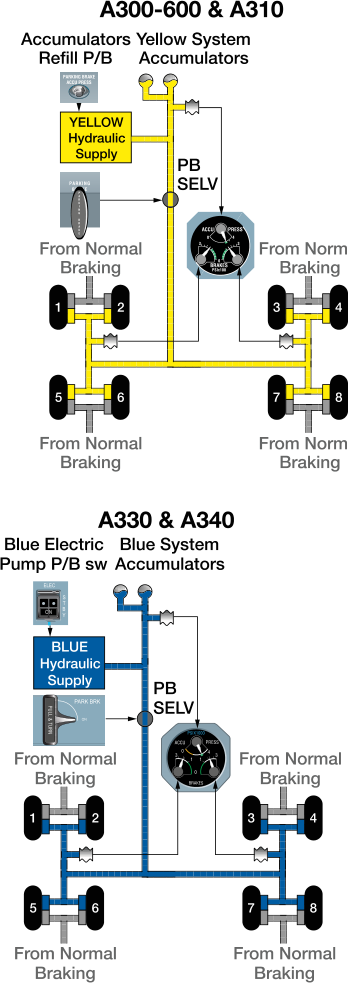
Section titled “THE PARKING BRAKE ARCHITECTURE”The parking brake application relies on the hydraulic pressure provided by one or two hydraulic pressure accumulator(s) (depending on the aircraft type) when the engines are not running. The accumulator(s) provide sufficient hydraulic pressure for the parking brake over a 12 hour period without repressurizing.
When the parking brake handle is set to ON, the Parking Brake Selector Valve (PBSELV) opens, allowing hydraulic pressure to apply the brakes and hold the aircraft in its parked position.
Accumulator(s) pressurization
Section titled “Accumulator(s) pressurization”Accumulators are units that are automatically pressurized by their associated hydraulic system when the aircraft’s engines are running. They can also be manually repressurized (or refi lled) by pressing the Accu refi ll/reinfl ate pushbutton (A300-600/A310/A350/A380) or by switching the yellow (A300/A320) or blue (A330/A340) electrical pump to ON on the overhead panel.
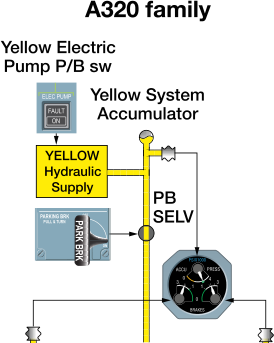
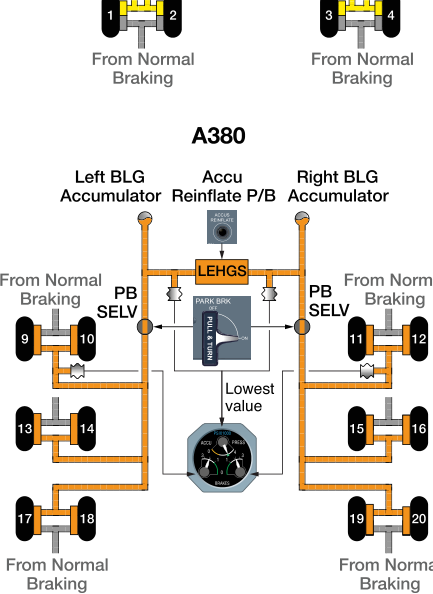
The BRAKES and ACCU pressure indicator: An essential indication of a safe parking confi guration
Section titled “The BRAKES and ACCU pressure indicator: An essential indication of a safe parking confi guration”(fi g.1)
Section titled “(fi g.1)”Functional schematics of the parking brake system
On A300-600, A310, A320 family, A330, A340 and A380 aircraft, the BRAKES and ACCU pressure indicator located on the center instrument panel enables the fl ight crew to quickly check the available accumulator pressure on its upper part and the actual pressure applied to the brakes on its lower part (fi g.1).
Safety fi rst #29 | January 2020 039
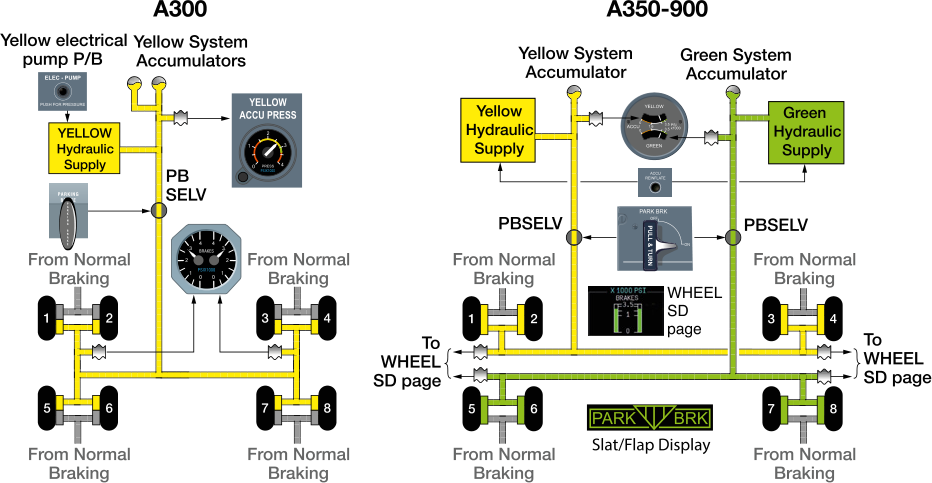
On A300 aircraft, the YELLOW ACCU PRESS indic ator lo cated on the ove r hea d panel provides yellow accumulator pressure indication t o the f ight c rew. The brake pressure indicator located on the center instrument panel provides measurement of the actual pressure applied to the b rakes (fi g.2).
On A350 aircraft, the ACCU pressu re indicator provide s pressure indication from both g reen a nd yellow accumul ators . The fl ight cr ew ca n check the pressure applie d to th e brakes on the SD WHEE L page or ch eck th at the PBSELV is open and that suffi cient pressure is applied to the brakes when the Slat/Flap display shows the green PARK BRK indication (fi g.2).
(fi g. 2)
Section titled “(fi g. 2)”Functional schematics of the parking brake system for A300 and A350 aircraft (A350-1000 not represented)
Cases of incorrect application of the parking brake reported in service
Section titled “Cases of incorrect application of the parking brake reported in service”There are two reasons that were identified as root causes of the incorrect application of the parking brake reported in service:
Incorrect opening of the Parking Brake Selector Valve (PBSELV)
Section titled “Incorrect opening of the Parking Brake Selector Valve (PBSELV)”The incorrect opening of the PBSELV does not enable the hydraulic pressure to reach the brakes as expected as it was the case in the event described above.
Insuffi cient accumulator pressure
Section titled “Insuffi cient accumulator pressure”Insuffi cient accumulator pressure limits the friction applied on the brake discs and may lead to unwanted aircraft movement.
The insuffi cient pressure may be due to a leak in the hydraulic system or in the brake system itself. It can also be due to a long aircraft stay on ground (more than 12 hours) or following numerous parking brake application and release without accumulator repressurization.
RECALL OF THE PARKING PROCEDURE
Section titled “RECALL OF THE PARKING PROCEDURE”The correct application of the FCOM parking procedure enables the fl ight crew to detect if there is a defect that could cause incorrect application of the parking brake.
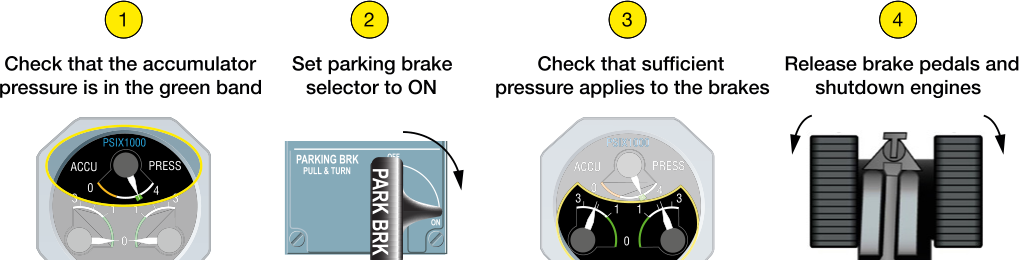
(fi g.3) Example of the parking procedure on A320 aircraft
Step 1: Accumulator pressure check (Engines running and brake pedals
Section titled “Step 1: Accumulator pressure check (Engines running and brake pedals”pressed)
Section titled “pressed)”The fi rst step is to check the accumulator pressure on the BRAKES and ACCU PRESS indicator (ACCU Pressure indicator on A350) before applying the parking brake. The accumulator(s) pressure must be in the green band (fi g.3).
If the pressure is not suffi cient, the fl ight crew must keep the brake pedals pressed and contact the ground operator to put chocks in place before switching off the engines and make a logbook entry once the aircraft is parked to alert Maintenance.
Step 2: Parking brake application (Engines running and brake pedals still
Section titled “Step 2: Parking brake application (Engines running and brake pedals still”pressed)
Section titled “pressed)”If accumulator pressure is suffi cient, the parking brake selector can be set to ON.
Step 3 & 4: Check of the brake pressure, pedal brake release and engine shutdown
Section titled “Step 3 & 4: Check of the brake pressure, pedal brake release and engine shutdown”To ensure that the PBSELV opened correctly and that suffi cient hydraulic pressure is provided to the brakes, it is essential to check the left and right brake pressure on the BRAKES and ACCU pressure indicator (or that the green PARK BRK indicator is displayed on the Slat/Flap display on A350). If the indicators show insuffi cient parking brake pressure, the fl ight crew must keep the brake pedals pressed and contact the ground operator to put chocks in place before switching off the engines and then make a logbook entry to alert Maintenance.
What if the aircraft starts to move after parking brake application?
Section titled “What if the aircraft starts to move after parking brake application?”On A300 and A310 aircraft, the parking brake handle must be set back to OFF to recover normal pedal braking to stop the aircraft.
On A320 Family/A330/A340/A350 and A380 aircraft, normal pedal braking has priority over parking brake, so pedal braking can be directly used to stop the aircraft.
Safety first #29 | January 2020 041
Why is it not recommended to leave the parking brake ON with hot brakes?
Section titled “Why is it not recommended to leave the parking brake ON with hot brakes?”The SOP recommends to set the parking brake brake back to OFF once the chocks are in place when the brakes are hot (refer to FCOM for temperature values). This is to prevent transmitting heat to the brake pistons potentially causing seal degradation, hydraulic fluid overheating and generation of a black aggregate, that can reduce the piston running clearance and then lead to brake dragging.
ALSO BEWARE DURING MAINTENANCE!
Section titled “ALSO BEWARE DURING MAINTENANCE!”An illustrative event reported to Airbus recently involved an A319 aircraft, which was being towed to the gate to resume operations after maintenance activities. The operator on the ground requested the person seated in the cockpit to set the parking brake to ON before disconnecting the towbar from the nose landing gear. They turned the parking brake handle to the ON position without checking the accumulator pressure on the BRAKES and ACCU pressure indicator or confirming the brake pressure. The ground operator disconnected the towbar and the aircraft began to roll backwards and away from the tow tractor. The person in the cockpit attempted to stop the aircraft by pressing down on the brake pedals but the aircraft continued to roll because there was no hydraulic pressure present in the normal braking system. The aircraft eventually came to rest after colliding with ground obstacles.
It is essential to check the braking pressure indications and/ or that chocks are in place before disconnecting the towbar or the towing truck.
This example shows why it is essential to check the braking pressure indications and/or that chocks are in place before disconnecting the towbar or the towing truck. Inflation of the accumulator(s) using the Accu reinflate pushbutton or the appropriate electrical pump pushbutton (depending on the aircraft type) will provide sufficient accumulator pressure for parking brake application for up to 12 hours.
AVAILABLE SAFETY ENHANCEMENT: THE PARKING BRAKE MONITORING FUNCTION
Section titled “AVAILABLE SAFETY ENHANCEMENT: THE PARKING BRAKE MONITORING FUNCTION”Airbus introduced the parking brake monitoring function on A320 Family/A330/ A350 aircraft. This function detects any discrepancy between the parking brake handle position and the PBSELV. The BRAKES PARK BRK FAULT ECAM warning (fig.4) triggers if the PBSELV does not open when the parking brake handle is set to ON, and reminds the flight crew to consider requesting ground personnel place chocks at the wheels before shutting down the engines.
This modifi cation is installed on A320 family aircraft built from October 2010 (serial number 4468 onward), on A330 aircraft built from January 2011 (serial number 1187 onward) and on all A350.
This parking brake monitoring function modifi cation can be retrofi tted on earlier A320 Family/A330/A340 aircraft by the following Service Bulletins:
-
SB A320-32-1381
-
SB A320-31-1353
-
SB A330-32-3244
-
SB A340-32-4285
-
SB A340-32-5105
GROUND OPERATION RECOMMENDATIONS
Section titled “GROUND OPERATION RECOMMENDATIONS”Chocks Placement
Section titled “Chocks Placement”At the gate (transit)
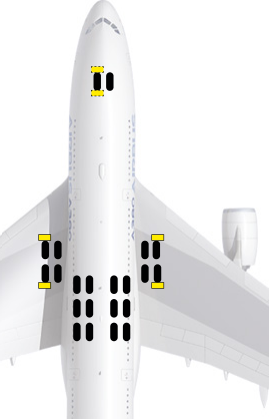
Section titled “At the gate (transit)”(fi g.5) Recommended location of chocks during transit
Airbus recommends to fi rst place a set of chocks on one wheel of the nose landing gear as soon as the aircraft comes to a stop. Then two sets of chocks should be placed on the outboard wheels of the main landing gear only when the engines are switched off and spooling down. Chocks on the NLG can now be removed if it is required (fi g.5). The ground operator must notify the fl ight crew that the chocks are in place.
Safety fi rst #29 | January 2020 043
Night stop, long stay or windy conditions
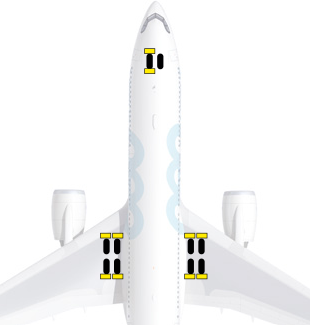
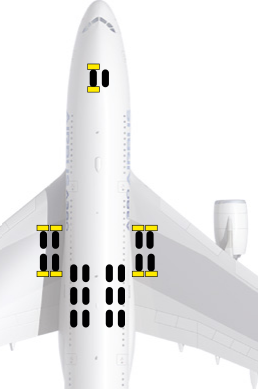
Section titled “Night stop, long stay or windy conditions”For a night stop, a long stay or in the case of strong wind, Airbus recommends to keep the nose landing gear chocks in place and also secure the inboard wheels of the main landing gear with additional sets of chocks (fi g.6).
(fi g.6) Recommended location of chocks during night stop, long stay or in strong wind conditions
During Maintenance
Section titled “During Maintenance”Specifi c chocks placements may be required for a maintenance task. The chocks placement guidance in the Aircraft Maintenance Manual (AMM) should be followed.
Chocks design
Section titled “Chocks design”Many different types of chocks are used by ground operators throughout the world. Airbus participated in a study to defi ne an optimum design for chocks that can solve recurrent issues faced in operation such as:
-
Chocks durability
-
High weight with associated handling diffi culties
-
Reduced effi ciency on wet and contaminated aprons
-
Diffi culties to remove chocks before pushback with risk of delay
The recommended chocks are made of urethane type material and have an asymmetric design enabling optimum effi ciency depending on if the apron is dry or wet/contaminated (fi g.7).
For more information, refer to the AIR4905 revA document published by SAE international that provides general considerations for the design and use of aircraft wheel chocks.
(fi g.7)
Section titled “(fi g.7)”Example of chocks with asymmetric design adapted to apron state
Dry ground surface (limited weight applied on the chocks for easy removal)
Wet or contaminated ground surface (increased weight on the chocks to increase friction on the ground)
CONTRIBUTORS:
Section titled “CONTRIBUTORS:”Laurent COUTURET
Section titled “Laurent COUTURET”Product Leader A380/A300 Braking and steering - Engineering Customer Services
Willy-Pierre DUPONT Senior Expert Airport Operations
Didier GENDRE
Section titled “Didier GENDRE”Ground Operations Engineer Airport Operations
David PIERRE-ANTOINE
Section titled “David PIERRE-ANTOINE”To ensure that an aircraft remains safe and stationary when using the parking brake, flight crew or maintenance personnel must first ensure that sufficient accumulator pressure is available using the BRAKES and ACCU pressure indicator before setting the brake handle to ON. If the indicator is in the green band, they can set the parking brake to ON and confirm using the pressure indicator that sufficient pressure is applied to the brakes. If not, they must wait until chocks are correctly placed at the wheels before releasing the brake pedals and switching off the engines or disconnecting from the towing vehicle. Maintenance must be alerted about the issue to troubleshoot and rectify.
When chocks are required for ground operations or when the parking brake pressure is insufficient, chocks must be correctly placed at the aircraft’s wheels. Airbus recommends chocks made of urethane type material with an asymmetric design that allows them to be orientated for the most efficient holding friction on wet or dry apron surfaces.
HO Braking and Steering Systems Engineering Support Customer Services
Peimann TOFIGHI-NIAKI
Section titled “Peimann TOFIGHI-NIAKI”Flight Operations Support Engineer Flight Operations Support
Safety fi rst, #29 January, 2020. Safety fi rst is published by Airbus S.A.S. - 1, rond point Maurice Bellonte - 31707 Blagnac Cedex/France. Publisher and Editor: Yannick Malinge, Chief Product Safety Offi cer. Concept Design by Airbus MultiMedia Studio 20192534. Reference: X00D16031905 Issue 29. Photo by H. Goussé.
来源: Airbus Safety First 网址: https://safetyfirst.airbus.com/safe-aircraft-parking/ 发布日期: 2020-01-15 类别: 飞行运营、地面运营、维修 PDF: 原始PDF
安全飞机停泊 在航班结束时不正确或不完整地执行停泊程序可能导致意外的飞机移动,进而可能造成人员伤害或与地面障碍物碰撞导致的重大损坏。每年都有多起此类发生在维修期间的事件向空客报告。
本文概述了停留刹车架构,解释了施加停留刹车前检查蓄压器压力的重要性,以及确认刹车组件处有足够液压压力的必要性。本文还描述了A320系列和A330/A340飞机上可用的安全增强措施,并就轮挡的设计和放置提供了建议。
Safety first #29 | 2020年1月 037
本文适用于A300/A310/A320/A330/A340/A350/A380飞机。不适用于A220飞机,因为A220配备了电刹车。
在着陆并滑行至机位后,这架A319正在接近廊桥机位。飞行员使用了脚蹬刹车,并在刹车和蓄压器压力指示器上检查了蓄压器压力值。蓄压器压力指示在绿色区域,属于正常。飞行员将停留刹车手柄设置到ON,但没有确认指示器上是否有足够的刹车压力显示。他松开了刹车脚蹬并关闭了两台发动机。飞机开始向前滑动,撞上了廊桥。碰撞后,机组检查了刹车和蓄压器压力指示器。此时显示刹车处有足够的压力。既然蓄压器压力指示为绿色,且碰撞发生后指示器显示刹车处压力充足,那么为什么在松开刹车脚蹬后、停留刹车已设置的情况下,飞机会向前滑动?
机组在设置停留刹车手柄至ON之前正确地检查了蓄压器压力指示,但他们忘记了在松开刹车脚蹬和关闭发动机之前确认刹车压力指示。对DFDR进行译码和故障排查后,发现停留刹车选择活门(Parking Brake Selector Valve,PBSELV)存在问题,导致其开启非常缓慢。尽管停留刹车手柄已设置到ON,但当飞行员把脚从脚蹬上移开时,停留刹车压力尚未达到足够水平,飞机因此向前滑动。当停留刹车选择活门最终转动至开启位置时,刹车压力指示器才最终显示刹车处有足够的压力,但这已经太晚了。
标准操作程序建议在停留刹车手柄设置到ON之后、松开刹车脚蹬之前,在三联指示器上检查刹车压力。这本可以让飞行员了解到刹车组件处的液压压力过低,无法仅凭停留刹车将飞机保持在停泊位置。
停留刹车架构
Section titled “停留刹车架构”停留刹车的施加依赖于当发动机不工作时由一个或两个液压蓄压器(取决于飞机类型)提供的液压压力。蓄压器能够在不重新增压的情况下,为停留刹车提供足够液压压力持续12小时。
当停留刹车手柄设置到ON时,停留刹车选择活门(Parking Brake Selector Valve,PBSELV)打开,允许液压压力施加刹车并将飞机保持在停泊位置。
蓄压器是当飞机发动机运行时由其相关液压系统自动增压的装置。蓄压器也可以通过按下蓄压器补充/重新充气按钮(A300-600/A310/A350/A380),或通过在头顶面板上将黄泵(A300/A320)或蓝泵(A330/A340)电门设置到ON来进行人工增压(或补充)。
刹车和蓄压器压力指示器:安全停泊构型的必要指示
Section titled “刹车和蓄压器压力指示器:安全停泊构型的必要指示”停留刹车系统功能原理图
在A300-600、A310、A320系列、A330、A340和A380飞机上,位于中央仪表板上的刹车和蓄压器压力指示器使飞行机组能够快速在其上部检查可用蓄压器压力,在其下部检查实际施加在刹车上的压力**(图1)**。
Safety first #29 | 2020年1月 039
在A300飞机上,位于头顶面板上的黄色蓄压器压力指示器向飞行机组提供黄色蓄压器压力指示。位于中央仪表板上的刹车压力指示器提供实际施加在刹车上的压力的测量值**(图2)**。
在A350飞机上,蓄压器压力指示器提供来自绿系统和黄系统两个蓄压器的压力指示。飞行机组可以在SD WHEEL(机轮)页面检查施加在刹车上的压力,或检查停留刹车选择活门是否打开,以及当缝翼/襟翼显示器显示绿色PARK BRK(停留刹车)指示时确认有足够的压力施加到刹车**(图2)**。
(fi g. 2)
Section titled “(fi g. 2)”A300 和 A350 飞机停留刹车系统的功能示意图(A350-1000 未展示)
运营中报告的停留刹车错误使用案例
Section titled “运营中报告的停留刹车错误使用案例”经识别,有两个原因被视为导致运营中停留刹车错误使用的根本原因:
停留刹车选择活门(PBSELV)错误打开
Section titled “停留刹车选择活门(PBSELV)错误打开”PBSELV 错误打开后,液压压力无法按预期到达刹车系统,正如上述事件所述。
蓄压瓶压力不足
Section titled “蓄压瓶压力不足”蓄压瓶压力不足会限制施加在刹车盘上的摩擦力,并可能导致飞机意外移动。
压力不足可能是由于液压系统或刹车系统本身泄漏所致。也可能是由于飞机在地面停放时间过长(超过 12 小时),或在蓄压瓶未重新充压的情况下多次施加和释放停留刹车。
停留程序回顾
Section titled “停留程序回顾”正确执行 FCOM 停留程序能使飞行机组检测到是否存在可能导致停留刹车错误使用的故障。
(fi g.3) A320 飞机停留程序示例
第一步:蓄压瓶压力检查(发动机运转且刹车踏板按下)
Section titled “第一步:蓄压瓶压力检查(发动机运转且刹车踏板按下)”第一步是在施加停留刹车之前,检查 BRAKES and ACCU PRESS 指示器上的蓄压瓶压力(A350 上为 ACCU Pressure 指示器)。蓄压瓶压力必须在绿色区域 (fi g.3)。
如果压力不足,飞行机组必须保持刹车踏板按下,并联系地面人员放置轮挡,然后再关闭发动机,并在飞机停稳后填写记录本以通知维修部门。
第二步:施加停留刹车(发动机运转且刹车踏板保持按下)
Section titled “第二步:施加停留刹车(发动机运转且刹车踏板保持按下)”如果蓄压瓶压力充足,可以将停留刹车选择手柄设置到 ON 位。
第三步和第四步:刹车压力检查、刹车踏板松开和发动机关闭
Section titled “第三步和第四步:刹车压力检查、刹车踏板松开和发动机关闭”为确保 PBSELV 正确打开且有足够的液压压力到达刹车系统,必须在 BRAKES and ACCU pressure 指示器上检查左、右刹车压力(或在 A350 的 Slat/Flap 显示组件上确认绿色 PARK BRK 指示灯亮起)。如果指示器显示停留刹车压力不足,飞行机组必须保持刹车踏板按下,联系地面人员放置轮挡,然后再关闭发动机,然后填写记录本通知维修部门。
如果飞机在施加停留刹车后开始移动怎么办?
Section titled “如果飞机在施加停留刹车后开始移动怎么办?”在 A300 和 A310 飞机上,必须将停留刹车手柄重新设置到 OFF 位,以恢复正常踏板刹车来停止飞机。
在 A320 系列/A330/A340/A350 和 A380 飞机上,正常踏板刹车优先于停留刹车,因此可以直接使用踏板刹车来停止飞机。
Safety first #29 | January 2020 041
为什么不建议在刹车过热时让停留刹车保持 ON 位?
Section titled “为什么不建议在刹车过热时让停留刹车保持 ON 位?”SOP 建议当刹车过热时(温度值请参阅 FCOM),在轮挡放置到位后将停留刹车手柄重新设置到 OFF 位。此举是为了防止将热量传递到刹车活塞,可能导致密封件降解、液压油过热并产生黑色沉积物,这会减小活塞运行间隙,进而导致刹车拖滞。
维修期间也需注意!
Section titled “维修期间也需注意!”空客近期收到一起说明性事件,涉及一架 A319 飞机。该飞机在维修活动后被牵引至登机口恢复运营。地面操作人员要求坐在驾驶舱内的人员在将牵引杆从前起落架脱开之前,将停留刹车设置为 ON。他们将停留刹车手柄转到 ON 位,但未检查 BRAKES and ACCU pressure 指示器上的蓄压瓶压力,也未确认刹车压力。地面操作人员脱开了牵引杆,飞机开始向后滚动并远离牵引车。驾驶舱内人员尝试通过踩下刹车踏板来停止飞机,但飞机继续滚动,因为正常刹车系统中没有液压压力。飞机最终撞上地面障碍物后才停下。
在脱开牵引杆或牵引车之前,必须检查刹车压力指示和/或确认轮挡已就位。
此案例表明了在脱开牵引杆或牵引车之前检查刹车压力指示和/或确认轮挡已就位的重要性。使用 Accu reinflate 按键或适当的电动泵按键(取决于飞机型号)对蓄压瓶进行充压,可为停留刹车提供足够的蓄压瓶压力,最长维持 12 小时。
可用的安全增强功能:驻车制动监控功能
Section titled “可用的安全增强功能:驻车制动监控功能”Airbus 在 A320 系列/A330/A350 飞机上引入了驻车制动监控功能。该功能可检测驻车制动手柄位置与 PBSELV 之间的任何偏差。如果将驻车制动手柄设置为 ON 时 PBSELV 未打开,则触发 BRAKES PARK BRK FAULT ECAM 警告 (图 4),以提醒机组人员在关闭发动机前考虑请求地面人员将轮挡放置在机轮上。
此改装安装在以下飞机上:
- 2010 年 10 月以后生产的 A320 系列飞机(序列号 4468 及之后)
- 2011 年 1 月以后生产的 A330 飞机(序列号 1187 及之后)
- 所有 A350 飞机
可通过以下服务通告对此功能进行改装:
- SB A320-32-1381
- SB A320-31-1353
- SB A330-32-3244
- SB A340-32-4285
- SB A340-32-5105
地面操作建议
Section titled “地面操作建议”廊桥位(过站期间)
Section titled “廊桥位(过站期间)”(图 5) 过站期间轮挡的建议位置
Airbus 建议在飞机完全停稳后,首先在一侧前起落架机轮上放置一套轮挡。然后,仅在发动机关闭并减速后再在主起落架外侧机轮上放置两套轮挡 (图 5)。如需要,此时可移除前起落架上的轮挡。地面操作员必须通知机组人员轮挡已就位。
Safety first #29 | 2020 年 1 月 043
夜间停放、长时间停留或大风天气
Section titled “夜间停放、长时间停留或大风天气”对于夜间停放、长时间停留或遇到强风的情况,Airbus 建议保留前起落架轮挡,并额外在主起落架内侧机轮上放置轮挡 (图 6)。
(图 6) 夜间停放、长时间停留或强风条件下的轮挡建议位置
某些维护任务可能需要特定的轮挡放置方式。应遵循《 aircraft maintenance manual》(AMM)中关于轮挡放置的指导。
全球各地的地面运营商使用多种不同类型的轮挡。Airbus 参与了一项研究,以确定轮挡的最佳设计,从而解决运营中遇到的常见问题,例如:
- 轮挡耐用性
- 重量大导致操作困难
- 在潮湿和受污染的机坪上效率降低
- 在推出前移除轮挡困难,存在延误风险
推荐的轮挡采用聚氨酯类材料制成,具有不对称设计,可根据机坪是干燥还是潮湿/受污染状态提供最佳效率 (图 7)。
更多信息请参阅 SAE International 发布的 AIR4905 revA 文件,其中提供了飞机轮挡设计与使用的通用考虑事项。
具有适应机坪状态的不对称设计轮挡示例
干燥地面(轮挡上施加有限重量以便于移除)
潮湿或受污染地面(轮挡上增加重量以提高与地面的摩擦力)
Laurent COUTURET
Section titled “Laurent COUTURET”A380/A300 制动与转向产品负责人 - 工程客户服务
Willy-Pierre DUPONT 机场运营高级专家
Didier GENDRE
Section titled “Didier GENDRE”机场运营地面运营工程师
David PIERRE-ANTOINE
Section titled “David PIERRE-ANTOINE”制动与转向系统工程支持客户服务工程师
Peimann TOFIGHI-NIAKI
Section titled “Peimann TOFIGHI-NIAKI”飞行运营支持工程师 飞行运营支持
为确保使用驻车制动时飞机保持安全静止,飞行机组或维护人员必须首先使用 BRAKES 和 ACCU 压力指示器确认蓄压器压力充足,然后才能将制动手柄设置为 ON。如果指示器在绿色区域内,他们可以将驻车制动设置为 ON,并使用压力指示器确认已向制动器施加足够的压力。否则,必须等待轮挡正确放置在机轮上后,才能松开制动踏板并关闭发动机或断开牵引车连接。必须将问题告知维护部门以进行故障排除和修复。
当地面操作需要轮挡或驻车制动压力不足时,必须将轮挡正确放置在飞机机轮上。Airbus 推荐使用聚氨酯类材料制成的不对称设计轮挡,可根据潮湿或干燥的机坪表面调整方向,以获得最佳的保持摩擦力。
Safety first, #29 2020 年 1 月。Safety first 由 Airbus S.A.S. 出版 - 1, rond point Maurice Bellonte - 31707 Blagnac Cedex/France。出版人和编辑:首席产品安全官 Yannick Malinge。概念设计:Airbus MultiMedia Studio 20192534。参考编号:X00D16031905 第 29 期。照片:H. Goussé。