Corrosion A Potential Safety Issue
Source: Airbus Safety First URL: https://safetyfirst.airbus.com/corrosion-a-potential-safety-issue/ Published: 2013-01-14 Magazine Issue: 2013-02 Category: Archive PDF: Original PDF
Safety
David HILL
Section titled “David HILL”Head of Maintenance Programs Engineering - Structures Customer Services
Corrosion: A Potential Safety Issue
Section titled “Corrosion: A Potential Safety Issue”1. Introduction
Section titled “1. Introduction”Corrosion, if left to propagate, can significantly reduce the strength of the aircraft structure and compromise safety. Corrosion can also affect the aircraft systems and induce failures in components such as landing gear (corrosion initiated crack propagation) and fuel systems (corroded bonding and electrical connectors, micro-biological contamination) to name a few.
To help and enable operators, Airbus has established a Corrosion Prevention and Control Program (CPCP). The CPCP defines regular
inspections on specific parts of the aircraft. The efficiency of the CPCP is dependent on Operators monitoring and reporting findings to ensure the correct type of inspection and interval are selected to prevent propagation of corrosion.
To reduce corrosion, good maintenance practices have to be put in place to keep the aircraft clean (interior and exterior), to ensure the drain paths are clear and to maintain the surface protections (paint, plating, water repellents, etc).
3. Types of Corrosion
Section titled “3. Types of Corrosion”There are several types of corrosion:
q pitting
-
q galvanic
-
q crevice
-
q exfoliation
-
q intergranular.
3.1 Pitting Corrosion
Section titled “3.1 Pitting Corrosion”2. What is Corrosion?
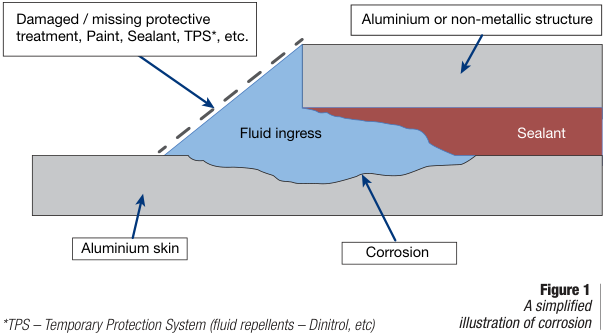
Section titled “2. What is Corrosion?”Essentially, corrosion is the combination of damaged or missing protective coatings causing exposed metals and fluid ingress or contact between metallic and non metallic structure (e.g. aluminium to carbon fibre). A chemical reaction sets up a positive and negative electrical charge (cathode and anode, like a battery) and the subsequent chemical reaction ‘dissolves’ and breaks down the metal.
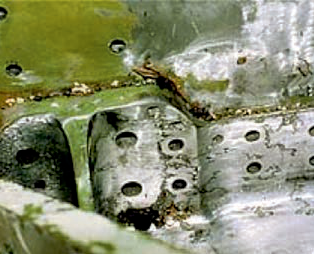
Corrosion products often cover the pits. Many small, narrow pits with minimal overall metal loss can lead to degradation of the structural strength and initiate cracking.
3.2 Galvanic Corrosion
Section titled “3.2 Galvanic Corrosion”When a galvanic couple forms between metals, one of the metals in the couple becomes the anode and corrodes faster than it would all by itself, while the other becomes the cathode (the battery effect) and corrodes slower than it would alone.
In the case of a metallic and non-metallic (Carbon or composite material) couple, then the metal part will corrode and potentially cause deformation damage to the non-metallic part, also reducing the strength of the assembly.
For galvanic corrosion to occur, three conditions must be present:
-
q Electrochemically dissimilar metals must be present
-
q These metals must be in electrical contact, and
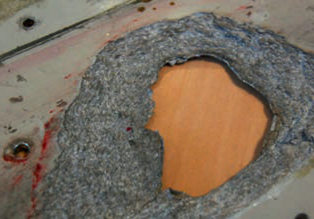
Figure 3 example of galvanic corrosion of a galley storage container caused by a well known brand of soft drink
- q The metals must be exposed to an electrolyte.
3.3 Exfoliation Corrosion
Section titled “3.3 Exfoliation Corrosion”Exfoliation corrosion is corrosion that can occur along aluminum grain boundaries. These grain boundaries in both aluminum sheet and plate are oriented in layers parallel due to the rolling process. The delamination of these thin layers of the aluminum, with white corrosion deposits between the layers, is evident as the surface protections appear distorted, revealing the white deposits.
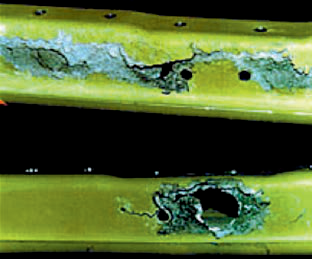
Figure 4 example of exfoliation corrosion
3.4 Crevice Corrosion
Section titled “3.4 Crevice Corrosion”Crevice corrosion is a localized form of corrosion usually associated with a stagnant solution on the micro-environmental level (toilet floor beams, bilges, etc). This occurs in crevices (shielded areas) such as under gaskets, washers, insulation material, fastener heads, surface deposits, disbonded coatings, threads, lap joints and clamps. Crevice corrosion is initiated by changes in local chemistry within the crevice.
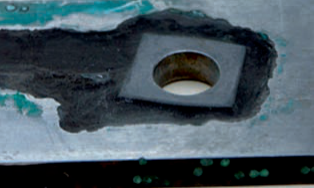
Figure 5 example of crevice corrosion
3.5 Intergranular Corrosion
Section titled “3.5 Intergranular Corrosion”This type of corrosion is at the grain boundaries of the metal alloys and can be encountered in alloy castings, stainless steel alloys and 2000, 5000, and 7000 series aluminium alloys. Intergranular or intercrystalline corrosion (IGC) is the preferential attack of the grain boundaries or closely adjacent grains without significant attack of the grains themselves. The material can become susceptible to corrosion attack or crack propagation if under tensile stress. Research and design have reduced this phenomena significantly.
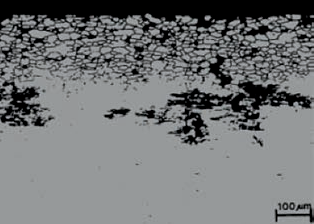
Figure 6 example of intergranular corrosion
4. Where is Corrosion found?
Section titled “4. Where is Corrosion found?”Corrosion can be found all over the aircraft, however, the evolution in technology, materials, design and manufacturing processes has greatly improved resistance to corrosion. Greater use of titanium, corrosion resistant steels, aluminium-lithium alloys, composite materials, carbon, protective coatings and sealants have all contributed to significantly reduce the level of corrosion experienced a few years ago.
Typically, structure exposed to corrosive products (particularly when the protective coating is damaged or missing) such as water, salty/humid environments,
runway de-icer, cargo spillages, food/ drinks, human waste, etc are susceptible. So, areas around and underneath galleys and toilets, cargo bay bilges, exterior of the aircraft, fwd/aft wing spars, landing gear bays, flight controls, exterior skins, and fuel tanks are all to be considered.
Safety
5. Possible Consequences of Corrosion
Section titled “5. Possible Consequences of Corrosion”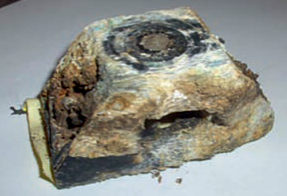
Figure 7 Corrosion of a galley foot fitting may lead to the failure of the security of the galley (or toilet) monument and could cause the monument to detach
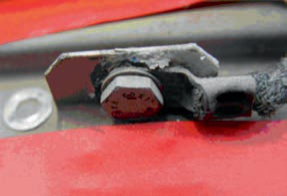
Figure 11 Corrosion of electrical bondings, vital for aircraft systems safety (lightening strike, static electricity discharge, etc), could cause them to become ineffective
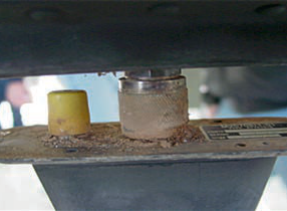
Figure 12 Corrosion between the interlaying surfaces of aerial connections could lead to loss of communication
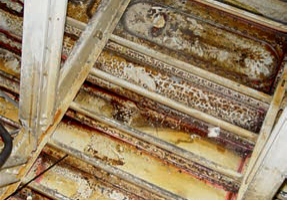
Figure 8 Accumulation of corrosive “products” below a leaking toilet could reduce the thickness of the structure (hence the strength). Aside from the potential health concerns, this may lead to structural failure (decompression)
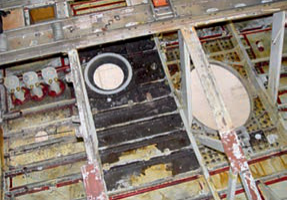
Figure 9 Corrosion through accumulation of dirt, debris and fluids in the bilge area
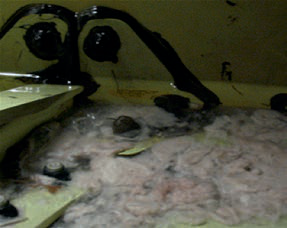
Figure 10 Micro-biological growth in the fuel tanks may lead to bacterial build up in the boundary between the fuel and accumulated water in the tanks. The micro-biological growth could affect the structure and/or block fuel filters/pumps
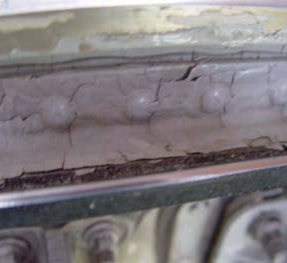
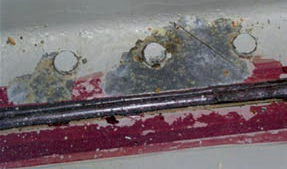
Figures 13 & 14 Missing/damaged protective treatments (Paint, primer, sealant, plating’s, etc) will all allow ingress of fluids/corrosive products to cause corrosion damage, hence weakening the structure
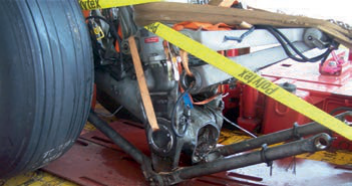
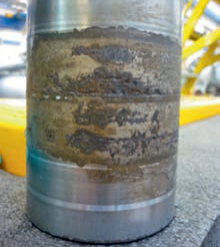
Figure 16 Pitting corrosion caused the failure of a landing gear bogie beam
Figure 15
Water ingress to a landing gear pin led to pitting corrosion, which attacked the chrome plating and blocked the lubrication, could lead to the seizure of the landing gear
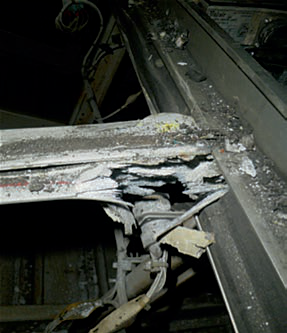
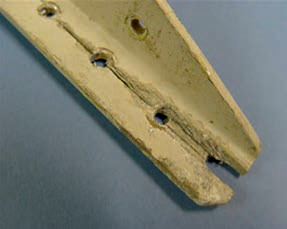
Figure 17 Stress induced corrosion along the fastener holes
Figure 18 Cargo bay spillages damaged a cargo floor beam
6. Corrosion Prevention and Control Program (CPCP)
Section titled “6. Corrosion Prevention and Control Program (CPCP)”Cracks and loss of strength initiated by corrosion and pressurization cycles can lead to major structural failure. After a series of incidents involving old, high flight cycle aircraft, new regulations where introduced by Airworthiness Authorities in the early 1990’s requiring manufacturers to develop structural inspections to clearly identify and control corrosion.
To enable operators to do this, Airbus has established a Corrosion Prevention and Control Program (CPCP) for all aircraft maintenance programs. These structural inspections are determined by design analyses, in-service experience and regulations. Implementation of these Inspection Programs is mandatory.
6.1 Three Levels of Corrosion
Section titled “6.1 Three Levels of Corrosion”For the purposes of assessment, corrosion is classified into the following three levels:
-
q Level 1 Corrosion - Any corrosion of primary structure that does not require structural reinforcement or replacement (minor surface corrosion requiring minor restauration and reapplication of protective treatments, etc) (fig. 19).
-
q Level 2 Corrosion - Any corrosion of primary structure that requires a structural reinforcement or replacement and which is not considered as level 3 (fig. 20).
-
q Level 3 Corrosion - Corrosion of any primary structure which may be determined to be an urgent fleet airworthiness concern.
The regulations state that corrosion shall be controlled to level 1 or better and to ensure that corrosion does not exceed the limits of Level 1 between two successive inspections. If level 1 limits are exceeded there are several options:
-
q Decrease the inspection threshold/interval
-
q Consider a more detailed inspection level
-
q Apply Temporary Protection System more frequently
-
q Embody preventive modifications where appropriate.
CPCP is, therefore, self regulating.
6.2 Role of the operators
Section titled “6.2 Role of the operators”The task of the operators is to ensure the aircraft remain at the optimum level of performance and safety by:
-
q Inspecting the aircraft structure and systems in accordance with Airbus instructions
-
q Ensuring the bilge drains are clear, the galleys and toilets are clean and leaktight, the cargo bays are free from spillage and the non textile flooring is in good condition
-
q Maintaining the protective treatments
-
q Applying temporary protection schemes (TPS), such as Dinitrol, as applicable
-
q Reporting findings to Airworthiness Authorities and Airbus.
6.3 Role of Airbus
Section titled “6.3 Role of Airbus”The task of Airbus, as manufacturer, is to:
-
q Lead continuous improvement
-
q Monitor trends
-
q Introduce corrective actions
-
q Adjust the maintenance program accordingly.
7. Conclusion
Section titled “7. Conclusion”Corrosion may become a safety issue, as illustrated by past in-service incidents.
The Airbus Corrosion Prevention and Control Program (CPCP) has been established to prevents its propagation. Operators and Airbus have each specific responsibilities to ensure the CPCP is as effective as possible. The capacity of Airbus to meets its obligation is largely dependant upon an efficient reporting of findings by operators.
REMEMBER Clean it, Inspect it, Drain it, Seal it, Report.
Section titled “REMEMBER Clean it, Inspect it, Drain it, Seal it, Report.”Safety
Safety
David HILL
Section titled “David HILL”维修项目工程结构专业负责人——客户服务中心
腐蚀:一个潜在的安全问题
Section titled “腐蚀:一个潜在的安全问题”腐蚀如果任其发展,会显著降低飞机结构的强度并危及安全。腐蚀还可能影响飞机系统,并引发起落架(腐蚀引发裂纹扩展)和燃油系统(腐蚀导致的粘接和电连接器损坏、微生物污染)等部件故障。
为帮助和支持运营商,空客建立了腐蚀预防与控制方案(CPCP)。CPCP 定义了对飞机特定部位的定期检查。CPCP 的有效性取决于运营商对检查结果的监控和报告,以确保选择正确类型的检查和检查间隔来防止腐蚀扩散。
为减少腐蚀,必须实施良好的维护做法,保持飞机清洁(内部和外部),确保排水通道畅通,并维护表面保护(油漆、电镀、防水剂等)。
3. 腐蚀类型
Section titled “3. 腐蚀类型”腐蚀有多种类型:
q 点蚀
-
q 电偶腐蚀
-
q 缝隙腐蚀
-
q 层状腐蚀
-
q 晶间腐蚀。
3.1 点蚀
Section titled “3.1 点蚀”2. 什么是腐蚀?
Section titled “2. 什么是腐蚀?”从本质上讲,腐蚀是受损或缺失的保护涂层导致金属暴露、金属与非金属结构之间(如铝与碳纤维)渗入液体或接触的结果。化学反应产生正负电荷(阴极和阳极,像电池一样),随后发生的化学反应会”溶解”并破坏金属。
腐蚀产物通常覆盖在蚀坑上。许多细小、狭窄的蚀坑,即使整体金属损失很小,也可能导致结构强度退化并引发裂纹。
3.2 电偶腐蚀
Section titled “3.2 电偶腐蚀”当金属之间形成电偶时,电偶中的一种金属成为阳极,其腐蚀速度比单独存在时更快,而另一种则成为阴极(电池效应),其腐蚀速度比单独存在时更慢。
对于金属与非金属(碳或复合材料)的电偶,金属部分会发生腐蚀,并可能对非金属部分造成变形损坏,同时降低整个组件的强度。
电偶腐蚀的发生必须满足三个条件:
-
q 必须存在电化学性质不同的金属
-
q 这些金属必须处于电气连接状态,以及
图 3 某知名软饮料品牌导致的厨房储物箱电偶腐蚀示例
- q 金属必须暴露在电解质中。
3.3 层状腐蚀
Section titled “3.3 层状腐蚀”层状腐蚀是沿铝晶界发生的一种腐蚀。在铝板和铝型材中,这些晶界由于轧制工艺而呈层状平行排列。这些铝薄层的分层,层间出现白色腐蚀沉积物,表现为表面保护层出现变形,露出白色沉积物。
图 4 层状腐蚀示例
3.4 缝隙腐蚀
Section titled “3.4 缝隙腐蚀”缝隙腐蚀是一种局部腐蚀形式,通常与微观环境中的停滞溶液有关(如厕所地板梁、舱底等)。这发生在缝隙(屏蔽区域)内,如垫片、垫圈、保温材料、紧固件头部、表面沉积物、涂层剥离处、螺纹、搭接接头和卡箍下方。缝隙腐蚀由缝隙内局部化学环境的变化引起。
图 5 缝隙腐蚀示例
3.5 晶间腐蚀
Section titled “3.5 晶间腐蚀”这种腐蚀发生在金属合金的晶界上,可出现在合金铸件、不锈钢合金以及 2000、5000 和 7000 系列铝合金中。晶间腐蚀或晶界腐蚀(IGC)是晶界或紧密相邻晶粒的选择性侵蚀,而晶粒本身不受明显侵蚀。如果材料处于拉伸应力下,会变得容易受到腐蚀侵蚀或裂纹扩展。研究和设计已显著减少了这一现象。
图 6 晶间腐蚀示例
4. 腐蚀发生在哪些部位?
Section titled “4. 腐蚀发生在哪些部位?”腐蚀可能出现在飞机的任何部位,然而,技术、材料、设计和制造工艺的进步极大地提高了抗腐蚀能力。钛合金、更广泛使用的耐腐蚀钢、铝锂合金、复合材料、碳纤维、防护涂层和密封剂的应用,都显著降低了多年前所面临的腐蚀程度。
通常,暴露于腐蚀性物质(特别是防护涂层受损或缺失时)的结构部位容易发生腐蚀,如水、盐雾/潮湿环境、跑道除冰剂、货物泄漏物、食品/饮料、人体排泄物等。因此,厨房和卫生间及其周围区域、货舱舱底、飞机外表面、前/后翼梁、起落架舱、飞行操纵面、外层蒙皮以及燃油箱等部位均需予以关注。
安全
5. 腐蚀的可能后果
Section titled “5. 腐蚀的可能后果”
图 7 厨房脚架连接件的腐蚀可能导致厨房(或卫生间)壁板固定失效,并可能造成壁板脱落
图 11 电气搭接带的腐蚀对飞机系统安全至关重要(防雷击、静电放电等),腐蚀可能导致搭接失效
图 12 天线连接层间表面的腐蚀可能导致通信中断
图 8 马桶泄漏形成的腐蚀性物质积聚会降低结构厚度(从而降低强度)。除潜在的健康问题外,还可能导致结构失效(减压)
图 9 舱底区域积聚的污物、碎屑和液体导致的腐蚀
图 10 燃油箱内的微生物生长可能导致细菌在燃油与箱内积聚水的交界面上繁殖。微生物生长可能影响结构并/或堵塞燃油滤和燃油泵
图 13 和 14 防护处理层(油漆、底漆、密封剂、电镀层等)的缺失/损坏都会使液体/腐蚀性物质渗入,造成腐蚀损伤,从而削弱结构强度
图 16 点蚀导致起落架转向架梁失效
图 15
起落架销钉进水导致点蚀,侵蚀镀铬层并阻塞润滑通道,可能导致起落架卡阻
图 17 沿紧固件孔发生的应力腐蚀
图 18 货舱泄漏物损坏货舱地板梁
6. 腐蚀预防与控制方案 (CPCP)
Section titled “6. 腐蚀预防与控制方案 (CPCP)”由腐蚀和增压循环引发的裂纹和强度损失可能导致重大结构失效。在一系列涉及老旧高飞行循环飞机的事件之后,航空当局于 1990 年代初出台了新法规,要求制造商开发结构检查方案,以明确识别和控制腐蚀。
为空客已为所有飞机维修方案建立了腐蚀预防与控制方案 (CPCP),使运营商能够执行上述要求。这些结构检查方案由设计分析、服役经验和法规共同确定。实施这些检查方案是强制性的。
6.1 腐蚀的三个等级
Section titled “6.1 腐蚀的三个等级”为便于评估,腐蚀分为以下三个等级:
-
q 一级腐蚀 - 不需要结构加固或更换的主结构腐蚀(需要轻微修复和重新涂覆防护处理层的轻微表面腐蚀等)(图 19)。
-
q 二级腐蚀 - 需要结构加固或更换、且不属于三级腐蚀的主结构腐蚀**(图 20)**。
-
q 三级腐蚀 - 确定为紧急机队适航问题的主结构腐蚀。
法规规定,腐蚀应控制在一级或更优水平,并确保在两次连续检查间隔期间腐蚀不超过一级限值。若超过一级限值,可采取以下措施:
-
q 缩短检查门槛/间隔
-
q 考虑更详细的检查等级
-
q 更频繁地应用临时防护系统
-
q 酌情实施预防性改装。
因此,CPCP 具有自我调节功能。
6.2 运营商的职责
Section titled “6.2 运营商的职责”运营商的职责是通过以下方式确保飞机保持最佳性能和安全水平:
-
q 按照空客指令对飞机结构和系统进行检验
-
q 确保舱底排水管畅通、厨房和卫生间清洁无渗漏、货舱无溢洒、非织布地板状况良好
-
q 维护防护处理措施
-
q 视情况应用临时防护方案(TPS),如 Dinitrol
-
q 将发现情况报告给适航当局和空客。
6.3 空客的职责
Section titled “6.3 空客的职责”作为制造商,空客的职责包括:
-
q 引领持续改进
-
q 监测趋势
-
q 采取纠正措施
-
q 相应调整维护方案。
腐蚀可能成为安全问题,过去的运营中事故已说明了这一点。
空客制定了腐蚀预防与控制方案(CPCP)以防止腐蚀蔓延。运营商和空客各有特定职责,以确保 CPCP 发挥最大效能。空客履行其义务的能力在很大程度上取决于运营商是否有效报告发现的问题。
牢记 清洁它、检查它、排水它、密封它、报告它。
Section titled “牢记 清洁它、检查它、排水它、密封它、报告它。”安全